


Bush Blackcap
Sylvia nigricapillus

Number Of Mature
Individuals (Regional)
1 000 – 3 300

Regional
Population Trend
Decreasing
2025
Regional Category
Vulnerable
Search by species
CONTENTSOverview
Names
|
IOC English Name: |
Bush Blackcap |
|
SA & IOC Scientific Name: |
Sylvia nigricapillus |
|
BirdLife International Taxonomy (scientific name): |
Sylvia nigricapillus |
|
Order: |
PASSERIFORMES |
|
Family: |
Sylviidae |
|
Species name author: |
Vieillot 1818 |
|
Afrikaans: |
Rooibektiptol |
|
Sesotho (South Africa): |
mmameru-hlohontsho |
|
Sesotho (Lesotho): |
mameru-hloont |
|
Siswati: |
|
|
Zulu: |
unosigqokomnyama |
Current Assessment Status
|
2025 Regional Category [Criteria] |
VU [C2a(i)] |
|
2024 Global Category [Criteria] |
VU [C2a(i)] (BirdLife International 2017) |
|
Population size (Regional) |
1 000 – 3 300 mature individuals (BirdLife International 2017) |
|
Population size (Global) |
1 000 – 3 300 mature individuals (BirdLife International 2017) |
|
Distribution size (EOO) (Regional) km2 |
322 247 (Lee 2024) – 337 000 (BirdLife International 2017) |
|
Distribution size (EOO) (Global) km2 |
322 247 (Lee 2024) – 337 000 (BirdLife International 2017) |
|
Distribution size (AOO) (Regional) km2 |
38 356 (Lee 2024) |
|
Generation time |
4.8 years (BirdLife International 2017) |
|
Status change reason |
No Change |
|
Migrant (in the region) |
Altitudinal Migrant |
|
Regional endemic |
Yes |
Historic Listing Information
|
2000 Regional Status |
NT [C1+2a(i)] |
|
2015 Regional Status |
VU [A2bc] |
|
Status change reason (if applicable) |
Genuine (recent) |
|
2015 Population size (Regional) |
1500 – 3000 mature individuals |
|
2015 Global Status |
NT [C1+2a(i)] |
Reason for Inclusion
Reason for Inclusion in the Assessment
The species is endemic to the region and was listed as regionally Vulnerable in the 2015 regional assessment (Taylor and Coverdale 2015).
Category Justification
Category Justification
The taxonomically intriguing Bush Blackcap Sylvia nigricapillus is an elusive, localised, regional endemic estimated at 1000 – 3300 mature individuals. This species is a habitat specialist, with only an estimated 3% of its relatively large Extent of Occurrence (EOO) and Area of Occupancy (AOO) representing suitable breeding habitat (Taylor and Coverdale 2015), equating to a more realistic AOO of less than 2000 km2.
There is evidence that this small population is in decline, with a decline of 9.4% modelled over three generations (Lee 2024). The population is fragmented, and it seems unlikely that any single subpopulation could have >1000 mature individuals (BirdLife International 2017). Bush Blackcap therefore is still considered to be Vulnerable, with a small declining fragmented population.
Population Justification
No recent population estimates exist. Siegfried (1992) estimated the global population at 1500 – 5000 birds with 500 – 1000 occurring in protected areas. Parker (1994) provides a figure of 40 birds for Eswatini while Monadjem et al. (2003) suggested an updated figure of 40 – 60 individuals. It should be noted that the majority of the Eswatini records are from the winter months (Monadjem et al. 2003) indicating a possible seasonal influx from higher altitudes in South Africa. Siegfried’s (1992) estimate, adjusted to 1500 – 3000 mature individuals is still considered the best estimate although this is considered an upper estimate, given the modelled declines in AOO. Confidence in this population estimate is low, and it requires verification.
Trend Justification
The population is suspected to be in decline owing to ongoing habitat destruction through afforestation and fragmentation (BirdLife International 2017, Cooper et al. 2017). Modelled declines in AOO over three generations suggest that a decline of almost 10% has taken place over the past three generations (Lee 2024, Figure 1). The population is also fragmented (Figure 1), making these declines even more concerning for this regional endemic as declines can represent localised extinctions.
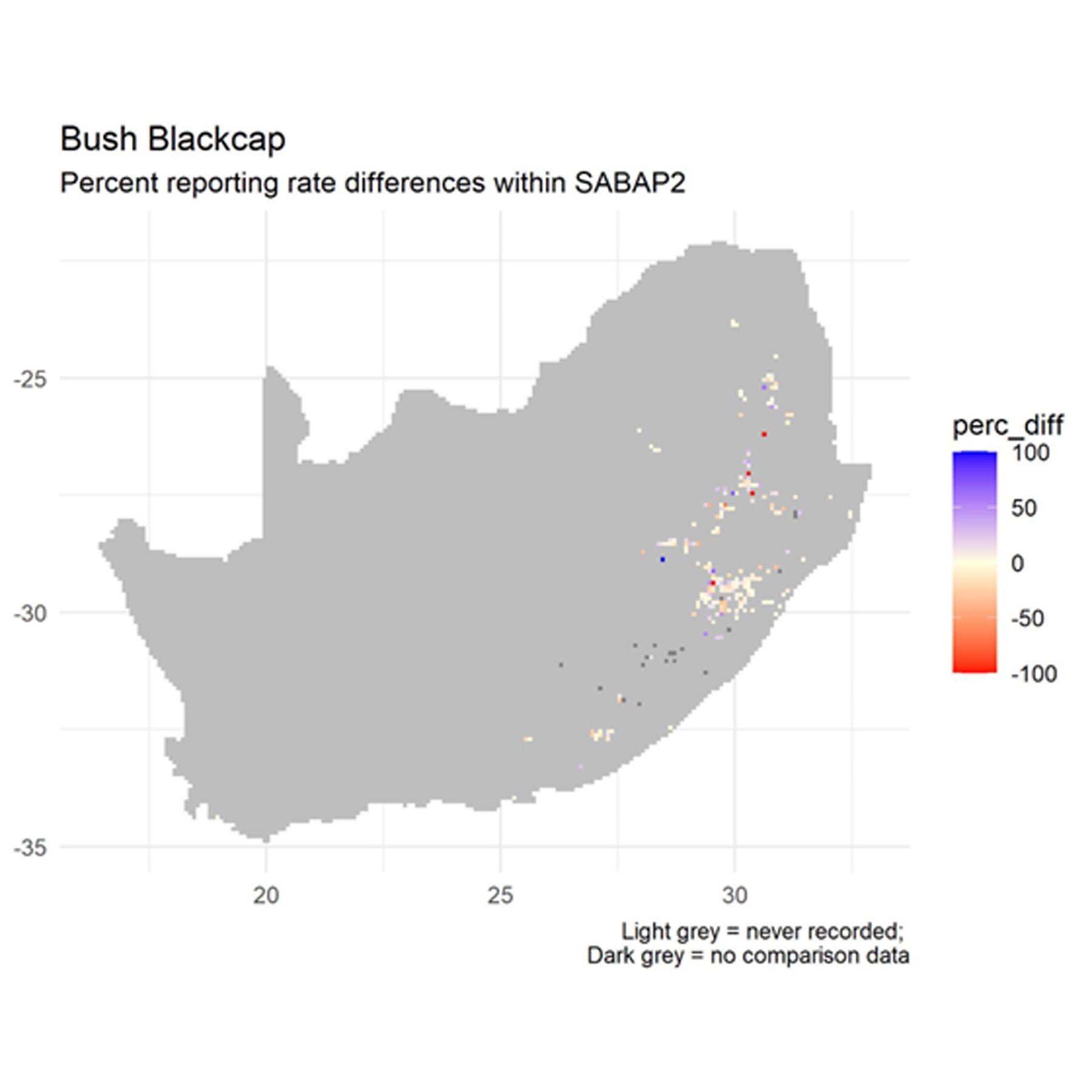
Figure 1: Reporting rate differences between the early (2007-2015) and late (2016-2023) periods in the Southern African Bird Atlas Project. Map from Lee (2024).
Biology & Ecology
Taxonomy
Debates regarding the taxonomic relationship of the Bush Blackcap with previous opinions suggesting affinities with babblers (Timaliidae) or bulbuls (Pycnonotidae) are no longer of reference and genetic studies confirm that it is in fact a sylviid babbler/ warbler (Sylviidae), allied to the Pseudoalcippe hill babblers (Taylor and Coverdale 2015). Previously isolated in Lioptilus within Timaliidae, but genetic data (Moyle et al. 2012) reveal that it belongs in the present genus. The species is monotypic (Collar et al. 2020).
Identification
16–19 cm, 26–34 g. Sexes alike. Distinctive black cap and nape, together with coral bill, diagnostic. Upperparts, including upper wing coverts, brown. Flight feathers olive-brown with pale grey edged primaries. Underparts from throat to belly pale grey. Flanks, thighs and undertail coverts pale brown. Legs and feet light pink (Lloyd 2005).
Distribution
The Bush Blackcap is endemic to the region, occurring from the north-eastern Eastern Cape, through the lower foothills and mistbelt forests of KwaZulu-Natal, the eastern Free State, western Eswatini and Mpumalanga in a band of 750–1825 meters above sea level, hugging the escarpment (Oatley 1997). Within this area, it shows a distinct preference for stands of Ouhout Leucosidea sericea and different sagewood species Buddleja spp. (Barnes 2000) as well edges of Afromontane forests (Lloyd 2005). The species is an altitudinal migrant. Occasional records from the central and south-eastern Free State (Earlé and Grobler 1987) and with increasing frequency around Johannesburg, Gauteng (Selfe 1999, Pienaar 2000) may represent unusually extensive altitudinal migration or juvenile dispersal (Lloyd 2005), or perhaps pioneering colonisation efforts of Gauteng’s ‘urban forest’ during the non-breeding season.
Despite its relatively large EOO and AOO, its very specific ecological requirements mean that only approximately 3% of this range represents suitable breeding habitat (Taylor and Coverdale 2015), equating to a more realistic AOO of less than 2000 km2. It should be noted that the extensive post-breeding movements of the Bush Blackcap (Collar et al. 2020) may have over-inflated its estimated AOO. 37% of the pentads in which this species has been reported are protected (Lee 2024).
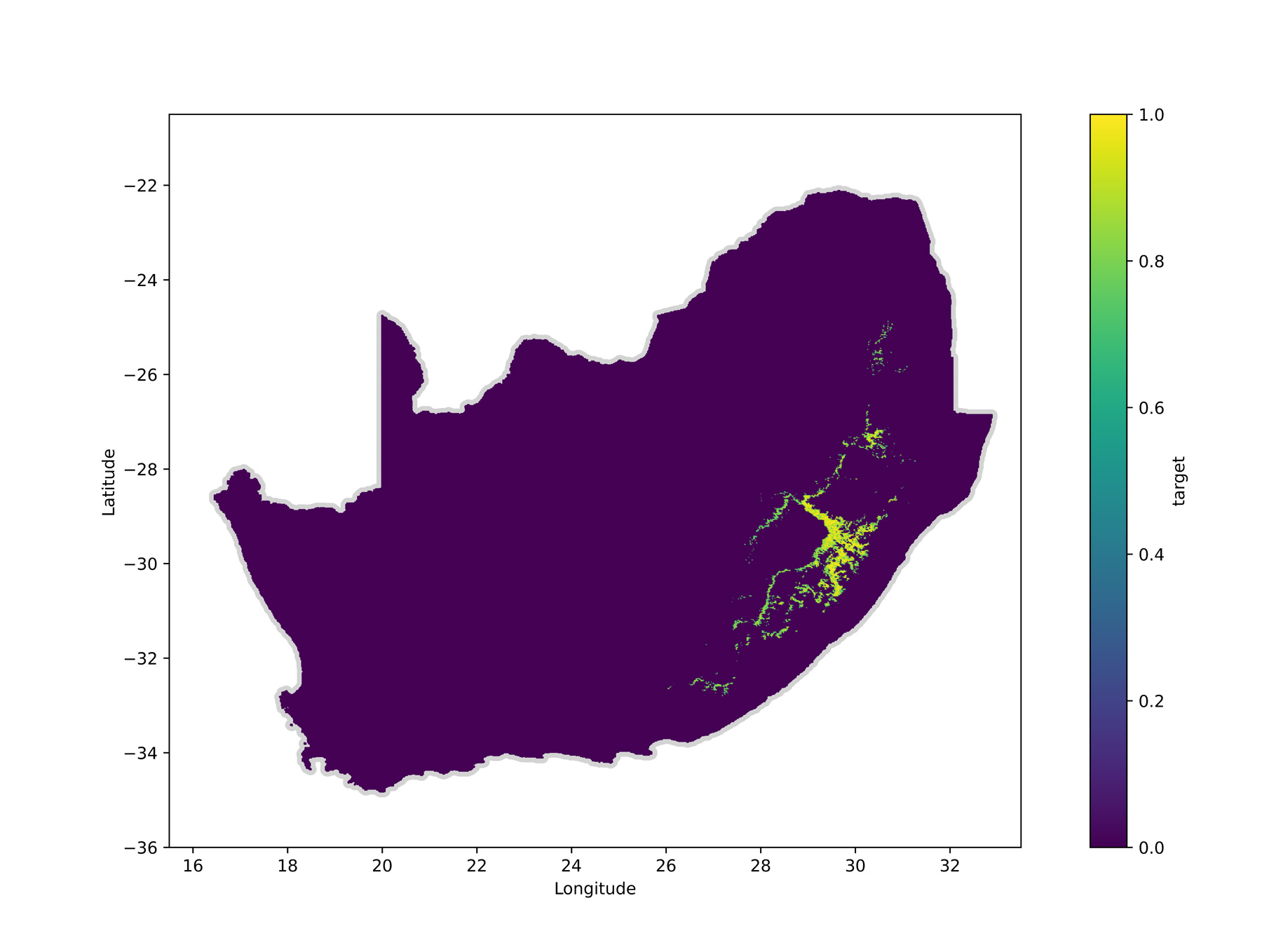
Figure 2: Probability distribution map for occurrence of Bush Blackcap from SABAP2, iNaturalist and eBird records. Yellow regions indicate greater probability of occurrence (p>0.05). Map from Lee (2024).
Ecology
Solitary, but pairs up in the breeding season (Oatley 1997). Preferred breeding habitat is verges of Afromontane forests and pockets of precursor forest, often on the fringes of the forest as opposed to the interior (Maclean 1993, Tarboton 2001). The surrounding grassland and cultivated lands may prove to be beneficial to the species (Cooper 2015). Lays 2–3 eggs from October to January, peaking in November (Tarboton 2001). Due to its seasonal altitudinal movements, the species’ breeding range is significantly smaller than the modelled AOO from Lee (2024). A generation length of 4.8 years is provided by BirdLife International (2017). Little is known of its diet; MacLean (1993) mentions that it is predominantly frugivorous although Taylor and Bucknill (1907) mention that it is insectivorous after examining the stomach contents of a collected specimen. Forages with slow deliberate movements through the middle layer of the forests edge or lower down in the scrub (Collar et al. 2020).
Threats & Conservation
Threats
The severity of threats facing the Bush Blackcap have not been fully investigated, and concerns for its conservation stem mostly from its naturally small range, restricted and fragmented habitat and low densities. The continuation of forestry plantations on the breeding grounds of the Bush Blackcap in KwaZulu-Natal and Mpumalanga poses a major threat in the form of habitat loss, degradation and fragmentation. In the KwaZulu-Natal Midlands, commercial afforestation and agriculture (both commercial and subsistence), as well as urban development, have badly affected the wintering grounds of this species, however cultivation and urbanization can mitigate some of the effects resulting from afforestation (Cooper 2015). The potential effects of climate change on the Bush Blackcap should be assessed.
Conservation Measures Underway
There are no species-specific conservation measures currently in place for this species. However, the establishment and ongoing management of the Maloti-Drakensberg Park World Heritage Site has aided in the conservation of a major portion of the species’ breeding stronghold.
Conservation Measures Proposed
Apart from continuing protection of Afromontane forest patches, conservation measures pertaining specifically to the Bush Blackcap can only be proposed once the threats facing the species, and the reasons behind its apparent decline in range and abundance, have been analysed.
Research Priorities and Questions
- An accurate estimate of the population is required as is a better understanding of its altitudinal movements.
- Post-breeding movements should be investigated to identify potentially important non-breeding habitats for this species, as well as the identification of other threats which may be contributing to the decline of this species.
- Assess threats and reasons behind decline.
- Improved understanding of population dynamics in suitable areas that are undisturbed or not easily accessible to members of the public.
Contributors & References
Assessor/s
Brent Coverdale
Reviewer/s
Niall Perrins, Sanjo Rose
References
Barnes KN. 2000. Bush Blackcap Lioptilus nigricapillus. In: Barnes KN (ed), The Eskom Red Data Book of Birds of South Africa, Lesotho and Swaziland. Johannesburg, South Africa: BirdLife South Africa. pp 147.
BirdLife International. 2017. Sylvia nigricapillus. The IUCN Red List of Threatened Species 2017: e.T22716650A118400733. https://dx.doi.org/10.2305/IUCN.UK.2017-3.RLTS.T22716650A118400733.en. [Accessed on 20 May 2024].
Collar N, C Robson, Sharpe CJ. 2020. Bush Blackcap. In: del Hoyo J, Elliott A, Sargatal J, Christie DA, de Juana E (eds), Birds of the World. Cornell Lab of Ornithology, Ithaca, NY, USA. Available at https://doi.org/10.2173/bow.busbla1.01
Cooper TJG. 2015. The effects of land use changes on the distribution of forest dependent bird species in South Africa. Stellenbosch University.
Cooper TJ, Wannenburgh AM, Cherry MI. 2017. Atlas data indicate forest dependent bird species declines in South Africa. Bird Conservation International 27(3): 337–54.
Earlé R, Grobler N. 1987. First atlas of bird distribution in the Orange Free State. Bloemfontein, South Africa: National Museum.
Lee ATK. 2024. Regional Red Data Book of the Birds of South Africa, Lesotho and Eswatini: SABAP2 synthesis and supporting information and graphics for Bush Blackcap. Unpublished report. Johannesburg: BirdLife South Africa.
Lloyd P. 2005. Bush Blackcap Lioptilus nigricapillus. In: Hockey PAR, Dean WRJ, Ryan PG (eds), Roberts – Birds of Southern Africa 7th Edn. Cape Town, South Africa: BirdLife South Africa. pp 814–815.
Maclean GL. 1993. Roberts – Birds of South Africa (6th Edn). Cape Town, South Africa: The Trustees of the John Voelcker Bird Book Fund.
Monadjem A, Boycott RC, Parker V, Culverwell J. 2003. Threatened vertebrates of Swaziland: Swaziland red data book: fishes, amphibians, reptiles, birds and mammals. Mbabane, Swaziland: Ministry of Tourism, Environment and Communications.
Moyle RG, Andersen MJ, Oliveros CH, Steinheimer FD, Reddy S. 2012. Phylogeny and biogeography of the core babblers (Aves: Timaliidae). Systematic Biology 61(4): 631–651.
Oatley TB. 1997. Bush Blackcap Lioptilus nigricapillus. In: Harrison JA, Allan DG, Underhill LG, Herremans M, Tree AJ, Parker V, Brown CJ (eds), The atlas of southern African birds Vol II: Passerines. Johannesburg, South Africa: BirdLife South Africa.
Parker V. 1994. Swaziland bird atlas, 1985-1991. Mbabane, Swaziland: Websters.
Pienaar L. 2000. Bush Blackcap in Krugersdorp. Bokmakierie 188: 12-13.
Selfe G. 1999. Bush Blackcap in Johannesburg. Africa – Birds and Birding 4: 29.
Siegfried W. 1992. Conservation status of the South African endemic avifauna. South African Journal of Wildlife Research 22: 61–64.
Tarboton W. 2001. Guide to the nests and eggs of southern African birds. Cape Town, South Africa: Struik Publishers.
Taylor CH, Bucknill JA. 1907. Notes on a collection of birds made in the Amsterdam district upon the Transvaal-Swaziland border between the months of June and October, 1906. Journal of the South African Ornithologists Union 3: 12–42.
Taylor MR, Coverdale BM. 2015. Bush Blackcap Lioptilus nigricapillus. In: Taylor MR, Peacock F, Wanless RM (eds), The Eskom Red Data Book of Birds of South Africa, Lesotho and Swaziland. Johannesburg, South Africa: BirdLife South Africa. pp 192–193.
Citation
Coverdale B 2025. Bush Blackcap. In: Lee ATK, Rose S, Banda S, Bezeng SB, Maphalala MI, Maphisa DH, Smit-Robinson H (eds), The 2025 Red Data Book of Birds of South Africa, Lesotho and Eswatini. Johannesburg, South Africa: BirdLife South Africa. Available at: https://www.birdlife.org.za/red-list/bush-blackcap/
Our generous sponsors


