


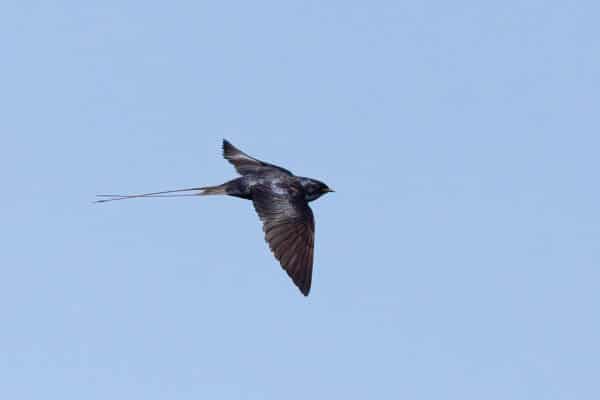
Blue Swallow
Hirundo atrocaerulea

Number Of Mature
Individuals (Regional)
80

Regional
Population Trend
Decreasing
2025
Regional Category
Critically Endangered
Search by species
CONTENTSOverview
Names
|
IOC English Name: |
Blue Swallow |
|
SA & IOC Scientific Name: |
Hirundo atrocaerulea |
|
BirdLife International Taxonomy (scientific name): |
Hirundo atrocaerulea |
|
Order: |
PASSERIFORMES |
|
Family: |
Hirundinidae |
|
Species name author: |
Sundevall 1850 |
|
Afrikaans: |
Blouswael |
|
Sesotho (South Africa): |
|
|
Sesotho (Lesotho): |
|
|
Siswati: |
Inkonjane |
|
Zulu: |
inkonjanesibhakabhaka |
Current Assessment Status
|
2025 Regional Category [Criteria] |
CR [C1] |
|
2024 Global Category [Criteria] |
EN [C2a(ii)] (BirdLife International 2024) |
|
Population size (Regional) |
c. 80 (Evans unpubl data) |
|
Population size (Global) |
1000 – 2500 (Evans et al. 2015, BirdLife International 2024) |
|
Distribution size (EOO) (Regional) km2 |
43 198 (Lee 2024) |
|
Distribution size (EOO) (Global) km2 |
Breeding range: 1 290 000 (BirdLife International 2024) Non-breeding range: 146 000 (BirdLife International 2024) |
|
Distribution size (AOO) (Regional) km2 |
204 (Lee 2024) |
|
Generation time |
4 years ( BirdLife International 2024) |
|
Status change reason |
No Change |
|
Migrant (in the region) |
Yes |
|
Regional endemic |
No |
Historic Listing Information
|
2000 Regional Status |
CR [A1c+2bc; C1+2a] |
|
2015 Regional Status |
CR [C1+2a(ii)] |
|
Status change reason (if applicable) |
No change |
|
2015 Population size (Regional) |
<250 (106 mature individuals) |
|
2015 Global Status |
VU [C2a] |
Reason for Inclusion
Reason for Inclusion in the Assessment
More than 5% of the global distribution of this intra-African migrant occurs within the region (Evans and Bouwman 2010, Evans et al. 2015). In addition, it was listed as regionally Critically Endangered in 2000 (Evans and Barnes 2000) and 2015 (Evans 2015).
Category Justification
Category Justification
The Blue Swallow Hirundo atrocaerulea satisfies the population size criteria for regionally Critically Endangered (population numbers <250 individuals and a decline of at least 25% is predicted in the next four years). Unfortunately, there has been no improvement since the previous assessment (Evans 2015). The Blue Swallow's distribution in the region is fragmented into three distinct subpopulations in Mpumalanga, Eswatini, and KwaZulu-Natal (Evans 2015).
Population Justification
The global population has been quantified at c. 2500 mature individuals (Evans et al. 2015). In 2000, there were estimated to be a maximum of 240 mature individuals within the region (Evans and Barnes 2000). In 2015, only four nests were known from Mpumalanga and approximately 16 and 33 in Eswatini and KwaZulu-Natal, respectively (Evans 2015). In 2015, the regional population was estimated at 53 pairs or 106 mature individuals. The current estimate is two nests in Mpumalanga and approximately 12 and 25 in Eswatini and KwaZulu-Natal, respectively (Evans unpubl data). Currently the regional population is estimated at 39 pairs or 78 mature individuals. Confidence in this regional population estimate is high (Evans unpubl data).
Trend Justification
The global population is in decline (BirdLife International 2024). The regional population has showed a similar trend and decreased by 52.4% over three generations (2000 to 2011) (Evans et al. 2015). It is believed that this decline is continuous and will be >25% within one generation length (four years). Based on Southern African Bird Atlas Project (SABAP2) data from 2007-2015 to 2016-2023, Lee (2024) estimated a decline of 68.4% in the bird’s distribution range over three generations. Confidence in these regional trend estimates is high.
The Blue Swallow’s range in South Africa and Eswatini has contracted by 74% from 1890 to 2005 (Evans and Bouwman 2010a). Blue Swallows have disappeared from 21 of 29 known sites between 1880 and 1987 (Allan et al. 1997). By the end of the 1980s, the four pairs in Blinkwater Nature Reserve were locally extinct (Evans and Barnes 2000). In the 1990s, Blue Swallow pairs near Haenertsburg in the Limpopo Province, and in the Blyde River Canyon Nature Reserve and along the Mac-Mac Escarpment in Mpumalanga had become locally extinct (Evans and Bouwman 2010a, Dzerefos unpubl data). By the end of the 2000s, the most recent local extinctions were the loss of two pairs in Misty Mountain Natural Heritage Site, the last two remaining pairs near Nongoma, in northern KwaZulu-Natal and nine pairs in the Blue Swallow Natural Heritage Site (Evans unpubl data). The few pairs near Nongoma were the only Blue Swallows in the region occupying the Northern Zululand Mistbelt Grassland vegetation type (Evans unpubl data).
Biology & Ecology
Taxonomy
The results of a phylogenetic analysis of the genus Hirundo indicate that the Blue Swallow is most closely related to the Black-and-rufous Swallow Hirundo nigrorufa (Dor et al. 2010). There is currently no support for the placement of the Blue Swallow in the monospecific genus Natalornis by Roberts (1940).
Identification
20–25 cm, 14 g. The adult male and female Blue Swallow are glossy dark blue with no white spots in the tail. The male differs from the female in having much longer outer tail-feathers (streamers) and being slightly larger (Evans 2010). Immature Blue Swallows are sooty black with scattered glossy dark blue patches. When the adults and immature birds are perched, variable white patches are occasionally visible on their sides and flanks (Mackworth-Praed and Grant 1955, Spottiswoode 2005).
The Blue Swallow could be confused with the Black Saw-wing Psalidoprocne pristoptera where their ranges overlap (Keith et al. 1992, Evans 2010). However, the Black Saw-wing is sooty-black in appearance with a deeply forked scissor-shaped tail with no streamers (Turner and Rose 1989, Keith et al. 1992).
Distribution
The Blue Swallow is an African endemic and an intra-African migrant in sub-Saharan Africa (Keith et al. 1992). This bird breeds in eastern South Africa, western Eswatini, eastern Zimbabwe, western Mozambique, Malawi, north-eastern Zambia, southern Tanzania and south-eastern Democratic Republic of the Congo from September to April (Turner and Rose 1989, Allan and Earlé 1997, Evans and Bouwman 2010a, Evans et al. 2016). During the non-breeding season (May to August), Blue Swallows migrate to western Kenya, southern Uganda, north-western Tanzania, and north-eastern Democratic Republic of the Congo (Turner and Rose 1989, Evans and Bouwman 2010a, Wakelin et al. 2011).
In South Africa, the species is restricted to grasslands of the Eastern Escarpment. In KwaZulu-Natal, the northern and southern limits of the breeding range are Impendle and Harding respectively, with the majority of birds breeding in the Ixopo district (Wakelin 2006). In Eswatini, all suitable Blue Swallow habitats are located along the western part of the country above 1200 m asl (Parker 1994, Monadjem et al. 2006). Recent confirmed breeding events occurred in Malolotja Nature Reserve, Sibebe Mountains, and Mahlangatsha (Parker 1994, Monadjem et al. 2003, Monadjem et al. 2006).
Ecology
In South Africa and Eswatini, Blue Swallows have been recorded from 760 m asl, in the southern part of their range, to a maximum of 1760 m asl in the northern parts of their range (Allan et al. 1987, Monadjem et al. 2003). Blue Swallow nest sites are located within high-altitude, high-rainfall (>1000 mm per year), undulating, open, primary mist-belt grasslands with a sward height of <0.5 m (Allan et al. 1987, Monadjem et al. 2003, Evans 2010, Evans and Bouwman 2010a). In Mpumalanga and KwaZulu-Natal, Blue Swallows significantly prefer wetlands to grasslands for foraging (Evans 2010, Evans and Bouwman 2010a, calculated from Wakelin et al. 2018). In KwaZulu-Natal, Wakelin (2006) found that Blue Swallows also preferred to forage in the ecotone between grasslands and wetlands. The minimum home range size is approximately 3.3 km2, consisting, at a minimum, of grasslands (2.4 km2 or 73%) and wetlands, including drainage lines (0.9 km2 or 27%) (Evans and Bouwman 2010a). An area of grassland with no drainage lines or other wetlands is considered unlikely to support any Blue Swallow pairs, probably owing to a lack of food (Evans and Bouwman 2010a).
Threats & Conservation
Threats
The highest priority threats, resulting in habitat degradation and conversion, are afforestation, large-scale and subsistence agriculture, invasion by alien eucalyptus, pine and wattle trees, (Allan et al. 1987, Wakelin and Hill 2007), rural population growth, and inappropriate management and drainage of wetlands (Evans et al. 2002, Evans 2010). Inappropriate farming methods lead to soil erosion (Monadjem et al. 2003). The drainage of wetlands for cultivation and road construction remains a serious threat (Evans 1996, 2010, Evans and Bouwman 2010a) while mining represents a threat of moderate to high importance (Kemper and Niemand 1992, Evans 1996, 2010).
The process of sinkhole formation, upon which Blue Swallows rely on for nesting sites, may be negatively affected by timber forests drying out underground streams (Snell 1969). Fragmentation of grasslands, as a result of grassland transformation, may result in Aardvark Orycteropus afer not getting to potentially suitable sites to dig holes that can be used by the birds. The snaring of Aardvark has led to a decline in local populations (Marchant 2012), thereby also influencing the number of holes available for the birds. Tarboton (1992) demonstrated the importance of sufficient altitudinal range over which to forage during mist periods for the survival of Blue Swallows near Graskop. The loss of foraging habitat at lower elevations that were less often enveloped in mist, as compared to the higher-altitude breeding and foraging habitat, results in the birds being unable to find sufficient food and prolonged poor weather conditions adversely affecting breeding success (Evans and Bouwman 2010a). Uncoordinated small-scale ecotourism developments have resulted in loss of Blue Swallow nesting sites in South Africa (Evans 1997). In areas where Blue Swallows coexist in proximity to agricultural crops, the use of insecticides may affect aerial insect prey availability to Blue Swallows (Evans et al. 2002).
As a migrant species, Blue Swallow populations are not only affected by threats on their breeding grounds in South Africa and Eswatini, but also on their migratory routes and in their non-breeding range in Uganda (Evans and Bouwman 2010a, Wakelin et al. 2011). Swallows migrate by day and feed en route (Turner and Rose 1989). A loss of habitat along their migratory routes may result in there being less food available to the birds on migration, resulting in an increase in mortality of these birds, and, in turn, resulting in fewer birds returning to South Africa and Eswatini to breed. In addition, a reduction of habitat suitable for Blue Swallows in their non-breeding range would result in an increase in mortality and fewer birds returning to breed (Evans et al. 2002).
Conservation Measures Underway
An International Action Plan and South African Population and Habitat Viability Assessment (PHVA) was completed for the Blue Swallow in 2002 (Evans et al. 2002). Over the past 20 years, research into the extent of the decline of the Blue Swallow population in South Africa, and further afield in Africa, has been completed (Wakelin and Hill 2007, Evans and Bouwman 2010a, Evans et al 2015). Research into the habitat requirements of Blue Swallows in South Africa has also been conducted (Wakelin 2006, Evans and Bouwman 2010a, Wakelin et al 2018). Initial research into the migratory linkages between Blue Swallows’ breeding and non-breeding ranges has been undertaken (Evans and Bouwman 2010b, Wakelin et al. 2011) although certain aspects, including stop-over sites, still need to be investigated.
There are several stakeholders involved in Blue Swallow conservation. Ezemvelo KwaZulu-Natal Wildlife is coordinating efforts to protect this species and does so through a provincial Blue Swallow Monitoring Programme. The Blue Swallow Working Group of the Endangered Wildlife Trust, now part of the Threatened Grassland Species Programme, contributes to the development of conservation policy, legislation and advocacy for the protection of threatened grassland species including the Blue Swallow. The group also undertakes research and monitoring into the habitat requirements and population trends of the species, education and awareness campaigns.
Ezemvelo KwaZulu-Natal Wildlife has implemented incentive and compensation-based contractual agreements between provincial agencies and private landowners to safeguard nesting and foraging habitat for Blue Swallows. The monitoring programme as set out in the Ezemvelo KwaZulu-Natal Wildlife Blue Swallow Monitoring Programme is being implemented. Environmental Impact Assessments are contributing to the protection of historical Blue Swallow nest sites and suitable grassland and wetland habitat for the birds (Coverdale pers comm).
Where required, artificial nest holes for Blue Swallows have been created (Johnson et al 1996) and existing nest holes are being maintained. Blue Swallow breeding success in Mpumalanga was best in north- and west-facing nest sites, and in KwaZulu-Natal, breeding success was best in north- and east-facing nest sites (Evans 2018). Artificial nest sites should continue to be created for Blue Swallows that are north to west facing in Mpumalanga (and possibly in Eswatini), and north to east facing in KwaZulu-Natal (Johnson et al 1996, Evans 2018).
Ezemvelo KwaZulu-Natal Wildlife is coordinating the compilation of a Biodiversity Management Plan for the Blue Swallow. When complete, this plan will be submitted to the South African Department of Environmental Affairs which will provide greater legal support to the provincial conservation authorities and other institutions in their efforts to conserve the Blue Swallow and its grasslands and wetland habitat.
All localities known to contain breeding Blue Swallows in South Africa are designated as Important Bird Areas (Barnes 1998). The Blue Swallow is listed in Appendix I and II of the Convention on the Conservation of Migratory Species. It is listed under Schedule 2: Specially Protected Wild Animal under the Limpopo Environmental Management Act No 7 of 2003. The Blue Swallow is listed as Critically Endangered in Eswatini and is protected by the Eswatini Game Act (Monadjem et al. 2003).
Conservation Measures Proposed
The Blue Swallow population will continue to decline if conservation efforts in South Africa and Eswatini are not matched by conservation efforts on the bird’s non-breeding grounds (Evans et al. 2002, Evans et al 2003). Consequently, the Blue Swallow conservation action plan compiled for Zimbabwe (BirdLife Zimbabwe 2004) should be updated and implemented. National Blue Swallow conservation action plans should be compiled for Tanzania, Malawi, the Democratic Republic of Congo, Kenya and Uganda, and implemented.
The proportion of the Blue Swallow population in strictly protected and unprotected areas on their breeding grounds is 53% and 47%, respectively (Evans et al. 2015). Whereas on their non-breeding grounds the corresponding percentages are 25% and 75%, respectively. The proportion of the Blue Swallow population in strictly protected areas should be increased, especially on the non-breeding grounds.
An assessment of the minimum viable Blue Swallow population size suggests that a goal for the long-term conservation of the Blue Swallow should be to mitigate current threats that are driving declines such that the population increases to a minimum of 3600 individuals. This should consist of at least 900 individuals in each of the four clusters identified, along with a minimum of 500 individuals in at least one of the meta-populations per cluster (Evans et al. 2015). The four clusters are located in (1) the southeasten Democratic Republic of Congo, (2) highlands of southern Tanzania and northern Malawi, (3) eastern highlands of Zimbabwe and (4) South Africa and Eswatini.
Ezemvelo KwaZulu-Natal Wildlife has set the following targets to be achieved to conserve the Blue Swallow in the province: 1) increasing and securing the KwaZulu-Natal Blue Swallow population to 80 active nests; 2) and achieving an average fledgling success rate of two per breeding event per year. The long-term objectives are to rehabilitate and secure the breeding population of Blue Swallow in KwaZulu-Natal to 156 active breeding pairs with an average fledgling success rate of two per breeding event per year (Marchant 2012). In addition, Ezemvelo KwaZulu-Natal Wildlife has compiled a monitoring plan for Blue Swallow in the province (Marchant 2012) which should be used to update applicable sections of the International Blue Swallow Action Plan and the Population and Habitat Viability Assessment.
To achieve the aforementioned targets, in addition to the conservation measures underway, Ezemvelo KwaZulu-Natal Wildlife identified the following priority actions:
- Increasing the amount of formally protected Mistbelt Grassland areas;
- Implementing appropriate grazing regimes;
- Remove alien plants in the vicinity of nest sites; and
- Rehabilitate areas of suitable areas that have undergone afforestation and agriculture.
Research Priorities and Questions
Research priorities include:
- The generation time, and survival probabilities of adults and fledglings should be determined.
- Further research is needed to confirm where the regional breeding population migrates to during the austral winter.
- Further research on the habitat requirements of the Blue Swallow on their non-breeding grounds is required.
- The indirect impact of the use of pesticides on reducing aerial arthropod food available to Blue Swallows needs to be determined.
- The importance of grassland and wetland corridors and their role in connecting habitat patches needs to be investigated.
Contributors & References
Assessor/s
Steven W. Evans
Reviewer/s
Machawe Maphalala, Mark Brown
References
Allan, DG, Earlé RA. 1997. Blue Swallow Hirundo atrocaerulea. In: Harrison JA, Allan DG, Underhill LG, Herremans M, Tree AJ, Parker V, Brown CJ (eds), The atlas of Southern African birds Vol. 2. Cape Town: CTP Book Printers Ltd. pp 52–53.
Allan DG, Harrison JA, Navarro RA, Van Wilgen BW, Thompson MW. 1997. The impact of commercial afforestation on bird populations in Mpumalanga – insights from bird-atlas data. Biological Conservation 79: 173–185.
BirdLife International. 2024. Hirundo atrocaerulea. The IUCN Red List of Threatened Species 2024: e.T22712318A232888633. https://dx.doi.org/10.2305/IUCN.UK.2024-2.RLTS.T22712318A232888633.en. [Accessed on 22 April 2025].
BirdLife Zimbabwe 2004. Zimbabwe National Blue Swallow Conservation Action Plan. Harare: Zimbabwe.
Dor R, Safran RJ, Sheldon FH, Winkler DW, Lovette IJ. 2010. Phylogeny of the genus Hirundo and the Barn Swallow subspecies complex Molecular Phylogenetics and Evolution 56: 409–418.
Evans SW. 1996. The Impact of Alluvial and Underground Mining on the Blue Swallow Natural Heritage Site. Endangered Wildlife Trust. Unpublished Report.
Evans SW. 1997. Ecotourism development of and the significance of the Stanley Bush Kop Blue Swallow population for the conservation of the species in South Africa. Unpublished report completed for the Mpumalanga Parks Board: Specialist Services.
Evans SW. 2010. The conservation ecology and breeding biology of the Blue Swallow Hirundo atrocaerulea, Sundevall 1850, in South Africa. PhD thesis, North-West University, Potchefstroom. South Africa.
Evans SW, 2015. Blue Swallow Hirundo atrocaerulea. In: Taylor MR, Peacock F, Wanless RM (eds), The Eskom Red Data Book of Birds of South Africa, Lesotho and Swaziland. Johannesburg, South Africa: BirdLife South Africa. pp 48–51.
Evans SW. 2018. The effect of nest site orientation on the breeding success of blue swallows Hirundo atrocaerulea in South Africa. African Journal of Ecology 56(1): 91–100.
Evans SW, Barnes KN. 2000. Blue Swallow Hirundo atrocaerulea. In: Barnes KN (ed), The Eskom Red Data Book of birds of South Africa, Lesotho and Swaziland. Johannesburg: BirdLife South Africa. pp 32–34.
Evans SW, Cohen L, Sande E, Monadjem A, Hoffmann D, Mattison H, Newbery P, Ndanganga K; Friedmann Y. 2002. Blue Swallow (Hirundo atrocaerulea) International Action Plan. Final Workshop Report. Johannesburg: Conservation Breeding Specialist
Evans SW, Biggs D, van Zyl C, Cohen L, McNamara M, McCartney S, Krynaw S, Burden D, Mattison H, Friedmann Y (eds). 2003. Blue Swallow (Hirundo atrocaerulea) Population and Habitat Viability Assessment. Draft Workshop Report. Conservation Breeding Specialist Group Southern Africa.
Evans SW, Bouwman H. 2010a. Habitat selection by blue swallows Hirundo atrocaerulea Sundevall, 1850 breeding in South Africa and its implications for conservation. African Journal of Ecology 48: 871–879
Evans SW, Bouwman H. 2010b. Historical and current distribution, population size and current migration routes of the Blue Swallow Hirundo atrocaerulea in Africa. Bird Conservation International 20: 240–254.
Evans SW, Monadjem A, Roxburgh L, McKechnie AE, Baker EM, Kizungu RB, Little IT, Matsvimbo F, Mulwa RK, Mwizabi D, Nalwanga D, Ndang’ang’a K, Combrink L. 2015. Current conservation status of the Blue Swallow Hirundo atrocaerulea Sundevall 1850 in Africa. Ostrich 86(3): 195–211.
Evans SW, Baker EM, Baker NE, Cilliers D. 2016. Current distribution and population size of the Blue Swallow Hirundo atrocaerulea in the southern Tanzanian highlands. Ostrich 87(1): 37–46.
Johnson, DN, Morford JS, Croft M. 1996. Digging for the Blue Swallow – Does it work? Is it ethical? Lammergeyer 44: 46–49.
Keith S, Urban EK, Fry CH (eds). 1992. Birds of Africa. Vol. 4. London: Academic Press.
Kemper NP, Niemand R. 1992. A Habitat Suitability Assessment for the Blue Swallow in the Transvaal. Chief Directorate of Nature & Environmental Conservation. Internal Report. Pretoria.
Lee ATK. 2024. Regional Red Data Book of the Birds of South Africa, Lesotho and Eswatini: SABAP2 synthesis and supporting information and graphics for Blue Swallow. Unpublished report. Johannesburg: BirdLife South Africa.
Mackworth-Praed CW, Grant CHB. 1955. Birds of Eastern and North Eastern Africa. London: Longmans, Green & Co.
Marchant A (ed). 2012. Ezemvelo KZN Wildlife Monitoring Plan: Blue Swallow. Pietermaritzburg, South Africa: Ezemvelo KZN Wildlife.
Monadjem A, Boycott RC, Parker V, Culverwell J. 2003. Threatened Vertebrates of Swaziland. Swaziland Red Data Book: Fish, Amphibians, Reptiles, Birds and Mammals. Mbabane, Swaziland: Ministry of Tourism, Environment and Communications.
Monadjem A, Boycott RC, Roques K, Gama R, Garcelon D. 2006. Breeding biology and conservation status of the Blue Swallow Hirundo atrocaerulea in Swaziland. Bird Conservation International 16 1–10.
Parker V. 1994. Swaziland bird atlas, 1985–1991. Mbabane: Websters.
Roberts A. 1940. The Birds of South Africa. Cape Town & London: The Trustees of the South African Bird Book Fund & H.F.& G. Witherby Ltd.
Snell ML. 1969. Notes on the breeding of the Blue Swallow. Ostrich 40(3): 65–74.
Spottiswoode CN. 2005. Blue Swallow. In: Hockey PAR, Dean WRJ, Ryan PG (eds), Roberts birds of southern Africa. Cape Town: The Trustees of the John Voelcker Bird Book Fund. pp 752–754.
Tarboton WR. 1992. A Study of the Blue Swallow Nest Distribution and Foraging Activity in the Graskop Grasslands. Chief Directorate of Nature & Environmental Conservation: Internal Report. Pretoria.
Turner A, Rose C. 1989. A handbook to the Swallows and Martins of the world. London: Christopher Helm.
Wakelin J. 2006. An investigation to determine the critical habitat requirements of the breeding Blue Swallow Hirundo atriocaerulea Sundevsall. MSc thesis, University of KwaZulu-Natal, South Africa. pp 186.
Wakelin J, Hill TR. 2007. The impact of land transformation on breeding blue swallows Hirundo atrocaerulea Sundevall, in Kwazulu-Natal, South Africa. Journal for Nature Conservation 15: 245–255.
Wakelin J, McKechnie AE, Woodborne, S. 2011. Stable isotope analysis of migratory connectivity in a threatened intra-African migrant, the Blue Swallow (Hirundo atrocaerulea). Journal of Ornithology 152:171–177 DOI 10.1007/s10336-010-0562-4
Wakelin J, Oellermann CG, Wilson A-L, Downs CT, Hill T. 2018. Habitat use by the critically endangered Blue Swallow in KwaZulu-Natal, South Africa. Bothalia 48: 1–7. https://doi.org/10.4102/abc.v48i1.2173.
Citation
Evans SW 2025. Blue Swallow. In: Lee ATK, Rose S, Banda S, Bezeng SB, Maphalala MI, Maphisa DH, Smit-Robinson H (eds), The 2025 Red Data Book of Birds of South Africa, Lesotho and Eswatini. Johannesburg, South Africa: BirdLife South Africa. Available at: https://www.birdlife.org.za/red-list/blue-swallow/
Our generous sponsors


