


Blue-billed Teal
Spatula hottentota

Number Of Mature
Individuals (Regional)
10 000

Regional
Population Trend
Decreasing
2025
Regional Category
Least Concern
Search by species
CONTENTSOverview
Names
|
IOC English Name: |
Blue-billed Teal |
|
SA & IOC Scientific Name: |
Spatula hottentota |
|
BirdLife International Taxonomy (scientific name): |
Spatula hottentota |
|
Order: |
ANSERIFORMES |
|
Family: |
Anatidae |
|
Species name author: |
Eyton 1838 |
|
Afrikaans: |
Gevlekte Eend |
|
Sesotho (South Africa): |
|
|
Sesotho (Lesotho): |
|
|
Siswati: |
|
|
Zulu: |
Idadelincane |
Current Assessment Status
|
2025 Regional Category [Criteria] |
LC |
|
2024 Global Category [Criteria] |
LC (BirdLife International 2016) |
|
Population size (Regional) |
c. 10 000 (Suspected) |
|
Population size (Global) |
25 000 – 100 000 |
|
Distribution size (EOO) (Regional) km2 |
1 068 954 (Lee 2024) |
|
Distribution size (EOO) (Global) km2 |
19 500 000 (BirdLife International 2016) |
|
Distribution size (AOO) (Regional) km2 |
33 900 – 58 800 (BIRDIE 2024, Lee 2024) |
|
Generation time |
6.6 years (BirdLife International 2016) |
|
Status change reason |
No change |
|
Migrant (in the region) |
Resident |
|
Regional endemic |
No |
Historic Listing Information
|
2000 Regional Status |
Not Evaluated |
|
2015 Regional Status |
Not Evaluated |
|
Status change reason (if applicable) |
Not applicable |
|
2015 Population size (Regional) |
Unknown |
|
2015 Global Status |
LC |
Reason for Inclusion
Reason for Inclusion in the Assessment
This species was not previously assessed. Preliminary screening of Coordinated Waterbird Counts (CWAC) data indicated a significant decline in number of Blue-billed Teal Spatula hottentota counted per year, albeit of magnitude unknown.
Category Justification
Category Justification
The regional population of the Blue-billed Teal does not meet the thresholds for inclusion in any of the Red List Threatened categories. Though a decrease in predicted Area of Occupancy (AOO) is reported from an analysis of Southern African Bird Atlas Project (SABAP2) data, and the species is in decline according to both SABAP2 and CWAC data (Lee 2024), neither the magnitude nor rate of decline meets the thresholds for Criterion A. Estimated Extent of Occurrence (EOO) and AOO and habitat quality remain outside of the required ranges for Criterion B. The population is suspected to be >10 000 mature individuals, so Criterion C is not applicable. Thus, the species is regionally assessed as Least Concern.
Population Justification
Both the global and regional population size of Blue-billed Teal are poorly known. Numbers in southern Africa (including Angola, Zambia and Malawi) were historically estimated between 100 000 and 200 000 birds (Scott and Rose 1996). However, Wetlands International (2024) estimates 25 000 – 100 000 individuals for the global population for the period 1967 – 2018. The species is described as ‘locally common’ (Colahan 2005). Even with good quality local datasets such as the SABAP1 (1986-1997) and SABAP2 (2007- ongoing) and CWAC, estimates of regional population size remain challenging for the species. Blue-billed Teal appears to have a low reporting rate in SABAP2 (Lee 2024); this could stem from a number of factors such as low detection probability or inconsistent observer effort (this species may take more effort to find than other species in similar habitat). Thus, reporting rates provide at best uncertain estimates of abundance for Blue-billed Teal.
CWAC can offer insight into Blue-billed Teal populations at specific sites, but again, these may or may not reflect wider regional trends. However, the 95% CI intervals for South Africa’s population at CWAC sites is 52 – 1304 individuals (BIRDIE 2024). This species was recorded at 257 of 719 CWAC sites. Mean winter count was 3, median was 0, and max was 181. Mean summer count was 3, median was 0 and max was 1100 recorded at St Lucia on 14 January 2013 (Lee 2024). Although the regional population is assumed to be >10 000 mature individuals, it may well be lower: the regional EOO is <10% of the global EOO, so at the lower bound of the Wetlands International estimate, the local population may be as low as 2500. Confidence in this estimate is low.
Trend Justification
The global population is in decline (BirdLife International 2016). CWAC and SABAP2 data indicate a decline in the regional Blue-billed Teal population, however, with large uncertainty between model types and no convincing evidence that declines meet levels approaching 30% in three generations (Lee 2024).
Modelled range change within SABAP2, comparing the periods 2007-2015 to 2016-2023 suggested a 17% contraction (Lee 2024), approaching a level that could be considered Near Threatened. It is important to note, though, that this may apply only to some populations of Blue-billed Teal, whilst others may be stable or unknown.
Biology & Ecology
Taxonomy
Spatula hottentota was described by Eyton (1838) along the western coast of South Africa, near Orange River, Cape Province. The species was originally named punctata, but was subsequently renamed hottentota (Nye and Melville 1977). The Blue-billed Teal is considered monotypic, although a Madagascar subspecies, Spatula hottentota delacouri, was formerly recognised (Scott and Rose 1996). It was formerly called ‘Hottentot Teal’, but was renamed to Blue-billed Teal for cultural sensitivity reasons.
Identification
30–36 cm (Colahan 2005). Adults have a dark brown cap and a paler face, throat and breast (Carboneras and Kirwan 2001). The feathers on the upperparts are fringed with paler shades (Carboneras and Kirwan 2001). The back and rump tend to be blackish, while the underparts are paler, often spotted on the sides and breast and barred on the belly (Carboneras and Kirwan 2001, Colahan 2005). The upperwing appears dark and features a metallic green speculum with a white trailing edge (Colahan 2005). This contrasts with the pale underwing (Carboneras and Kirwan 2001). The bill is pale blue with a distinctive black culmen ridge, complemented by dark bluish-grey legs and feet, and brown eyes (Carboneras and Kirwan 2001). Females are like males but tend to have a browner speculum in the wing, a duller cap, and paler brown underparts, with more spotting than barring on the belly (Colahan 2005). Juveniles resemble females but appear duller overall (Carboneras and Kirwan 2001).
Confusing species: the Red-Billed Teal Anas erythrorhyncha has a similar head pattern, but its bill is red and is larger (Colahan 2005).
Distribution
Blue-billed Teal distribution extends through much of continental Africa, from the eastern Afrotropics and Madagascar to South Africa with additional isolated populations in Nigeria, Cameroon and Chad (Scott and Rose 1996, Colahan 2005). The species occurs in Namibia, Botswana, Zambia, Zimbabwe, Mozambique, eSwatini, Lesotho and South Africa (Colahan 2005). Blue-billed Teal is widely distributed in South Africa, most common in the northern highveld of North West Province, Gauteng and Mpumalanga (Colahan 2005, Figure 1). A lower bound for the AOO was obtained from Lee (2024), who used the number of pentads for the 2016-2023 period, and an upper bound was obtained from BIRDIE 2024, which provides the modelled number of pentads for 2022.
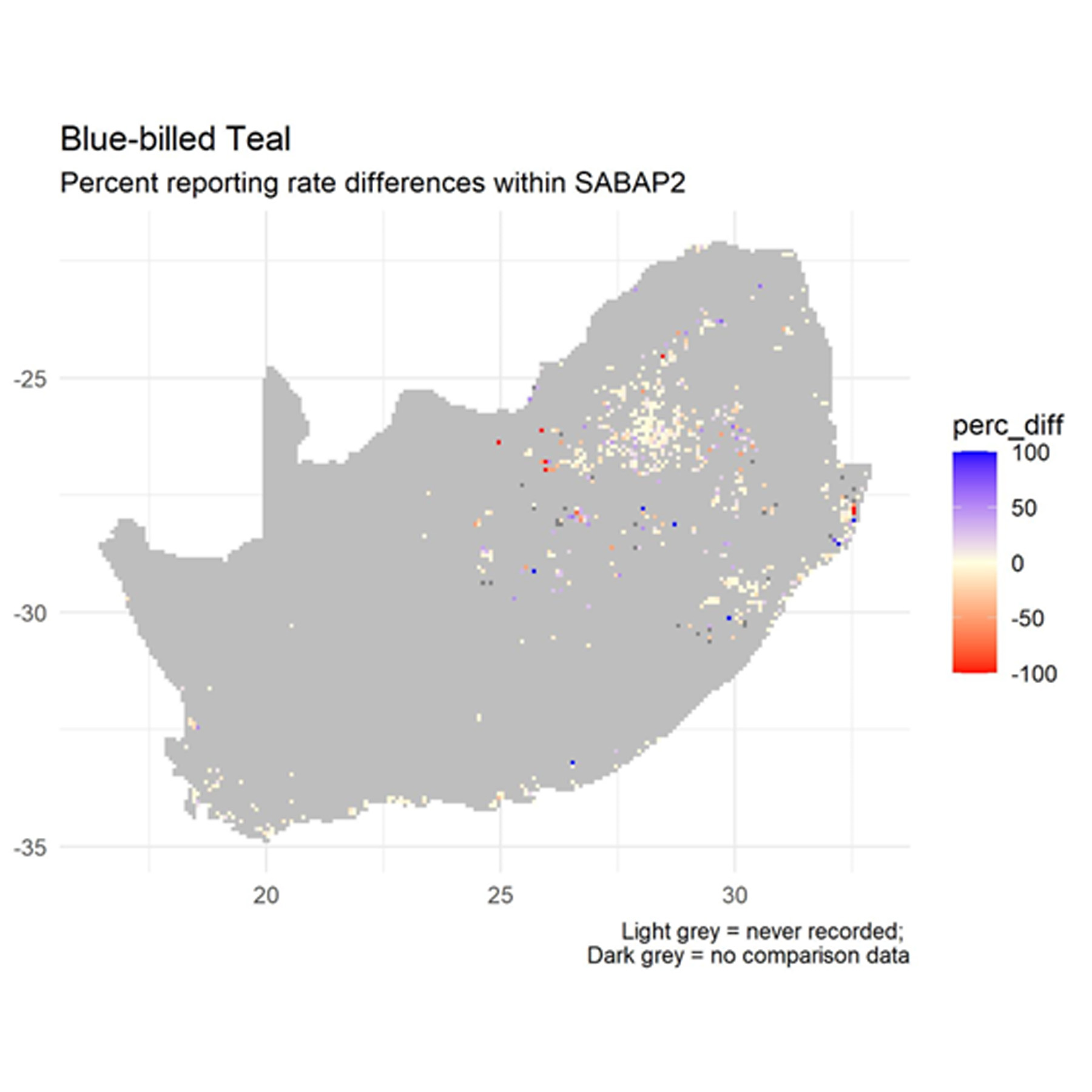
Figure 1: Regional map for Blue-billed Teal showing the change in reporting rate from early SABAP2 (2007-2015) and the later period (2016-2023). Cream indicates no change, blue and increase and peach a decline. Map from Lee (2024).
Ecology
Blue-billed Teal prefer habitats such as shallow freshwater marshes, swamps, streams, ponds and small lakes, especially those with plenty of floating and fringe vegetation like waterlilies and Typha bulrushes (Kear 2005a). They also utilise wetlands within urban areas, provided these habitats remain relatively undisturbed (Safford and Hawkins 2013). Additionally, Blue-billed Teals have been observed in flooded fields, rice paddies, and man-made wetlands such as dams and sewage ponds (Kear 2005b).
Presumed to be mainly sedentary in South Africa, with some nomadic populations undertaking local or seasonal movements. Populations in Namibia, Botswana, Mozambique, Zambia and Zimbabwe likely complete complex longitudinal migrations (Scott and Rose 1996, Colahan 2005).
Breeding occurs throughout the year in South Africa, with a peak during the wet season from January to April (Tarboton 2001) and breeds in the first year (Siegfried 1965). The species breeds in shallow freshwater wetlands that have good coverage of vegetation, especially reeds or sedges, ensuring the nest is well hidden (Tarboton 2001). The nest, constructed by both male and female, is a large, raised structure made of grass, leaves, and reed stems, lined with dark brown down (Tarboton 2001). Down is added continuously throughout the egg laying process (Tarboton 2001). The clutch size ranges from 6 to 7 cream or yellow-buff eggs, laid at 1-day intervals (Tarboton 2001). The incubation period lasts for 25 to 27 days by the female only and begins only when the clutch is complete (Tarboton 2001). The fledging period extends from 60 to 65 days. Young are primarily cared for by the female, with the male assisting (Tarboton 2001). Longevity for ringed birds is two years and 4 months; however, these birds do live longer than two years (Underhill et al. 1999). Breeding success: no data
The species displays a varied omnivorous and seasonal diet, consuming a wide array of food items throughout the year (Kear 2005a, Colahan 2005). Plant matter consumed includes pondweed, algae, seeds and fruits (Colahan 2005). Blue-billed Teal also feeds on snails, insects and small frogs (Johnsgard 1978, Brown et al. 1982, del Hoyo et al. 1992, Colahan 2005, Kear 2005a).
Threats & Conservation
Threats
Habitat degradation and transformation are likely the primary threats to the Blue-Billed Teal, since these birds prefer undisturbed and well-vegetated wetlands for breeding. However, the species’ ability to utilise anthropogenically modified habitats (i.e. fields, dams and sewage ponds) suggests some resilience to habitat transformation.
Conservation Measures Underway
No species-specific measures are currently in place for Blue-billed Teal.
Conservation Measures Proposed
Habitat protection could broadly benefit the species, but specific threats need to be assessed in order to craft meaningful interventions. Blue-billed Teal has not been well studied in this regard.
Research Priorities and Questions
The threats facing the Blue-billed Teal should be evaluated before targeted conservation actions are put in place. These evaluations will require regular monitoring of regional populations at key sites, as well as making a concerted effort to quantify regional abundance. An assessment of especially the St Lucia population is required, and monitoring should be conducted preferably through formal monitoring projects such as CWAC.
Contributors & References
Assessor/s
Maria Paul, Karis Daniel
Reviewer/s
Kayla Webster, Sanjo Rose, Alan Lee
References
BirdLife International. 2016. Spatula hottentota. The IUCN Red List of Threatened Species 2016: e.T22680332A92856138. Available at https://dx.doi.org/10.2305/IUCN.UK.2016-3.RLTS.T22680332A92856138.en. [Accessed on 17 April 2024].
BIRDIE. 2024. An online platform for African wetland and waterbird data. https://biodiversityadvisor.sanbi.org/contentmanagement/index?guid=42305260-12b0-4a92-912e-7d801d15fdac. [Accessed on 8 September 2024].
Brown LH, Urban EK, Newman K. 1982. The Birds of Africa, vol. 1. London: Academic Press.
Carboneras C, Kirwan GM. 2021. Blue-billed Teal (Spatula hottentota), version 1.1. In: del Hoyo et al. (eds), Birds of the World. Ithaca, NY, USA: Cornell Lab of Ornithology. https://doi.org/10.2173/bow.hottea1.01.1.
Colahan BD. 2005. Hottentot Teal. In: Hockey PAR, Dean WRJ, Ryan PG (eds), Roberts Birds of Southern Africa, 7th edn. Cape Town, South Africa: Trustees of the John Voelcker Bird Book Fund.
del Hoyo J, Elliot A, Sargatal J. 1992. Handbook of the Birds of the World, vol. 1: Ostrich to Ducks. Barcelona, Spain: Lynx Edicions.
Johnsgard PA. 1978. Ducks, Geese and Swans of the World. Lincoln, NE, USA: University of Nebraska Press.
Kear J (ed). 2005a. Ducks, Geese and Swans, vol. 1: General Chapters and Species Accounts (Anhima to Salvadorina). Oxford, UK: Oxford University Press.
Kear J (ed). 2005b. Ducks, Geese and Swans, vol. 2: Species Accounts (Cairina to Mergus). Oxford, UK: Oxford University Press.
Lee ATK. 2024. Regional Red Data Book of the Birds of South Africa, Lesotho and Eswatini: SABAP2 synthesis and supporting information and graphics for Blue-billed Teal. Unpublished report. Johannesburg: BirdLife South Africa.
Nye IWB, Melville RV. 1977. International Commission on Zoological Nomenclature, “Opinion 1078.” The Bulletin of Zoological Nomenclature 34: 14–15. Available: https://www.biodiversitylibrary.org/item/44476.
Safford RJ, Hawkins AFA (eds). 2013. The Birds of Africa, vol. 8: The Malagasy Region. London, UK: Christopher Helm.
Scott DA, Rose PM. 1996. Atlas of Anatidae Populations in Africa and Western Eurasia. Wageningen, The Netherlands: Wetlands International. pp 153–155.
Tarboton W. 2001. Guide to Nests & Eggs of Southern African Birds. Cape Town, South Africa: Struik Nature.
Siegfried WR. 1965. The Cape Shoveller Anas smithii (Hartert) in southern Africa. Ostrich 36: 155–198.
Underhill LG, Tree AJ, Oschadleus HD, Parker V. 1999. Review of Ring Recoveries of Waterbirds in Southern Africa. Avian Demography Unit, University of Cape Town.
Wetlands International. 2024. Waterbird Census from the period of 1967–2018. https://iwc.wetlands.org/index.php/aewatrends8
Citation
Paul M, Daniel K 2025. Blue-billed Teal. In: Lee ATK, Rose S, Banda S, Bezeng SB, Maphalala MI, Maphisa DH, Smit-Robinson H (eds), The 2025 Red Data Book of Birds of South Africa, Lesotho and Eswatini. Johannesburg, South Africa: BirdLife South Africa. Available at: https://www.birdlife.org.za/red-list/blue-billed-teal/
Our generous sponsors


