


Black-winged Pratincole
Glareola nordmanni

Number Of Mature
Individuals (Regional)
>10 000

Regional
Population Trend
Decreasing
2025
Regional Category
Least Concern
Search by species
CONTENTSOverview
Names
|
IOC English Name: |
Black-winged Pratincole |
|
SA & IOC Scientific Name: |
Glareola nordmanni |
|
BirdLife International Taxonomy (scientific name): |
Glareola nordmanni |
|
Order: |
CHARADRIIFORMES |
|
Family: |
Glareolidae |
|
Species name author: |
Fischer von Waldheim 1842 |
|
Afrikaans: |
Swartvlerksprinkaanvoël |
|
Sesotho (South Africa): |
lehlakangwato-pheontsho |
|
Sesotho (Lesotho): |
lehlakangoato-pheeont |
|
siSwati: |
|
|
Zulu: |
iwambelimaphikamnyama |
Current Assessment Status
|
2025 Regional Category [Criteria] |
LC |
|
2024 Global Category [Criteria] |
NT [A2bc+3bc+4bc] (BirdLife International 2021a) |
|
Population size (Regional) |
Unknown |
|
Population size (Global) |
150 000 – 190 000 (BirdLife International 2021a) |
|
Distribution size (EOO) (Regional) km2 |
479 060 (Lee 2024) |
|
Distribution size (EOO) (Global) km2 |
5 560 000 (BirdLife International 2021a) |
|
Distribution size (AOO) (Regional) km2 |
191 780 (Lee 2024) |
|
Generation time |
2.99 years (BirdLife International 2021a) |
|
Status change reason |
Improved Knowledge |
|
Migrant (in the region) |
Full migrant |
|
Regional endemic |
No |
Historic Listing Information
|
2000 Regional Status |
NT |
|
2015 Regional Status |
NT [A2bc+3bc+4bc] |
|
Status change reason (if applicable) |
No change |
|
2015 Population size (Regional) |
Unknown |
|
2015 Global Status |
NT |
Reason for Inclusion
Reason for Inclusion in the Assessment
The Black-winged Pratincole Glareola nordmanni was previously assessed as regionally Near Threatened in 2000 and 2015 (Barnes 2000, Taylor et al. 2015). The species has also been assessed globally in 2021 as Near Threatened (BirdLife International 2021a) and Least Concern according to the Europe Assessment (BirdLife International 2021b).
Category Justification
Category Justification
The Black-winged Pratincole is a nonbreeding visitor to the region and is listed as globally Near Threatened (Birdlife International 2021a). Within the region, both Extent of Occurrence (EOO) and Area of Occupancy (AOO) exceeds the threshold for Criterion B. While the regional population size is unknown it is not believed to approach the thresholds for Vulnerable under the population size criteria (Criteria C and D). There is some evidence from the Southern African Bird Atlas (SABAP2) that the population may be in decline (9.8% over three generations), but as yet this rate of decline does not approach the >30% threshold for Criterion A.
While this species is now assessed as Least Concern, it is in decline and continued monitoring is recommended.
Population Justification
The global population estimate is 152 000 – 190 000 (AEWA 2024), 150 000 – 190 000 (Birdlife International 2021a). It must be noted that the AEWA (2024) and BirdLife International (2021a) global estimates are direct conversions of Kamp et al. (2009) estimates of 76 000 – 95 000 breeding pairs. These figures therefore reflect mature individuals, but are considered conservative estimates as not all mature individuals in a population breed.
The erratic occurrence of the species within southern Africa makes it difficult to assess population size and/or trends (Maclean and Herremans 1997, Tree 2005). No systematic surveys have been published.
Various once off counts are available for various parts of Africa either on passage (e.g. Benson et al. 1971, Aspinwall and Conant 1977) or on the wintering grounds (e.g. Penry and Tarboton 1990, du Plessis 1995, Coordinated Waterbird Counts (CWAC) unpubl data). While these counts would give an indication of numbers of birds migrating south and/or numbers of birds within the region none are recent and considering relatively recent population declines (Kamp et al. 2009) these counts are mere indications of historical numbers. Of special note to the region are the flocks of 250 000 – 800 000 birds reported by du Plessis (1995) in the Orange Free State in 1991 and the 76 500 birds counted on the southern end of the Vaal Dam, South Africa in 2006 (CWAC unpubl data). The regional population is therefore considered to exceed 10 000 mature individuals.
Trend Justification
BirdLife International (2021a) indicates that the population is declining at a rate of 1–19%, based on a stable European population and estimates of low-moderate declines for the Asian population. Wetlands International (2024) indicates that the population trend for Black-winged Pratincole is uncertain, highlighting the difficulty of estimating trends for a nomadic species. Despite the poorly studied trends for the Asian population, available evidence indicates that the global population is not small nor undergoing a rapid decline (BirdLife International 2024).
At a regional level insufficient population data exists to determine population trends, probably due to the erratic occurrence of the species resulting from its nomadic nature. There is some evidence of regional declines, with predicted range change from SABAP2 over the past three generations indicating that AOO for this species has decreased by 9.8% (Figure 1, Lee 2024).
However, given that the species is poorly monitored within the region, the global trends are used to inform the assessment outcome here. Most of the global population migrates to southern Africa (Maclean and Kirwin 2020), it is therefore reasonable that global declines (1–19%) are reflected regionally as well. Evidence exists of range contraction within southern Africa around the same period as the significant declines that occurred on the breeding grounds in Eurasia (MacLean and Herremans 1997).
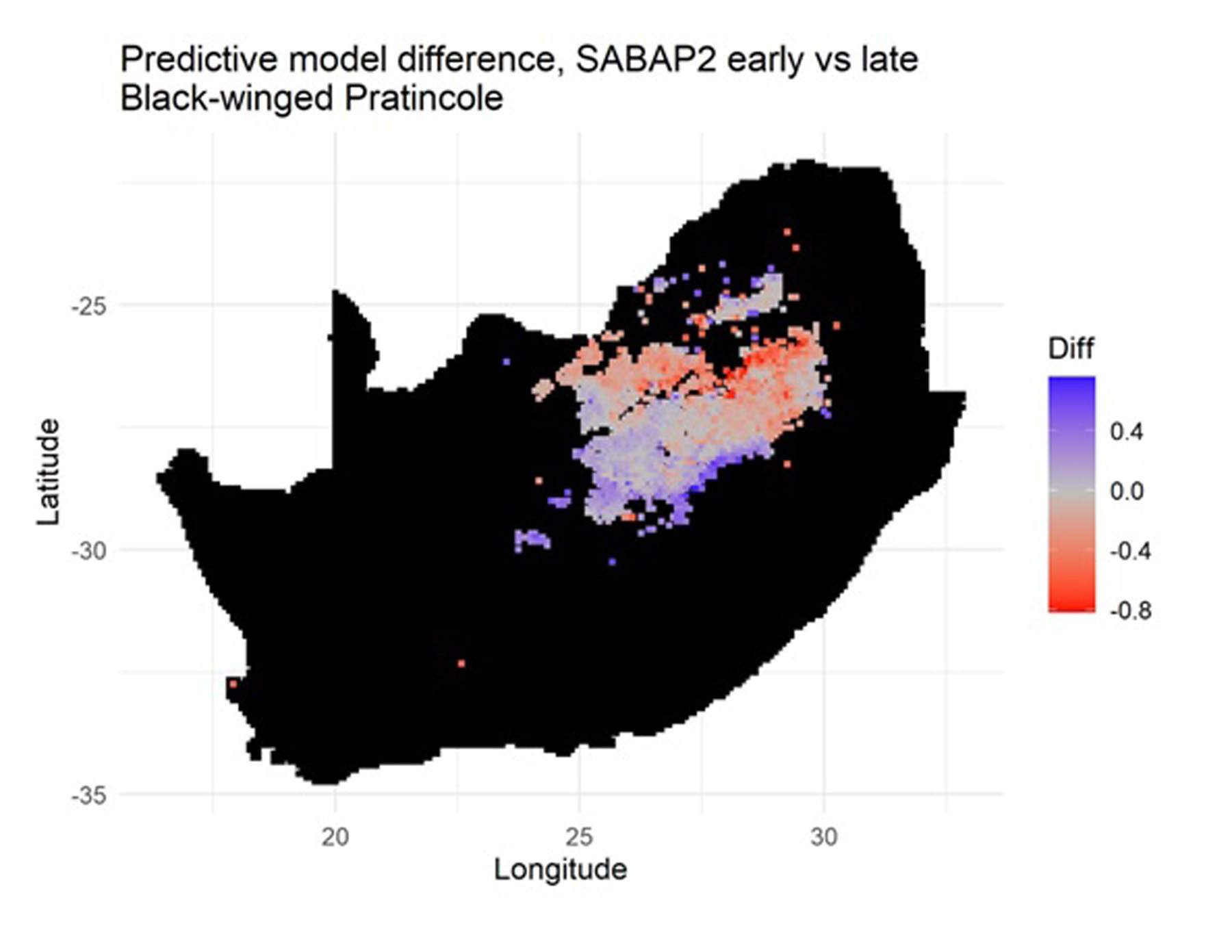
Figure 1: Predictive occurrence model results comparing data from 2007-2015 and 2016-2023. Red indicates a lower probability of recording for the latter period while Blue indicates a higher recording (from Lee 2024).
Biology & Ecology
Taxonomy
Monotypic.
Identification
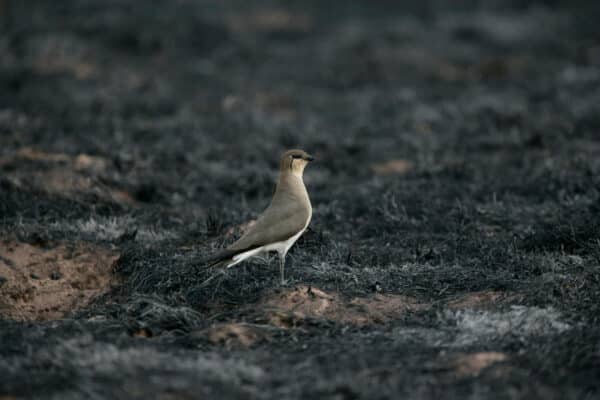
25 cm, 100g. Sexes alike. Eyes are dark brown, legs, feet and bill blackish, the latter with limited red at the base. The upperparts are dark olive-brown, with a buff yellow chin and throat that is bordered by a distinctive dark gorget. The breast is deep cinnamon with a white belly. The uppertail coverts and the base of the tail are white, while the underwing coverts and remiges are black. Outer tail feathers are white (Tree 2005). The species can be confused with Collared (Red-winged) Pratincole G. pratincola especially in low light conditions when the black underwing coverts of the Black-winged Pratincole are difficult to see (Maclean and Herremans 1997).
Distribution
The breeding range of the Black-winged Pratincole is within the steppe zone of Eurasia stretching from Romania and Ukraine in the west to the Russian Altai and Kazakhstan in the east. They may breed irregularly further north in the forest steppe zone. The species migrates overland through countries in the Middle East and the Arabic Peninsula into and down through Africa to the wintering grounds in the savannahs of southern and south-western Africa and West Africa (Belik and Lebedeva 2004). In southern Africa Black-winged Pratincole occur mostly in Botswana and South Africa and considered a very rare straggler within the rest of the area (Maclean and Herremans 1997).
Regionally, the species is mostly found on the Highveld of the North West, Limpopo, Gauteng and Free State provinces (Maclean and Herremans 1997, Tree 2005). Tarboton et al. (1987) indicate that the species is more numerous and regular on the eastern Highveld and scarcer on the western Highveld (Figure 2).
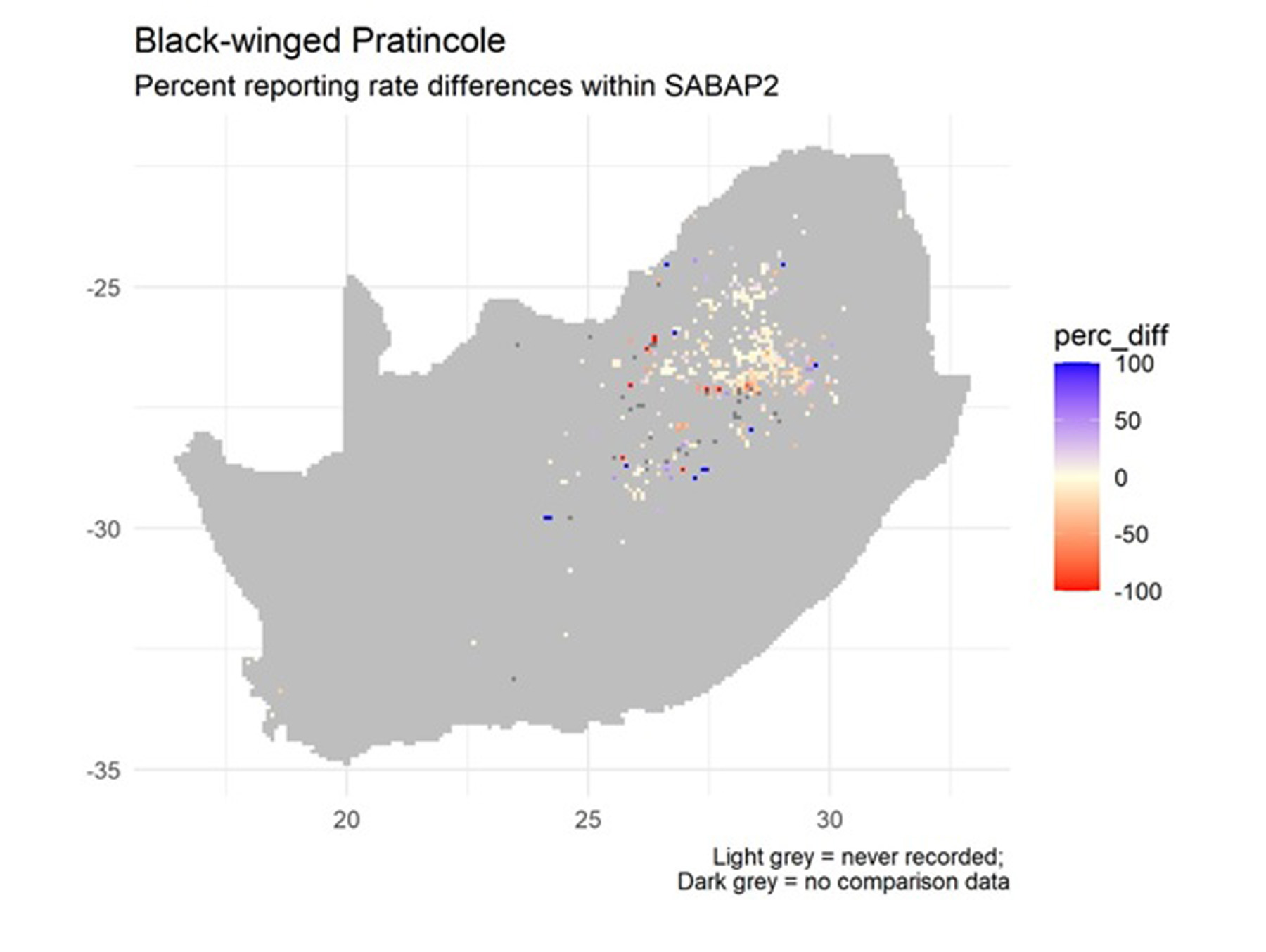
Figure 2: Distribution map of Black-winged Pratincole also showing pentad level change between SABAP2 periods 2007-2015 and 2016-2023 (from Lee 2024).
Ecology
Habitat:
Within the breeding range the species inhabits saline and alkaline steppes, grasslands, ploughed and arable land in river valleys and along the shorelines of lakes or seas, preferring sparsely vegetated saline soil close to water or wet meadows (Maclean and Kirwin 2020). On the non-breeding grounds Black-winged Pratincole prefer open grassland, edges of pans and cultivated fields (Maclean and Herremans 1997). Tarboton et al. (1987) indicated that the species is attracted to areas where mowing and ploughing has taken place as well as recently flooded grass areas.
Migration:
The species is a long-distance migrant, leaving the breeding grounds in Eurasia during August-September and arriving early November to western and southern Africa, but mostly to South Africa and Botswana. On the non-breeding grounds the species is almost permanently nomadic responding to local rainfall events and rarely stays in one place for long (Maclean and Herremans 1997). Sightings of large flocks by du Plessis (1995) in the Free State led Maclean and Herremans (1997) to suggest that at times the majority of the world population occurs as a single flock in the region.
Breeding:
Nonbreeding regionally.
Diet:
The Black-winged Pratincole diet consist predominantly of insects mostly locusts, grasshoppers, crickets, beetles and termite alates. The species forages mainly on the wing, but does also forage on the ground either flying in short bursts over the ground or running in short dashes (Maclean and Kirwin 2020).
Threats & Conservation
Threats
Threats on the breeding ground include changing land-use practices, nest trampling by livestock (Kamp et al. 2009), predation by corvids, foxes and hedgehogs (Belik and Lebedeva 2004) and climate change (Nagy et al. 2021). Specifically, Nagy et al. (2021) projected a 49% net winter range loss by 2050 with a 45% and 54% reduction in the current passage and wintering range of the Black-winged Pratincole.
Kamp et al. (2009) showed that Black-winged Pratincole is largely dependent on the presence of large grazers, and declines occurring from the 19th century are due to a switch to arable agriculture and the subsequent loss of grazed steppe to ploughing. Kubelka et al. (2019) also reported high predation rates of breeding Black-winged Pratincoles at the Caspian steppe lakes, also suggesting that there may be a strong connection between vole abundance and steppe population productivity with vole abundance influencing predation pressure on ground-nesting birds.
On the non-breeding grounds the threat is predominantly reduction of available habitat through grassland degradation although negative impacts from the control of locust swarms have been inferred (Hockey and Douie 1995). Locust control by widespread pesticide use reduces a valuable food source and may lead to direct mortality of Black-winged Pratincoles.
Conservation Measures Underway
There are no specific conservation measures currently in place for the Black-winged Pratincole in the region. The species listed in Appendix II (migratory species that have an unfavourable conservation status and that require international agreements for their conservation and management, as well as those that have a conservation status which would significantly benefit from the international cooperation that could be achieved by an international agreement) of the Convention on the Conservation of Migratory Species (CMS 2024). It is also listed in Column A category 4 (species, which are listed as Near Threatened on the IUCN Red List of Threatened species, as reported in the most recent summary by BirdLife International, but do not fulfil the conditions in respect of Categories 1, 2 or 3, as described above, and which are pertinent for international action.) under the African-Eurasian Migratory Waterbird Agreement (AEWA 2022).
An international single species action plan was compiled for the species in 2004 (Belik and Lebedeva 2004) and although comprehensive it is unclear if any of the interventions proposed were implemented.
Conservation Measures Proposed
- Hockey and Douie (1995) indicate that agricultural practices, in terms of habitat alteration and pesticide use may have had significant impacts on Black-winged Pratincole on the wintering range. The implementation of environmentally sound practices within the agricultural sector would improve the situation for the species
- Develop a monitoring program that will enable annual estimates of populations visiting the region. Considering the nomadic nature of the species within southern Africa, this may require coordination with neighbouring countries, most notably Namibia and Botswana
Research Priorities and Questions
- Agricultural practices have in the past impacted on the species (Hockey and Douie 1995). Which agricultural practices and how these agricultural practices have affected and probably still affect the species need to be researched in order to develop strategies to alleviate these pressures.
- The regional population size needs to be determined.
- Drivers of population size fluctuations need to be identified.
- The impact of agrochemicals on this species should be determined.
Contributors & References
Assessor/s
Kevin Shaw
Reviewer/s
James Westrip
References
AEWA. 2022. Agreement on the Conservation of African-Eurasian Migratory Waterbirds (AEWA) – Agreement Text and Annexes. As amended at the 8th Session of the Meeting of the Parties to AEWA. UNEP/AEWA Secretariat 26 – 30 September 2022, Budapest, Hungary.
AEWA. 2024. Glareola nordmanni. https://www.unep-aewa.org/en/species/glareola-nordmanni. [Accessed on 09 September 2024].
Aspinwall DR, Conant P. 1977. Palearctic migrants. Newsletter of the Zambian Ornithological Society 7: 98
Barnes KN (ed). 2000. The Eskom Red Data Book of Birds of South Africa, Lesotho and Swaziland. Johannesburg, South Africa: BirdLife South Africa.
Belik VP, Lebedeva EA. 2004. International Single Species Action Plan for the Conservation of the Black-winged Pratincole, Glareola nordmanni. AEWA Technical Series No. 4.UNEP/AEWA Secretariat
Benson CW, Brooke RK, Dowset RJ, Irwin MPS. 1971. The Birds of Zambia. London: Collins.
BirdLife International.2021a. Glareola nordmanni. The IUCN Red List of Threatened Species 2021: e.T22694136A205787289. https://dx.doi.org/10.2305/IUCN.UK.2021-3.RLTS.T22694136A205787289.en. [Accessed on 09 September 2024].
BirdLife International.2021b. Glareola nordmanni (Europe assessment). The IUCN Red List of Threatened Species 2021: e.T22694136A166269161. https://dx.doi.org/10.2305/IUCN.UK.2021-3.RLTS.T22694136A166269161.en. [Accessed on 09 September 2024].
BirdLife International. 2024. Species factsheet: Black-winged Pratincole Glareola nordmanni. Downloaded from https://datazone.birdlife.org/species/factsheet/black-winged-pratincole-glareola-nordmanni on 09/09/2024.
CMS (Convention on the Conservation of Migratory Species of Wild Animals). 2024. Appendices I and II of the Convention on the Conservation of Migratory Species of Wild Animals (CMS) as amended by the Conference of the Parties 17th May 2024.
du Plessis GJ. 1995. Large aggregation of Black-winged Pratincoles Glareola nordmanniin the northern Orange Free State. Ostrich 66: 40–41.
Hockey P, Douie C. 1995.Waders of southern Africa. Cape Town, South Africa: Struik Winchester.
Kamp J, Koshkin MA, Sheldon RD. 2009. Population size, breeding performance and habitat use of the Black-winged Pratincole Glareola nordmanni. Bird Conservation International 19: 149–163.
Kubelka V, Mlíkovský J, Zavadilová V, Frencl M, Ivanov A, Litvinov K, Šálek M. 2019. Pilot study on nest predation in shorebirds breeding at the Caspian steppe lakes. Wader Study 126: 142–150.
Lee ATK. 2024, Regional Red Data Book of the Birds of South Africa, Lesotho and Eswatini: SABAP2 synthesis and supporting information and graphics for Black-winged Pratincole. Unpublished report. Johannesburg: BirdLife South Africa.
Maclean GL, Herremans M. 1997.Blackwinged Pratincole Glareola nordmanni. In: Harrison JA, Allan DG, Underhill LG, Herremans M, Tree AJ, Parker V, Brown CJ (eds), The atlas of southern African birds Vol I: Non-passerines. Johannesburg, South Africa: BirdLife South Africa. pp 456–457.
Maclean GL, Kirwan GM. 2020. Black-winged Pratincole (Glareola nordmanni), version 1.0. In: del Hoyo J, Elliott A, Sargatal J, Christie DA, de Juana E (eds), Birds of the World. Ithaca, NY, USA: Cornell Lab of Ornithology.
Nagy S, Breiner FT, Anand M, Butchart SHM, Flörke M, Fluet-Chouinard E, Guisan A, Hilarides L, Jones VR, Kalyakin M, Lehner B, Pearce-Higgins JW, Voltzit O. 2021. Climate change exposure of waterbird species in the African-Eurasian flyways. Bird Conservation International 1–26. https://doi.org/10.1017/s0959270921000150
Penry EH, Tarboton WR. 1990. Red-winged Pratincoles breeding at Lake Ngami. Babbler 19: 7–11.
Tarboton WR, Kemp MI, Kemp AC. 1987. Birds of the Transvaal. Pretoria: Transvaal Museum.
Taylor MR, Peacock F, Wanless RW (eds). 2015. The Eskom Red Data Book of Birds of South Africa Lesotho and Swaziland. Johannesburg, South Africa: BirdLife South Africa.
Tree AJ. 2005. Black-winged Pratincole Glareola nordmanni. In: Hockey PAR, Dean WRJ, Ryan PG (eds), Roberts Birds of Southern Africa, 7th Edn. Cape Town: John Voelcker Bird Book Fund. pp 429–430.
Wetlands International. 2024. Available: https://www.wetlands.org/.
Citation
Shaw K 2025. Black-winged Pratincole. In: Lee ATK, Rose S, Banda S, Bezeng SB, Maphalala MI, Maphisa DH, Smit-Robinson H (eds), The 2025 Red Data Book of Birds of South Africa, Lesotho and Eswatini. Johannesburg, South Africa: BirdLife South Africa. Available at: https://www.birdlife.org.za/red-list/black-winged-pratincole/
Our generous sponsors


