


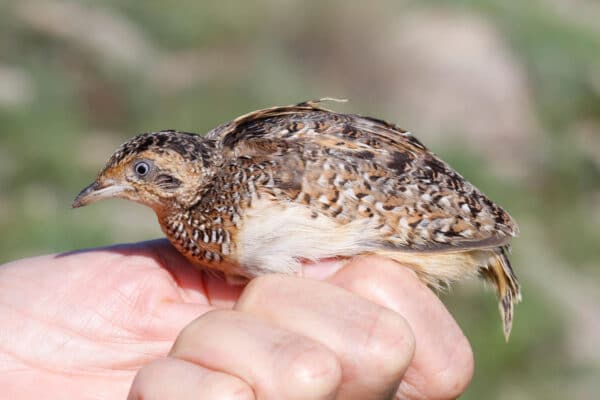
Black-rumped Buttonquail
Turnix nanus

Number Of Mature
Individuals (Regional)
<1 000

Regional
Population Trend
Decreasing
2025
Regional Category
Endangered
Search by species
CONTENTSOverview
Names
|
IOC English Name: |
Black-rumped Buttonquail |
|
SA & IOC Scientific Name: |
Turnix nanus |
|
BirdLife International Taxonomy (scientific name): |
Turnix nanus |
|
Order: |
CHARADRIIFORMES |
|
Family: |
Turnicidae |
|
Species name author: |
Sundevall 1851 |
|
Afrikaans: |
Swartrugkwarteltjie |
|
Sesotho (South Africa): |
Sekuwapana sa nkotontsho |
|
Sesotho (Lesotho): |
|
|
Siswati: |
|
|
Zulu: |
ungoqo |
Current Assessment Status
|
2025 Regional Category [Criteria] |
EN [B2ab(ii,iii,iv); C2a(i)] |
|
2024 Global Category [Criteria] |
LC (BirdLife International 2024) |
|
Population size (Regional) |
<1000 (Peacock 2015) |
|
Population size (Global) |
Unknown |
|
Distribution size (EOO) (Regional) km2 |
156 085 (Lee 2024) |
|
Distribution size (EOO) (Global) km2 |
9 990 000 (BirdLife International 2024) |
|
Distribution size (AOO) (Regional) km2 |
228 (Lee 2024) |
|
Generation time |
2.81 years (BirdLife International 2024) |
|
Status change reason |
No change |
|
Migrant (in the region) |
Partial |
|
Regional endemic |
No |
Historic Listing Information
|
2000 Regional Status |
EN [C2a] |
|
2015 Regional Status |
EN [B2b(ii,iii,iv,v); C2a(i)] |
|
Status change reason (if applicable) |
No change |
|
2015 Population size (Regional) |
<1000 |
|
2015 Global Status |
LC |
Reason for Inclusion
Reason for Inclusion in the Assessment
The Black-rumped Buttonquail Turnix nanus was listed as regionally Endangered in the 2015 Regional Red List (Peacock 2015).
Category Justification
Category Justification
The Black-rumped Buttonquail has a small, fragmented regional population, estimated to be <1000 mature individuals, with no sub-populations likely to exceed 250 mature individuals. The range within the region is dependent on grasslands that have been much reduced in terms of species richness and diversity (Muller et. al. 2021), resulting in a fragmented geographic range and area of occupancy of <500 km2 (Lee 2024) qualifying it as regionally Endangered.
Population Justification
The global population size is unknown (BirdLife International 2024) and studies on the species are limited due to its cryptic nature (Gutiérrez-Expósito et al. 2023). Within the region, historical population assessments have varied with Brooke (1984) classifying the species as one of the five most threatened birds in South Africa, speculating that it probably no longer bred in the region, with Barnes (1998) estimating a total of 212 – 584 birds possibly occurring in 13 IBAs in eastern South Africa, whilst Parker (1994) estimated a population of 70 birds in Eswatini. Taylor (2000) suggested that the regional population was around 1000 individuals, however, the confidence was low due to the cryptic nature of the species and often being overlooked. In the absence of reliable and up to date population estimates, combined with the loss of optimal breeding habitat in the preceding 20 years, the regional population is almost certainly <1000 mature individuals.
Trend Justification
The global population is in decline (BirdLife International 2024). Regionally the trend is unclear. Lee (2024) suggests stable reporting rates within the Southern African Bird Atlas Project (2007-2023, SABAP2), with modelled increases in Area of Occupancy. However, utilising citizen science data for this species is challenging as it is generally overlooked. This species is not easily flushed, preferring to run rather than fly (del Hoyo et al. 2020). A regional decline is inferred based on the decline in suitable habitat due to over grazing, trampling and human settlement (del Hoyo et al. 2020). Confidence in this estimate is medium.
Biology & Ecology
Taxonomy
Although previously considered conspecific with the Fynbos Buttonquail T. hottentottus by many authorities (Dowsett and Dowsett-Lemaire 1993, Maclean 1993, del Hoyo et al. 1996), Sibley and Monroe (1990) suggested that the two taxa constitute different species, a notion supported by their allopatric ranges and different habitat preferences and possibly movement patterns (Dean 2005) as well as subtle differences in plumage. Following Ryan and Hockey (1995) that a thorough reassessment of the taxonomic status was critical for any future conservation decisions, a split between nanus and hottentottus (s.s.) is currently accepted by BirdLife International (2024), BirdLife South Africa (Lotz 2024) and the International Ornithologists’ Union (Gill et. al 2024). Darker northern populations, previously recognised as races luciana and insolata, are now considered indistinguishable from the nominate nanus, making the species monotypic (del Hoyo et al. 1996).
Identification
14–15 cm, 42–60 g. Sexes differ slightly in plumage colour and size, the female with more confined barring below and broad rufous buff inner webs to tertials. Both sexes intricately patterned in brown, black and rich rufous buff above, feathers with white tips or fringes. Blackish rump and uppertail coverts, usually obvious in flight, distinguish this species from Fynbos Buttonquail and Common Buttonquail T. sylvaticus. Crown dark, lacking pale central stripe; offset against orange-buff face and supercilium. Throat white to pale orange rufous.
Distinguished from Fynbos Buttonquail by less profusely marked underparts, darker rump contrasting with rest of upperparts, more distinct supercilium, bluish white (not pale yellow) irides and whitish flesh (not yellow) legs (del Hoyo et al. 1996).
Distribution
A secretive and easily overlooked species that is widespread but generally sparse in moist woodland belts, savannah and grassland in sub-Saharan Africa. Occurs from Senegal and Gambia eastwards to Uganda and western Kenya, and south through much of central Africa to northern Angola, Zambia and Malawi (Urban et al. 1986). In Zimbabwe, recorded from the south-eastern Lowveld, and also from across the Mashonaland Plateau between Harare and Marondera, where it is an itinerant and nomadic visitor, mostly in the rainy season (Irwin 1981, Allan and Colahan 1997). Status uncertain in Mozambique, and probably widely overlooked; north of the Save River considered an uncommon breeding summer migrant to moist grasslands, and fairly numerous on low-lying plains from Beira northwards (Parker 2005); in southern Mozambique recorded from a few scattered localities in summer (Parker 1999).
Within the region, the Black-rumped Buttonquail’s occurrence is generally patchy and erratic, but its secretive behaviour, cryptic plumage and imperfectly known movement patterns ensure that it is widely under-recorded, or misidentified (Christian 2004). Based on SABAP2 and BirdLasser data, the species occurs on the outskirts of Gauteng, across Mpumalanga, through KwaZulu-Natal to the northern Eastern Cape. A record along the Eastern Cape coastline near Gxarha (Yearsley 2023), further supports the patchy and erratic occurrence.
Ecology
Generally elusive and difficult to flush, and adept at avoiding detection by creeping or running through grassy cover. Like other buttonquails, probably polyandrous, with the larger females vocalising to establish and maintain territories and attract males (Urban et al. 1986). Usually solitary or in pairs but may be encountered in loose aggregations (Urban et al. 1986), and under optimal conditions, several females may hold adjacent territories in a small area (Christian 2004). Considered a partial migrant, but the limited understanding of the species movement, has resulted in a number of theories being proposed, with the species probably being nomadic and responding to rainfall, climatic and habitat changes (Urban et al. 1986). Breeding has been recorded through September to March, with a summer peak between December and March (Dean 2005). The fragmentation and loss of suitable grass cover may further impact the species ability to adapt to changes in climate and habitat.
Threats & Conservation
Threats
The threats faced by this species are shared with many other grassland specialists, all contributing to the deterioration and destruction of its grassland habitat: commercial afforestation, crop agriculture, stock farming and expanding rural and urban settlements (Allan and Colahan 1997, Muller et al. 2021), and on a local scale, mining operations and infrastructure development. Overly frequent burning is also considered a threat, but fires are probably an essential element to maintaining this species’ preferred short and open-structured grassland habitat and preventing development of a dense moribund layer at ground-level. The ideal fire frequency is dependent on rainfall, grazing regime and available biomass, varying from two to five years (SANBI 2014, but further research is needed.
The extent and quality of suitable habitat is likely to be reduced by infestation of forbs and exotic pioneer plants, trampling by livestock, grazing practices, agricultural activities, soil erosion and edge effects of increasing habitat fragmentation; the latter may influence local dispersal ability as well (Peacock 2015). The potential effects of drought and climate change should also be investigated. At sites near human settlements, localised threats may include disturbance from pedestrians, dogs, and ‘quad’ bikes (Christian 2004), collisions with illuminated windows when flying at night, and predation by domestic and feral cats. It is unknown whether wing-shooting poses a significant threat, but there is a strong possibility that this species may be shot inadvertently while hunting the superficially similar Common Quail Coturnix coturnix, a highly prized quarry for both social and commercial wing-shooters in summer (Little 2012). The very similar Common Buttonquail may also be hunted occasionally inadvertently resulting in the shooting of the species.
Conservation Measures Underway
No species-specific conservation measures focusing on the Black-rumped Buttonquail are currently underway.
Conservation Measures Proposed
Various authors (Brooke 1984, Allan and Colahan 1997, Taylor 2000, Peacock 2015), have urged that a survey is required to establish the status, distribution and habitat preferences before any adequate conservation programmes can be planned and implemented. This is indeed still the case. The development of a Biodiversity Management Plan similar to Mathieson and Smith (2009), is encouraged to: 1) investigate biological, ecological and demographic questions, 2) map and survey the historic, current and potential range, 3) develop an effective land-management strategy, 4) protect, expand and rehabilitate suitable habitat, 5) reduce or eliminate threats to the species and its habitat, 6) investigate the feasibility of captive breeding and reintroduction and 7) establish a long-term monitoring programme. Such a plan should be in consultation and involvement of conservation authorities, public interest groups and landowners.
Securing, through protection and effective management, of suitably sized and appropriate breeding sites is critical to the survival of this species. Considering Taylor’s (2000) estimation that 20 – 56% of the regional population may occur in fully or partially protected IBAs, a re-assessment of the management practices and status of these areas should be executed. Lee (2024) supports such, estimating that almost 50% of the population occurs within Protected Areas. More detailed surveys are thus required within all identified Protected Areas throughout the region.
Birdwatchers and landowners should be encouraged to report any ad hoc sightings, especially through the BirdLasser initiatives with supporting details to BirdLife South Africa and SABAP2.
Research Priorities and Questions
- Collate in a database all known historical and contemporary occurrence and breeding records, based on atlasing data, sight records, published literature, birdlasser records and museum specimens; critically assess and verify the authenticity of all records.
- Using this database, map the historic and current range of the species and identify ecological requirements and factors limiting the distribution.
- Develop a predictive model of the species’ distribution, incorporating a variety of environmental variables and current land-use data, in order to identify key zones for conservation and areas which potentially hold suitable habitat to support the species.
- Develop an effective methodology for surveying and monitoring buttonquails, and survey potential sites where the species is known to occur, occurred historically, or potentially occurs, following on the predicative model.
- Evaluate threats to the species and its habitat and develop and implement an effective management plan.
Contributors & References
Assessor/s
Brent Coverdale
Reviewer/s
Murray Christian
References
Allan DG, Colahan BD. 1997. Black-rumped Buttonquail Turnix hottentotta. In: Harrison JA, Allan DG, Underhill LG, Herremans M, Tree AJ, Parker V, Brown CJ (eds), The atlas of southern African birds, vol. 1: Non-passerines. Johannesburg, South Africa: BirdLife South Africa. pp 305.
Barnes KN. 1998. The Important Bird Areas of Southern Africa. Johannesburg, South Africa: BirdLife South Africa.
BirdLife International. 2024. Turnix nanus. The IUCN Red List of Threatened Species 2024: e.T22725531A263691587. https://dx.doi.org/10.2305/IUCN.UK.2024-2.RLTS.T22725531A263691587.en. [Accessed on 14 April 2025].
Brooke RK. 1984. South African Red Data Book – Birds. Pretoria, South Africa: Foundation for Research Development, CSIR.
Christian MB. 2004. Black-rumped Buttonquail nest records and notes from KwaZulu-Natal. Durban Museum Novitates 29: 54.
Dean WRJ. 2005. Black-rumped Buttonquail Turnix nanus. In: Hockey PAR, Dean WRJ, Ryan PG (eds), Roberts – Birds of Southern Africa, 7th Edn. Cape Town, South Africa: The Trustees of the John Voelcker Bird Book Fund. pp 120–121.
del Hoyo J, Elliott A, Sargatal J. 1996. Handbook of the Birds of the World, vol. 3: Hoatzin to Auks. Barcelona, Spain: Lynx Edicions.
del Hoyo J, Collar N, Kirwan GM. 2020. Black-rumped Buttonquail (Turnix nanus), version 1.0. In: del Hoyo J, Elliott A, Sargatal J, Christie DA, de Juana E (eds), Birds of the World. Ithaca, NY, USA: Cornell Lab of Ornithology. https://doi.org/10.2173/bow.hotbut3.01
Dowsett RJ, Dowsett-Lemaire F. 1993. A contribution to the distribution and taxonomy of Afrotropical and Malagasy birds. Liège, Belgium: Tauraco Press.
Gill F, Donsker D, Rasmussen P (eds). 2024. IOC World Bird List (v14.1). Available: http://www.worldbirdnames.org.
Gutiérrez-Expósito C, Clavero M, Revilla E. 2023. Prioritizing the conservation and research efforts for poorly known species: the buttonquails (Turnicidae) as a study case. Ardea 111: 501–510. doi:10.5253/arde.2022.a33
Irwin MPS. 1981. The Birds of Zimbabwe. Harare, Zimbabwe: Quest Publishing (Pvt) Ltd.
Lee ATK. 2024. Regional Red Data Book of the Birds of South Africa, Lesotho and Eswatini: SABAP2 synthesis and supporting information and graphics for Black-rumped Buttonquail. Unpublished report. Johannesburg: BirdLife South Africa.
Little RM. 2012. Gamebirds of Southern Africa. Cape Town, South Africa: Random House Struik.
Lotz C. 2024. BirdLife South Africa Checklist of Birds in South Africa 2024. Johannesburg, South Africa: BirdLife South Africa.
Maclean GL. 1993. Roberts – Birds of Southern Africa, 6th Edn. Cape Town, South Africa: The Trustees of the John Voelcker Bird Book Fund.
Mathieson M, Smith GC. 2009. National Recovery Plan for the Black-breasted Button-quail: Turnix melanogaster. Queensland, Australia: Department of Environment and Resource Management.
Muller M, Siebert SJ, Ntloko BR, Siebert F. 2021. A floristic assessment of grassland diversity loss in South Africa. Bothalia 51(1).
Parker V. 1994. Swaziland Bird Atlas, 1985–1991. Mbabane, Swaziland: Websters.
Parker V. 1999. The atlas of the birds of Sul do Save, southern Mozambique. Cape Town, South Africa: University of Cape Town.
Parker V. 2005. The atlas of the birds of central Mozambique. Cape Town, South Africa: Endangered Wildlife Trust and the Avian Demography Unit.
Peacock F. 2015. Black-rumped Buttonquail Turnix hottentotta. In: Taylor MR, Peacock F, Wanless RM (eds), The Eskom Red Data Book of Birds of South Africa, Lesotho and Swaziland. Johannesburg, South Africa: BirdLife South Africa. pp 97–100.
Ryan PG, Hockey PAR. 1995. Is the Hottentot Buttonquail really endangered? Ostrich 66: 92–93.
SANBI. 2014. Grazing and Burning Guidelines: Managing Grasslands for Biodiversity and Livestock Production. Compiled by Lechmere-Oertel RG. Pretoria: South African National Biodiversity Institute.
Sibley CG, Monroe BL. 1990. Distribution and Taxonomy of Birds of the World. New Haven, United States of America: Yale University Press.
Taylor PB. 2000. Black-rumped Buttonquail Turnix hottentotta. In: Barnes KN (ed), The Eskom Red Data Book of Birds of South Africa, Lesotho and Swaziland. Johannesburg, South Africa: BirdLife South Africa. pp 41–43.
Urban EK, Fry CH, Keith S. 1986. Birds of Africa, vol. 2: Gamebirds to Pigeons. London, United Kingdom: Academic Press.
Yearsley G. 2023. eBird Checklist: https://ebird.org/checklist/S141693421. eBird: An online database of bird distribution and abundance [web application]. eBird, Ithaca, New York. Available: http://www.ebird.org. [Accessed: 30 October 2024].
Citation
Coverdale B 2025. Black-rumped Buttonquail. In: Lee ATK, Rose S, Banda S, Bezeng SB, Maphalala MI, Maphisa DH, Smit-Robinson H (eds), The 2025 Red Data Book of Birds of South Africa, Lesotho and Eswatini. Johannesburg, South Africa: BirdLife South Africa. Available at: https://www.birdlife.org.za/red-list/black-rumped-buttonquail/
Our generous sponsors


