


Black Heron
Egretta ardesiaca

Number Of Mature
Individuals (Regional)
<10 000

Regional
Population Trend
Decreasing
2025
Regional Category
Least Concern
Search by species
CONTENTSOverview
Names
|
IOC English Name: |
Black Heron |
|
SA & IOC Scientific Name: |
Egretta ardesiaca |
|
BirdLife International Taxonomy (scientific name): |
Egretta ardesiaca |
|
Order: |
PELECANIFORMES |
|
Family: |
Ardeidae |
|
Species name author: |
Wagler 1827 |
|
Afrikaans: |
Swartreier |
|
Sesotho (South Africa): |
Leholotsiane le lentsho |
|
Sesotho (Lesotho): |
|
|
Siswati: |
|
|
Zulu: |
unokilonkomnyama |
Current Assessment Status
|
2025 Regional Category [Criteria] |
LC° |
|
2024 Global Category [Criteria] |
LC (BirdLife International 2024) |
|
Population size (Regional) |
Unknown |
|
Population size (Global) |
16 700 – 66 700 (BirdLife International 2024) |
|
Distribution size (EOO) (Regional) km2 |
863 827 (Lee 2024) |
|
Distribution size (EOO) (Global) km2 |
26 600 000 (BirdLife International 2024) |
|
Distribution size (AOO) (Regional) km2 |
213 640 (Lee 2024), 40 275 (BIRDIE 2024) |
|
Generation time |
4.8 years (BirdLife International 2024) |
|
Status change reason |
No change |
|
Migrant (in the region) |
No |
|
Regional endemic |
No |
Historic Listing Information
|
2000 Regional Status |
Not Evaluated |
|
2015 Regional Status |
Not Evaluated |
|
Status change reason (if applicable) |
Not applicable |
|
2015 Population size (Regional) |
Unknown |
|
2016 Global Status |
LC |
Reason for Inclusion
Reason for Inclusion in the Assessment
This species was not assessed previously. Preliminary screening of Coordinated Waterbird Counts (CWAC) data indicated a significate decline in the number of Black Heron Egretta ardesiaca counted per year (Lee 2024).
Category Justification
Category Justification
Black Heron is poorly studied throughout its range. Within the region very little is known, and trends are inferred from citizen science data. Within the Southern African Bird Atlas Project (SABAP2) (2007-2023) there is no evidence of regional declines. There is evidence of slight declines between SABAP1 (1986-1997) and SABAP2 (2007-2015), and CWAC trends but these declines do not seem to meet the 30% or 10% thresholds for Criteria A or C. The regional population size is unknown, but it is highly unlikely that it greatly exceeds 10 000 mature individuals (e.g. Louw 2005, Martínez-Vilalta et al. 2020). It may be therefore that the regional population meets threshold for Near Threatened, Criterion C1. This is adjusted however to Least Concern, as a rescue effect from the Botswana population is considered very likely. Continued monitoring is recommended.
Population Justification
The global population is estimated at 16 700 – 66 700 (BirdLife International 2024). Poorly studied in the region. The regional population size is unknown but is likely <10 000.
Trend Justification
Trend analysis based on SABAP2 data indicates a significant decline in the probability of reporting the Black Heron, with high confidence in this trend. A comparison of reporting rate within SABAP2 showed no evidence of declines, while comparing SABAP1 (1986-1997) with SABAP2 (2007-2015) showed evidence of moderate declines. CWAC count totals have declined slightly. Given the decline of freshwater habitat quality and extent throughout the region it seems very likely that Black Heron are in decline. Rate and specific drivers of decline are unknown. Black Heron is considered to be in decline but confidence in this assumption is low. Monitoring at key roost sites is strongly recommended to determine an accurate regional threat status in the near future.
Biology & Ecology
Taxonomy
Monotypic.
Identification
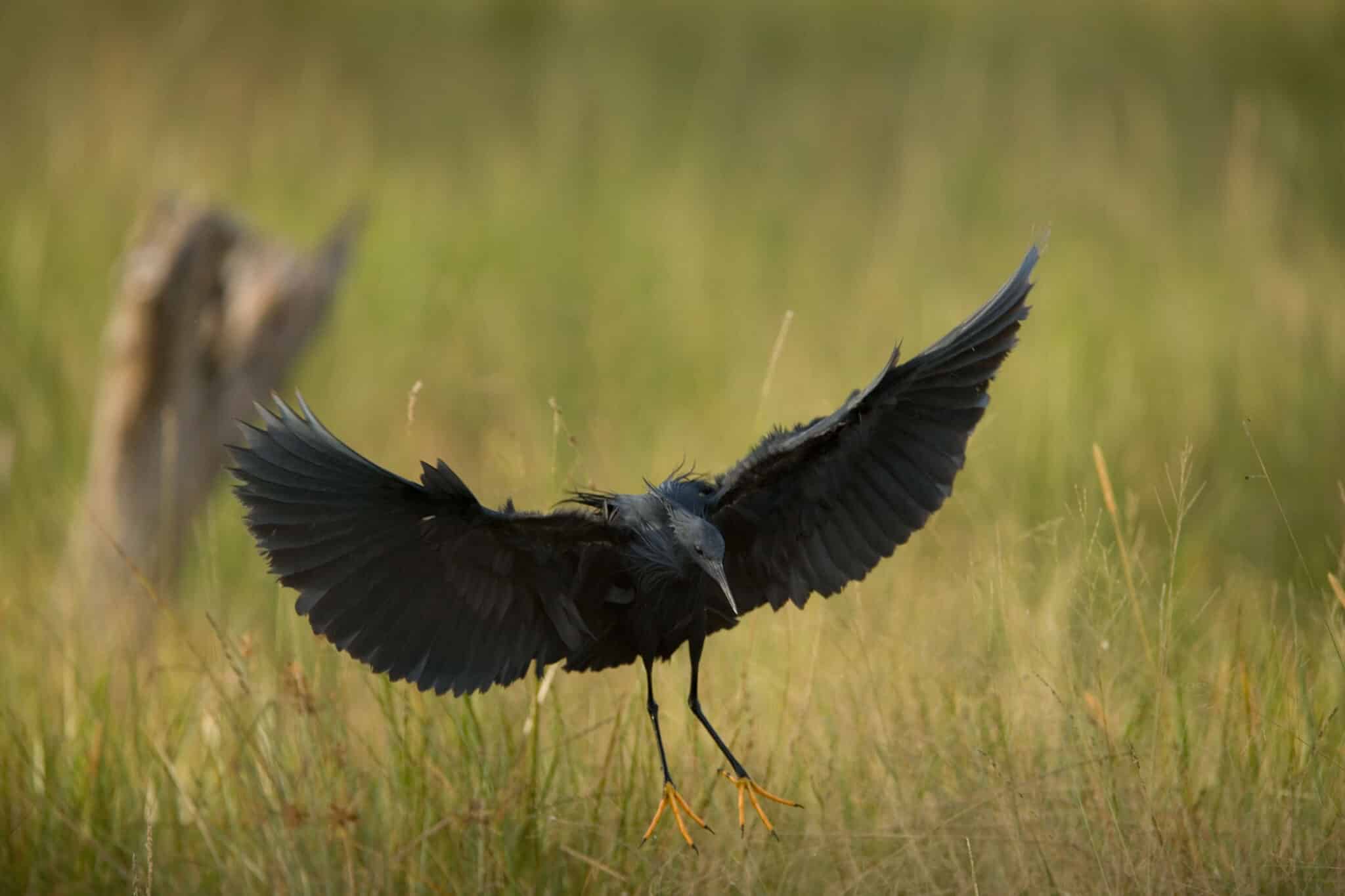
42–66 cm. Sexes are alike in appearance (Louw 2005). Overall black with black plumage, bill and legs (Dowsett 1981). Eyes are yellow as well as their feet (Louw 2005). Well known for spreading its wings over its head to form an umbrella (Martínez-Vilalta et al. 2020).
Confusing species: It is darker than the Slaty Egret Egretta vinaceigula, featuring a black throat instead of vinaceous-buff, and black tarsi rather than yellow (Louw 2005).
Distribution
Occurs in sub-Sahara Africa, found from Senegal to Ethiopia and southward to South Africa, including Madagascar (Louw 2005). In Southern Africa, it predominantly occurs in northeastern Namibia, northern and eastern Botswana, Zimbabwe and northern and eastern South Africa (Louw 2005). In South Africa it occurs across the northern and central highveld, with a narrow distribution in the mesic regions of eastern Limpopo and Mpumalanga, and Zululand, KwaZulu-Natal (Anderson 1997, Figure 1). It is an occasional visitor to the Western Cape.
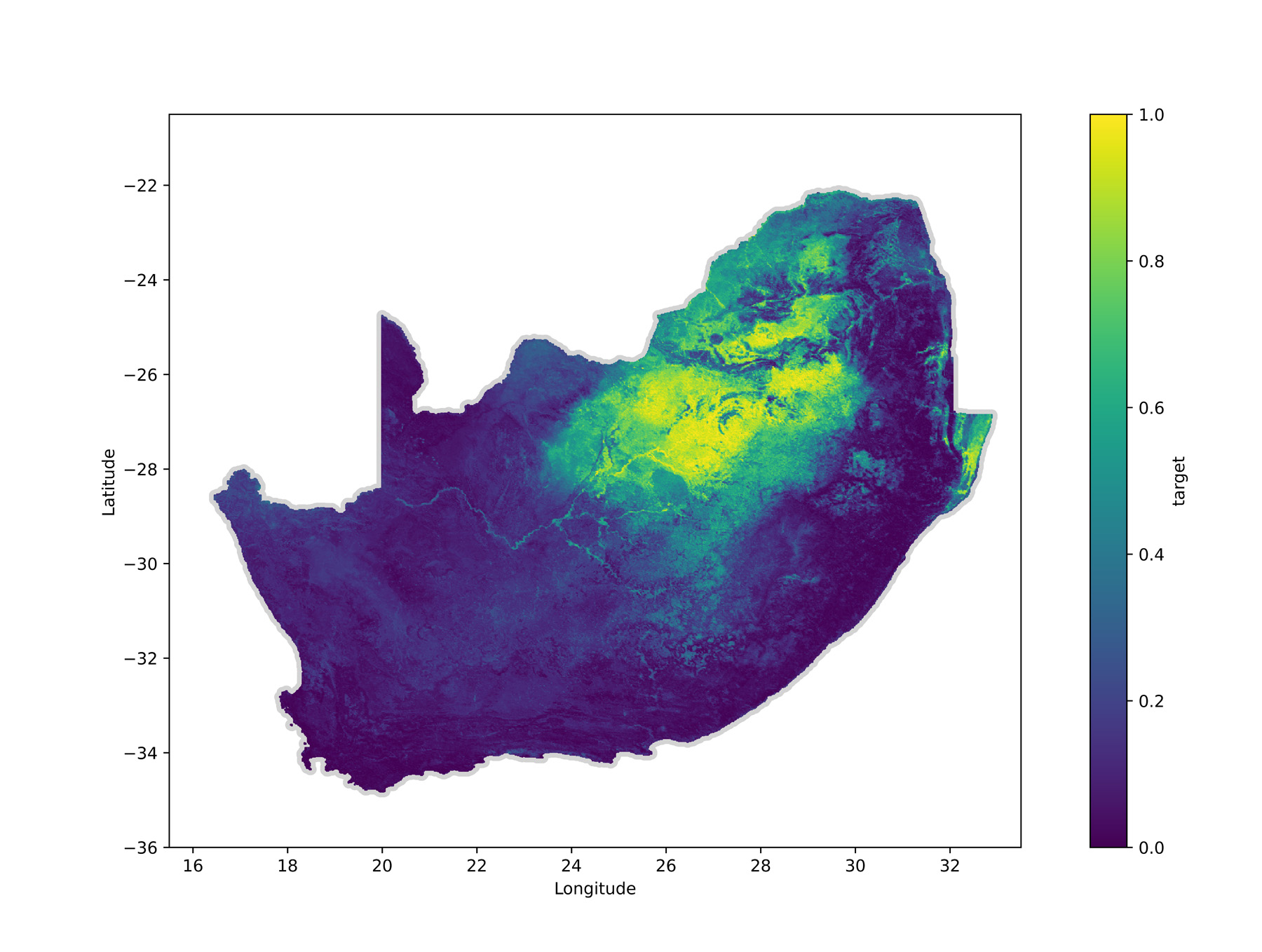
Figure 1: Probability distribution map produced from BirdLasser location data at 2×2 km grid scale, using iNaturalist and eBird as absence data only. This represents the predicted range for the 2016-2023 period. Map from Lee (2024).
Ecology
Habitat:
Black Heron prefers shallow, perennial water such as streams, lagoons, pools, ponds, lakes, marshes, estuaries and mangroves, and may also forage in pastures, reservoirs, canals, aquaculture ponds (del Hoyo et al. 1992).
Diet:
Primarily feeds on small fishes but will also eat crustaceans and aquatic insects and amphibians (Hancock and Kushlan 1984).
Migration:
Poorly known. Considered sedentary but assumed to move in response to changing habitat conditions.
Breeding:
Poorly known in the region. Historical records showed breeding from February to April (Brown et al. 1982, Anderson 1997). Nests are platforms, constructed from sticks and twigs, or reeds, grass, and leafy branches (Milstein and Hunter 1974, Tarboton, 2001). Typically, 2–4 eggs are laid per clutch (Maclean 1993). Breeding success and incubation behaviour unknown.
Threats & Conservation
Threats
Threatened by human disturbance and avian predation at nest sites, as well as threats to the aquatic habitats on which the species depends (Kushlan and Hancock 2005). It is highly threatened in Madagascar due to human interference at breeding sites (del Hoyo et al. 1992, Hancock and Kushlan 2005).
Conservation Measures Underway
There are no known species-specific conservation measures currently in place for the Black Heron in the region.
Conservation Measures Proposed
This species is poorly known in the region and as such proposing effective conservation measures is not possible. Key current population strongholds need to be identified in order for these to be protected and maintained. An understanding of drivers of decline (if these exist) and key requirements are needed in order to ensure future regional population health.
Research Priorities and Questions
- Determine the population size and trends of the Black Heron in the region through targeted surveys and monitoring.
- Identify key breeding and foraging sites for the species and assess potential threats at these sites.
- Investigate the potential impacts of habitat loss, degradation, and disturbance on the Black Heron population.
- Study the species’ dispersal capabilities and patterns of local movement to better understand its ecology and conservation needs.
Contributors & References
Assessor/s
David Ehlers Smith, Maria Paul
Reviewer/s
Grzegorz Kopij
References
Anderson MD. 1997. Black Egret. In: Harrison JA, Allan DG, Underhill LG, Herremans M, Tree AJ, Parker V, Brown CJ (eds), The Atlas of Southern African Birds. Vol. 1. Johannesburg, South Africa: BirdLife South Africa. pp 57–59.
BIRDIE. 2024. An online platform for African wetland and waterbird data. https://biodiversityadvisor.sanbi.org/contentmanagement/index?guid=42305260-12b0-4a92-912e-7d801d15fdac. [Accessed on 8 September 2024].
BirdLife International. 2024. Egretta ardesiaca. The IUCN Red List of Threatened Species 2024: e.T22696926A265002412. https://dx.doi.org/10.2305/IUCN.UK.2024-2.RLTS.T22696926A265002412.en. [Accessed on 11 February 2025].
Brown LH, Urban EK, Newman K. 1982. The Birds of Africa. Vol. 1. London, United Kingdom: Academic Press.
del Hoyo J, Elliott A, Sargatal J. 1992. Handbook of the Birds of the World. Vol. 1: Ostrich to Ducks. Barcelona, Spain: Lynx Edicions.
Dowsett RJ. 1981. Breeding and other observations on the Slaty Egret Egretta vinaceigula. Bulletin of the British Ornithologists’ Club 101: 323–327.
Hancock J, Kushlan J. 1984. The herons handbook. London, United Kingdom: Croom Helm.
Louw K. 2005. Slaty Egret. In: Hockey PAR, Dean WRJ, Ryan PG (eds), Roberts – Birds of Southern Africa (7th Edn). Cape Town, South Africa: Trustees of the John Voelcker Bird Book Fund. pp 582–583.
Lee ATK. 2024. Regional Red Data Book of the Birds of South Africa, Lesotho and Eswatini: SABAP2 synthesis and supporting information and graphics for Black Heron. Unpublished report. Johannesburg: BirdLife South Africa.
Maclean GL.1993. Roberts’ Birds of Southern Africa. 6th edn. Cape Town, South Africa: John Voelcker Bird Book Fund.
Martínez-Vilalta A, Motis A, Kirwan GM. 2020. Black Heron (Egretta ardesiaca). In: del Hoyo J, Elliott A, Sargatal J, Christie DA, de Juana E (eds), Birds of the World version 1.0. Ithaca, NY, USA: Cornell Lab of Ornithology. Available: https://doi.org/10.2173/bow.blaher1.01.
Milstein P le S, Hunter HC. 1974. The spectacular Black Heron. Bokmakierie 26: 93–97.
Tarboton W. 2001. A Guide to the Nests and Eggs of Southern African Birds. Cape Town, South Africa: Struik Nature.
Citation
Ehlers Smith DA, Paul M 2025. Black Heron. In: Lee ATK, Rose S, Banda S, Bezeng SB, Maphalala MI, Maphisa DH, Smit-Robinson H (eds), The 2025 Red Data Book of Birds of South Africa, Lesotho and Eswatini. Johannesburg, South Africa: BirdLife South Africa. Available at: https://www.birdlife.org.za/red-list/black-heron/
Our generous sponsors


