


Bearded Vulture
Gypaetus barbatus

Number Of Mature
Individuals (Regional)
209

Regional
Population Trend
Decreasing
2025
Regional Category
Critically Endangered
Search by species
CONTENTSOverview
Names
|
IOC English Name: |
Bearded Vulture |
|
SA & IOC Scientific Name: |
Gypaetus barbatus meridionalis |
|
BirdLife International Taxonomy (scientific name): |
Gypaetus barbatus |
|
Order: |
Accipitriformes |
|
Family: |
Accipitridae |
|
Species name author: |
Linneaus 1758 |
|
Afrikaans: |
Baardaasvoël |
|
Sesotho (South Africa): |
Ntsu-kobokobo |
|
Sesotho (Lesotho): |
Ntsu-kobokobo |
|
Siswati: |
|
|
Zulu: |
ukhozilwentshebe |
Current Assessment Status
|
2025 Regional Category [Criteria] |
CR [A2acd+3bd+4abcd; C1+2a; E] |
|
2024 Global Category [Criteria] |
NT [A2cde] (BirdLife International 2021) |
|
Population size (Regional) |
209 mature individuals (334 entire population) (Krüger et al. 2022) |
|
Population size (Global) |
1675 – 6700 (BirdLife International 2021) |
|
Distribution size (EOO) (Regional) km2 |
66 000 |
|
Distribution size (EOO) (Global) km2 |
61 700 000 (BirdLife International 2021) |
|
Distribution size (AOO) (Regional) km2 |
26 250 |
|
Generation time |
16 years (Bird et al. 2020) |
|
Status change reason |
No Change |
|
Migrant (in the region) |
No |
|
Regional endemic |
No |
Historic Listing Information
|
2000 Regional Status |
EN [C2b] |
|
2015 Regional Status |
CR [A2acd+3bd+4abcd; C1+2a; E] |
|
Status change reason (if applicable) |
Genuine change in status |
|
2015 Population size (Regional) |
200 mature individuals |
|
2015 Global Status |
NT [A2cde] |
Reason for Inclusion
Reason for Inclusion in the Assessment
>5% of the global distribution of Bearded Vulture Gypaetus barbatus occurs within the region. In addition, the species was listed as regionally Critically Endangered in the 2015 Regional Red Listing assessment (Krüger 2015).
Category Justification
Category Justification
The regional population of Bearded Vulture satisfies the population criterion for regionally Critically Endangered because the population is small (population size estimated to number 90% of mature individuals occurring in a single sub-population), isolated, and continuing to decline because the causes of the decline have not been adequately addressed. In addition, a decline of 82.8% over three generations (between 1960-2012) satisfied the criterion for regionally Critically Endangered, while a recent quantitative analysis confirms the probability of extinction in the wild is at least 50% within the next three generations (Krüger et al. 2022).
Population Justification
The global population has been quantified at 1675 – 6700 mature individuals (BirdLife International 2021). There are two isolated populations in Africa, the East African population consists of a few hundred pairs in Ethiopia, three pairs in Kenya, six pairs in Tanzania and an unknown number of pairs in Uganda, and an isolated sub-population in the Southern African region. The regional population, which is a distinct sub-population both geographically and genetically, is estimated at 334 (306 – 382) birds of which c. 209 are mature individuals (Krüger et al. 2022). The current estimate is based on known nest sites, therefore confidence in the regional population estimate is high.
Trend Justification
This species is declining throughout most of its global range, although the European population has increased since 1980, largely due to conservation actions such as reintroduction programmes (BirdLife International 2021). The regional population suffered a decline of nearly 40% in its distribution range from the 1700s until 1969 (Boshoff et al. 1978). In 1991, Brown estimated the breeding population to be in the region of 204 pairs: 122 in Lesotho and 82 in South Africa (Brown 1991). In the 1990s, Colahan and Esterhuizen (1997) found no breeding pairs in South Africa’s Free State province, and Maphisa (1997) noted that sightings in the lowlands of Lesotho were rare, and some nest sites were abandoned. In 2012, Krüger et al. (2014a) estimated the regional population at c. 200 mature individuals. When these estimates are compared with those of Brown (1991), the decline over the past three generations, or 53 years, is 82.8%.
A Vortex population model was used to simulate the extinction process with models predicting a negative growth rate for the population with 62 birds (20 breeding pairs) remaining in the wild in 50 years’ time (2072), should no further interventions be implemented (Krüger et al. 2022). The high probability of extinction is as a result of low survival estimates (particularly for adults, 90%) and reduced productivity (46%). To achieve a positive growth rate, mortality rates would need to be reduced by >15% per annum and productivity increased by >5% per annum. In addition, to effectively support the recovery of the wild population, a minimum of 32 birds are required in the captive population which can be achieved by harvesting six eggs per annum for the next three years. The confidence in this regional population trend estimate is high.
Biology & Ecology
Taxonomy
Two subspecies are recognised (Mundy et al. 1992), with G. b. meridionalis occurring in the region. Phylogenetic analysis by Godoy et al. (2004) revealed the existence of two divergent mitochondrial lineages. Lineage A occurs mainly in western European populations and lineage B in African, eastern European and central Asian populations. The phylogeographic pattern suggests allopatric differentiation of the two lineages in separate Mediterranean and African or Asian glacial refugia, followed by range expansion from the latter leading to two secondary contact suture zones in central Europe and north Africa. Due to the marked genetic structure, extinction of central European populations in the past century resulted in the loss of a major portion of the genetic diversity for the species.
Krüger et al. (2015a) confirm low genetic diversity in the regional population. Research by Burke (2018), using microsatellite data, identified the regional population as genetically unique which warrants management as a separate conservation unit which would benefit from a higher conservation status and more focused conservation attention as a result. In particular, the isolated Southern African and central Russian populations are genetically distinct from the other Bearded Vulture populations, with genotypes collected from these regions belonging to unique genetic clusters. There is moderate genetic differentiation of Southern African populations from eastern and western Africa, and the Southern African population was found to be strongly differentiated from all populations outside of Africa. The southern and eastern African populations are entirely genetically isolated from the European and Asian populations. Emigration rates are low between the African populations. In particular, the Southern African population is crucial in preserving genetic diversity within the species as it contains the greatest percentage of private alleles.
At present, the genetic diversity of the Southern African Bearded Vulture population is sufficient to buffer the population against the effects of genetic drift, despite low population numbers (Burke 2018, Streicher et al. 2021).
Identification
110 cm, 5.7 kg. Sexes are alike although females may be slightly larger. A large and spectacular raptor, with a characteristic silhouette when flying overhead. Adult appears as a dark bird with blonde head. Head fully feathered, with prominent eye and beard tuft, lacks a supra-orbital ridge. Facial mask black around the eye, extending downwards over the nostrils and cere to end in a bristly beard. Belly colour varies from almost white to bright orange, depending on level of iron oxide staining. Whole of underbody, feathered leggings and long undertail coverts orange to rufous. Upper body dark slate-grey. Flight feathers blackish. Tail feathers plain dark brown with contrasting white quills. Juvenile dark brown, feathered mane blackish. Eyes slightly opaque, pale yellow-brown, eye-ring changes from opaque brown-red at 8 months to opaque dull red. Tail and flight feathers plain dark brown, paler along shafts and tipped buff (Piper 2005).
Distribution
The species occurs in Europe, Asia and Africa (Mundy et al. 1992). The subspecies barbatus occurs north of the Tropic of Cancer in Africa, Europe, and Asia while meridionalis occurs only south of the Tropic of Cancer in Ethiopia, East Africa and southern Africa. The regional population is restricted to the highlands of Lesotho and South Africa along the Drakensberg Escarpment of eastern KwaZulu-Natal, north-eastern Eastern Cape and north-eastern Free State. Historically the species has lost c. 40% of its former range in the southern and south-western Western Cape and Eastern Cape provinces (Boshoff et al. 1978, Brown 1991). The species is restricted to Alpine, Sour and mixed grasslands on rugged mountains and escarpments at an altitude of >1500 m.
The birds forage along ridges and valleys in protected areas, but range over communal and commercial lands. Adult birds appear to avoid areas of human habitation (Mundy et al. 1992, Krüger et al. 2015b, Abbass 2021). Home ranges of breeding adults did not vary in size between the breeding versus the non-breeding seasons, but adults utilised their home range more intensively whilst breeding, moving greater distances during the incubation and chick hatching period (Krüger et al. 2014b). Young birds wander widely, but concentrate in areas of low adult densities, i.e. nursery areas (Mundy et al. 1992, Krüger et al. 2014b).
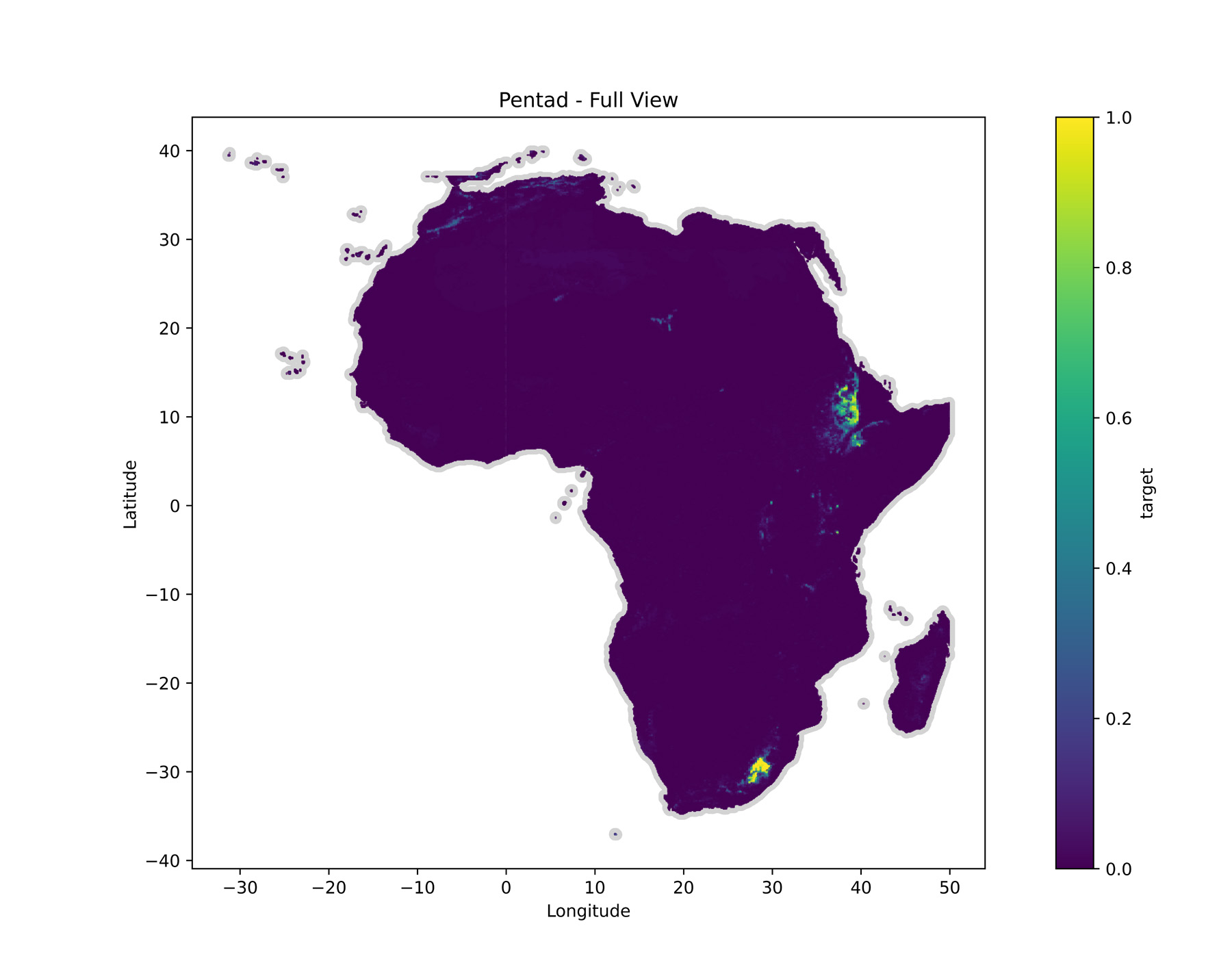
Figure 1: Africa distribution maps for Bateleur produced from ABAP, iNaturalist and eBird data using a Random Forest model and various predictor variables. Colour gradient is predicted probability of occurrence, with a 0.5% threshold applied. Brighter colours = higher probability of occurrence (from Lee 2024).
Ecology
Survival of immatures up to age four was 12% (an average annual survival rate of 59%), while adult survival was 95% per year (Mundy et al. 1992). Survival estimates based on tracking data between 2009-2024 suggest an average annual survival rate of 75% of immatures up to age four, while adult survival was 90% per year (Krüger et al. 2022). There is no evidence to suggest that the survival rates of males and females differ. Adults make up 60% of the population (Krüger 2014). A generation length of 16 years was provided by Bird et al. (2020).
The diet consists mainly of bones from both fresh and old carcasses; they prefer bone to fresh meat but require red meat to feed nestlings (Brown and Plug 1990). The species is well-adapted to handle and process bones, including in having a wide gape of c. 70 mm which allows bones of up to 250 mm long by 35 mm thick to be swallowed, and digestion can proceed with part of the bone sitting in the throat or even still protruding from the mouth (Mundy et al. 1992). The species is a solitary, winter-nester, and although pairs usually lay two eggs, they only raise a single nestling per breeding attempt. The substantial stick-nest, lined with wool and fur, is placed on a cliff, usually in a pothole or small cave. Pairs have 2–5 additional nests that are used in alternate years (Piper 2005).
Threats & Conservation
Threats
The primary threat is poisoning with 42% of tracked birds (n = 21) being killed due to poison ingestion and the presence of high lead levels (Krüger 2014, Krüger and Amar 2018). Poisoning incidents are mainly indirect, with jackals being the primary target. Collisions with power lines are an additional major threat. Since it is difficult to find carcasses in remote, mountainous terrain, the number of mortalities due to collisions is assumed to be far greater than recorded (SC Krüger pers obs). An increase in the electrification of the Lesotho Highlands, in conjunction with current electrification networks of the lowlands of South Africa, is likely to cause collisions to increase (SC Krüger pers obs). A study on the potential impact of windfarms on the species (Rushworth and Krüger 2014), and one that developed habitat use models (Reid et al. 2015), found that relatively small-scale wind farm developments within the species range would likely result in accelerated population decline and extinction based on the species habitat use and flight behaviour which placed them at a high risk of collision with wind turbines. A further threat is a reduction in food supply caused by a loss of natural ungulates, superior animal husbandry practices and improved animal hygiene (Boshoff et al. 1983).
Bearded Vulture mortalities due to gin traps have been recorded in the Free State (Colahan 2004) and Lesotho (Maphisa 1997), but this is considered a lesser threat. The intensity of disturbance by people may be increasing because of better access to the interior of Lesotho for the Lesotho Highlands Development Project; many new roads around Katse and Mohale dams allow people and development to move into much of the Lesotho Highlands (Maphisa 1997). Although the threat of direct persecution may not be a current one in South Africa, an increase in the number of firearms in Lesotho may see an increase in incidents (Maphisa 1997). Vultures are an important component in prognostication (e.g. predicting the outcomes of horse races, political elections) in belief-based use. A number of individuals have been trapped in Lesotho in recent years, likely for use in the belief-based use trade (SC Krüger pers obs). The skin as well as plumage have been known to be used for ceremonial purposes in southern Africa (Mundy et al. 1992, Maphisa 1997, Mander et al. 2007). The birds are reputed to be used as food in Lesotho (Maphisa 1997). Fires below nesting cliffs, especially if extensive, intensive and of long duration, may influence breeding success.
Conservation Measures Underway
The Bearded Vulture Task Force, the steering committee of the Bearded Vulture Recovery Programme, coordinates conservation efforts in the region to ensure collaboration between Lesotho and South Africa in implementing actions detailed in the Bilateral Bearded Vulture Recovery Strategy & Action Plan for Southern Africa (Krüger 2022). The Action plan has been aligned with the Multi-species Action Plan to conserve African-Eurasian Vultures (Botha et al. 2017). Current conservation activities include monitoring of nest sites, breeding success, ranging behaviour, population age structure and habitat use, poison awareness training, education and awareness throughout the species range, and the establishment of a specialist breeding centre by the Bearded Vulture Breeding Programme, the ex-situ component of the Bearded Vulture Recovery Programme. An annual count day, which has a dual purpose of monitoring and awareness raising, is held on the first Saturday of September every year and forms part of International Vulture Awareness Day.
Conservation Measures Proposed
The Bearded Vulture Recovery Programme’s Bilateral Bearded Vulture Recovery Strategy & Action Plan for Southern Africa contains 10 objectives and 127 actions. The objectives that are required to be met to achieve the purpose, goals and targets of the Bearded Vulture Recovery programme are as follows:
- Achieve a significant reduction in mortality caused unintentionally by toxic substances used in the control of problem animals.
- Achieve a significant reduction in mortality caused by the trade in Bearded Vulture parts for African belief-based use.
- Achieve a significant reduction in persecution and disturbance of Bearded Vultures.
- Prevent or substantially reduce Bearded Vulture mortality caused by collisions with energy generation and transmission infrastructure.
- Ensure availability of an appropriate level of safe food across the Bearded Vulture range.
- Ensure availability of sufficient suitable habitat for Bearded Vultures to breed and forage.
- Build and maintain a Bearded Vulture Breeding Programme to ensure an ex-situ genetic reserve, to supplement the in-situ population, and/or restore populations where extirpated.
- Promote Bearded Vulture conservation through cross-cutting actions in relation to education and awareness.
- Support Bearded Vulture conservation through cross-cutting actions in relation to research and monitoring.
- Ensure effective administration of the Bearded Vulture Recovery Programme including fund raising for programme sustainability.
Research Priorities and Questions
- Continue population tracking: This will help to provide more accurate survival estimates over time, which is crucial for modelling population trends, identifying areas to avoid when planning new infrastructure like wind farms, and understanding other causes of mortality.
- Monitor population status and demographics: Regular monitoring is essential to assess the success of the management actions that have been implemented. The results should be used in the 5-year review cycle of the management plan, allowing for adjustments as part of an adaptive management approach.
- Investigate changes in food and water resources: Research how variations in the quantity and quality of food and water (e.g., safe food sources) at different spatial scales impact the foraging patterns of fledglings and breeding adults, and the overall population health.
- Study the impacts of climate change: Determine how Bearded Vultures respond to different climate change scenarios, which will help in understanding and mitigating the effects of climate change on the species.
- Examine movement patterns and weather: Research whether Bearded Vultures alter their daily movements and flight patterns based on weather conditions. Use tracking data to explore links between changes in air pressure, wind speed and direction, temperature, and the onset of cold fronts.
- Explore indigenous knowledge and trade: Investigate the role of indigenous knowledge in the trade of vultures for belief-based use. Understand what drives this use and determine the scale and impact of the illegal trade in live birds, eggs, and body parts.
- Evaluate genetic diversity: Study the non-neutral (functional) genetic diversity within the species by genotyping genes associated with traits linked to survival and fitness. This is important because the genetic variation in a population determines its ability to adapt to environmental changes. A loss of this variation could reduce the population’s adaptive potential and threaten the species’ survival.
- Conduct microbiome and endocrine studies: Establish baseline biochemical and haematological parameters to assess the stress levels of individual vultures. This information is critical for understanding the overall health and well-being of the population.
- Assess disease risks: Investigate the potential impacts of diseases on this small, isolated population and the risks that diseases may pose to the declining population.
Contributors & References
Assessor/s
Sonja Krüger
Reviewer/s
Lindy Thompson, Andre Botha
References
Abbass MIZAS. 2021. The effect of land use and human settlement on the availability of foraging habitat/area of occupancy of the Bearded Vulture in southern Africa. MSc Thesis. FitzPatrick Institute, University of Cape Town, Cape Town, South Africa.
BirdLife International. 2021. Species factsheet: Gypaetus barbatus. Available: https://datazone.birdlife.org/species/factsheet/bearded-vulture-gypaetus-barbatus. [Available: 28 May 2024].
Bird JP, Martin R, Akçakaya HR, Gilroy J, Burfield IJ, Garnett ST, Symes A, Taylor J, Şekercioğlu ÇH, Butchart SHM. 2020. Generation lengths of the world’s birds and their implications for extinction risk. Conservation Biology 34(5): 1252–1261.
Boshoff AF, Brooke RK, Crowe TM. 1978. Computerized distribution mapping scheme for vertebrates in southern Africa. South African Journal of Wildlife Research 8(4): 145–149.
Boshoff AF, Vernon CJ, Brooke RK. 1983. Historical atlas of the diurnal raptors of the Cape Province (Aves: Falconiformes). Annals of the Cape Province Museum (Natural History Series) 14: 173–297.
Botha AJ, Andevski J, Bowden CGR, Gudka M, Safford RJ, Tavares J, Williams NP. 2017. Multi-species Action Plan to Conserve African-Eurasian Vultures. CMS Raptors MOU Technical Publication No. 5. CMS Technical Series No. xx. Coordinating Unit of the CMS Raptors MOU, Abu Dhabi, United Arab Emirates.
Brown CJ. 1991. An investigation into the decline of the Bearded Vulture Gypaetus barbatus in southern Africa. Biological Conservation 57: 315–337.
Brown CJ, Plug I. 1990. Food choice and diet of the Bearded Vulture Gypaetus barbatus in southern Africa. South African Journal of Zoology 25: 169–177.
Burke MB. 2018. Population Genetics of the Bearded Vulture. MSc Thesis. University of KwaZulu-Natal, Pietermaritzburg, South Africa.
Colahan BD, Esterhuizen JR. 1997. The status and conservation of vultures in the Free State Province, South Africa. In: Boshoff AF et al. (eds), Vultures in the 21st Century. Proceedings of a Workshop on Vulture Research and Conservation in Southern Africa. Vulture Study Group, Johannesburg. pp 46–49.
Colahan BD. 2004. The status and conservation of vultures in the Free State Province of South Africa. In: Monadjem A, Anderson MD, Piper SE, Boshoff AF (eds), The Vultures of Southern Africa – Quo Vadis? Proceedings of a workshop on vulture research and conservation in southern Africa. Birds of Prey Working Group, Johannesburg, South Africa.
Godoy JA, Negro JJ, Hiraldo F, Donázar JA. 2004. Phylogeography, genetic structure and diversity in the endangered bearded vulture (Gypaetus barbatus L.) as revealed by mitochondrial DNA. Molecular Ecology 13: 371–390.
Krüger S (ed). 2022. The Bilateral Bearded Vulture Recovery Strategy & Action Plan for Southern Africa. Bearded Vulture Task Force, unpublished report. pp 84.
Krüger SC, Allan DG, Jenkins AR, Amar A. 2014a. Trends in territory occupancy, distribution, and density of the Bearded Vulture Gypaetus barbatus meridionalis in southern Africa. Bird Conservation International 24: 162–177.
Krüger SC, Reid T, Amar A. 2014b. Differential range use and anthropogenic risk exposure between age classes of southern African Bearded Vultures Gypaetus barbatus. PLoS ONE 9(12): e114920.
Krüger SC, Wesche PL, Jansen van Vuuren B. 2015a. Reduced genetic diversity in Bearded Vultures Gypaetus barbatus in Southern Africa. Ibis 157: 162–166.
Krüger SC, Simmons RE, Amar A. 2015b. Anthropogenic activities influence the abandonment of Bearded Vulture Gypaetus barbatus territories in southern Africa. The Condor 117: 94–107.
Krüger SC, Amar A. 2018. Lead Exposure in the Critically Endangered Bearded Vulture (Gypaetus barbatus) Population in Southern Africa. Journal of Raptor Research 52: 491–499.
Krüger S, Rushworth I, Coverdale B, Hoffman S, Howells B, Cockbain I, Llopis Dell A, Mokhele B, Matabotabo M, Copsey J, Waller LJ, Davies Mostert H. 2022. Bearded Vulture Population Viability Analysis Workshop Report – October 2022. IUCN SSC Conservation Planning Specialist Group, Apple Valley, MN, USA.
Lee ATK. 2024. Regional Red Data Book of the Birds of South Africa, Lesotho and Eswatini: SABAP2 synthesis and supporting information and graphics for Bearded Vulture. Unpublished report. Johannesburg: BirdLife South Africa.
Mander M, Diederichs N, Ntuli L, Khulile M, Williams V, McKean S. 2007. Survey of the Trade in Vultures for the Traditional Health Industry in South Africa. Futureworks, unpublished report. pp 30.
Maphisa DH. 1997. Vultures in Lesotho: past, present, and future. In: Boshoff AF et al. (eds), Vultures in the 21st Century. Proceedings of a Workshop on Vulture Research and Conservation in Southern Africa. Vulture Study Group, Johannesburg. pp 93–96.
Mundy P, Butchart D, Ledger J, Piper S. 1992. The Vultures of Africa. Johannesburg, South Africa: Russel Friedman Books CC.
Piper SE. 2005. Bearded Vulture Gypaetus barbatus. In: Hockey PAR, Dean WRJ, Ryan PG (eds), Roberts – Birds of Southern Africa 7th Edn. Cape Town, South Africa: The Trustees of the John Voelcker Bird Book Fund. pp 484–487.
Reid T, Krüger S, Whitfield P, Amar A. 2015. Using spatial analyses of Bearded Vulture movements in southern Africa to inform wind turbine placement. Journal of Applied Ecology 54: 881–892.
Rushworth I, Krüger S. 2014. Wind farms threaten southern Africa’s cliff-nesting vultures. Ostrich 85: 13–23.
Streicher M, Krüger S, Loercher F, Willows-Munro S. 2021. Evidence of genetic structure in the wide-ranging bearded vulture (Gypaetus barbatus (Linnaeus 1758)). BMC Ecology and Evolution 21: 42.
Krüger S. 2015. Bearded Vulture. In: Taylor MR, Peacock F, Wanless RW (eds), The Eskom Red Data Book of Birds of South Africa, Lesotho, and Swaziland. BirdLife South Africa, Johannesburg, South Africa. pp 55–57.
Citation
Krüger S 2025. Bearded Vulture. In: Lee ATK, Rose S, Banda S, Bezeng SB, Maphalala MI, Maphisa DH, Smit-Robinson H (eds), The 2025 Red Data Book of Birds of South Africa, Lesotho and Eswatini. Johannesburg, South Africa: BirdLife South Africa. Available at: https://www.birdlife.org.za/red-list/bearded-vulture/
Our generous sponsors


