


Allen’s Gallinule
Porphyrio alleni

Number Of Mature
Individuals (Regional)
17 128

Regional
Population Trend
Decreasing
2025
Regional Category
NA
Search by species
CONTENTSOverview
Names
|
IOC English Name: |
Allen’s Gallinule |
|
SA & IOC Scientific Name: |
Porphyrio alleni |
|
BirdLife International Taxonomy (scientific name): |
Porphyrio alleni |
|
Order: |
GRUIFORMES |
|
Family: |
Rallidae |
|
Species name author: |
Thomson 1842 |
|
Afrikaans: |
Kleinkoningriethaan |
|
Sesotho (South Africa): |
kgohomohlaka-pheresenyane |
|
Sesotho (Lesotho): |
khohomohlaka-pheresenyan |
|
Siswati: |
|
|
Zulu: |
unomhlangomncane |
Current Assessment Status
|
2025 Regional Status [Criteria] |
NA |
|
2024 Global Status [Criteria] |
LC (BirdLife International 2016) |
|
Population size (Global) |
Unknown |
|
Population size (Regional) |
17 128 (Ehlers Smith et al. 2024) |
|
Distribution size (EOO) (Regional) km2 |
816 085 (Lee 2024) |
|
Distribution size (EOO) (Global) km2 |
24 100 000 (BirdLife International 2016) |
|
Distribution size (AOO) (Regional) km2 |
173 (Ehlers Smith et al. 2024) |
|
Generation time |
5.9 years (BirdLife International 2016) |
|
Status change reason |
Nongenuine change: new information |
|
Migrant (in the region) |
No |
|
Regional endemic |
No |
Historic Listing Information
|
2000 Regional Status |
LC |
|
2015 Regional Status |
LC |
|
Status change reason (if applicable) |
No change |
|
2015 Population size (Regional) |
Unknown |
|
2015 Global Status |
LC |
Reason for Inclusion
Reason for Inclusion in the Assessment
Allen’s Gallinule Porphyrio alleni was assessed as a Peripheral Species in the previous version of the Red Data Book (Taylor et al. 2015). It was not mentioned in the 2000 assessment (Barnes 2000), but was listed as a species worthy of monitoring in the first official Red Data Book (Brooke 1984). Preliminary screening of Coordinated Waterbird Counts (CWAC) data indicated a significant decline in the number of Allen’s Gallinule counted per year (Lee 2024), prompting a complete evaluation of its status in the region.
Category Justification
Category Justification
Modelled Allen’s Gallinule range at the pentad level suggests 0.14% of its African range occurs in South Africa (from Lee 2024). The regional Extent of Occurrence is 3.4% of the global extent of occurrence. Application of the 5% regional population filter thus means that the regional status is Not Applicable. However, we comment here on potential categories and criteria below should new information come to light in the future, for instance with range contraction across the rest of the species range.
Allen’s Gallinule is a habitat specialist with a modelled Area of Occupancy (AOO) of 173 km2 in the region (Ehlers Smith et al. 2024). This small AOO coupled with the severely fragmented population and continuing decline projected / inferred AOO, extent and quality of habitat and number of subpopulations this species yields a potential assessment outcome of Endangered under Criterion B2. However, the likelihood of propagule migration for this species is high as Allen’s Gallinule is assumed to be widespread throughout Africa (BirdLife International 2016, Taylor 2020). Although it must be emphasised that there is a severe lack of any data on the extra-regional populations. The assessment outcome could therefore be adjusted to regionally Vulnerable in line with IUCN Regional Red List Guidelines (IUCN 2012).
Population Justification
The global population size is unknown (BirdLife International 2016). The erratic occurrence of this species in seasonal habitats makes determining population numbers very difficult (Taylor 2020). The regional population size is also unknown but a tentative estimate of c. 17 000 individuals is put forward (Ehlers Smith et al. 2024). This value was estimated based on the mean home-range size (1.03 ha) of sister taxon Purple Gallinule Porphyrio porphyrio (as extrapolation data for Allen’s Gallinule are lacking; Matthews 1983) and the AOO in South Africa, Eswatini and Lesotho (Ehlers Smith et al. 2024). It is important to note that the population estimate assumes ideal habitat within the AOO, and that all available habitat is occupied, which is unrealistic and so the values presented here are maximum values. Confidence in this population estimate is medium.
Trend Justification
The global population is assumed to be in decline based on the decline of suitable wetland habitat (BirdLife International 2016). No regional population trend data exists although there has been an increase in the number of pentads in which the species was reported, but the reporting rate has decreased (Lee 2024). It seems reasonable to assume that the regional population is in decline, based on the ongoing decline in suitable habitat (Ehlers Smith et al. 2024). Confidence in this trend is medium.
Biology & Ecology
Taxonomy
No notable issues. Monotypic. Sometimes placed in Gallinula or Porphyrula. Thought to be closely related to Purple Gallinule P. martinicus.
Identification
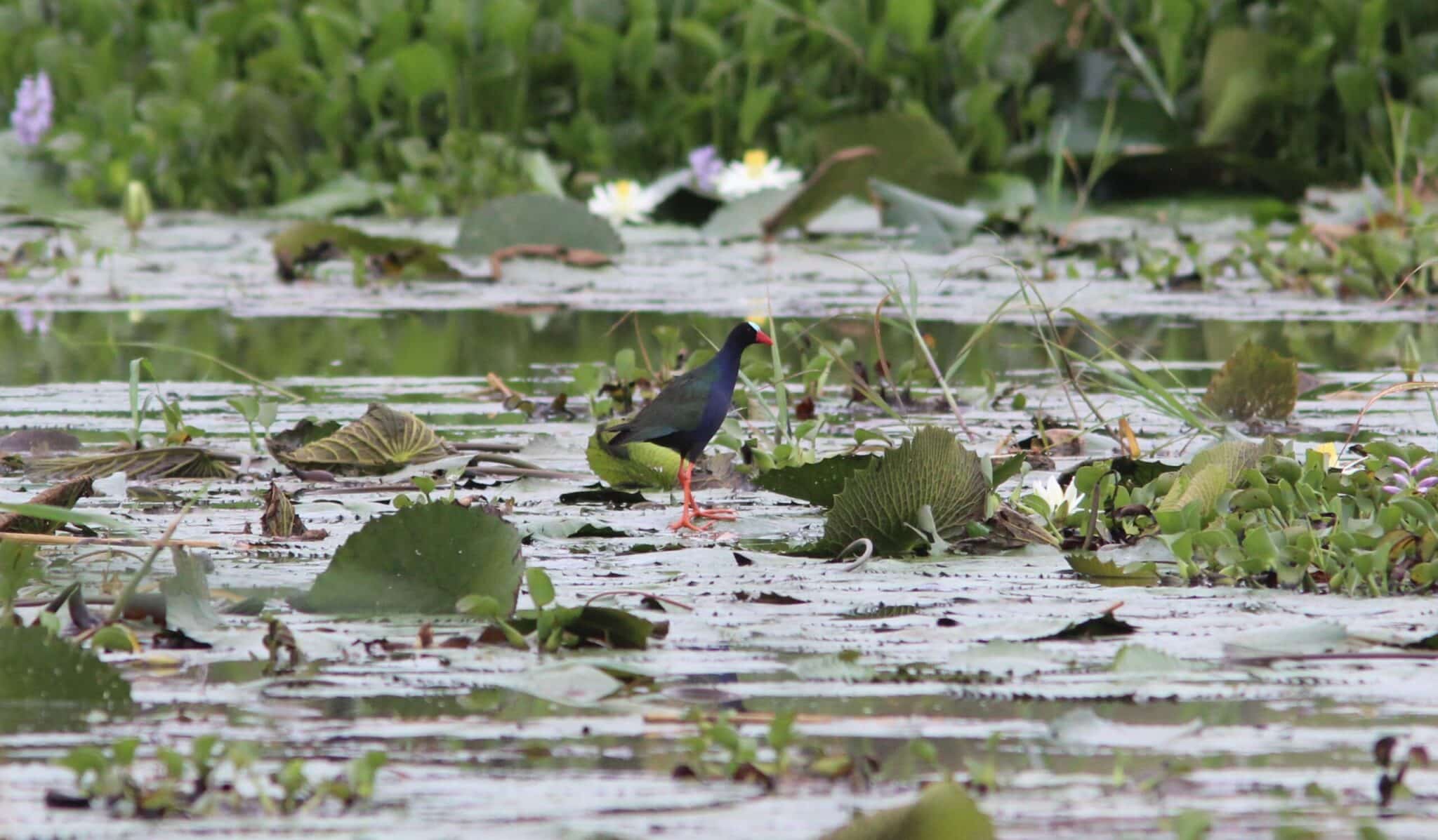
22–26cm. Sexes are similar in appearance. Has a distinctive black head and dark blue-violet neck, breast, and flanks (Taylor 2020). Its legs and feet are red, as is its bill (Taylor 2020). The frontal shield is slightly darker and can vary from bright turquoise blue in breeding males to apple green in females during the breeding season, fading to purplish to red-brown in non-breeding adults (Taylor 2020).
Confusing species:
- The African Purple Swamphen is much larger, with predominantly blue wings instead of green (Dean 2005). Juveniles of this species are overall greyish blue rather than brownish buff (Dean 2005).
- Juvenile Lesser Moorhens are smaller, less scaled above, and have a paler, yellowish bill (Dean 2005).
Distribution
The Allen’s Gallinule is found from Senegal eastward to southern Sudan and Ethiopia, extending southwards to South Africa (Dean 2005). In Southern Africa, it inhabits the Caprivi region of Namibia, northern and eastern Botswana, most parts of Zimbabwe, with potential sightings in southern Mozambique (Taylor 1997, Parker 1999). Occurs along the southeastern coast of South Africa, with sporadic records as far west as Rondevlei and Berg River in the southwestern Western Cape as well the extreme northeastern KwaZulu-Natal (Langley 1979, Hockey et al. 1989, Figure 1).
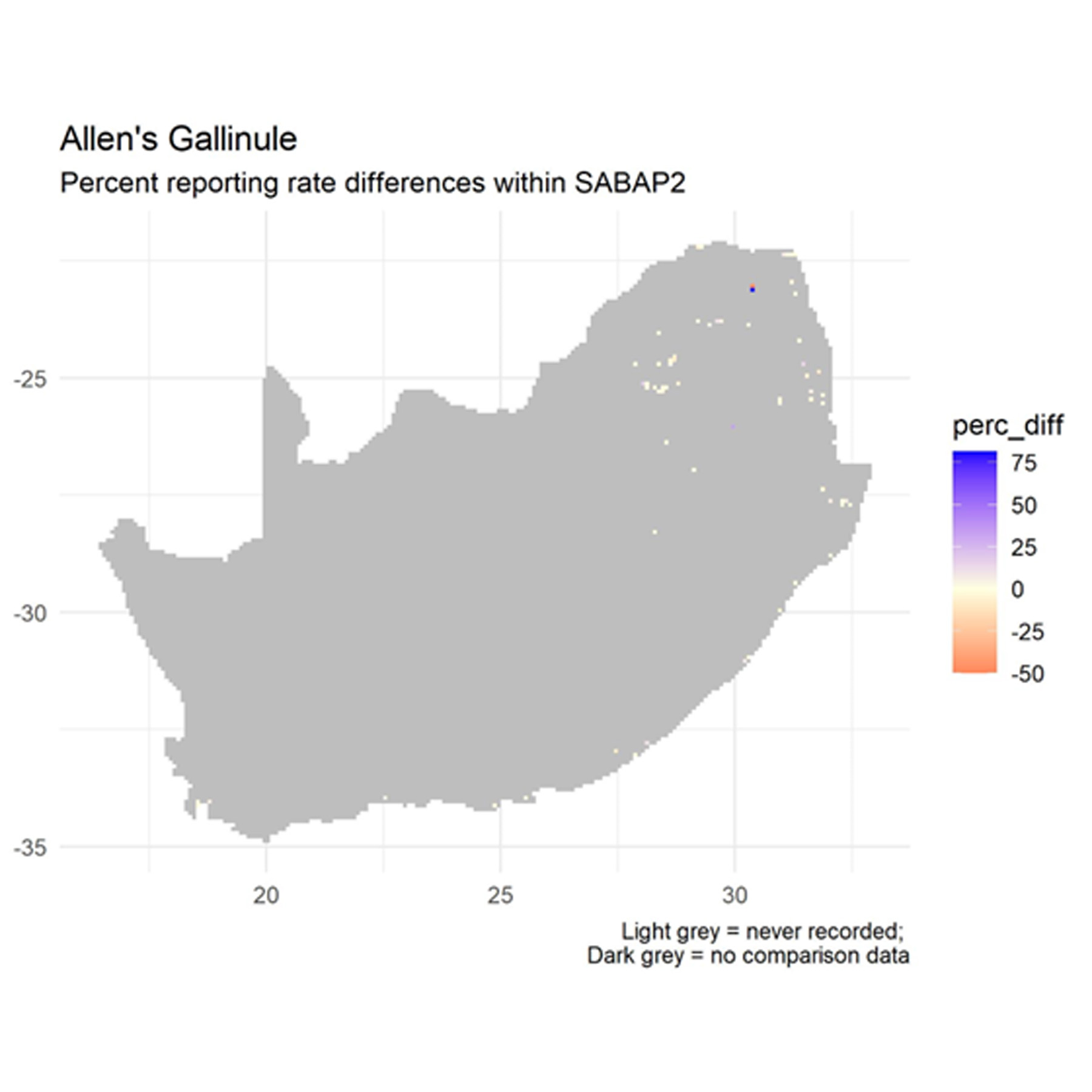
Figure 1: Regional map showing the change in reporting rate of Allen’s Gallinule from early SABAP2 (2007-2015) and the later period (2016-2023). Cream indicates no change, blue and increase and peach a decline. Map from Lee (2024).
Ecology
Habitat:
It occurs in a variety of aquatic habitats; flooded grasslands, lakes, rivers, ponds, freshwater marshes and reedbeds (Dean 2005, Taylor 2020).
Migration:
Resident in the region but highly nomadic in response to seasonal variation.
Breeding:
Laying times in South Africa, typically from December to March (Tarboton et al. 1987). The nest is a shallow to deep cup, built of reed stems and leaves (Urban et al. 1986, Taylor and Van Perlo 1998). Clutch size is 2–8 eggs. Incubation starts with the first-laid egg (Serle 1939, Urban et al. 1986), lasts about 15 days (Taylor and Van Perlo 1998), and is performed by both sexes (Serle 1939, Urban et al. 1986). Newly hatched young are downy and black (Taylor and Van Perlo 1998). The fledging period is about 55 days (Taylor 1985), and they can fly before they are fully grown (Taylor and Van Perlo 1998). The young are fed and cared for by both adults (Taylor and Van Perlo 1998). No data on breeding success, age of breeding or mortality.
Diet:
Omnivorous and varied, including flowers and seeds of reeds and sedges, seeds, stems, and leaves of grasses (Taylor 2020). It also consumes earthworms, mollusks, crustaceans, insects, spiders, fish eggs, and small fish (Taylor 2020).
Threats & Conservation
Threats
Threats for this species are related to habitat loss and degradation of wetland habitats. Wetland habitats in South Africa are highly vulnerable to pollution, cultivation, over grazing, artificial alteration of water depth (damming and flooding) and development (Skowno et al. 2019).
Conservation Measures Underway
No species-specific measures in place. The species is protected in 29 pentads and unprotected in 35 pentads throughout its regional distribution, with a protected ratio of 0.83 (Lee 2024).
Conservation Measures Proposed
Increased protection of freshwater wetlands generally is necessary in the region.
Research Priorities and Questions
- The threats facing the species should be evaluated before targeted conservation actions are put in place.
- Regular monitoring of the regional population and sub-populations at key sites is recommended.
Contributors & References
Assessor/s
Sanjo Rose, Maria Paul
Reviewer/s
David Ehlers Smith
References
Barnes KN (ed.). 2000. The Eskom Red Data Book of birds of South Africa, Lesotho and Swaziland. Johannesburg, South Africa: BirdLife South Africa.
BirdLife International. 2016. Porphyrio alleni. The IUCN Red List of Threatened Species 2016: e.T22692816A93370659. https://dx.doi.org/10.2305/IUCN.UK.2016-3.RLTS.T22692816A93370659.en. [Accessed on 22 April 2024].
Brooke RK. 1984. South African Red Data Book – Birds. Pretoria, South Africa: South African National Scientific Programmes Report No. 97, CSIR.
Ehlers Smith D, Rose S, Lee A. 2024. Range, population estimates and conservation recommendations for Baillon’s Crake, Allen’s Gallinule, African Swamphen and Red-chested Flufftail in South Africa. Afrotropical Bird Biology: Journal of the Natural History of African Birds 8: 4.
Dean WRJ. 2005. Green Woodhoopoe. In: Hockey PAR, Dean WRJ, Ryan PG (eds), Roberts birds of southern Africa (7th Edn.) Cape Town, South Africa: Trustees of the John Voelcker Bird Book Fund. pp 882–883.
Hockey PAR, Underhill LG, Neatherway M, Ryan PG. 1989. Atlas of the Birds of the Southwestern Cape. Cape Town, South Africa: Cape Bird Club.
IUCN. 2012. Guidelines for Application of IUCN Red List Criteria at Regional and National Levels: Version 4.0. Gland, Switzerland and Cambridge, UK: IUCN. iii + 41 pp.
Langley CH. 1979. Lesser Gallinule from the Cape Peninsula. Ostrich 50: 62.
Lee ATK. 2024. Regional Red Data Book of the Birds of South Africa, Lesotho and Eswatini: SABAP2 synthesis and supporting information and graphics for Allen’s Gallinule. Unpublished report. Johannesburg: BirdLife South Africa.
Matthews WC Jr. 1983. Home range, movements, and habitat selection of nesting gallinules in a Louisiana freshwater marsh. MSc thesis, Louisiana State University, Baton Rouge.
Parker V. 1999. The Atlas of the Birds of Sul do Save, Southern Mozambique. Cape Town and Johannesburg, South Africa: Avian Demography Unit & Endangered Wildlife Trust.
Serle W. 1939. Observations on the breeding habits of some Nigerian Rallidae. Oologists’ Record 19: 61–70.
Skowno AL, Poole CJ, Raimondo DC, Sink KJ, Van Deventer H, Van Niekerk L, Harris LR, Smith Adao LB, Tolley KA, Zengeya TA, Foden WB, Midgley GF, Driver A. 2019. National biodiversity assessment 2018: The status of South Africa’s ecosystems and biodiversity. Synthesis Report. South African National Biodiversity Institute, an entity of the Department of Environment, Forestry and Fisheries. pp 1–214.
Tarboton WR, Kemp MI, Kemp AC. 1987. Birds of the Transvaal. Pretoria, South Africa: Transvaal Museum.
Taylor B. 1985. Observations of Allen’s Gallinule Porphyrio alleni of Mombasa, Kenya. Malimbus 7: 141–149.
Taylor B. 1997a. Lesser Gallinule. In: Harrison JA et al. (eds), The Atlas of Southern African Birds. Vol. 1: 335. Johannesburg, South Africa: BirdLife South Africa.
Taylor B. 2020. Allen’s Gallinule (Porphyrio alleni), version 1.0. In: del Hoyo J, Elliott A, Sargatal J, Christie DA, de Juana E (eds), Birds of the World. Ithaca, NY, USA: Cornell Lab of Ornithology. https://doi.org/10.2173/bow.allgal1.01.
Taylor PB, Van Perlo B. 1998. Rails: A Guide to the Rails, Crakes, Gallinules and Coots of the World. Mountfield, UK: Pica Press.
Taylor MR, Peacock F, Wanless RW (eds). 2015. The Eskom Red Data Book of birds of South Africa, Lesotho and Swaziland. Johannesburg, South Africa: BirdLife South Africa.
Urban EK, Fry CH, Keith S. 1986. The Birds of Africa. Vol. 2. London, UK: Academic Press.
Citation
Rose S, Paul M 2025. Allen’s Gallinule. In: Lee ATK, Rose S, Banda S, Bezeng SB, Maphalala MI, Maphisa DH, Smit-Robinson H (eds), The 2025 Red Data Book of Birds of South Africa, Lesotho and Eswatini. Johannesburg, South Africa: BirdLife South Africa. Available at: https://www.birdlife.org.za/red-list/allens-gallinule/
Our generous sponsors


