


Agulhas Long-billed Lark
Certhilauda brevirostris

Number Of Mature
Individuals (Regional)
85 591 – 154 808

Regional
Population Trend
Decreasing
2025
Regional Category
Near Threatened
Search by species
CONTENTSOverview
Names
|
IOC English Name: |
Agulhas Long-billed Lark |
|
SA & IOC Scientific Name: |
Certhilauda brevirostris |
|
BirdLife International Taxonomy (scientific name): |
Not recognised |
|
Order: |
PASSERIFORMES |
|
Family: |
Alaudidae |
|
Species name author: |
Roberts 1941 |
|
Afrikaans: |
Overberglangbeklewerik |
|
Sesotho (South Africa): |
|
|
Sesotho (Lesotho): |
|
|
Siswati: |
|
|
Zulu: |
unonzwili waseAgulhas |
Current Assessment Status
|
2025 Regional Status [Criteria] |
NT [B1] |
|
2024 Global Status [Criteria] |
Not Recognised |
|
Population size (Regional) |
85 591 – 154 808 mature individuals (Evans 2021) |
|
Population size (Global) |
Not Recognised |
|
Distribution size (EOO) (Regional) km2 |
13 225 – 21 401 (Lee 2024) |
|
Distribution size (EOO) (Global) km2 |
Not Recognised |
|
Distribution size (AOO) km2 |
10 136 – 10 767 (Lee 2024) |
|
Generation time |
Unknown but assumed 3.5 years (BirdLife International 2016) |
|
Status change reason |
No change |
|
Migrant |
No |
|
Regional endemic |
Yes |
Historic Listing Information
|
2000 Regional Status |
NT [D1] |
|
2015 Regional Status |
NT [C1] |
|
Status change reason (if applicable) |
No change |
|
2015 Population size (Regional) |
c. 9000 mature individuals |
|
2015 Global Status |
Not recognised as full species |
Reason for Inclusion
Reason for Inclusion in the Assessment
Agulhas Long-billed Lark Certhilauda brevirostris is endemic to the region. In addition, it was assessed as Near Threatened in the 2015 (Peacock 2015).
Category Justification
Category Justification
Updated population size estimates for Agulhas Long-billed Lark are much greater than previous estimates from Peacock (2015) (de Kock and Lee 2019, Evans 2021). Consequently, the regional status of Near Threatened [C1] is no longer valid. It is important to note that the updated estimates do not represent an increase in population size but rather updated methodology.
Updated estimates of Extent of Occurrence (EOO) ranges from 13 225 km2 (Evans 2021) to 21 401 km2 (Lee 2024) (Table 1), which could justify listing this species as Vulnerable (B1). However, there is no evidence of fragmentation or extreme fluctuations in Area of Occupancy (AOO), EOO, number of locations, or area. Predicted occurrence indicates a decline of only 5.2% over three generations (Lee 2024).
Important additional considerations apply to this species: Agulhas Long-billed Lark is an endemic species with the total global population contained in a reasonably small area in which agricultural activities have destroyed almost all the natural vegetation (South Coast Renosterveld).
Considering the species endemic status, low EOO values and threats posed by intensifying agricultural practices, this species was assessed as Near Threatened.
Population Justification
The Agulhas Long-billed Lark is fairly common within its range (Ryan and Dean 2005, Lee 2024, Rose et al. 2024). Updated population estimates by de Kock and Lee (2019) and Evans (2021) are much greater than the 1600 – 60 000 adults previously estimated (Peacock 2015). De Kock and Lee (2019) provide a population estimate of 203 000 – 368 000 individuals based on point counts while Evans (2021) estimates 85 591 – 154 808 adults based on suitable available habitat. Differences in estimates stem from varying assumptions on how much of the transformed landscape remains suitable for this species. Peacock (2015) used Louw’s (2000) unpublished data which almost certainly underestimated the AOO for this species. Count and atlas data from the subsequent two decades since Louw (2000) have indicated that this species is able to utilise much of the transformed landscape. Confidence in a population estimate of over 10 000 individuals is high.
Trend Justification
Recruitment rate, breeding success and other demographic trends remain poorly understood. Existing nesting success estimates are very low, largely due to predation and disturbance (Rose et al. 2023). There is some evidence of decline, but values are below the >30% threshold (Evans 2021).
Table 1: Area of Occupancy (AOO) and Extent of Occurrence (EOO) estimates from Lee (2024). Prediction models were run using BirdLasser data filtered to a 2x2km grid. Confidence of absence was augmented using iNaturalist and eBird data. The ‘red’ package in R was used to estimate Extent of Occurrence and Area of Occupancy based on the resulting grids at probabilities of 0.4, 0.5 and 0.6 to provide bounds on the mean estimates (Lee 2024).
|
AOO (km2) |
EOO (km2) |
|
|
Mean |
10136 |
21401 |
|
Lower |
9056 |
21048 |
|
Upper |
11272 |
22035 |
Biology & Ecology
Taxonomy
The Agulhas Long-billed Lark was recognised as a species in 1998 (Ryan and Bloomer 1999). It was previously considered to be a subspecies of the ‘Long-billed Lark C. curvirostris’, which was initially described as four species (Roberts 1940), but subsequently lumped as a single, wide-ranging polytypic species. However, modern evidence suggests that the taxon is best viewed as five distinct species (Ryan and Bloomer 1999). Within the long-billed lark complex, the Agulhas Long- billed Lark C. brevirostris forms part of a group comprising coastal and grassland taxa including the Cape Long-billed Lark C. curvirostris and the Eastern Long-billed Lark C. semitorquata, which differ by at least 2% in sequence divergence of the mitochondrial cytochrome-b gene. Within this group, C. brevirostris is most closely related to C. curvirostris, but their ranges are separated by the Cape Fold Mountains, which form a natural barrier between these species. In addition to a genetic difference, they differ morphometrically, in plumage and vocalisations (Ryan and Bloomer 1999). However, some ambiguity exists regarding the taxonomy of the long-billed lark complex, with some authorities arguing that C. brevirostris and the Benguela Long-billed Lark C. benguelensis should not be elevated to species-level (e.g. BirdLife International 2016). In the latter case, brevirostris should be lumped with curvirostris, a species currently considered globally and regionally of Least Concern. Nevertheless, a prudent approach warrants viewing Agulhas Long-billed Lark as a species, and therefore as a conservation priority.
Identification
18–21 cm, c. 45 g. A range-restricted, but locally common and fairly conspicuous and bulky lark. In the field it appears large but slim, with long wings and a heavy tail. Sexes are alike in plumage colouration, but males are larger. Adults are buffy brown to grey-brown above, with dark brown streaking, which is heavier on the crown and mantle than on the rump and uppertail coverts. Below it is creamy buff, extensively streaked dark brown on the breast, flanks and often undertail coverts; the markings are heavier and blotchier on the bird’s breast, but thinner and more linear on its flanks. Its throat is whitish and lightly spotted. Its tail is dark brown; its central rectrices have a broad buff-brown edges, the remainder have narrow buffy outer edges. Its face has a fairly broad buff supercillium, but an indistinct dark brown eye-stripe; its pale throat extends in a C-shape around rear of its ear coverts. Its bill is blackish horn, with a slightly paler base; it is fairly short to long and decurved. Its eyes are brown. Its legs and feet are pinkish brown. Juveniles have buffy tips to the feathers of their crown, mantle and wing coverts, imparting a spotted appearance; with its breast more diffusely spotted rather than streaked (Keith et al. 1992, Ryan and Dean 2005, Peacock 2012).
Distribution
As its name implies, the Agulhas Long-billed Lark is endemic to South Africa’s Western Cape Province and is largely restricted to the Agulhas Plain and Overberg wheatbelt, east of the Hottentots Holland Mountains. The species is mostly limited to a c. 15 000 km2 area between the Bot River and Caledon (approximately 19°E) and Mossel Bay (22°E), and mostly south of 34°S (Ryan and Bloomer 1999, Evans 2021, Lee 2024).
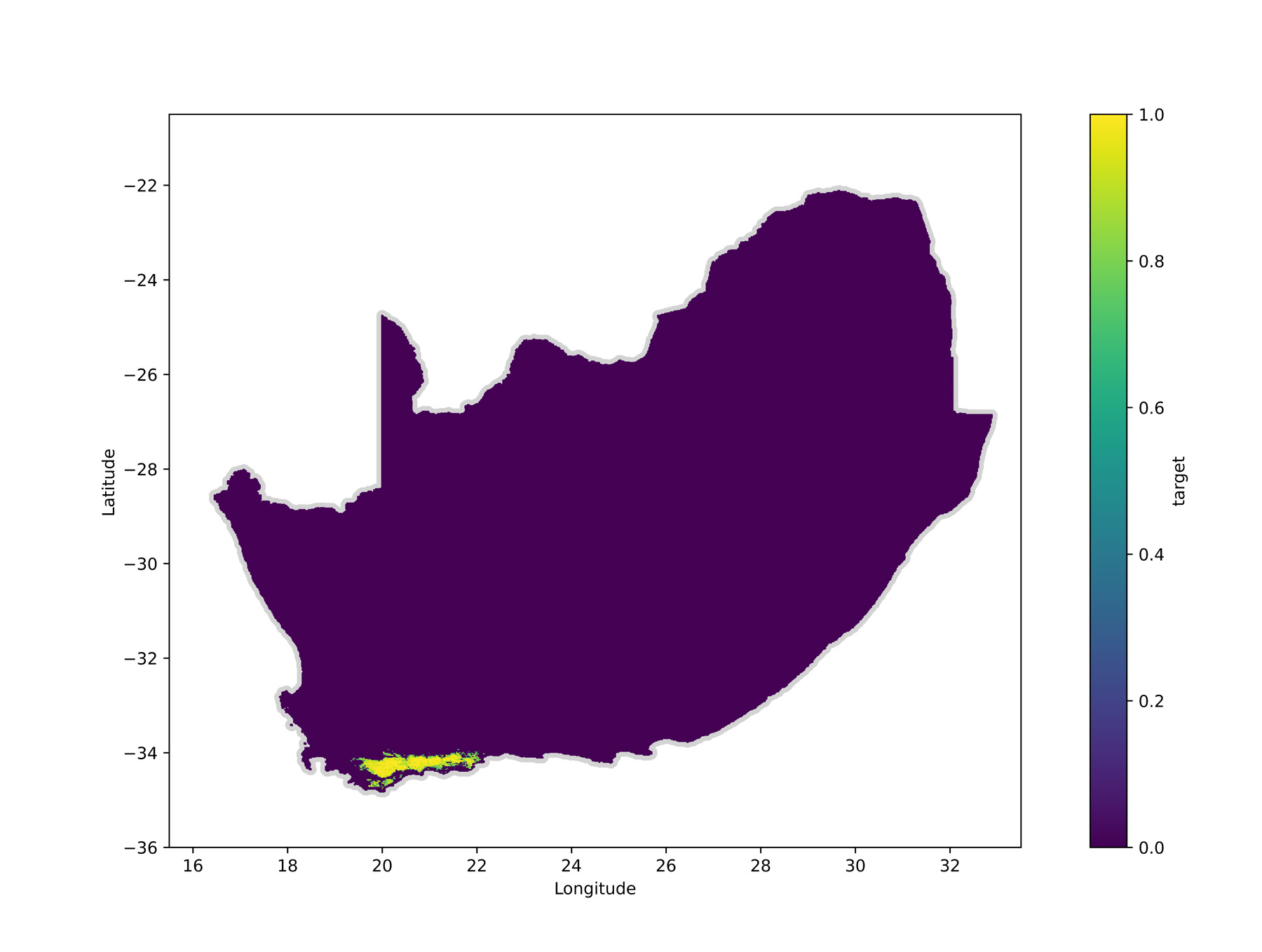
Figure 1: Agulhas Long-billed Lark distribution based on BirdLasser, iNaturalist and eBird data indicating the restricted distribution in the Overberg (from Lee 2024).
Ecology
More than 70% of the range of Agulhas Long-billed Lark has been transformed into crop fields and pastureland (Moncrieff 2021). Despite the large-scale transformation this species still occurs throughout its range. Rose et al. (2024) found that the probability of lark presence during point count surveys was not explained by the percentage cover of any vegetation type at a site. Supporting previous work that suggested that birds are mostly sedentary throughout the year, despite seasonal changes in crop type (Louw 2000). Bare or recently ploughed fields and burnt areas are also readily utilised.
They also occur in the dwarf Karoo Shrubland on clay soils in the foothills of the Breede River Valley. They are less common in Coastal Fynbos and Sand Plains Fynbos, favouring sandy areas (Louw 2000, Ryan and Dean 2005).
In contrast to vegetation type, vegetation structure is an important predictor of occupancy and presence at sites show a preference for open habitats with scattered bush cover and low (<30 cm), structurally diverse, species-rich vegetation (de Kock and Lee 2019, Rose et al. 2024). Rose et al. (2024) found that Agulhas Long-billed Lark occupancy was positively related to the presence of renosterveld hedgerows at sites.
Territorial males call all year round, often from elevated calling posts such as fences, ridges and bushy areas (Louw 2000). The species is primarily insectivorous. They are ground-nesting, with a nesting season July to December with peaks in September and October (Rose et al. 2023). Breeding success is low (Rose et al. 2023).
Threats & Conservation
Threats
The primary threat faced by this species is the continued eradication of renosterveld and intensifying agriculture within its range (Moncrief 2021, Rose et al. 2023, 2024). Eradication of renosterveld results specifically in a decline in Agulhas Long-billed Lark nesting habitat (Rose et al. 2023) but likely has many other adverse effects such as a reduction in invertebrate prey habitat resulting in a reduction in food available to the bird.
Although this species does appear to have adapted to the transformed landscape, it relies on remnant strips of renosterveld (such as hedgerows or roadside verges) (Rose et al. 2024). Reduced natural vegetation is known to expose species to a variety of additional pressures such as reduced invertebrate prey populations, altered predator pressure, increased disturbance and increased inter- and intra-specific competition. Renosterveld is protected but eradication continues illegally, and law enforcement is very poor (Curtis-Scott 2020, Moncrief 2021).
Despite three large, protected areas (Bontebok National Park, De Hoop Nature Reserve and the Haarwegskloof Renosterveld Reserve) within its range, this species remains poorly represented within protected areas (Lee 2024).
Its naturally limited range, threat of intensified agricultural practices as well as its dependence on transformed and privately-owned land, makes ongoing monitoring essential (Louw 2000, de Kock and Lee 2019, Rose et al. 2024).
Conservation Measures Underway
No species-specific conservation actions are currently underway. However, this species will benefit from the renosterveld reserves established by the Overberg Renosterveld Conservation Trust (ORCT).
Conservation Measures Proposed
The long-term survival of the Agulhas Long-billed Lark rests in the hands of private landowners. Continued efforts by ORCT to work with landowners in establishing private reserves to protect and manage remaining renosterveld is critical. Education and, where possible, guidance on land-use practices that are beneficial to this species are recommended. Specific guidance on the use of fire and grazing can help manage renosterveld to prevent it from becoming moribund and senescent and therefore inaccessible for Agulhas Long-billed Lark. The clearing of hedgerows around fields and vegetation growing along roadsides should be actively discouraged as these are important refugia for this species (Rose et al. 2024). All efforts to conserve and manage the remaining renosterveld needs to be supported and maintained.
Concurrently, attempts should be made to improve the status of this species within conserved areas (Figure 3), primarily by applying the correct use of fire. Ongoing population monitoring in the form of bird atlasing and species-specific surveys should be conducted to elucidate demographic trends. Finally, a thorough investigation of the taxonomic status of this taxon within the long-billed lark complex is essential, as it may have important implications for biodiversity conservation (Ryan and Bloomer 1999).
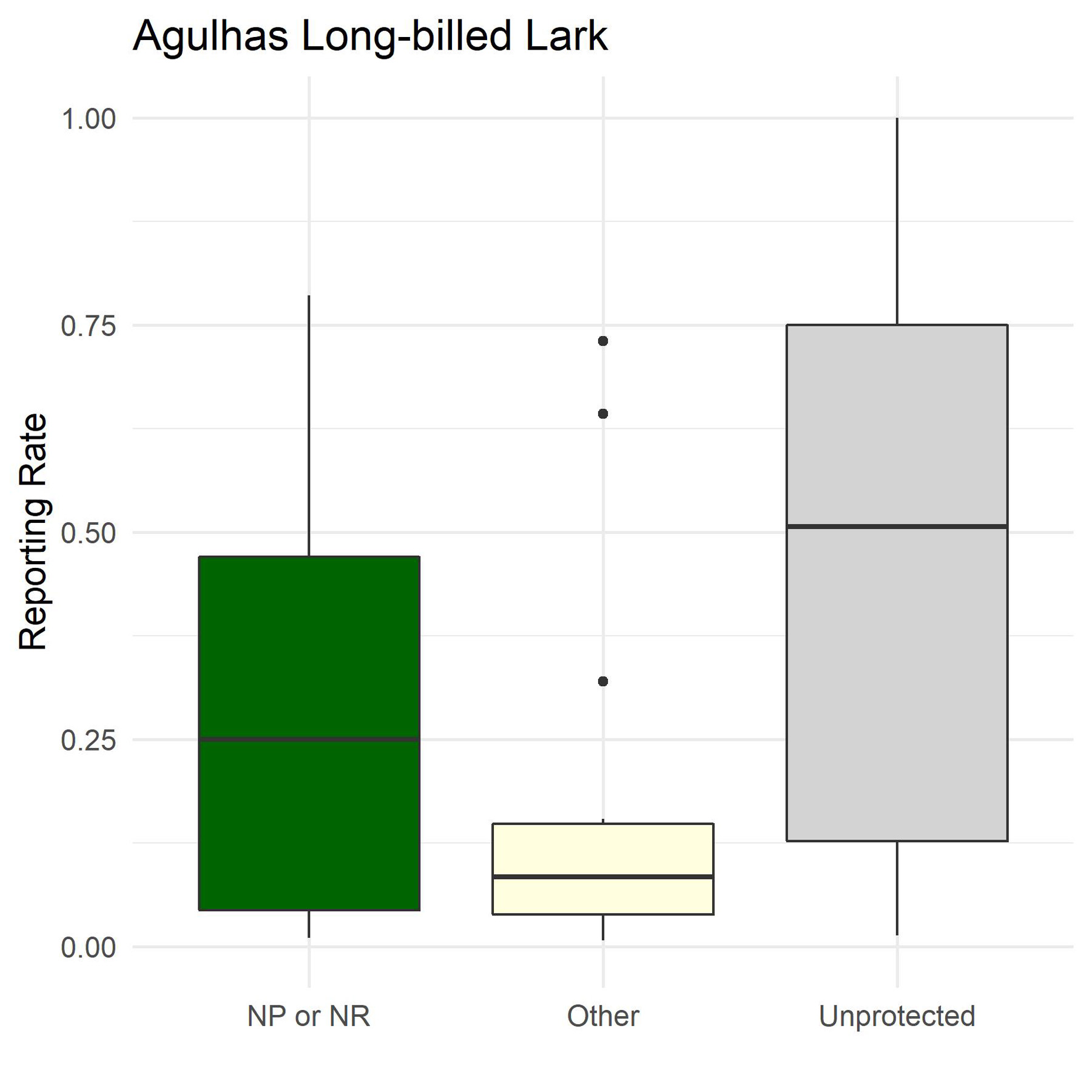
Figure 3: Boxplot comparisons of SABAP2 reporting rate in National Parks (NP), ‘Other’ (conservancies, Biosphere Reserves etc) and Nature Reserve (NR) in the ALBL range. The ratio of range (number of pentads) in both protected categories to unprotected is 0.21. Values over 1 indicate most of the range is in a protected area (from Lee 2024).
Research Priorities and Questions
- Enhanced Monitoring of Demographic Trends: Conduct more comprehensive and direct monitoring of demographic trends, with a focus on breeding success and recruitment rates across different habitats within the species’ range. Understanding the factors influencing breeding success is crucial.
- Impact of Agricultural Practices: Investigate the specific impacts of agricultural practices, particularly crop rotation and pesticide use, on the species. This research should aim to identify how these practices affect the population and habitat quality.
- Effectiveness of Protected Areas: Assess the effectiveness of formal protected areas in conserving the Agulhas Long-billed Lark. This includes evaluating the management practices within these areas and their impact on the species’ survival and habitat preservation.
- Foraging Ecology and Predation Risk: Conduct detailed studies on the foraging ecology of terrestrial predators in the region. This research will provide a better understanding of predation risks across various habitats, which is essential for developing targeted conservation strategies.
- Taxonomy: an investigation into the genetics of the long-billed lark complex is required (updating the study by Ryan and Bloomer (1999)) to clarify the species-status within the region.
Contributors & References
Assessor/s
Sanjo Rose
Reviewer/s
Steven Evans
References
BirdLife International. 2016. Certhilauda curvirostris. The IUCN Red List of Threatened Species 2016: e.T22735878A95119860. https://dx.doi.org/10.2305/IUCN.UK.2016-3.RLTS.T22735878A95119860.en. [Accessed on 03 March 2025].
Curtis-Scott O. 2020. Field guide to Renosterveld of the Overberg. South Africa: Penguin Random House.
de Kock C, Lee ATK. 2019. Agulhas long-billed lark (Certhilauda brevirostris) densities, population estimates and habitat association in a transformed landscape. African Zoology 54: 161–168.
Evans SW. 2021. The effects of habitat loss and fragmentation on updated estimates of the population of the Agulhas Long-billed Lark Certhilauda brevirostris, a South African endemic. Ostrich 92: 243–256.
Keith S, Urban E, Fry CH. 1992. The birds of Africa, Vol IV: Broadbills to Chats. New York: Academic Press.
Lee ATK. 2024. Regional Red Data Book of the Birds of South Africa, Lesotho and Eswatini: SABAP2 synthesis and supporting information and graphics for Agulhas Long-billed Lark. Unpublished report. Johannesburg: BirdLife South Africa.
Louw KG. 2000. The Habitat Preferences and Conservation Status of the Agulhas Long-Billed Lark Certhilauda brevirostris in South Africa. BSc Hons Thesis, University of Cape Town, South Africa.
Moncrieff GR. 2021. Locating and dating land cover change events in the Renosterveld, a Critically Endangered shrubland ecosystem. Remote Sensing 13: 834.
Peacock F. 2012. Chamberlain’s LBJs: the definitive guide to southern Africa’s Little Brown Jobs. Pretoria: Mirafra Publishing.
Peacock F. 2015. Agulhas Long-billed Lark Certhilauda brevirostris. In: Taylor MR, Peacock F, Wanless RM (eds), Eskom Red Data Book of Birds of South Africa, Lesotho and Swaziland. Johannesburg: BirdLife South Africa. pp 316–318.
Rose S, Thomson RL, Lee ATK, Ryan PG. 2023. The breeding ecology of the Agulhas Long-billed Lark: an endemic bird dependent on the remnant Renosterveld of the Western Cape Province, South Africa. Journal of Ornithology 2: 1–14.
Rose S, Thomson RL, Lee ATK. 2024. Persisting in a transformed landscape: occupancy and habitat association of the range-restricted Agulhas Long-billed Lark Certhilauda brevirostris. Emu – Austral Ornithology 124(2): 155–164.
Ryan PG, Bloomer P. 1999. The long-billed lark complex: A species mosaic in southwestern Africa. The Auk 116: 194–208.
Ryan PG, Dean WRJ. 2005. Agulhas Long-billed Lark Certhilauda brevirostris. In: Hockey PAR, Dean WRJ, Ryan PG (eds), Roberts birds of southern Africa 7th Edn. Cape Town, South Africa: Trustees of the John Voelcker Bird Book Fund. pp 880–881.
Citation
Rose S 2025. Agulhas Long-billed Lark. In: Lee ATK, Rose S, Banda S, Bezeng SB, Maphalala MI, Maphisa DH, Smit-Robinson H (eds), The 2025 Red Data Book of Birds of South Africa, Lesotho and Eswatini. Johannesburg, South Africa: BirdLife South Africa. Available at: https://www.birdlife.org.za/red-list/agulhas-long-billed-lark/
Our generous sponsors


