


African Skimmer
Rynchops flavirostris

Number Of Mature
Individuals (Regional)
<50

Regional
Population Trend
Unknown
2025
Regional Category
NA
Search by species
CONTENTSOverview
Names
|
IOC English Name: |
African Skimmer |
|
SA & IOC Scientific Name: |
Rynchops flavirostris |
|
BirdLife International Taxonomy (scientific name): |
Rynchops flavirostris |
|
Order: |
CHARADRIIFORMES |
|
Family: |
Laridae |
|
Species name author: |
Vieillot 1816 |
|
Afrikaans: |
Waterploeër |
|
Sesotho (South Africa): |
Selemametsi sa Afrika |
|
Sesotho (Lesotho): |
|
|
Siswati: |
|
|
isiZulu: |
unokhukhula |
Current Assessment Status
|
2025 Regional Category [Criteria] |
NA Species of Conservation Concern |
|
2024 Global Category [Criteria] |
LC (BirdLife International 2021) |
|
Population size (Regional) |
<50 mature individuals |
|
Population size (Global) |
10 000 – 17 000 mature individuals (BirdLife International 2021) |
|
Distribution size (EOO) (Regional) km2 |
c. 111 960 (Lee 2024) |
|
Distribution size (EOO) (Global) km2 |
17 200 000 (BirdLife International 2021) |
|
Distribution size (AOO) (Regional) km2 |
308 (228 – 556) (Lee 2024) |
|
Generation time |
6.3 years (BirdLife International 2021) |
|
Status change reason |
Genuine change in status |
|
Migrant (in the region) |
Yes (Full Migrant) |
|
Regional endemic |
No |
Historic Listing Information
|
2000 Regional Status |
RE* |
|
2015 Regional Status |
RE* |
|
Status change reason (if applicable) |
No change |
|
2015 Population size (Regional) |
0 |
|
2015 Global Status |
LC |
* Regionally Extinct
Reason for Inclusion
Reason for Inclusion in the Assessment
African Skimmer Rynchops flavirostris was assessed as Regionally Extinct in 2015 (Taylor et al. 2015), Barnes (2000) and Brooke (1984). Recent breeding records from Limpopo and sightings from Kruger National Park in the interim suggest a reassessment is required.
Category Justification
Category Justification
Although African Skimmer is considered Least Concern at the global scale (BirdLife International 2021), its tiny and historically intermittent presence within South Africa, Lesotho, and Eswatini would qualify it under Criterion D for Critically Endangered (CR), or at least Endangered (EN), due to the extremely low number of mature individuals (far fewer than 50) that have been documented attempting to breed. By most measures, a persistent subpopulation of that size would warrant the highest possible threat category regionally.
However, it is likely African Skimmer has never been anything more than a peripheral breeder at the very southern edge of its distribution. Historical data point to a maximum of nine breeding pairs at Lake St Lucia (1942-1943), and no evidence suggests the regional population ever exceeded 500 birds (i.e. much less than 5% of the current global total). Under the national Red List framework, the 5% threshold excludes such an ephemeral population from formal threat listings. For this reason, African Skimmer is classified as Not Applicable (NA) or “peripheral” to avoid a perpetual oscillation between “Regionally Extinct” when absent and “CR” when a single pair reappears.
In practice, if breeding is confirmed in the future, local managers should adopt the same level of scrutiny and habitat safeguard that would be afforded a Critically Endangered species. This principle recognizes that even though African Skimmer is globally secure and regionally marginal, any potential nesting attempt in South Africa is highly vulnerable and may benefit from the stricter on-site conservation attention typically reserved for regionally listed CR or EN species. Thus, while NA may remain the best fit for national listing consistency, breeding locations merit focused protection.
Population Justification
Globally, 10 000 – 17 000 mature individuals are estimated (BirdLife International 2021). In Southern Africa, strongholds occur along the Zambezi, Chobe, and Okavango Rivers, with major breeding colonies located outside the assessment region. The single breeding colony at Lake St Lucia has been extinct since 1944 (Brooke 1984), though vagrants from the north still occur rarely, with nine breeding pairs counted in 1942 (Berruti 1980). There is no evidence that the regional population ever exceeded a few hundred birds, and breeding in South Africa ceased by the late 1940s, leading to the species’ former classification as Regionally Extinct. A single unsuccessful breeding attempt at Albasini Dam in 2016 (Engelbrecht and Mulaudzi 2017) suggests that fewer than 50 mature individuals occasionally move into the region. Despite minimal nesting success to date, the species is no longer considered entirely extinct regionally.
Trend Justification
Nationally, no robust trend analysis is possible due to the extremely small and sporadic breeding attempts sightings. Southern African Bird Atlas Project (SABAP2) data show occasional records in the northernmost parts of the country, but these are too infrequent to indicate a firm trajectory. Observers have noted increased reports in the last few years, but these may merely reflect transient conditions (e.g., droughts farther north). Overall, there is insufficient evidence to suggest a sustained increase, and the population in the region should still be considered minimal and highly variable over time.
Biology & Ecology
Taxonomy
African Skimmer is one of three skimmer species (family Laridae). Some authors have at times considered all skimmers in a superspecies complex (R. niger, R. albicollis, R. flavirostris), but the current consensus recognises them as separate species. African Skimmer is recognised as monotypic, with no subspecies described.
Identification
The African Skimmer is a striking, tern-like waterbird with an average mass of about 205 g and a length of 36–42 cm (Hockey 2005). Its slender orange bill, with the lower mandible noticeably longer than the upper, enables its characteristic “skimming” foraging method over calm waters. In flight, it is readily identified by its buoyant, agile wingbeats, black upperparts, and contrasting white underparts. The bright orange colouration of the bill tends to fade slightly toward the tip, which may appear yellowish.
Distribution
Globally, African Skimmers inhabit broad rivers, lakes, and lagoons across sub-Saharan Africa, from Senegal and The Gambia east through Nigeria, Cameroon, and Sudan, then southward across countries such as Uganda, Tanzania, Zambia, and into Botswana, Zimbabwe, Mozambique, and northern Namibia (Figure 1, BirdLife International 2021). Large breeding colonies are typically found along major river systems such as the Zambezi, Chobe, and Okavango.
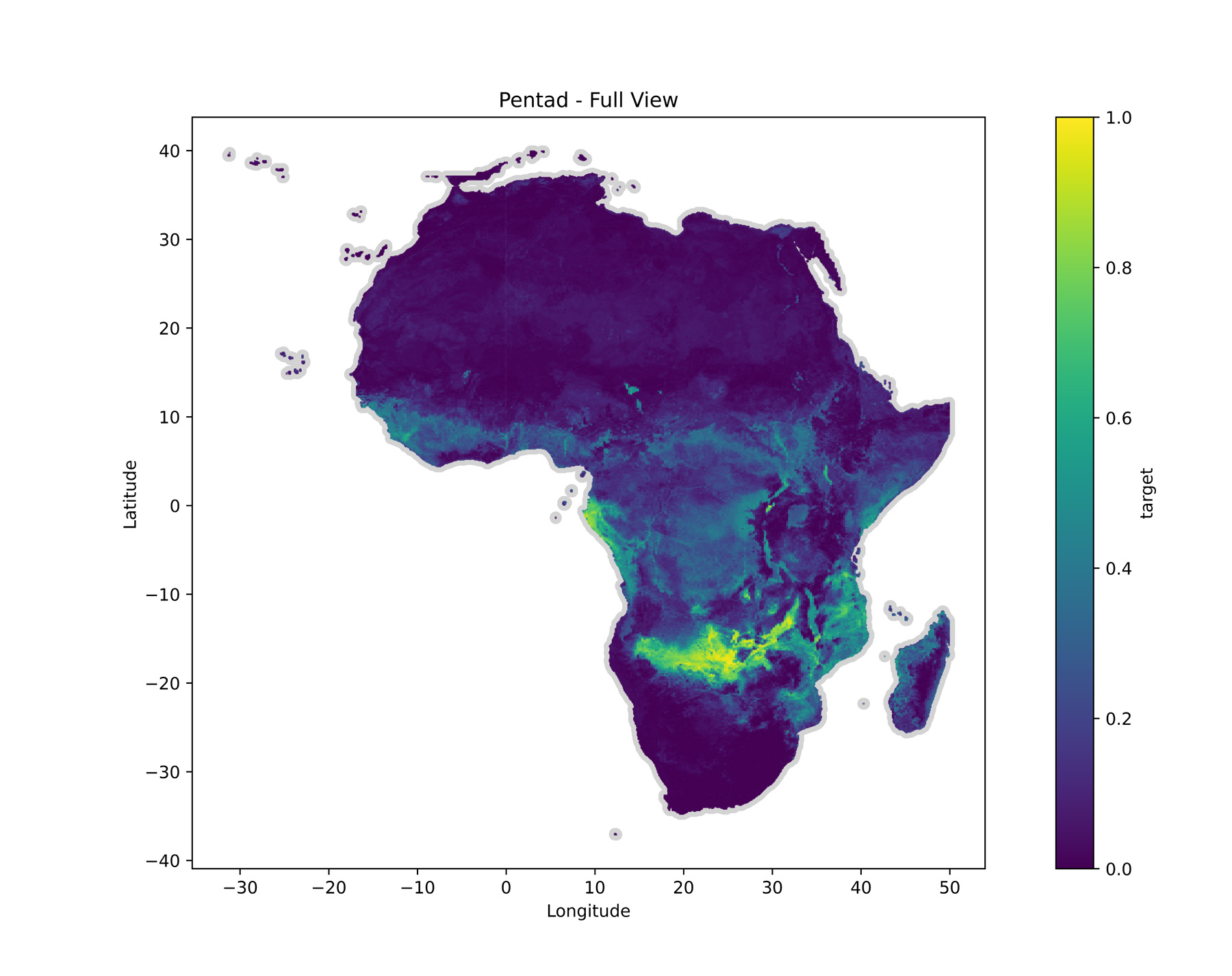
Figure 1: Africa distribution map produced from ABAP, iNaturalist and eBird data using a Random Forest model and various predictor variables. Colour gradient is predicted probability of occurrence, with a 0.5% threshold applied. Brighter colours = higher probability of occurrence.
Throughout much of this range, breeding coincides with the local dry season, when water levels recede to expose extensive sandbars for nesting. Non-breeding flocks disperse widely and may appear in estuaries, lakes, and occasionally coastal zones. In the assessment region of South Africa, Lesotho, and Eswatini, the species was historically recorded breeding in KwaZulu-Natal (KZN) up to the 1940s (Berruti 1980). Clancey (1964) indicates the species was first recorded breeding in St Lucia in 1942 and then the following year 1943 and up until he published 1964 there were no further breeding records in KZN. Subsequently, it was considered Regionally Extinct until very recently, when a failed breeding attempt was documented at Albasini Dam, Limpopo Province (Engelbrecht and Mulaudzi 2017). As of 2016, there are sporadic sightings stretching from St Lucia to Limpopo (Figure 2).
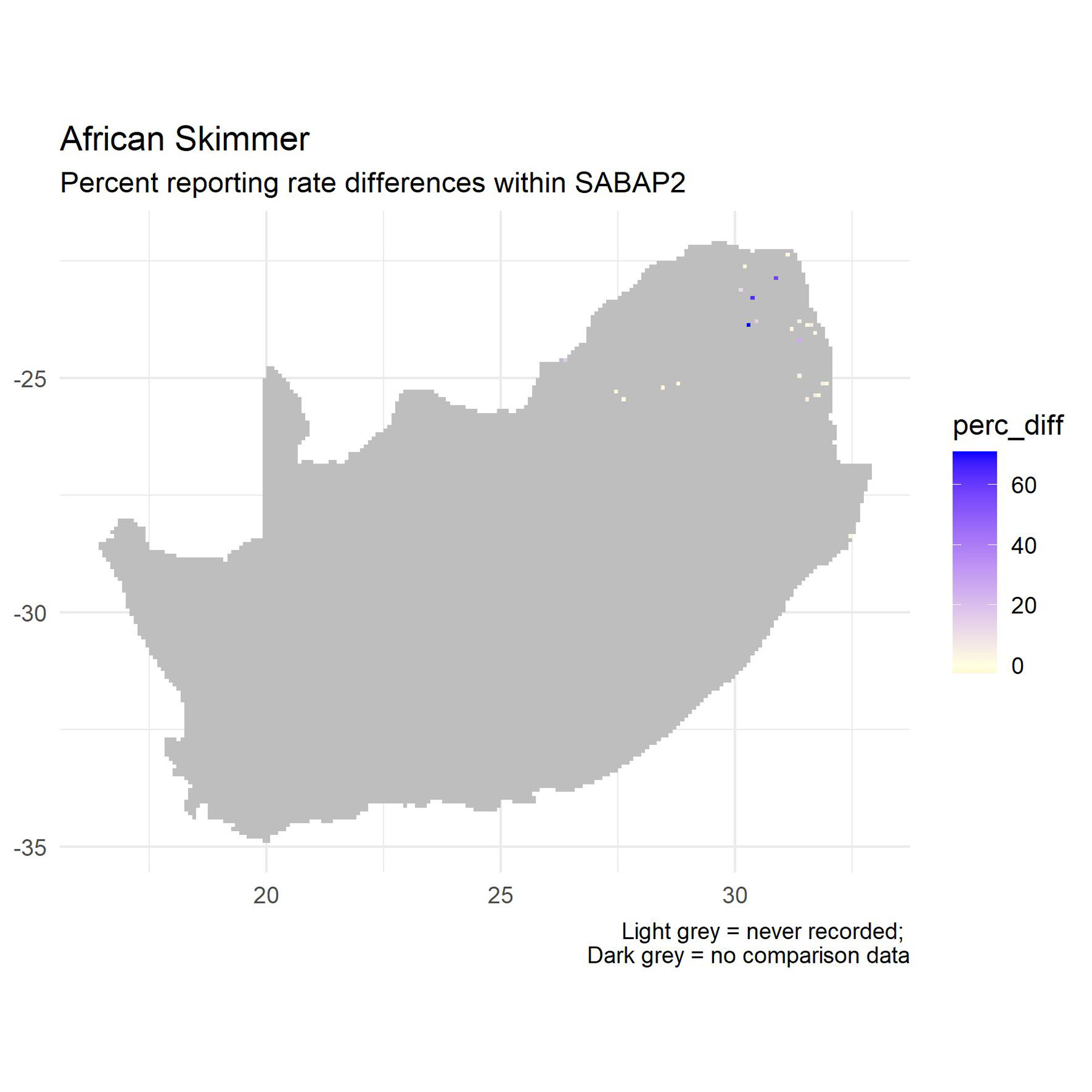
Figure 2: Distribution of African Skimmer from SABAP2, with blue indicating increase and red decrease in reporting rates. In this case, no pentads display a decrease in reporting, so there is no red on this map (from Lee 2024).
Ecology
African Skimmers are highly adapted to riverine and lacustrine ecosystems, where exposed sandbars and shallow waters facilitate both nesting and foraging. They nest in the dry season when water levels drop, typically forming small colonies or loose aggregations on sandy substrates that are free of dense vegetation (Zusi et al. 2020). Nests consist of shallow scrapes in the sand, and each clutch usually contains 1–3 eggs. In southern Africa, the primary breeding window often spans July–November, coinciding with periods of minimal river flow (Hockey 2005). At Lake St Lucia it bred among the sand dunes between the lake and the sea (Berruti 1980). There is a breeding record from Kruger National Park from 2021 (John Adamson pers comm).
Outside the breeding season, African Skimmers may disperse widely or migrate along river systems in search of optimal sandbank and feeding conditions. Lee (2024) reports that in the North West Province, SABAP2 reporting rates peak in May, possibly reflecting an influx of non-breeding or transient birds, whereas in Limpopo, peak reporting peaks in August. These differing peaks highlight the species’ regionally nomadic tendencies and the influence of local water regimes on their movements. Outside the region, when not actively nesting, African Skimmers congregate at larger waterbodies, sometimes in flocks of dozens to hundreds, where they skim the surface for small fish (e.g., cichlids). Their specialised foraging technique involves flying low with the elongated lower mandible submerged in the water, snapping shut upon detecting contact with prey. Their nocturnal and crepuscular foraging habits are also well documented in many parts of their range (Zusi et al. 2020).
Threats & Conservation
Threats
- Habitat Loss and River Regulation: Dams and fluctuating water levels destroy or submerge sandbars.
- Disturbance and Egg Collecting: Human and livestock traffic on sandbars can trample nests; boat wakes wash eggs or chicks away.
- Pollution and Overfishing: Pesticides (e.g. DDT) and reduced fish stocks threaten prey availability.
- Climate Change: Altered rainfall patterns and extreme flood/drought events can hinder stable breeding attempts.
Conservation Measures Underway
Occasional visitors to Kruger National Park benefit from protected-area status, though no dedicated measures exist specifically for African Skimmer.
Conservation Measures Proposed
- Restrict disturbance at known nesting sandbars (e.g. signage, seasonal closures to tourist traffic, limit boating wakes).
- Coordinate river-flow management with dam operators to maintain stable water levels during nesting periods.
- Enhance national waterbird monitoring (Coordinated Waterbird Count (CWAC), SABAP2) for early detection of new breeding attempts.
- Collaborate with neighbouring countries (Botswana, Zimbabwe) on transboundary water and habitat management, leveraging the regional rescue effect.
Research Priorities and Questions
- Exact Population and Area of Occupancy (AOO): Determine if additional ephemeral breeding sites exist along Limpopo or other northern rivers/dams.
- Movement: Document seasonal movements and links to populations in the Okavango or Zambezi systems. Birders are encouraged to submit sightings to databases such as SABAP2.
- Threat Mitigation Strategies: Investigate the impact of boat wakes, egg collecting, and pesticide runoff in potential breeding sites.
Contributors & References
Assessor/s
Alan Lee
Reviewer/s
Kevin Shaw
References
Barnes KN. 2000. The Eskom Red Data Book of Birds of South Africa, Lesotho and Swaziland. Johannesburg, South Africa: BirdLife South Africa.
Berruti A. 1980. Status and review of waterbirds breeding at Lake St Lucia. Lammergeyer 28: 1–19.
BirdLife International. 2021. Rynchops flavirostris. The IUCN Red List of Threatened Species 2021: e.T22694262A179400911. Available: https://dx.doi.org/10.2305/IUCN.UK.2021-3.RLTS.T22694262A179400911.en. [Accessed on 24 February 2025].
Brooke RK. 1984. South African Red Data Book – Birds. South African National Scientific Programmes Report No. 97. Pretoria, South Africa: Foundation for Research Development, CSIR.
Clancey PA. 1964. The birds of Natal and Zululand. Edinburgh: Oliver & Boyd.
Engelbrecht E, Mulaudzi S. 2017. New breeding species: African Skimmer. African BirdLife 5(3): 14. https://www.birdlife.org.za/wp-content/uploads/2020/08/14_News5.pdf
Hockey PAR. 2005. African Skimmer Rynchops flavirostris. In: Hockey PAR, Dean WRJ, Ryan PG (eds), Roberts – Birds of Southern Africa (7th Edn). Cape Town, South Africa: Trustees of the John Voelcker Bird Book Fund. pp 437–439.
Lee ATK. 2024. Regional Red Data Book of the Birds of South Africa, Lesotho and Eswatini: SABAP2 Synthesis and Supporting Information and Graphics for African Skimmer. Unpublished report. Johannesburg: BirdLife South Africa.
Taylor MR, Peacock F, Wanless RM (eds). 2015. The Eskom Red Data Book of Birds of South Africa, Lesotho and Swaziland. Johannesburg, South Africa: BirdLife South Africa.
Zusi RL, Kirwan GM, Garcia E. 2020. African Skimmer (Rynchops flavirostris), version 1.0. In: del Hoyo J, Elliott A, Sargatal J, Christie DA, de Juana E (eds), Birds of the World. Ithaca, NY, USA: Cornell Lab of Ornithology. Available: https://doi.org/10.2173/bow.afrski1.01.
Citation
Lee ATK 2025. African Skimmer. In: Lee ATK, Rose S, Banda S, Bezeng SB, Maphalala MI, Maphisa DH, Smit-Robinson H (eds), The 2025 Red Data Book of Birds of South Africa, Lesotho and Eswatini. Johannesburg, South Africa: BirdLife South Africa. Available at: https://www.birdlife.org.za/red-list/african-skimmer/
Our generous sponsors


