


African Rock Pipit
Anthus crenatus

Number Of Mature
Individuals (Regional)
130 000 (31 158 – 231 860)

Regional
Population Trend
Stable
2025
Regional Category
Least Concern
Search by species
CONTENTSOverview
Names
|
IOC English Name: |
African Rock Pipit |
|
SA & IOC Scientific Name: |
Anthus crenatus |
|
BirdLife International Taxonomy (scientific name): |
Yellow-tufted Pipit (Anthus crenatus) |
|
Order: |
PASSERIFORMES |
|
Family: |
Motacillidae |
|
Species name author: |
Finsch and Hartlaub 1870 |
|
Afrikaans: |
Klipkoester |
|
Sesotho (South Africa): |
tshaase-ea-thaba |
|
Sesotho (Lesotho) |
|
|
Siswati |
|
|
Zulu: |
umngcelu wasematsheni |
Current Assessment Status
|
2025 Regional Category [Criteria] |
LC |
|
2024 Global Category [Criteria] |
NT [C1] (BirdLife International 2021) |
|
Population size (Regional) |
130 000 (31 158 – 231 860) (Lee and Wright 2024) |
|
Population size (Global) |
3300 – 8900 (BirdLife International 2021) |
|
Distribution size (EOO) (Regional) km2 |
681 106 (Lee 2024) |
|
Distribution size (EOO) (Global) km2 |
As per regional |
|
Distribution size (AOO) (Regional) km2 |
164 000 (Lee 2024) |
|
Generation time |
2.4 years (BirdLife International 2021) |
|
Status change reason |
Improved knowledge |
|
Migrant (in the region) |
Resident |
|
Regional endemic |
Yes |
Historic Listing Information
|
2000 Regional Status |
LC |
|
2015 Regional Status |
NT [A2c+3c; C1; E] |
|
Status change reason (if applicable) |
Predicted change in population size |
|
2015 Population size (Regional) |
3300 – 8900 |
|
2015 Global Status |
LC |
Reason for Inclusion
Reason for Inclusion in the Assessment
The species is endemic to the region, is globally assessed as Near Threatened (BirdLife International 2021) and was regionally assessed in 2015 (Peacock 2015).
Category Justification
Category Justification
African Rock Pipit Anthus crenatus is assessed as Least Concern as a recent population estimate (Lee and Wright 2024) is much higher than that listed in the previous assessments (Siegfried 1992, Peacock 2015). The population trend according to citizen science data is stable (high confidence; Lee 2024). The range and available habitat are extensive, so neither the Extent of Occurrence (EOO) nor Area of Occupancy (AOO) approach thresholds for Vulnerable. Therefore, there is no longer any evidence that this species approaches Near Threatened under any criteria.
Population Justification
The population estimate (31 158 – 231 860) was based on a point count survey of the South African Karoo region during 2017-2018 using Distance Sampling techniques (Lee and Wright 2024). The authors note that the population estimate (c. 85 000 individuals) is for the Karoo region only. Kopij (2010, 2012, 2013, 2014, 2015) using line transect method calculated the following linear densities in Lesotho: Afro-mountain Grassland near Semonkong (transect length 170 km): 2.3 breeding pairs (bp) per 10 km (Kopij 2014); Afro-mountain Grassland near Thaba Tseka and Marakabai: 2.1 bp/10 km (transect length 61 km) (Kopij 2015); river valleys in highlands (transect length 136 km): 5.3 bp/10km (Kopij 2013); river valleys in foothills (transect length 73 km): 1.9 bp/10 km (Kopij 2012); River valleys in lowlands (transect length 24 km): 1.7 bp/10 km (Kopij 2012); Senqu Valley (transect length 26 km): 1.9 bp/10. Based on these data, the overall population size for Lesotho could be in the range of 25 000 to 50 000 breeding pairs or 50 000 – 100 000 individuals (excluding immature birds). Based on the AOO (164 000 km2) and a mean in range density estimate of 0.8 individuals / km2 (Lee and Wright 2024) the total population could be 131 200 which would represent the number of mature individuals given the survey methodology where calling birds are recorded. However, it is likely on the high end of the range provided here given high densities in Lesotho. The previous population estimate (<10 000) was unfeasibly low given density estimates of a pair per 1–10 km (Kopij 2010, 2012, 2013, 2015) and the species large range.
Trend Justification
Analysis of the Southern African Bird Atlas Projects (SABAP2 and SABAP1) data for African Rock Pipit (Lee 2024) suggested a stable probability of reporting with high confidence. Bootstrapped results of subsets of the data revealed no alarming changes, either within the SABAP2 project (2007-2015 compared to 2016-2023), nor between SABAP1 (1987-1992) and SABAP2 (2007-2015). While range declines were suggested (9–13% Lee et al. 2017, Peacock 2015) from a comparison between SABAP1 and SABAP2, comparisons between these projects should be treated with caution due to differences in temporal and spatial scale (Brooks et al. 2022).
Biology & Ecology
Taxonomy
Genetic analysis confirms that the African Rock Pipit is closely allied to the Striped Pipit and these two species appear to be sister to the radiation of longclaws (Tmetothylacus, Hemimacronyx, and Macronyx) (Voelker 1999, Pietersen et al. 2018), which shares the African Rock Pipit’s yellowish feather edges and underwing coverts, has a similarly robust build, has a musical song, does not perform habitual tail wagging, and also favours steep, rocky slopes (Peacock 2012). The alternative genus or sub-genus of Petranthus was suggested for this species (Roberts 1922). It is distinguished from other Anthus pipits by its distinctive call (de Swardt and Engelbrecht 2024).
Identification
17–18 cm, males 32.7 g and females 32.5 g (de Swardt 2022). A fairly large, compact, stocky brown pipit associated with steep rocky slopes. Sexes alike, but female slightly smaller. Robust in build with strong legs and claws and a relatively short tail. From a distance, it looks plain brown except for conspicuous pale supercilium, bordered below by darker band through eye. From close quarters, shows diffuse streaking or mottling on olive-brown mantle. Underparts paler, rich buff to cinnamon, throat and chin whiter, with dark malar stripe. Breast and sometimes flanks with variably distinct diffuse darker streaks. Undertail coverts often show dark centres. Tail feathers dark brown with yellowish green edges; outermost rectrix with off-white outer web and tip on inner web. Remiges edged yellowish green; lesser coverts and alula edged yellow. Underwing coverts buff with broad yellow tips. Bill heavy; all-dark with paler base to lower mandible. Eyes hazel. Legs and feet pale brown. Hind claw short and curved. Juvenile and immature plumages are paler than the adults, more spotted above, and with shorter tail feathers, the outer tail feathers buff white; like adults (de Swardt 2002, Voelker 2005).
Distribution
The African Rock Pipit is endemic to South Africa and Lesotho (Figure 1). It is considered mostly resident and sedentary, although local movements are suspected and vagrant records from the Cape Fold Mountains indicate a degree of dispersal. Except for several isolated populations in Northern Cape Province its range is virtually continuous, and no subspecies are differentiated (de Swardt 2017). The species is fairly common on inselbergs and mountainous regions of the Nama Karoo (density estimate of 0.29 – 2.15 individuals / km2, Lee and Wright 2024), and along the escarpment from west of Beaufort West to northern Lesotho. At the southern end of its range in the Western Cape, the African Rock Pipit’s distribution is fragmented and sparse in the southern fold mountains, where it is better described as vagrant. In addition, several small, isolated populations persist in suitable habitat islands elsewhere, including in the vicinity of Suikerbosrand and Nigel in south-eastern Gauteng, and in the vicinity of Hotazel (Tswalu Kalahari), Olifantshoek, Kuruman, Springbok and Groblershoop areas in the Northern Cape (de Swardt 2017).
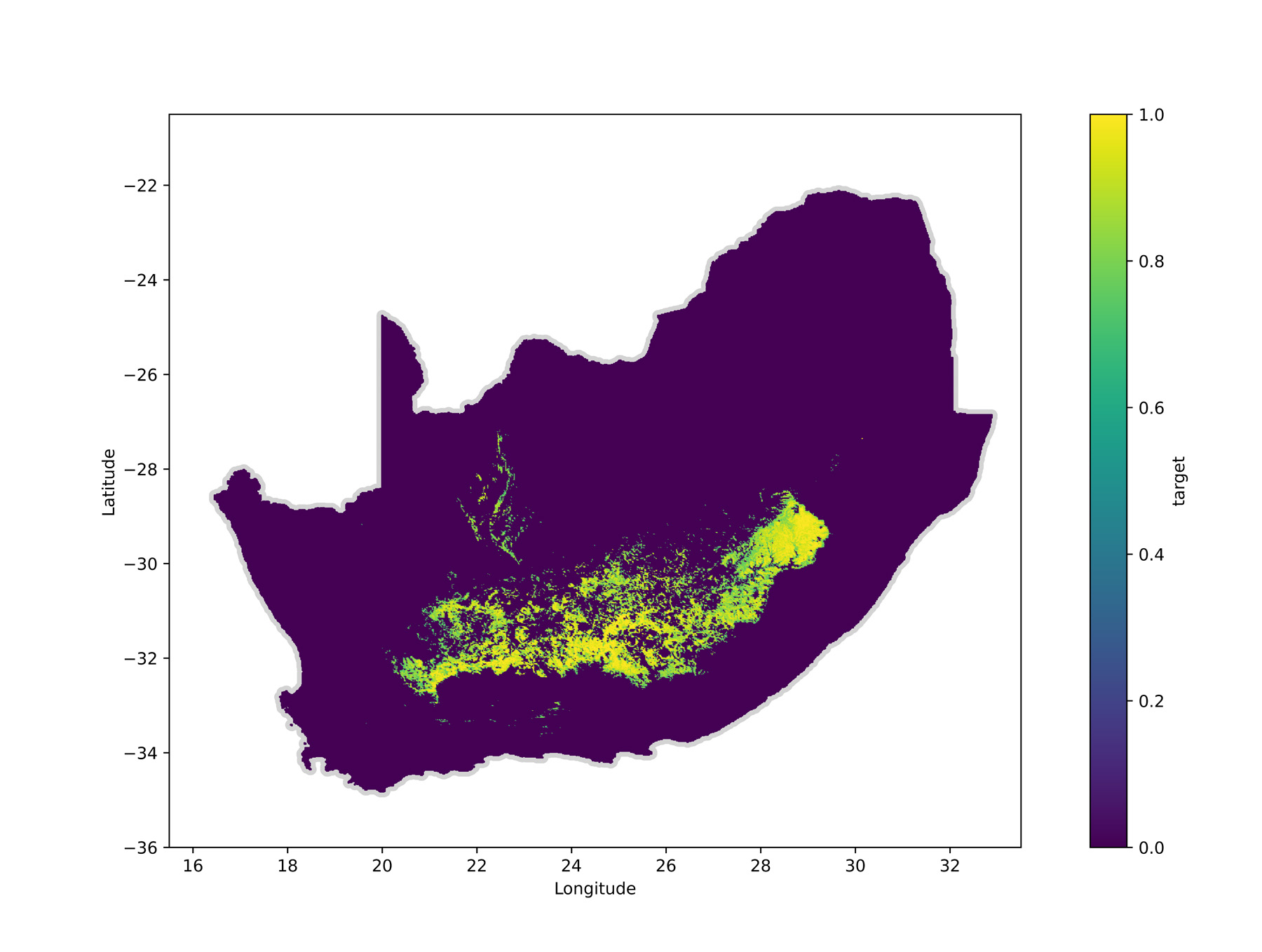
Figure 1: African Rock Pipit probability distribution map, produced from BirdLasser location data at 2×2 km grid scale, using iNaturalist and eBird as absence data only. This represents the predicted range for the 2016-2023 period at p>0.5 (from Lee 2024).
Ecology
The African Rock Pipit is closely associated with rocky or boulder-strewn slopes and rocky scree. It occurs in a wide altitudinal band of up to 3000 m in Lesotho, and in a range of climatic conditions: western birds occur in semi-arid karroid and inselbergs surrounded by savanna vegetation while eastern birds occur in mesic, high-rainfall, temperate alpine grasslands. Throughout its range, it is limited to steep, rocky slopes of mountains, koppies, valleys, gorges and rock outcrops. It requires some grassy cover which is important for nest sites as well as scattered shrubs or small trees, which, together with prominent boulders, are used as song-posts (de Swardt 2002, de Swardt 2006).
Threats & Conservation
Threats
As a high-altitude specialist, climate change may result in range contractions, range shifts, population decreases and local extinctions in the future (Simmons et al. 2004). Preliminary analyses suggest that is may lose as much as 85% of its climatically suitable range by 2070-2100 (Coetzee et al. 2009). Simmons et al. (2004) suggested that two factors that may be detrimental to the African Rock Pipit are its reliance on mountain-slope habitats, and its occurrence in the Succulent Karoo Biome (which, together with Fynbos, are expected to suffer the greatest area loss through climate change). Small, isolated populations are especially vulnerable, such as those in the Northern Cape. Given its rocky habitat, the species is probably only marginally affected by grazing pressure and fire frequency, although we suggest bush encroachment may also pose a threat in the future (O’Connor et al. 2014). The species may be vulnerable to construction of wind farms (Sands 2015, Perold et al. 2020).
Conservation Measures Underway
There are currently no species-specific conservation measures underway.
Conservation Measures Proposed
According to SABAP2 as of early 2024, African Rock Pipits have been recorded in 55 pentads in nature reserves or protected areas, and 54 pentads with some other form of protection, but mostly occur outside protected areas (381 pentads, Lee 2024). Windfarm developments should consider biodiversity offsets where this species occurs. No immediate conservation efforts are currently required, apart from continued monitoring and the estimation of more accurate demographic statistics. Long-term point sampling at a range of sites, and regular field surveys should be considered to assess the African Rock Pipit’s susceptibility and response to the effects of climate change, especially the isolated Northern Cape populations (de Swardt 2017).
Research Priorities and Questions
Population and density estimates are required from the Lesotho Highlands (with particular attention to the Buthe-Buthe and Leribe districts) and in the remote parts of the Northern Cape mountains with particular attention in the mountains near Aggenys. The involvement of landowners in these studies is important because many of the hilltops where the birds are found are on private property and are inaccessible to casual observers (especially the mountain ranges parallel with the N10 west of Groblershoop towards Upington and also in the Olifantshoek / Langberg mountain ranges in the Postmasburg areas).
Further climatic modelling should be performed to identify at-risk populations and identify areas that may become critical from a conservation perspective in the future, for the preservation of this and other endemic montane species. Behavioural and physiological studies of the effect of increasing temperature may be needed.
Contributors & References
Assessor/s
Dawie de Swardt, Alan Lee
Reviewer/s
Grzegorz Kopij
References
BirdLife International. 2021. Anthus crenatus. The IUCN Red List of Threatened Species 2021: e.T22718452A178967870. https://dx.doi.org/10.2305/IUCN.UK.2021-3.RLTS.T22718452A178967870.en. Accessed on 15 May 2025.
Brooks M, Rose S, Altwegg R, Lee AT, Nel H, Ottosson U, Retief E, Reynolds C, Ryan PG, Shema S, Tende T. 2022. The African Bird Atlas Project: a description of the project and BirdMap data-collection protocol. Ostrich 93(4): 223–32.
Coetzee BWT, Robertson MP, Erasmus BFN, Van Rensburg BJ, Thuiller W. 2009. Ensemble models predict Important Bird Areas in southern Africa will become less effective for conserving endemic birds under climate change. Global Ecology and Biogeography 18: 701–710.
de Swardt DH. 2002. Notes on the breeding biology of the Rock Pipit, Anthus crenatus. Ostrich 73(3&4): 170–171.
de Swardt DH. 2006. Singing behaviour and perch use of male African Rock Pipits Anthus crenatus. Navorsinge van die nasionale museum 22: 129–144.
de Swardt DH. 2016. Alarm calls of African Rock Pipit Anthus crenatus – A new vocalization. Biological Observations 7(17): 1–3.
de Swardt DH. 2017. Living in isolation – Observations on African Rock Pipits in the Northern Cape. Biological Observations 8(13): 1–6.
de Swardt DH. 2022. Notes on African Rock Pipit Anthus crenatus biometrics. Afrotropical Bird Biology 2: 1–6.
de Swardt DH, Engelbrecht GD. 2024. Yellow-tufted Pipit (Anthus crenatus), version 2.0. In: Engelbrecht GD, Smit B (eds), Birds of the World. Ithaca, NY, USA: Cornell Lab of Ornithology. https://doi.org/10.2173/bow.yetpip1.02
Kopij G. 2010. Sandstone plateaus as bird refugia in Lesotho lowlands, southern Africa. Berkut 54: 69–77.
Kopij G. 2012. Avian assemblages or river valleys in Lesotho lowlands, Senque Valley and foothills. Berkut 21(1): 23–30.
Kopij G. 2013. Avian assemblages of river gorges in the Maloti/Drakensberg ‘hot-spot’ region, southern Africa. Zoology and Ecology 23(3): 171–182.
Kopij G. 2014. Die Vogelgemeinschaft des afromontanen Themeda-Festuca Graslandes der endemitenreichen Drakensberg-Region, Südafrica. Ornithologische Mitteilungen, 66(3&4): 99–107.
Kopij G. 2015. Avian assemblages in the Afro-mountain and Alti-mountain Grasslands in the endemic Maloti/Drakensberg region of Lesotho. Zoology and Ecology 25(4): 319–326.
Lee ATK, Barnard P, Altwegg R. 2017. Estimating conservation metrics from atlas data: the case of southern African endemic birds. Bird Conservation International 27(3): 323–336.
Lee ATK. 2024. Regional Red Data Book of the Birds of South Africa, Lesotho and Eswatini: SABAP2 synthesis and supporting information and graphics for African Rock Pipit. Unpublished report, Johannesburg: BirdLife South Africa.
Lee ATK, Wright DR. 2024. A conservation assessment of birds in the Karoo region of South Africa: densities, populations, ranges, and trend estimates. Ostrich 95(2): 129–139. https://doi.org/10.2989/00306525.2024.2331162
O’Connor TG, Puttick JR, Hoffman MT. 2014. Bush encroachment in southern Africa: changes and causes. African Journal of Range & Forage Science 31(2): 67–88.
Peacock F. 2015. African Rock Pipit Anthus crenatus. In: Taylor MR, Peacock F, Wanless RM (eds), The 2015 Eskom Red Data Book of Birds of South Africa, Lesotho and Swaziland. Johannesburg: BirdLife South Africa. pp 357–359.
Perold V, Ralston-Paton S, Ryan P. 2020. On a collision course? The large diversity of birds killed by wind turbines in South Africa. Ostrich 91(3): 228–239. https://doi.org/10.2989/00306525.2020.1770889
Pietersen DW, McKechnie AE, Jansen R, Little IT, Bastos ADS. 2018. Multi-locus phylogeny of African pipits and longclaws (Aves: Motacillidae) highlights taxonomic inconsistencies. Ibis 161: 781–792.
Sands D. 2015. Mapping the sensitivity of Lesotho’s avifauna to wind farm developments. MSc. dissertation, University of Cape Town, Cape Town, South Africa.
Siegfried W. 1992. Conservation status of the South African endemic avifauna. South African Journal of Wildlife Research 22: 61–64.
Simmons RE, Barnard P, Dean WRJ, Midgley GF, Thuiller W, Hughes G. 2004. Climate change and birds: perspectives and prospects from southern Africa. Ostrich 75: 295– 308.
Roberts A. 1922. Review of the nomenclature of South African birds. Annals of the Transvaal Museum 8(4):187–272. Available: https://journals.co.za/doi/epdf/10.10520/AJA00411752_767
Voelker G. 2005. African Rock Pipit. In: Hockey PAR, Dean WRJ, Ryan PG (eds), Roberts Birds of Southern Africa. 7th Edn. Cape Town: The Trustees of the John Voelcker Bird Book Fund. pp 1102–1103.
Citation
de Swardt DH, Lee ATK 2025. African Rock Pipit. In: Lee ATK, Rose S, Banda S, Bezeng SB, Maphalala MI, Maphisa DH, Smit-Robinson H (eds), The 2025 Red Data Book of Birds of South Africa, Lesotho and Eswatini. Johannesburg, South Africa: BirdLife South Africa. Available at: https://www.birdlife.org.za/red-list/african-rock-pipit/
Our generous sponsors


