


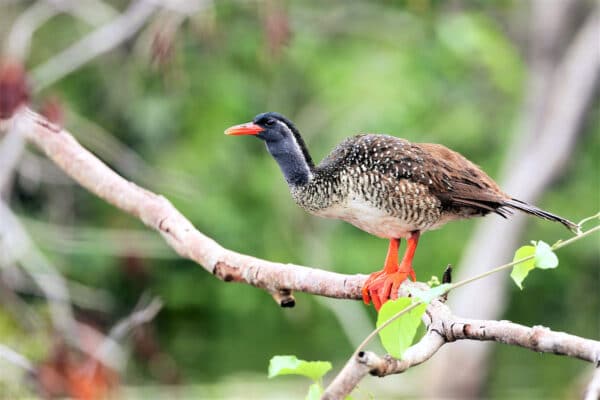
African Finfoot
Podica senegalensis

Number Of Mature
Individuals (Regional)
<1 000

Regional
Population Trend
Decreasing
2025
Regional Category
Vulnerable
Search by species
CONTENTSOverview
Names
|
IOC English Name: |
African Finfoot |
|
SA & IOC Scientific Name: |
Podica senegalensis |
|
BirdLife International Taxonomy (scientific name): |
The same as SA & IOC |
|
Order: |
GRUIFORMES |
|
Family: |
Heliornithidae |
|
Species name author: |
Vieillot 1817 |
|
Afrikaans: |
Watertrapper |
|
Sesotho (South Africa): |
Sehatametsi |
|
Sesotho (Lesotho): |
|
|
Siswati: |
|
|
Zulu: |
Igwedlamanzi |
Current Assessment Status
|
2025 Regional Category [Criteria] |
VU [C1; D1] |
|
2024 Global Category [Criteria] |
LC (BirdLife International 2024) |
|
Population size (Regional) |
<1000 |
|
Population size (Global) |
30 000 – 823 000 (Wetlands International 2023) |
|
Distribution size (EOO) (Regional) km2 |
848 588 (Lee 2024) |
|
Distribution size (EOO) (Global) km2 |
20 600 000 (BirdLife International 2024) |
|
Distribution size (AOO) (Regional) km2 |
560–24 100 (Peacock 2015, Lee 2024) |
|
Generation time |
6.19 years (BirdLife International 2024), 10.4 (BirdLife International 2016) |
|
Status change reason |
No Change |
|
Migrant (in the region) |
No |
|
Regional endemic |
No |
Historic Listing Information
|
2000 Regional Status |
VU [A2c; C1] |
|
2015 Regional Status |
VU [B2b(ii,iii); C1; D1] |
|
Status change reason (if applicable) |
No Change |
|
2015 Population size (Regional) |
<1000 |
|
2015 Global Status |
LC |
Reason for Inclusion
Reason for Inclusion in the Assessment
The African Finfoot Podica senegalensis was previously assessed in the 2015 Regional Red Data Book for South Africa, Lesotho, and Eswatini (Peacock 2015).
Category Justification
Category Justification
The African Finfoot qualifies for a Vulnerable (VU) listing under Criteria C1 and D1, with an estimated population of fewer than 1000 mature individuals and projected declines of over 10% across three generations (31 years, based on a generation length of 10.4 years) (BirdLife International 2016, Lee 2024). Citizen science data, including Southern African Bird Atlas (SABAP2) and Coordinated Waterbird Counts (CWAC), consistently indicate declines in reporting rates and population metrics, with CWAC data showing a 2.5% annual decline (95% CI: -4.8% to -0.18%) (Lee 2024). With a lack of information on movements, and generally presumed to be sedentary, it is unlikely there will be a significant regional rescue effect from the Africa population. The species has a large range across the higher rainfall, warmer regions of South Africa, from Limpopo to the Western Cape, resulting in a large Extent of Occurrence (EOO). Although the Area of Occupancy (AOO) has previously been reported as 560 km2 (Peacock 2015), this likely represents a lower bound: the species has been reported from 174 pentads in the recent SABAP2 period since 2015, representing an area 12 600 km2, with an area of potentially suitable habitat across South Africa, Lesotho and Eswatini modelled to be 24 104 km2 (Lee 2024), which is greater than the threshold for Vulnerable under the B Criteria.
Population Justification
Within the region, the population of African Finfoot is estimated to be fewer than 1000 mature individuals (Peacock 2015). The low density and patchy distribution across suitable habitats support this conservative population size estimate. Despite this, the global population is 30 000 – 823 000 (Wetlands International 2023) and is thus classified as Least Concern (LC) by BirdLife International (Peacock 2015, BirdLife International 2024).
Trend Justification
Population trends were assessed based on SABAP2 and CWAC data, which consistently indicate declines (Lee 2024). SABAP2 reveals a reduced probability of reporting over time, while CWAC data further estimate a 2.5% annual decrease, with low variability confidence (Figure 1, Lee 2024). This projected decline exceeds the 10% threshold over three generations required for a Vulnerable listing under Criterion C1.
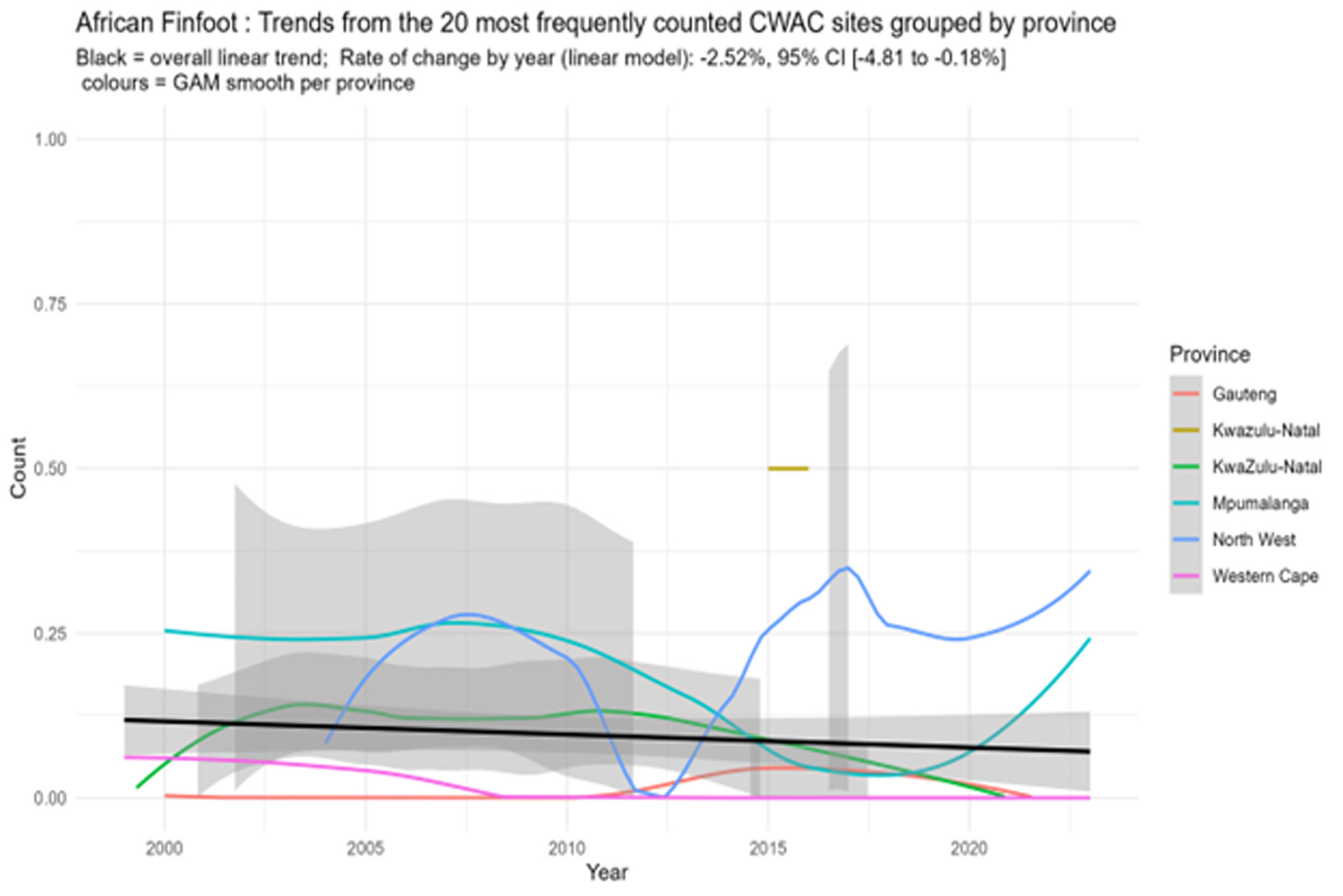
Figure 1: Coordinated Waterbird Counts (CWAC) trends for African Finfoot from the most frequently counted sites within the species range (from Lee 2024) indicate lower counts. Similar trends are observed with other model types.
Biology & Ecology
Taxonomy
The African Finfoot was first described by Vieillot in 1817. No recent taxonomic revisions have impacted its classification, and the name is consistent across major sources, including BirdLife International and the IOC (Peacock 2015, BirdLife International 2024). Four subspecies are recognized: camerunensis, petersii, senegalensis and somereni. The subspecies petersii is found from Angola to South Africa (Chapin 1954, Gill et al. 2024). There is only one other finfoot species: Masked Finfoot P. personatus from southeastern Asia, listed as Critically Endangered (BirdLife International 2022).
Identification
The African Finfoot is a shy, medium-sized waterbird, about the size of a Reed Cormorant Microcarbo africanus, but superficially resembling an African Darter Anhinga rufa. It is distinguished by its shorter, stouter neck and a bright coral-red dagger-like bill, which contrasts with the yellowish horn bill of similar species. Unlike the African Darter, the Finfoot seldom dives, preferring to forage close to vegetated water margins. On land, its squat, duck-like stance and distinctive salmon-orange legs and disproportionately large feet are noticeable (Peacock 2015).
This species exhibits sexual dimorphism: the larger, darker male has an unmarked face, while the smaller female is primarily brown with a boldly patterned face. Immature birds resemble females but have a blackish bill and a less prominent facial pattern (Engelbrecht 2024).
Distribution
Across Africa, the African Finfoot’s distribution is tied to warmer and wetter sub-Saharan regions, especially the equatorial regions, spanning from West Africa through Central and East Africa to the southern regions, including the Zambezi and Save River systems (Figure 2). In the regional context of South Africa, Lesotho, and Eswatini, it primarily inhabits slow-flowing, well-vegetated rivers and streams, particularly within or near protected areas (Allan 1997). While widely distributed, the species’ presence is often sparse, and it typically occurs at low densities within suitable habitats, with pairs spaced kilometres apart (Peacock 2015). This restricted and localized distribution within suitable riparian habitats underscores its vulnerability to habitat degradation and anthropogenic disturbance.
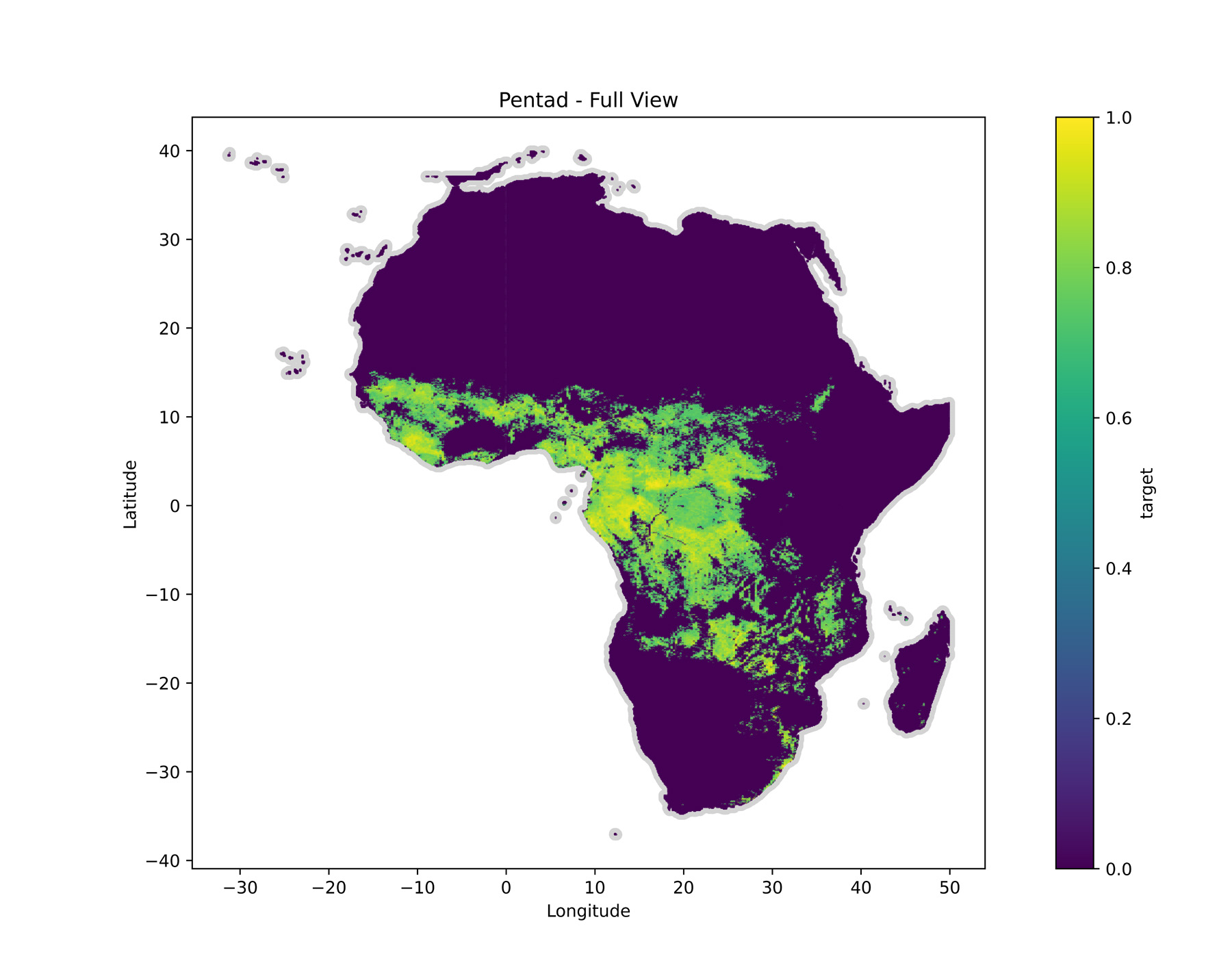
Figure 2: Modelled distribution of the African Finfoot across Africa based on ABAP, eBird and iNaturalist location data. Brighter colours indicate a higher probability of presence, with areas of low probability (p<0.5) excluded. Map from Lee (2024).
Ecology
The African Finfoot is a riverine habitat specialist, favouring forested rivers, secluded streams, and densely vegetated riparian zones (Chittenden 2005). It typically forages close to the water’s edge, feeding on aquatic invertebrates, small fish, and amphibians found along and beneath overhanging vegetation. The species is usually solitary and highly territorial. Nesting generally occurs during high-water periods, which provide increased cover and access to food resources essential for rearing young (Chittenden 2005, Peacock 2015).
Threats & Conservation
Threats
The African Finfoot faces multiple threats primarily related to habitat degradation and environmental changes affecting its specialized riparian habitats (Peacock 2015). Habitat degradation is a significant concern, driven by activities such as siltation from poor land management practices, excessive water abstraction for agriculture, and the clearing of riparian vegetation for farming. Invasive species further threaten suitable habitats; notably, water hyacinth (Pontederia crassipes) clogs waterways, while lantana (Lantana camara) forms dense, impenetrable thickets along riverbanks, restricting the finfoot’s access to clean, open water (BirdLife International 2024). Pollution from agricultural runoff introduces harmful pesticides into rivers, which can directly harm the finfoot or its prey. Additionally, damming and water flow regulation disrupt natural river flows, reduce riparian cover, and alter the riverine ecosystems essential for this species’ survival (Chittenden 2005, Peacock 2015, BirdLife International 2024).
Conservation Measures Underway
Currently, there are no species-specific conservation programs directly targeting the African Finfoot. However, portions of its habitat fall within protected areas, such as nature reserves and national parks, which provide some incidental protection from threats like habitat clearance and agricultural encroachment. These protected areas help maintain critical riparian vegetation and water quality, indirectly supporting finfoot populations by preserving their specialized habitat needs (Peacock 2015, BirdLife International 2024). The Half-collared Kingfisher is one of the priority bird species considered in the latest conservation plan for Gauteng (Desmet et al. 2024).
Conservation Measures Proposed
- Habitat protection and management: Strengthen legal protections for riparian zones within and around protected areas. Enforce regulations that limit agricultural expansion, logging, and uncontrolled fires near riverine habitats to reduce habitat loss and degradation.
- Invasive species control: Implement removal programs for invasive plant species, particularly water hyacinth and lantana, which degrade habitat quality and restrict access to clear water. Coordinated efforts with local communities could help maintain long-term control.
- Sustainable water management: Advocate for policies that regulate water abstraction to maintain natural river flow regimes. Encouraging water management practices that preserve adequate flow levels, particularly in agricultural and urban areas, would help sustain the habitat quality and food resources vital for the finfoot.
- Pollution reduction initiatives: Promote sustainable agricultural practices and manage pollution sources to limit pesticide runoff into rivers. Efforts such as riparian buffer zones can help mitigate the impacts of agrochemicals on water quality and finfoot food sources.
Research Priorities and Questions
- Conduct population surveys: Conduct focused surveys in under-sampled regions to clarify population size, distribution, and density within suitable habitats across the region.
- Impact analysis: Investigate the specific effects of pollution, invasive species, and habitat fragmentation on the African Finfoot’s breeding success, survival rates, and foraging behaviour.
- Protected area efficacy: Assess the effectiveness of existing protected areas in supporting sustainable populations of African Finfoot and identify high-risk zones that may require additional protection or habitat restoration efforts.
- Population viability analysis (PVA): Undertake a PVA to evaluate the species’ long-term survival prospects under current and projected environmental conditions, taking into account expected habitat changes and threat levels
Contributors & References
Assessor/s
Alan Lee
Reviewer/s
David Ehlers Smith
References
Allan DG. 1997. African Finfoot Podica senegalensis. In: Harrison JA, Allan DG, Underhill LG, Herremans M, Tree AJ, Parker V, Brown CJ (eds), The atlas of southern African birds Vol I: Non-passerines. Johannesburg, South Africa: BirdLife South Africa. pp 344–345.
BirdLife International. 2016. Podica senegalensis. The IUCN Red List of Threatened Species 2016: e.T22692177A93339914. https://dx.doi.org/10.2305/IUCN.UK.2016-3.RLTS.T22692177A93339914.en. [Accessed on 05 May 2025].
BirdLife International. 2022. Heliopais personatus. The IUCN Red List of Threatened Species 2022: e.T22692181A181604713. https://dx.doi.org/10.2305/IUCN.UK.2022-1.RLTS.T22692181A181604713.en. [Accessed on 29 October 2024].
BirdLife International. 2024. Podica senegalensis. The IUCN Red List of Threatened Species 2024: e.T22692177A264975767. [Accessed on 28 October 2024].
Chapin JP. 1954. Races of the African Finfoot (Aves, Heliornithidae). American Museum Novitates 1659: 1–10. https://digitallibrary.amnh.org/items/91638525-b3a7-45dc-9530-f31dbaa61ee3
Chittenden HN. 2005. African Finfoot Podica senegalensis. In: Hockey PAR, Dean WRJ, Ryan PG (eds), Roberts – Birds of Southern Africa, 7th Edn. Cape Town, South Africa: Trustees of the John Voelcker Bird Book Fund. pp 314–315.
Desmet PG, Kani L, Hawley G. 2024. Revision of the Gauteng Province C-Plan (v4.0, 2023) Unpublished technical report prepared for Gauteng Department of Environment, Johannesburg.
Engelbrecht GD. 2024. African Finfoot (Podica senegalensis), version 2.0. In: Smit B, Engelbrecht GD (eds), Birds of the World. Ithaca, NY, USA: Cornell Lab of Ornithology. https://doi.org/10.2173/bow.afrfin1.02
Gill F, Donsker D, Rasmussen P (eds). 2024. IOC World Bird List (v 14.2). doi:10.14344/IOC.ML.14.2. http://www.worldbirdnames.org/
Lee ATK. 2024. Regional Red Data Book of the Birds of South Africa, Lesotho and Eswatini: SABAP2 synthesis and supporting information and graphics for African Finfoot. Unpublished report. Johannesburg: BirdLife South Africa.
Peacock F. 2015. African Finfoot Podica senegalensis. In: Taylor MR, Peacock F, Wanless RM (eds), The Eskom Red Data Book of Birds of South Africa, Lesotho and Swaziland. Johannesburg, South Africa: BirdLife South Africa. pp 58–60.
Wetlands International. 2023. Waterbird Populations Portal. Available: wpp.wetlands.org. [Accessed on 20 June 2024].
Citation
Lee ATK 2025. African Finfoot. In: Lee ATK, Rose S, Banda S, Bezeng SB, Maphalala MI, Maphisa DH, Smit-Robinson H (eds), The 2025 Red Data Book of Birds of South Africa, Lesotho and Eswatini. Johannesburg, South Africa: BirdLife South Africa. Available at: https://www.birdlife.org.za/red-list/african-finfoot/
Our generous sponsors


