


African Crake
Crecopsis egregia

Number Of Mature
Individuals (Regional)
<10 000

Regional
Population Trend
Decreasing
2025
Regional Category
Least Concern
Search by species
CONTENTSOverview
Names
| IOC English Name: | African Crake |
| SA & IOC Scientific Name: | Crecopsis egregia |
| BirdLife International Taxonomy (scientific name): | Crecopsis egregia |
| Order: | GRUIFORMES |
| Family: | Rallidae |
| Species name author: | Peters W 1854 |
| Afrikaans: | Afrikaanse Riethaan |
| Sesotho (South Africa): | motsuwane-mpamereto |
| Sesotho (Lesotho): | motsuoane-mpamereto |
| Siswati: | |
| Zulu: | umjekejeke waseAfrika |
Current Assessment Status
| 2025 Regional Category [Criteria] | LC° |
| 2024 Global Category [Criteria] | LC (BirdLife International 2016) |
| Population size (Regional) | <10 000 (Taylor 1997) |
| Population size (Global) | 100 000 (Convention on the Conservation of Migratory Species of Wild Animals 2020) |
| Distribution size (EOO) (Regional) km2 | 716 561 (Lee 2024) |
| Distribution size (EOO) (Global) km2 | 13 000 000 (BirdLife International 2016) |
| Distribution size (AOO) (Regional) km2 | 904 (Lee 2024) |
| Generation time | 3.7 years (BirdLife International 2016) |
| Status change reason | No change |
| Migrant (in the region) | Yes |
| Regional endemic | No |
Historic Listing Information
|
2000 Regional Status |
Lower Risk / LC |
|
2015 Regional Status |
LC |
|
Status change reason (if applicable) |
No change |
|
2015 Population size (Regional) |
Unknown |
|
2016 Global Status |
LC |
Reason for Inclusion
Reason for Inclusion in the Assessment
African Crake Crecopsis egregia has not been regionally assessed previously. However, the species was flagged as potentially in decline in South Africa due to lower counts according to Coordinated Waterbird Counts (CWAC) data, triggering this assessment (Lee 2024).
Category Justification
Category Justification
African Crake is a breeding visitor to the region. The predicted occurrence range change between 2015 and 2023 showed a dramatic increase of 494.10% (Lee 2024). This cannot be a true reflection of a change in the range of the species but could possibly be attributed to improved observer skills and potentially an influx of the species during favourable climatic conditions.
All the Extent of Occurrence (EOO) prediction models using BirdLasser and the ConR R package are well above the Vulnerable (VU) threshold (Lee 2024). The modelled Area of Occupancy (AOO) values (mean: 49 424 km2) is considered to be an overestimate and therefore the ConR AOO (904 km2) is used in this assessment. While this is well within the VU, Criterion B, being less than 2000 km2. However, the species does not meet the associated required conditions. There is no evidence of continued or projected decline and no extreme fluctuations have been observed. This migratory species is dependent on grassland habitats and can be present at a certain site in high numbers in some years or completely absent in other years. This does not reflect a change in overall population numbers but rather a response to habitat suitability, which is largely based on rainfall.
The population is suspected to be stable in the absence of evidence for any declines or substantial threats (BirdLife International 2016).
The regional population size is unknown. Taylor (1997) estimated that there were 8000 birds in South Africa in 1997. This is outdated although it is probably still below 10 000.
While the AOO and population size estimates could justify an assessment outcome of Near Threatened, the species is widespread throughout southern Africa. Therefore, adjusting the assessment outcome to Least Concern seems appropriate.
Population Justification
There are no recent population estimates and deriving accurate estimates of cryptic species is always challenging. The global population is unknown (BirdLife International 2016). The most recent population estimates include the African Crake report for the Convention on the Conservation of Migratory Species of Wild Animals website, which states that the global population is unknown but that it is over 100 000 individuals (Convention on the Conservation of Migratory Species of Wild Animals 2020). Regionally, the most recent estimate was in 1997, when it was estimated at 8000 birds in South Africa (Taylor 1997). Given the very large increase in AOO it is possible that the population may have increased but this is not known.
Trend Justification
The global population is considered stable (BirdLife International 2016). While the modelled predicted change in AOO from SABAP2 suggest a very large increase in the population this is almost certainly an overestimate. The AOO from BirdLasser and ConR were used instead to determine the regional AOO (Figure 1). A comparison of the reporting rate differences within SABAP2 would suggest that the regional population is fairly stable (Figure 2).
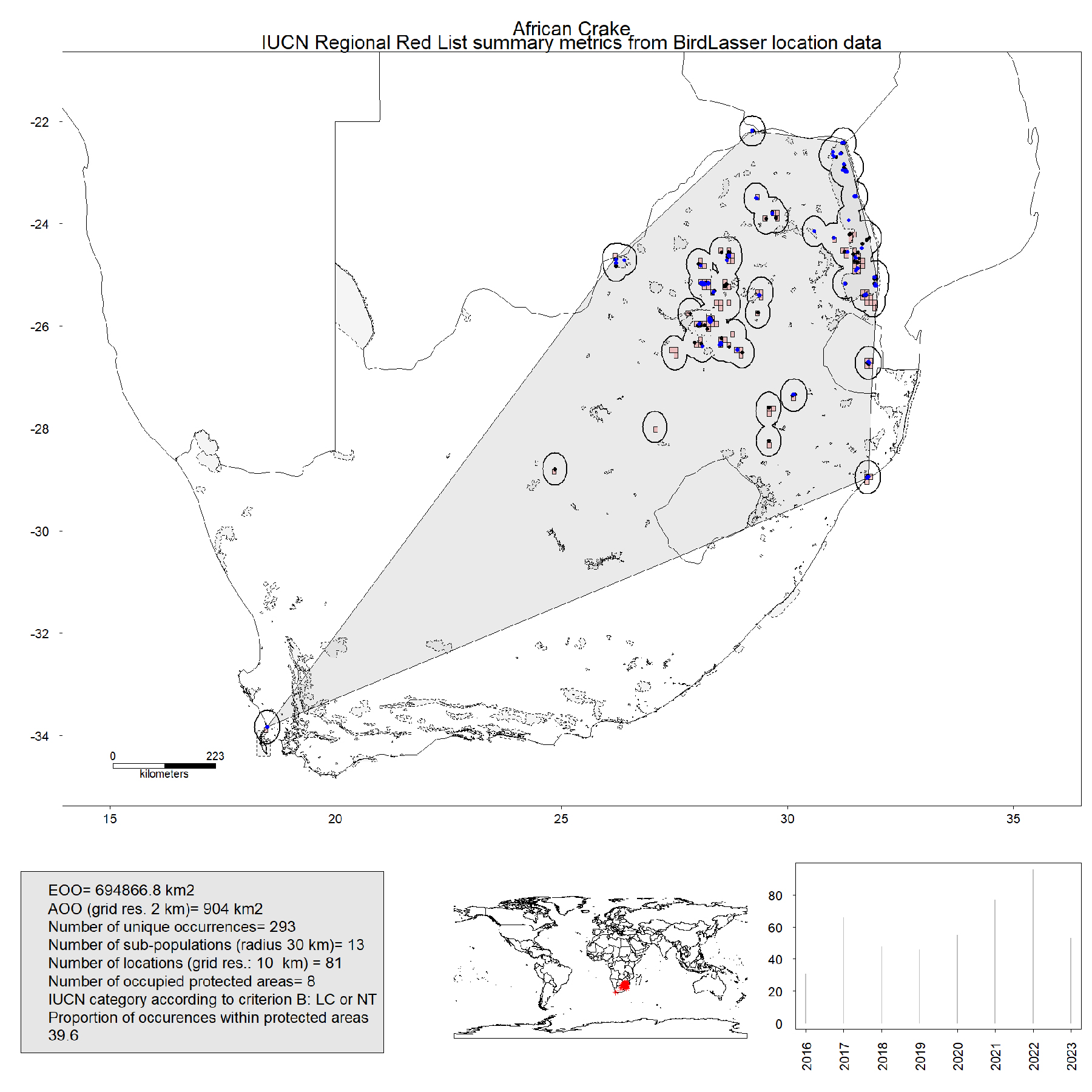
Figure 1: Map produced using BirdLasser data and the ConR R package (from Lee 2024).
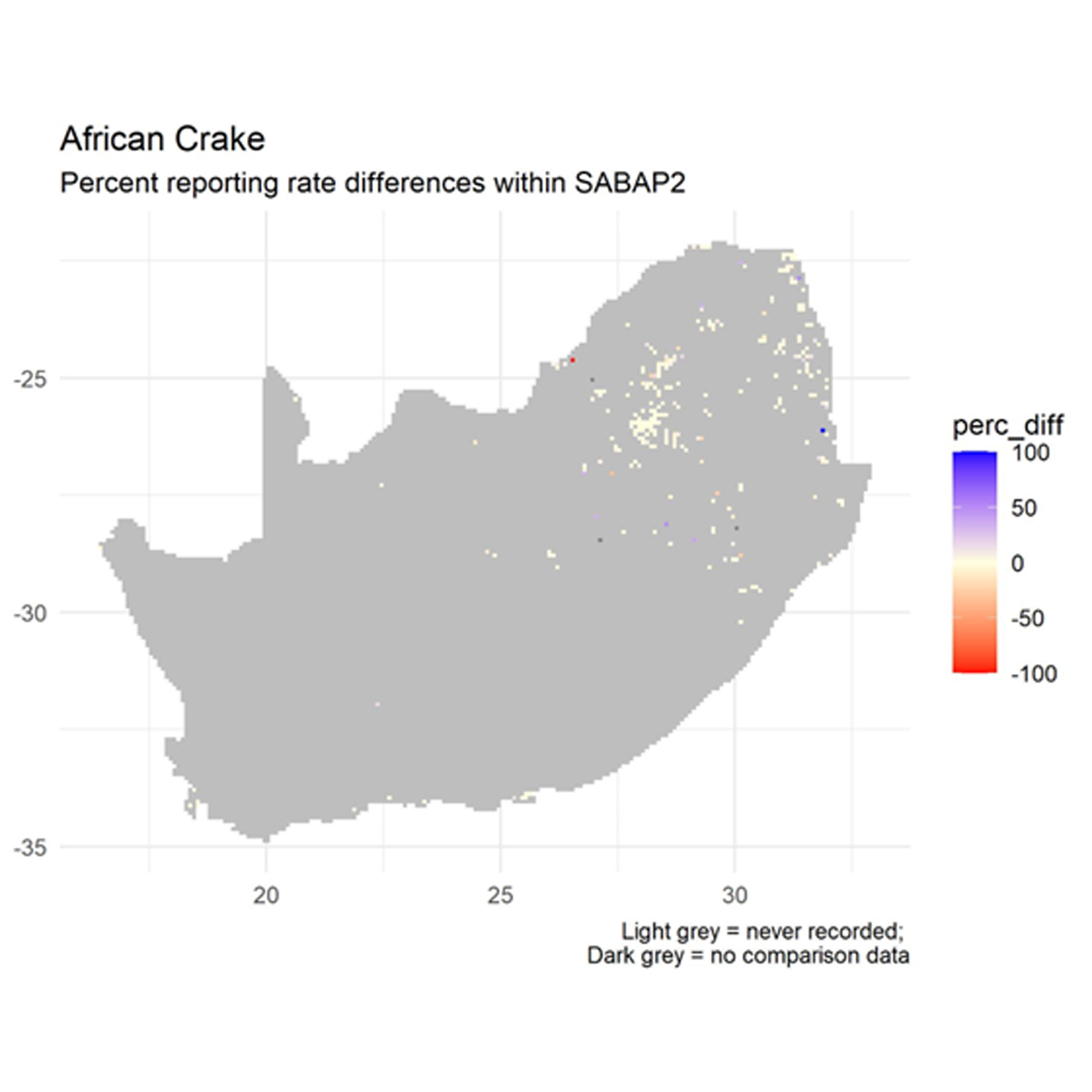
Figure 2: SABAP2 pentad level change between periods 2007-2015 and 2016-2023, being roughly comparable in terms of time and effort. The measure is a simple subtraction of percentage reporting rate for each period. Blue indicates higher reporting rate, red indicates lower, while cream is no change. Grey is not recorded, which could be either the species was not recorded or there is no data. Map from Lee 2024.
CWAC data indicates that the number of African Crake have declined each year. CWAC data for such a nomadic and reasonably cryptic species is sparse and makes it very difficult to have confidence in the trends.
In the absence of evidence to the contrary or of significant threats in the region, African Crake is tentatively considered to be stable.
Biology & Ecology
Taxonomy
The taxonomy of small crakes, including the African Crake, is complex. Initially described as Ortygometra egregia, it faced changes in genus classification, moving from Crecopsis to Crex. Different views on its relationship with the Corn Crake Crex crex and Ash-throated Crake Mustelirallus albicollis caused taxonomic shifts (BIRDIE 2024). These considerations on lineage more recently also include Rouget’s Rail Rougetius rougetii (Garcia et al 2020). The latest research, including the International Ornithological Committee’s (IOC) 2020 world bird list, place the African Crake back in the genus Crecopsis.
Identification
20–23 cm (Dean 2005). Sexes are similar. Adults: Upperparts are blackish, streaked with olive-brown resulting in a mottled appearance (Dean 2005). Flight feathers are dark brown with blackish underwing coverts (Dean 2005). These contrast with the boldly black-and-white barred flanks and belly in flight. The nape and hind-neck are plain brown, while the throat, breast and sides of the head are grey (Dean 2005). The bill is pink, reddish, or purplish with a greyish tip and the eyes are orange to red, with a salmon-pink to red eye ring, becomes brighter during breeding season (Dean 2005). Legs are pale brown or grey, sometimes with pink or red tinge (Dean 2005). Juveniles: similar to adults but darker and duller, have darker upperparts, a dark bill, grey eyes, and less distinct barring on the underparts (Dean 2005).
Confusing species: could be confused with African Rail Rallus caerulescens, but larger and longer billed, Corn Crake, also larger but also slightly paler (Dean 2005). Juvenile African Crake could be confused with Striped and Spotted Crake Aenigmatolimnas marginalis, Porzana porzana because they are similar in size, but both have white spotting on their upper parts (Dean 2005).
Distribution
Sub-Saharan Africa, ranging from Senegal to Kenya and extending southwards to South Africa (Taylor 2020). The species is widespread and locally common in most of its African range, excluding rainforests and drier regions with low annual rainfall (Taylor 2020). It is a vagrant to southern Mauritania, southwest Niger and southern Botswana (Taylor and van Perlo 1998, Hudson and Bouwman 2006).
Regionally, considered a vagrant in Lesotho, South Africa’s Northern and Eastern Cape and North West Province. Much of the suitable habitat in South Africa is protected in the Kruger National Park and iSimangaliso Wetland Park (Taylor and Van Perlo 1998).
Ecology
Habitat:
The African Crake exhibits a preference for various grassland habitats, ranging from seasonally moist to perennial waterlogged grasslands (del Hoyo et al. 1996, Taylor and van Perlo 1998). The species also inhabits suitable areas within and peripheral to temporary and permanent wetlands, as well as vegetated areas surrounding open water systems (del Hoyo et al. 1996, Taylor and van Perlo 1998). It is also found in tall grass savannas, dry grasslands in lightly wooded regions, and grassy areas within forest clearings (del Hoyo et al. 1996, Taylor and van Perlo 1998). The species can utilize a wide range of environments, even highly modified landscapes such as cultivated areas (i.e. maize, rice and cotton fields or moist sugar cane plantations) that are close to water have been reported to be utilized (del Hoyo et al. 1996, Taylor and van Perlo 1998).
Migration:
The African Crake is a partial migrant moving away from the equator, both north and south, to breed during the rainy seasons as the rain provides sufficient grass cover to allow them to breed (de Hoyo et al. 1996). Local nomadism also takes place in response to changing environmental conditions, but these movements are complex and poorly understood. Small groups of up to six individuals have been recorded during migration (Urban et al. 1986). Groups of 3–8 individuals have been recorded immediately after migration (Taylor 1998).
Breeding:
Breeds during the rainy season, in north-east South Africa this is between October-March (Taylor 2020). Solitary nester and territorial with pairs establish territories during the breeding season (Dean 2005). Nest is a shallow cup or saucer-shape made of dry grass and positioned on dry ground or slightly elevated above standing water (Tarboton 2001, Taylor 2020). Nests may occasionally be floating or standing in water with dense vegetation (Urban et al. 1986, del Hoyo et al. 1996, Taylor and van Perlo 1998). The clutch size ranges from 2-8, laid at daily intervals (Taylor and Van Perlo 1998). Both sexes participate incubating the eggs and incubation starts with the first-laid egg (Urban et al. 1986). Eggs will start hatching approximately 14 days after the start of incubation, all eggs hatch within a short timeframe of 48 hours (Urban et al. 1986). Chicks emerge from the nest soon after hatching but are still subject to parental care. Fledging occurs after 4–5 weeks (Taylor 2020). African Crake has a generation length of 3.7 years (BirdLife International 2016) and undergo a complete moult after breeding, while still present in the breeding grounds (Dean 2005).
Diet:
The African Crake’s diet comprises earthworms, molluscs, insects, and the larvae of insects, especially termites, ants, beetles, weevils, bugs and grasshoppers (del Hoyo et al. 1996, Taylor and van Perlo 1998). Their diet also includes small frogs, small fish, and vegetable matter such as grass blades, green shoots, various seeds and other leaves (del Hoyo et al. 1996, Taylor and van Perlo 1998).
Threats & Conservation
Threats
Migratory species require an evaluation of the threats faced within their non-breeding and breeding ranges, as well as along their migration routes. As such, it is essential to understand all existing and emerging threats across the African Crake’s range and along its migration routes. A threat to this species is the degradation and transformation of its wetland and grassland habitats caused by factors such as excessive grazing, cultivation, and human settlement (Taylor and van Perlo 1998). Pollution affecting water quality, as well as the use of insecticides and herbicides will negatively affect the habitat and food sources of this species. It is therefore noted that the 2018 SANBI National Biodiversity Assessment has indicated that 61% of freshwater wetland systems in South Africa are classified as critically endangered already. An additional threat is that the species is hunted for food in certain regions (del Hoyo et al. 1996, Taylor and van Perlo 1998). The 2016 Convention on Migratory Species (CMS) assessment of this species did not list any specific threats associated with its migration (Convention on the Conservation of Migratory Species of Wild Animals 2020).
Conservation Measures Underway
There are no dedicated conservation measures for this species, although will benefit from wetland and grassland focussed conservation initiatives within its distribution range.
Conservation Measures Proposed
The dire state of wetland ecosystems in South African as per the 2018 SANBI National Biodiversity Assessment (79% of inland wetland ecosystems are threatened) (SANBI 2024), necessitates meaningful conservation efforts based on integrated catchment management plans that effectively protect these freshwater systems and the services they provide. Appropriate protection, management and restoration of wetland habitats across the region, but in this case specifically wet grassland habitats, will benefit a suite of different species, including African Crake. The correlation of the existing protected area network and National Freshwater Ecosystem Priority Areas (FEPAs) (Nel et al. 2011) with priority African Crake breeding habitat would enable the quantification of how existing conservation planning could benefit or safeguard the species. A critical and honest evaluation of the success of the implementation of the national freshwater conservation plans within the distribution range of the African Crake would also be an essential component of understanding the potential benefits derived from this approach or whether species-specific actions would be needed to prevent decline.
Research Priorities and Questions
- Update the 1997 regional population estimate.
- Quantification of the hunting threat to the African Crake and the identification of practical mechanisms to mitigate this threat.
- Evaluate and quantify the potential of climate change impact predictions on the existing habitat range of African Crake and its migration routes.
- Correlation of recent wetland loss and degradation within South Africa to known breeding sites within South Africa. This could include habitat condition assessments and food source evaluations.
- Could the effective protection and management of African Crake habitat within the large, protected areas (such as Kruger National Park and iSimangaliso Wetland Park) in South Africa alone protect the species meaningfully from decline to a threatened status?
- Catalogue and quantify the threats and risks to African Crake preferred habitats within South / Southern Africa to assist in development appropriate and meaningful management interventions in mitigation of degradation and loss.
- Quantify and understand threats associated with migration, such as collisions with buildings at night (Taylor 2020).
- A critical evaluation of the suitability of the peripheral habitat options for the African Crake (such as Molopo Nature Reserve and Heuningvlei Pan, North-West Province) (Hudson and Bouwman 2006) and the potential of rehabilitation and restoration projects to improve habitat for the species in the face of ongoing decline / loss of its preferred habitat elsewhere.
Contributors & References
Assessor/s
Cliff and Suretha Dorse, Maria Paul
Reviewer/s
Dexx Ortell, Sanjo Rose
References
BirdLife International. 2016. Crex egregia. The IUCN Red List of Threatened Species 2016: e.T22692539A93357762. http://dx.doi.org/10.2305/IUCN.UK.2016-3.RLTS.T22692539A93357762.en
BirdLife International. 2024. Species factsheet: Crex egregia. https://datazone.birdlife.org/species/factsheet/african-crake-crex-egregia [Accessed on 20 February 2024].
BIRDIE. 2024. An online platform for African wetland and waterbird data. https://biodiversityadvisor.sanbi.org/contentmanagement/index?guid=42305260-12b0-4a92-912e-7d801d15fdac. [Accessed on 30 September 2024].
Convention on the Conservation of Migratory Species of Wild Animals (CMS). 2020. United Nations Environment Programme. Available: https://www.cms.int/en/document/african-crake-crecopsis-egregia [Accessed on 22 May 2024].
Dean WRJ. 2005. African Crake. In: Hockey PAR, Dean WRJ, Ryan PG (eds), Roberts Birds of southern Africa (7th Edn). Cape Town: Trustees of the John Voelcker Bird Book Fund. pp 324–325.
del Hoyo J, Elliott A, Sargatal J. 1996. Handbook of the Birds of the World, vol. 3: Hoatzin to Auks. Barcelona, Spain: Lynx Edicions.
Garcia-R, Juan C, Lemmon EM, Lemmon AR, French N. 2020. Phylogenomic reconstruction sheds light on new relationships and timescale of rails (Aves: Rallidae) evolution. Diversity 12(2): 70. doi:10.3390/d12020070.
Hudson A, Bouwman H. 2006. New records of 45 bird species in the desert margins area of the North-West Province, South Africa. Koedoe 49(1): 91–98.
Lee ATK. 2024. Regional Red Data Book of the Birds of South Africa, Lesotho and Eswatini: SABAP2 Synthesis and Supporting Information and Graphics for African Crake. Unpublished report. Johannesburg: BirdLife South Africa.
Nel JL, Murray KM, Maherry AM, Petersen CP, Rouw DJ, Driver A, Hill L, van Deventer H, Funke N, Swartz ER, Smith-Adao LB, Mbona N, Downsborough L, Nienaber S. 2011. Technical Report for the National Ecosystem Priority Areas Project. Water Research Commission, WRC Report No: 1801/2/11, ISBN 978-1-4312-0149-5.
SANBI. 2024. South African National Biodiversity Institute. https://www.sanbi.org/biodiversity/building-knowledge/biodiversity-monitoring-assessment/national-biodiversity-assessment/. [Accessed on 22 May 2024].
Tarboton W. 2001. Guide to Nests & Eggs of Southern African Birds. Struik Nature.
Taylor PB. 1997. The status and conservation of rallids in South Africa: results of a wetland survey in 1995/96. ADU Research Report No. 23. Cape Town: Avian Demography Unit, University of Cape Town.
Taylor PB. 1998. Rails: A Guide to the Rails, Crakes, Gallinules and Coots of the World. Mountfield, Sussex, UK: Pica Press.
Taylor PB, Van Perlo B. 1998. Rails: A Guide to the Rails, Crakes, Gallinules and Coots of the World. Mountfield, Sussex: Pica Press.
Taylor PB. 2020. African Crake (Crex egregia), version 1.0. In: del Hoyo J, Elliott A, Sargatal J, Christie DA, de Juana E (eds), Birds of the World. Ithaca, NY, USA: Cornell Lab of Ornithology. https://doi.org/10.2173/bow.afrcra1.01
Urban EK, Fry CH, Keith S. 1986. The Birds of Africa, Volume II. London: Academic Press.
Citation
Dorse C, Dorse S, Paul M 2025. African Crake. In: Lee ATK, Rose S, Banda S, Bezeng SB, Maphalala MI, Maphisa DH, Smit-Robinson H (eds), The 2025 Red Data Book of Birds of South Africa, Lesotho and Eswatini. Johannesburg, South Africa: BirdLife South Africa. Available at: https://www.birdlife.org.za/red-list/african-crake/
Our generous sponsors


