


African Broadbill
Smithornis capensis

Number Of Mature
Individuals (Regional)
<2 500

Regional
Population Trend
Decreasing
2025
Regional Category
Vulnerable
Search by species
CONTENTSOverview
Names
|
IOC English Name: |
African Broadbill |
|
SA & IOC Scientific Name: |
Smithornis capensis |
|
BirdLife International Taxonomy (scientific name): |
The same as SA & IOC |
|
Order: |
PASSERIFORMES |
|
Family: |
Calyptomenidae |
|
Species name author: |
Smith 1839 |
|
Afrikaans: |
Breëbek |
|
Sesotho (South Africa): |
|
|
Sesotho (Lesotho): |
|
|
Siswati: |
|
|
Zulu: |
umasikulufu |
Current Assessment Status
|
2025 Regional Category [Criteria] |
VU [A2c+3c+4c; C1] |
|
2024 Global Category [Criteria] |
LC (BirdLife International 2024) |
|
Population size (Regional) |
<2500 (Engelbrecht 2015) |
|
Population size (Global) |
Unknown (BirdLife International 2024) |
|
Distribution size (EOO) (Regional) km2 |
273 541 (103 673 – 332 539) (Lee 2024) |
|
Distribution size (EOO) (Global) km2 |
13 600 000 (BirdLife International 2024) |
|
Distribution size (AOO) (Regional) km2 |
5736 (4500 – 7400) (Lee 2024) |
|
Generation time |
3.14 (BirdLife International 2024) |
|
Status change reason |
No Change |
|
Migrant (in the region) |
No |
|
Regional endemic |
No |
Historic Listing Information
|
2000 Regional Status |
NT [A2c] |
|
2015 Regional Status |
VU [A2c+3c+4c; C1+2a(i)] |
|
Status change reason (if applicable) |
Genuine (recent) |
|
2015 Population size (Regional) |
<2500 |
|
2015 Global Status |
LC |
Reason for Inclusion
Reason for Inclusion in the Assessment
The African Broadbill Smithornis capensis is included in this assessment because more than 5% of its global population occurs within the region of South Africa, Lesotho, and Eswatini. Additionally, the species was previously assessed as Vulnerable (VU) in 2015 due to significant declines in its Area of Occupancy (AOO) and suspected population reductions (Engelbrecht 2015). Updated analyses using Southern African Bird Atlas (SABAP2) data confirm ongoing range contraction, supporting its continued inclusion in the regional assessment.
Category Justification
Category Justification
The African Broadbill is assessed as Vulnerable under Criteria A and C based on evidence of population decline, habitat loss, and a small regional population size. This species has a small and fragmented range within the region, with evidence of a continuing decline in AOO estimated as 10 371 km² in 2015 and 5736 km² in 2024, primarily driven by habitat loss and degradation.
Modelled declines of 32.4% in range over the past 10 years (3 generations), as inferred from SABAP2 data (Lee 2024), meet the threshold for classification as Vulnerable under Criterion A2b. This decline is supported by observed and inferred habitat degradation and loss, particularly outside protected areas. The causes of this decline, primarily deforestation, agricultural expansion, urbanization, and habitat fragmentation, have not ceased and are unlikely to be reversible. Under A3c, future declines are projected as habitat loss and degradation remain ongoing, particularly in the coastal and riparian forests that the species occupies. Combined, past and future trends satisfy A4c, where a continuing population reduction is inferred based on habitat loss, range contraction, and modelled trends over the relevant 3-generation period.
The regional population is estimated to be fewer than 2500 mature individuals (Engelbrecht 2015) and is certainly <10 000, with ongoing declines inferred from range contraction and reductions in habitat extent and quality. This meets the threshold for Criterion C1, as the population is both small and experiencing a continuing decline exceeding 10% over 3 generations (12.6 years).
The species does not meet the conditions for Criterion B, with EOO >20 000 and AOO >2000 km2.
The African Broadbill’s increasing reliance on protected areas for its persistence, combined with its specialization for dense understorey habitats, leaves it particularly vulnerable to habitat destruction and fragmentation. Given the observed, inferred, and projected declines in habitat quality, area of occupancy, and population size, the species qualifies as Vulnerable under Criteria A2c+3c+4c; C1.
Population Justification
The global population has not been quantified (BirdLife International 2024). The regional population of the African Broadbill is estimated to be fewer than 2500 mature individuals based on its highly fragmented distribution and limited area of occupancy (Engelbrecht 2015). Although no formal population estimates exist, broadbills are known to occur at low densities, with estimates of approximately 12 birds per square kilometer reported in Kakamega Forest, Kenya (Bruce and Boesman 2021). Given its reliance on specific forest types, territorial behavior, and patchy occurrence in South Africa, Lesotho, and Eswatini, it is reasonable to assume that regional densities are similarly low.
Trend Justification
The African Broadbill is experiencing a continuing decline in its regional population, primarily driven by habitat loss and fragmentation. The AOO has decreased from 10 371 km² in the 2015 assessment (Engelbrecht 2015) to a current mean estimate of 5736 km² (Lee 2024). Although AOO calculations between assessments was different, this still represents a substantial reduction in available habitat for a species that is highly specialized to dense forest understorey and forest-edge habitats. As threats resulting in habitat loss are ongoing, thresholds for Vulnerable under Criteria A2c+3c+4c are met.
Although SABAP2 trend analysis indicates a stable probability of reporting with high confidence (Lee 2024), this apparent stability is likely due to the species’ remaining populations becoming increasingly restricted to protected areas, where reporting rates may mask broader declines in unprotected habitats. Supporting this, modelled analyses show a 32.4% decline in predicted range occupancy over the last 10 years (Lee 2024), providing further evidence for a negative population trend.
As a habitat specialist, the African Broadbill is highly vulnerable to habitat loss and degradation. Between 2001 and 2023, South Africa lost approximately 12% of its natural forest cover (Global Forest Watch 2024), particularly in the coastal and riparian forests of KwaZulu-Natal and Limpopo where the species occurs. This loss is primarily driven by agricultural expansion, urbanization, timber plantations, and small-scale logging.
In summary, there is sufficient evidence to infer a >10% decline in the regional population over 3 generations (12.6 years) due to ongoing habitat loss and fragmentation, as well as observed range contraction. These trends support the assessment of the species as Vulnerable under Criterion C1.
Biology & Ecology
Taxonomy
The African Broadbill Smithornis capensis belongs to the family Calyptomenidae and was first described by Smith in 1839. The species exhibits notable geographic variation across its range, with up to nine recognized subspecies (Bruce 2003, Bruce and Boesman 2021). Within the regional assessment area of South Africa, Lesotho, and Eswatini, two subspecies are of particular interest: S. c. cryptoleucus and S. c. capensis (Vernon and Dean 2005).
The subspecies S. c. cryptoleucus occurs in northeastern South Africa, including parts of Limpopo and KwaZulu-Natal, as well as southern Mozambique and Eswatini. It is characterized by buff-olive upperparts and a pale crown in females, distinguishing it from other subspecies. The nominate subspecies, S. c. capensis, is restricted to the coastal forests of southeastern KwaZulu-Natal, where it occupies a more localized range (Vernon and Dean 2005).
The taxonomy of the African Broadbill remains well-established; however, isolated populations, such as those in northern Limpopo, have been noted for their distinctiveness and may warrant further investigation to confirm their subspecific status.
Identification
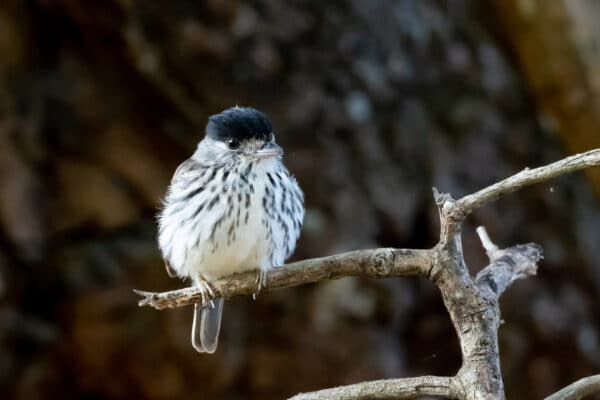
The African Broadbill is a small, stocky bird measuring 12–14 cm in length and weighing 17–27 g (Engelbrecht 2015). It has a distinctive broad, flattened bill and short tail, giving it a unique appearance among South Africa’s forest birds. The upperparts are rufescent-brown with black streaking on the mantle and back, and a prominent buff or cream wing-bar is formed by the tips of the median coverts. The underparts are predominantly white, with buffy tinges on the flanks and breast sides, and heavy black streaking except on the central belly. Males have a black crown, buffish forehead, and greyer nape, while females are similar but exhibit a duller crown that is grey with faint streaks (Bruce and Boesman 2021). Juveniles resemble females but have less pronounced buff tones on the forehead and weaker crown streaking (Bruce and Boesman 2021).
The African Broadbill is most readily detected by its distinctive mechanical display sound, a loud “k-k-krrrrrrrk” produced during short, elliptical flight displays as a result of aeroelastic fluttering of its outer primaries (Clark et al. 2016). This sound is a key feature for identifying the species in its dense, forested habitat, where it is otherwise inconspicuous. There are 15 species of Broadbill globally, of which three occur in Africa. African Broadbill is the only Broadbill in the subregion.
Distribution
The African Broadbill has a widespread but patchy distribution across sub-Saharan Africa (Figure 1). Globally, it occurs from West Africa (Guinea, Liberia, Ghana) through Central Africa (Cameroon, Gabon, Democratic Republic of the Congo) and into East Africa (Kenya, Tanzania, Uganda, Mozambique). The species reaches its southern limit in southern Africa, where it occurs locally in northeastern South Africa, southern Mozambique, and Eswatini (Cohen 1997).
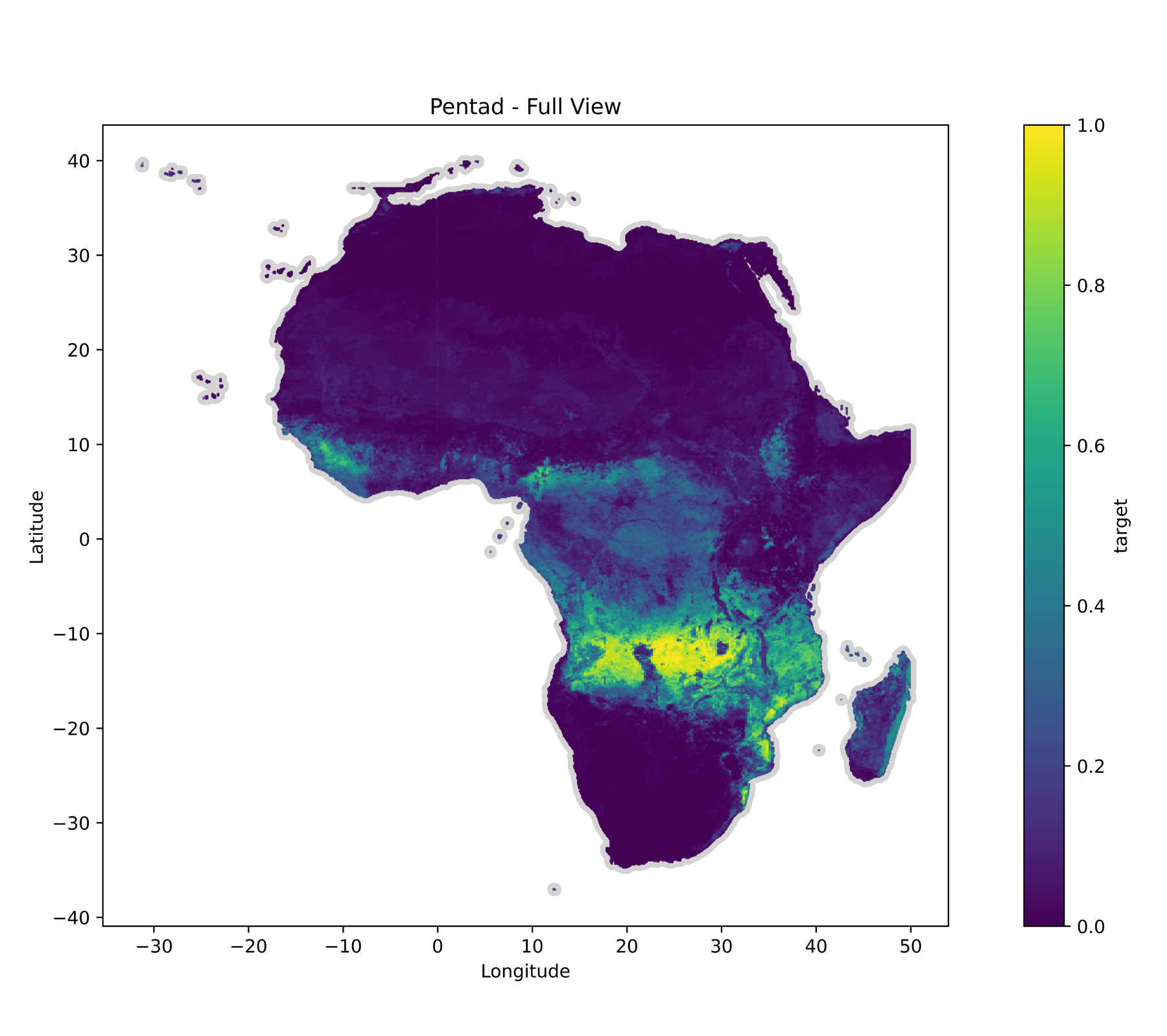
Figure 1: Modelled distribution of African Broadbill across Africa, based on ABAP, iNaturalist and eBird data at the pentad level. Map from Lee (2024).
Within the assessment region, the African Broadbill is restricted to suitable dense forest and thicket habitats in Limpopo and KwaZulu-Natal provinces in South Africa, as well as parts of eastern Eswatini (Figure 2). The nominate subspecies, S. c. capensis, occurs primarily in coastal scarp forests of southeastern KwaZulu-Natal, while S. c. cryptoleucus is found further north in the forests of Limpopo and eastern Eswatini. Its range within the region is increasingly fragmented due to habitat loss, with core populations persisting in protected areas such as iSimangaliso Wetland Park, and Ndumo Game Reserve (Engelbrecht 2015).
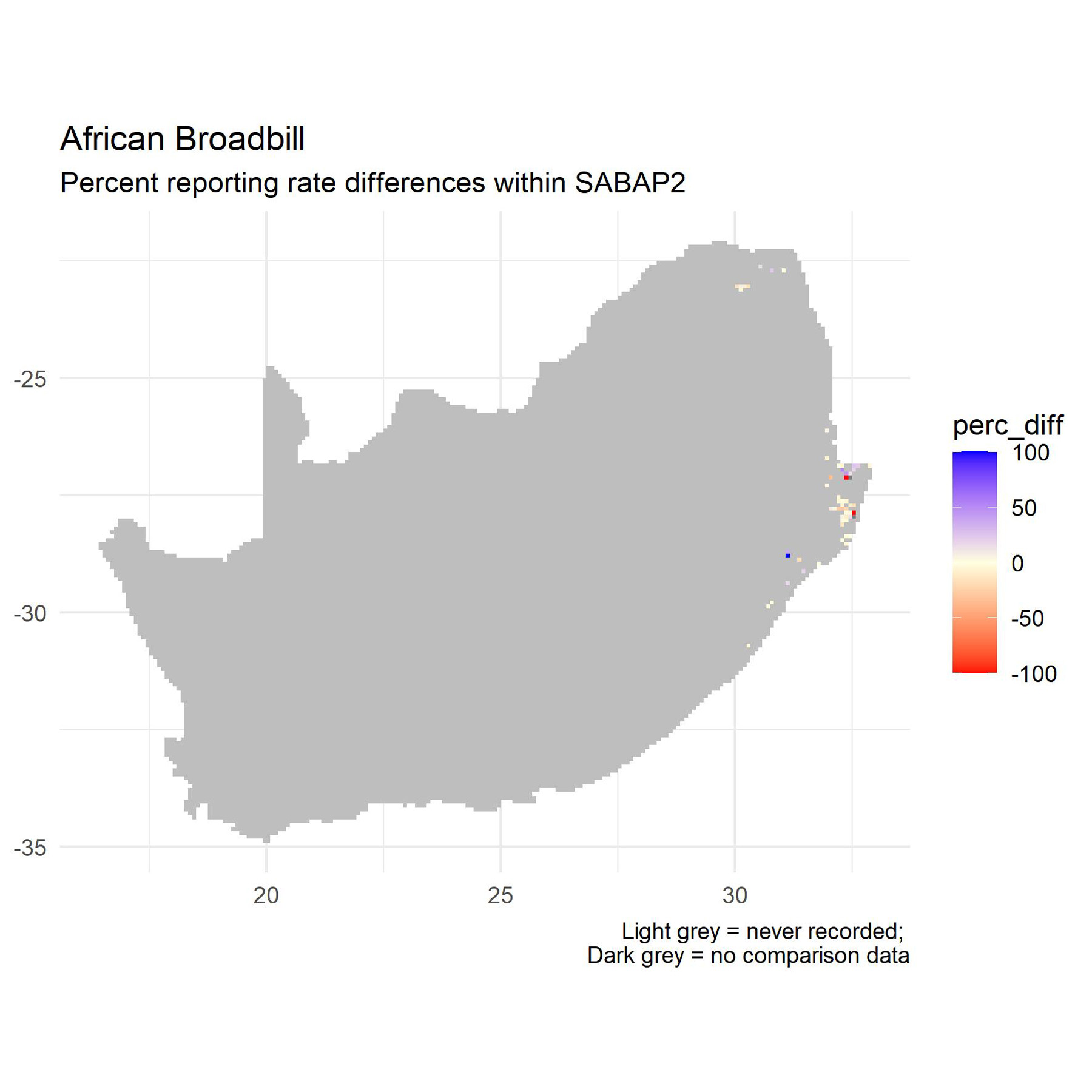
Figure 2: Distribution of the African Broadbill in South Africa and Eswatini according to SABAP2 data, with colour representing reporting rate change.
Ecology
The African Broadbill is a habitat specialist, reliant on dense understorey in forests, riparian thickets, and forest-edge habitats, including scarp and coastal forests (Cohen 1997, Engelbrecht 2015, Bruce and Boesman 2021). It forages primarily on insects, such as beetles, caterpillars, and orthopterans, using a sallying technique from low perches, and occasionally joins mixed-species foraging flocks (Bruce and Boesman 2021). Breeding is seasonal, occurring mainly from October to February in southern Africa, with the male performing a unique mechanical display flight, producing a loud rattling sound to attract mates and defend territories (Vernon and Dean 2005, Bruce and Boesman 2021). The nest is a suspended, untidy structure made of plant materials, usually placed low in dense vegetation, which may make it vulnerable to predation (Engelbrecht and Nethonzhe 2008).
The species’ strong reliance on undisturbed forest understorey, small clutch size (typically 1–3 eggs), and territorial behaviour limit its reproductive output and capacity to adapt to fragmented or degraded habitats (Cohen 1997, Engelbrecht 2015). There is no clear pattern of movement in the subregion revealed by SABAP2 data, with seasonal changes in reporting more likely associated with detectability during the onset of the breeding season, being highest around October (Lee 2024). These life history traits, combined with ongoing habitat loss and fragmentation, exacerbate its vulnerability to extinction.
Threats & Conservation
Threats
The African Broadbill is primarily threatened by habitat loss and fragmentation, driven by the ongoing destruction of natural forests across its range (Cooper et al. 2017, Mangwale et al. 2017, Clements et al. 2020). In South Africa, much of this loss occurring in the coastal and riparian forests that the species depends on. Habitat destruction is largely caused by agricultural expansion, timber plantations (e.g., Pinus and Eucalyptus), urban development, and small-scale logging (Engelbrecht 2015). Fragmentation further isolates populations, reducing habitat connectivity and restricting gene flow, which may exacerbate population declines over time.
The species’ reliance on dense understorey vegetation also makes it sensitive to forest degradation. Activities such as selective logging, fuelwood collection, and livestock grazing alter understorey structure, making habitats unsuitable for foraging and breeding. Additionally, the low placement of its nest and its reliance on undisturbed vegetation expose nests to predation, particularly in fragmented or edge habitats where predators such as Vervet Monkeys Chlorocebus pygerythrus and snakes are more prevalent (Engelbrecht 2015).
Climate change poses an emerging threat, particularly through changes to forest microclimates and the drying of riparian zones, which may further reduce the availability of suitable breeding and foraging habitats (Coldrey et al. 2022). These cumulative threats, compounded by the species’ small population size and restricted range, place the African Broadbill at continued risk of decline.
Conservation Measures Underway
There are currently no targeted conservation measures specifically for the African Broadbill within the region. However, the species does occur in several formally protected areas, which provide some level of refuge from habitat loss and degradation. Key protected areas include Kruger National Park, iSimangaliso Wetland Park, and Ndumo Game Reserve in South Africa, as well as forest reserves in Eswatini.
Conservation Measures Proposed
The measures proposed are those proposed by Engelbrecht (2015). In short, a Species Action Plan is recommended. All known populations should be monitored on an annual basis, to form the basis for conservation actions. The continuous fragmentation of existing habitat needs to be monitored and, wherever possible halted or reversed as a matter of urgency. Urgent conservation action is also required for the species in KwaZulu-Natal and particularly concerning the nominate race in the southern parts of the species’ range.
Research Priorities and Questions
- Conduct targeted surveys to generate robust population size estimates and monitor population trends, particularly in fragmented and unprotected areas, using standardized methods such as point counts and occupancy modelling.
- Investigate the species’ habitat preferences and tolerance to habitat degradation, particularly in secondary and fragmented forests, to inform habitat management and restoration efforts.
- Assess the effects of forest fragmentation on genetic connectivity, dispersal patterns, and reproductive success, particularly in small and isolated subpopulations.
- Study the species’ breeding biology, including nest predation rates, reproductive success, and factors influencing nesting site selection, to identify key vulnerabilities during the breeding season.
- Model the potential impacts of climate change on the species’ habitat availability and distribution, particularly in relation to shifts in forest microclimates and increased drought frequency.
- Quantify the impacts of specific threats, such as deforestation, selective logging, and livestock grazing, on the species’ habitat quality and population persistence.
- Identify opportunities to conserve and restore suitable habitat in unprotected areas, including private and communal lands, to improve landscape connectivity and support population resilience.
Contributors & References
Assessor/s
Alan Lee
Reviewer/s
David Ehlers Smith
References
BirdLife International. 2024. Smithornis capensis. The IUCN Red List of Threatened Species 2024: e.T22698707A263723663. Available at: https://www.iucnredlist.org. [Accessed 17 December 2024].
Bruce MD. 2003. Family Eurylaimidae (Broadbills). Handbook of the Birds of the World, 8: 54–93.
Bruce MD, Boesman PFD. 2021. African Broadbill (Smithornis capensis. In: Billerman SM, Keeney BK, Rodewald PG, Schulenberg TS (eds), Birds of the World version 1.1. Ithaca, NY: Cornell Lab of Ornithology. Available at: https://doi.org/10.2173/bow.afrbro1.01.1.
Clark CJ, Kirschel AN, Hadjioannou L, Prum RO. 2016. Smithornis broadbills produce loud wing song by aeroelastic flutter of medial primary wing feathers. Journal of Experimental Biology 219: 1069–1075.
Clements H, Biggs R, Cumming G. 2020. Cross-scale and social-ecological changes constitute main threats to private land conservation in South Africa. Journal of Environmental Management 274: 111235.
Cohen C. 1997. African Broadbill. In: Harrison JA, Allan DG, Underhill LG, Herremans M, Tree AJ, Parker V, Brown CJ (eds), The Atlas of Southern African Birds, vol. 2: Passerines. Johannesburg: BirdLife South Africa. pp 2.
Coldrey KM, Turpie J, Midgley G, Scheiter S, Hannah L, Roehrdanz P, Foden W. 2022. Assessing protected area vulnerability to climate change in a case study of South African national parks. Conservation Biology 36: e13941. Available at: https://doi.org/10.1111/cobi.13941.
Cooper TJG, Wannenburgh A, Cherry M. 2017. Atlas data indicate forest dependent bird species declines in South Africa. Bird Conservation International 27: 337–354.
Engelbrecht D, Nethonzhe C. 2008. Notes on the breeding biology of the African Broadbill Smithornis capensis in north-eastern South Africa. Ostrich 79: 239–241.
Engelbrecht GD. 2015. African Broadbill Smithornis capensis. In: Taylor MR, Peacock F, Wanless RM (eds), The Eskom Red Data Book of Birds of South Africa, Lesotho and Swaziland. Johannesburg: BirdLife South Africa. pp 194–196.
Global Forest Watch. 2024. Global Forest Watch: Tree cover loss data. World Resources Institute, Washington, DC, USA. Available at: https://www.globalforestwatch.org. [Accessed 17 December 2024].
Lee ATK. 2024. Regional Red Data Book of the Birds of South Africa, Lesotho and Eswatini: SABAP2 synthesis and supporting information and graphics for African Broadbill. Unpublished report. Johannesburg: BirdLife South Africa.
Mangwale K, Shackleton C, Sigwela A. 2017. Changes in forest cover and carbon stocks of the coastal scarp forests of the Wild Coast, South Africa. Southern Forests: A Journal of Forest Science 79: 305–315.
Vernon CJ, Dean WRJ. 2005. African Broadbill Smithornis capensis. In: Hockey PAR, Dean WRJ, Ryan PG (eds), Roberts Birds of Southern Africa, 7th Edn. Cape Town: Trustees of the John Voelcker Bird Book Fund. pp 678–679.
Citation
Lee ATK 2025. African Broadbill. In: Lee ATK, Rose S, Banda S, Bezeng SB, Maphalala MI, Maphisa DH, Smit-Robinson H (eds), The 2025 Red Data Book of Birds of South Africa, Lesotho and Eswatini. Johannesburg, South Africa: BirdLife South Africa. Available at: https://www.birdlife.org.za/red-list/african-broadbill/
Our generous sponsors


