


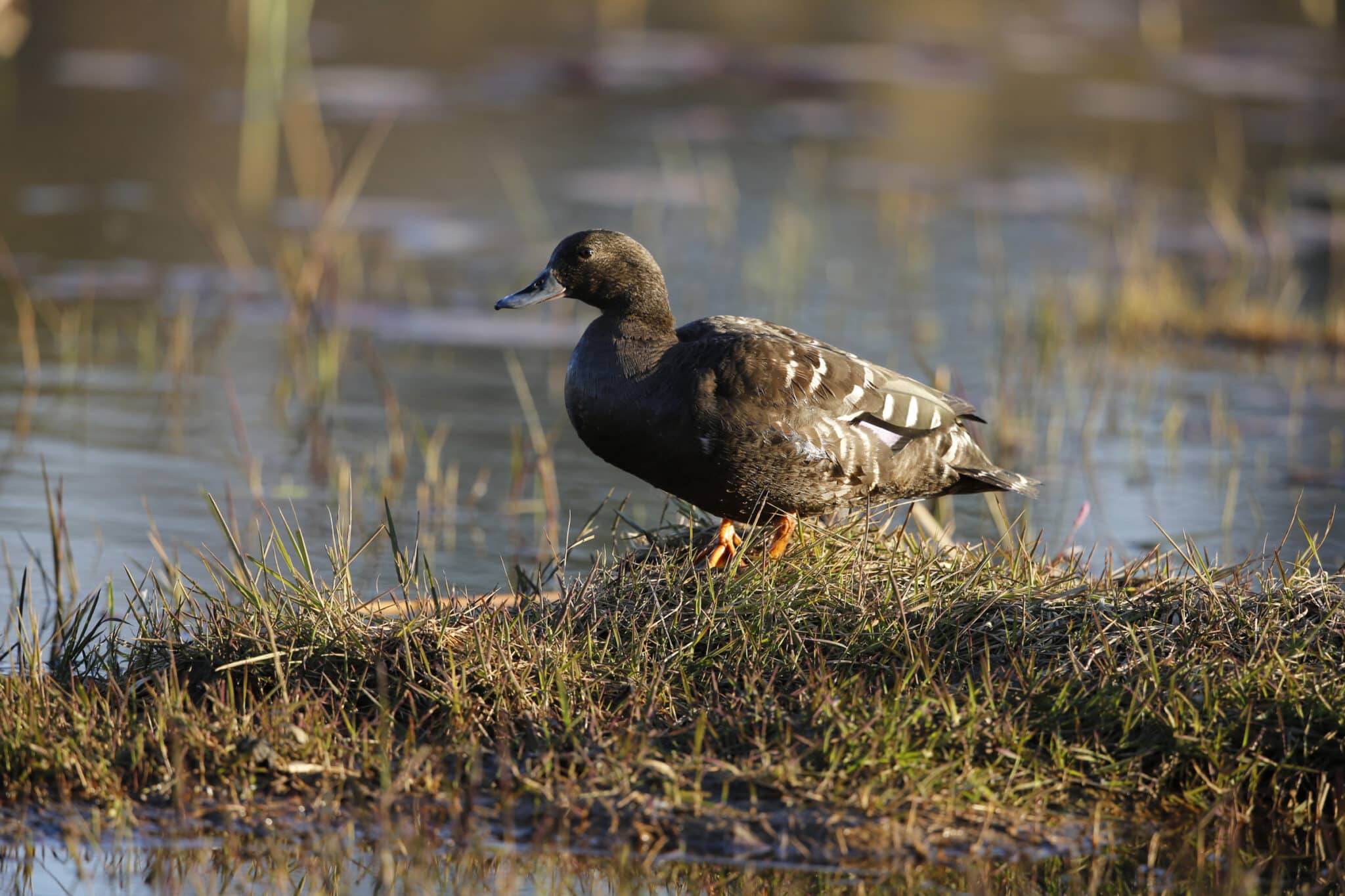
African Black Duck
Anas sparsa

Number Of Mature
Individuals (Regional)
20 000 – 50 000

Regional
Population Trend
Stable
2025
Regional Category
Least Concern
Search by species
CONTENTSOverview
Names
|
IOC English Name: |
African Black Duck |
|
SA & IOC Scientific Name: |
Anas sparsa |
|
BirdLife International Taxonomy (scientific name): |
Anas sparsa |
|
Order: |
ANSERIFORMES |
|
Family: |
Anatidae |
|
Species name author: |
Eyton 1838 |
|
Afrikaans: |
Swarteend |
|
Sesotho (South Africa): |
Letata-noka |
|
Sesotho (Lesotho): |
|
|
Siswati: |
Lidada lemfula |
|
Zulu: |
Idadelimnyama |
Current Assessment Status
|
2025 Regional Status [Criteria] |
LC |
|
2024 Global Status [Criteria] |
LC (BirdLife International 2016) |
|
Population size (Global) |
Unknown (BirdLife International 2016) |
|
Population size (Regional) |
20 000 – 50 000 (Scott and Rose 1996) |
|
Distribution size (EOO) (Regional) km2 |
1 357 280 (Lee 2024) |
|
Distribution size (EOO) (Global) km2 |
20 500 000 (BirdLife International 2016) |
|
Distribution size (AOO) km2 |
24 176 (Lee 2024) |
|
Generation time |
6.6 years (BirdLife International 2016) |
|
Status change reason |
No change |
Historic Listing Information
|
2000 Regional Status |
Not Evaluated |
|
2015 Regional Status |
Not Evaluated |
|
Status change reason |
Not applicable |
|
2015 Population size (Regional) |
Unknown |
|
2016 Global Status |
LC |
Reason for Inclusion
Reason for Inclusion in the Assessment
African Black Duck Anas sparsa has not been assessed regionally before. This species was flagged by an analysis of Coordinated Waterbird Counts (CWAC) data which indicated that the species is in decline (Lee 2024).
Category Justification
Category Justification
Despite evidence of some regional decline, African Black Duck currently does not meet any of the IUCN criteria threshold A-E to be assessed as threatened. The species is listed as Least Concern due to its large range and assumed large population. However, it is largely a river specialist and is likely to be negatively impacted by the degradation of its preferred habitat.
Population Justification
The global and regional populations are unknown. While there are no recent population estimates, Scott and Rose (1996) estimated the Southern African population to be between 20 000 – 50 000. An estimated 500 breeding individuals were estimated to occur in Eswatini in the early 1980s (Parker 1982) and over 1000 adults were thought to occur in Lesotho (Osborne and Tiger 1992), with Ambrose (2020) giving the population range of between 1000 and 10 000. As such, it can be assumed that the number of mature individuals in South Africa is >10 000 which exceeds the minimum number required for consideration as Vulnerable under Criterion C.
Trend Justification
The 2016 IUCN global assessment lists this species as Least Concern but declining, globally. Regionally, Southern African Bird Atlas Project (SABAP2) data indicate that there has been a decline in Area of Occupancy (AOO) over the past three generations, modelled to be 7% (Lee 2024). CWAC data too show a declining number of African Black Duck counted each year (Lee 2024). However, these declines do not meet thresholds for Vulnerable. Confidence in this trend is high.
Biology & Ecology
Taxonomy
The species is endemic to Africa south of the Sahara where two subspecies are recognised. Only the nominate subspecies, South African Black Duck Anas sparsa sparsa (Eyton 1838) occurs in the region. The second subspecies, Pink-billed Black Duck Anas sparsa leucostigma (Rüppel 1845), is found in West equatorial Africa, Ethiopia and Sudan to Zimbabwe.
Identification
48–57cm, c. 0.915–1.090 kg. This medium-sized duck is mostly black with irregular white marks on the back, wings and tail, forming rough bars. An iridescent green/purple speculum is present and most visible during flight. The legs and feet are bright orange to yellow and the eyes are dark brown. The bill is blueish grey/black. Sexes are alike in plumage colouration with males larger than females (Carboneras and Kirwan 2020). Juveniles are browner with buff markings and white underparts (Carboneras and Kirwan 2020). The duckling has two pairs of yellow blotches, one on the back and one on the rump, and a yellow panel in each wing (Siegfried 1968).
Distribution
A Sub-Saharan African endemic. The African Black Duck has a large range in eastern and southern sub-Saharan Africa from South Africa to South Sudan and Ethiopia, with isolated populations found in western equatorial Africa, in Nigeria, Cameroon and Gabon. Largely associated with perennial river systems across South Africa but absent in more arid areas, such as the Northern Cape (Figures 1, 2).

Figure 1: Modelled distribution of the African Black Duck in South Africa, Lesotho and Eswatini, based on citizen science data (BirdLasser and research grade iNaturalist records for presence, eBird for absence) at the 2×2 km grid level (from Lee 2024).
Ecology
Habitat:
The African Black Duck is a river specialist and mainly occurs on fast flowing, perennial rivers and streams, but will also utilise seasonal watercourses, wetlands, estuaries, dams, reservoirs and sewage treatment ponds (Johnsgard 1978, Brown et al. 1982). During the flightless moulting period, which lasts around 25 – 30 days, individuals rely heavily on riparian vegetation, fallen branches, washed-up logs or undercut riverbanks close to their foraging range for cover. Although dispersing birds and temporary residents may be found in a wide variety of habitats, Siegfried (1968) considered this species to be dependent in the longer term on the shallow, rocky substratum that he considered its main source of food.
Movements:
The African Black Duck is mainly sedentary and territorial, but will undertake longer movements out of areas such as the Karoo if its habitat dries out. In general, individuals of this species tend to stay within a particular area or region for a significant part of their lives, especially outside the breeding season. While they may not undertake extensive migrations, they can still exhibit local movements within their habitat in response to changing conditions, such as food availability or environmental changes.
Breeding:
A solitary nester with a generation length of 6.6 years. The African Black Duck is single-brooded and breeds in the first year, timing of breeding is variable and depends on the region although analyses of nest record cards (n = 339) suggests that this species is primarily a late winter breeder (Cumming et al. 2016). Clutch sizes range between 4–8 eggs with incubation by the female only. The male remains in close proximity to the nest during this period. Fledging occurs after 77–86 days. Female with brood remain very secretive utilising riparian and emerging vegetation for cover.
Diet:
The African Black Duck is an omnivore and its diet includes waterweeds, aquatic vegetation, agricultural grain, fruits from terrestrial plants near water like mulberries and firethorn berries, fallen acorns, aquatic insects and larvae, crustaceans, larval amphibians, and fish spawn. Primarily feeds among aquatic plants, flooded grasses, muddy substrates and rocks. Feeding has been recorded for 10 hours per day (Colahan 2005). Increased protein intake is important during breeding periods.
Threats & Conservation
Threats
As the African Black Duck occurs predominantly in river systems, they are threatened by habitat loss and degradation as a result of negative impacts including dam building, water extraction, groundwater abstraction, siltation, erosion, pollution, clearing of riparian vegetation and alien species invasion. With the contribution of climate change impacts on the rainfall patterns, the above threats will be exacerbated. While the upper reaches of most rivers generally remain in a better state, the lower reaches of rivers are most significantly impacted. This ongoing decline has been noted by the National River Ecostatus Monitoring Programme and specific areas of concern were notably subject to failing wastewater treatment works, land invasion, solid waste dumping and industrial pollution.
Potential hybridisation with Mallard Duck Anas platyrhynchos has also been recorded as a potential threat to the genetic integrity of the species. Mallard hybridisation with other Anas species such as Yellow-billed Duck Anas undulata has been confirmed but further research, specifically focused on the risk to African Black Duck is needed. The habitat preference and territoriality of African Black Duck has the potential to reduce this risk.
Similar threats occur across the species’ broader range, but the presence of additional riverine habitat in locations such as Zimbabwe, Mozambique and Zambia provide some measure of support for South African populations.
Conservation Measures Underway
This species has no dedicated conservation measures, although will benefit from broad river-based conservation initiatives.
Conservation Measures Proposed
The dire state of river ecosystems in South African (where 64% of river and 79% of inland wetland ecosystems are threatened) as per the 2018 SANBI National Biodiversity Assessment, necessitates meaningful conservation efforts based on integrated catchment management plans that effectively protect these freshwater systems and the services they provide. Such broad river-based conservation initiatives with appropriate ecological protection, restoration and management actions will benefit a suite of different species, inclusive of African Black Duck. The correlation of existing protected area networks, National Freshwater Ecosystem Priority Areas (FEPAs) and Strategic Water Source Areas with priority African Black Duck breeding habitat would enable the quantification of how conservation efforts could benefit or safeguard the species. A critical and honest evaluation of the success of the implementation of the national freshwater conservation plans to date would also be an essential component of understanding the potential benefits derived from this approach or whether species-specific actions would be needed to prevent an increased rate of decline.
Research Priorities and Questions
- What is the overall impact of dam construction on African Black Duck habitats, and can mitigation strategies be identified?
- How does the clearing of riparian vegetation influence nesting sites and overall river ecosystem health for African Black Ducks?
- How does aquatic and riparian invasive alien vegetation impact the African Black Duck?
- Quantify the hybridisation risk of African Black Duck and Mallard Duck.
- Could the effective protection and management of Strategic Water Source Areas in South Africa meaningfully benefit African Black Duck (and other faunal species at risk)?
- How regionally integrated are Southern African populations of African Black Duck, and are there key connecting or stepping-stone habitats that serve to maintain gene flow?
Contributors & References
Assessor/s
Cliff and Suretha Dorse
Reviewer/s
Graeme Cumming, Sanjo Rose
References
Ambrose D. 2020. Birds annotated bibliography, Lesotho annotated bibliography Section 167B. Roma, Lesotho: House 9 Publications and Mohokare Trust.
BirdLife International. 2024. Species factsheet: Anas sparsa. Downloaded from https://datazone.birdlife.org/species/factsheet/african-black-duck-anas-sparsa [Accessed on 24 June 2024].
Brown LH, Urban EK, Newman K. 1982. The Birds of Africa, Vol. I. London: Academic Press.
Carboneras C, Kirwan GM. 2020. African Black Duck (Anas sparsa), version 1.0. In: del Hoyo J, Elliott A, Sargatal J, Christie DA, de Juana E (eds), Birds of the World. Ithaca, NY, USA: Cornell Lab of Ornithology. Available at: https://doi.org/10.2173/bow.afbduc1.01 [Accessed on 24 June 2024].
Colahan B. 2005. African Black Duck. In: Hockey PAR, Dean WRJ, Ryan PG (eds), Roberts – Birds of Southern Africa (7th Edn). Cape Town, South Africa: Trustees of the John Voelcker Bird Book Fund. pp 103–105.
Cumming GS, Harebottle DM, Mundava J, Otieno N, Tyler SJ. 2016. Timing and location of reproduction in African waterfowl: an overview of >100 years of nest records. Ecology and Evolution 6(3): 631–646.
Johnsgard PA. 1978. Ducks, geese and swans of the World. Lincoln and London: University of Nebraska Press.
Lee ATK. 2024. Regional Red Data Book of the Birds of South Africa, Lesotho and Eswatini: SABAP2 synthesis and supporting information and graphics for African Black Duck. Unpublished report. Johannesburg: BirdLife South Africa.
Osborne PE, Tiger BJ. 1992. Priorities for bird conservation in Lesotho, southern Africa. Biological Conservation 61: 159–169.
Parker. 1982. African Black Duck (R.95). WBC News 118: 9.
SANBI. 2024. National Biodiversity Assessment. [online] Available at: https://www.sanbi.org/biodiversity/building-knowledge/biodiversity-monitoring-assessment/national-biodiversity-assessment/ [Accessed on 24 June 2024].
Scott DA, Rose PM. 1996. Atlas of Anatidae Populations in Africa and Western Eurasia. Wetlands International (Publ. No. 41). Wageningen, Netherlands.
Siegfried WR. 1968. The Black Duck in the south-western Cape. Ostrich 39(2): 61–75.
Citation
Dorse C, Dorse S 2025. African Black Duck. In: Lee ATK, Rose S, Banda S, Bezeng SB, Maphalala MI, Maphisa DH, Smit-Robinson H (eds), The 2025 Red Data Book of Birds of South Africa, Lesotho and Eswatini. Johannesburg, South Africa: BirdLife South Africa. Available at: https://www.birdlife.org.za/red-list/african-black-duck/
Our generous sponsors


