


White-winged Tern
Chlidonias leucopterus

Number Of Mature
Individuals (Regional)
>10 000

Regional
Population Trend
Decreasing
2025
Regional Category
Least Concern
Search by species
CONTENTSOverview
Names
|
IOC English Name: |
White-winged Tern |
|
SA and IOC Scientific Name: |
Chlidonias leucopterus |
|
BirdLife International Taxonomy (scientific name): |
Chlidonias leucopterus |
|
Order: |
CHARADRIIFORMES |
|
Family: |
Laridae |
|
Species name author: |
Temminck 1815 |
|
Afrikaans: |
Witvlerksterretjie |
|
Sesotho (South Africa): |
lepheulane-pheotshwe |
|
Sesotho (Lesotho): |
lepheulane-pheeotšoeu |
|
Siswati: |
|
|
Zulu: |
unochibi |
Current Assessment Status
|
2025 Regional Category [Criteria] |
LC |
|
2024 Global Category [Criteria] |
LC (BirdLife International 2016) |
|
Population size (Regional) |
>10 000 (Williams and Underhill 1997) |
|
Population size (Global) |
3 100 000 – 4 000 000 individuals (Wetlands International 2015) equating to 2 077 000 – 2 680 000 mature individuals |
|
Distribution size (EOO) (Regional) km2 |
1 354 058 (Lee 2024) |
|
Distribution size (EOO) (Global) km2 |
27 200 000 (BirdLife International 2016) |
|
Distribution size (AOO) (Regional) km2 |
48 544 – 275 140 (BIRDIE 2024, Lee 2024) |
|
Generation time |
9.9 years (BirdLife International 2016) |
|
Status change reason |
No change |
|
Migrant (in the region) |
Non-breeding migrant |
|
Regional endemic |
No |
Historic Listing Information
|
2000 Regional Status |
Not Evaluated |
|
2015 Regional Status |
Not Evaluated |
|
Status change reason (if applicable) |
Not applicable |
|
2015 Population size (Regional) |
Unknown |
|
2015 Global Status |
LC |
Reason for Inclusion
Reason for Inclusion in the Assessment
White-winged Tern Chlidonias leucopterus was not previously assessed. This species was newly identified for assessment due to declines identified using Coordinated Waterbird Counts (CWAC) data.
Category Justification
Category Justification
White-winged Tern is a non-breeding summer visitor the region. Regionally there is evidence that this species is in decline, from modelled predicted range change from the Southern African Bird Atlas Project (SABAP2, Table 1) and from CWAC count totals (Figure 1, Table 2).
These declines do not currently meet the 30% threshold of Vulnerable. The regional population size is unknown but assumed >10 000 based on the very large global population size.
The large global population is considered stable (BirdLife International 2016). White-winged Tern is assessed as regionally Least Concern, based on the large distribution and population size and stable global population trend.
Population Justification
The global population is estimated to be 3 100 000 – 4 000 000 individuals (Wetlands International 2015) which equates to 2 077 000 – 2 680 000 mature individuals.
Regionally, localised recent estimates exist for a few locations (e.g. Paarl Wastewater Works, Harebottle et al. 2008; Strandfontein, Kalejta-Summers et al. 2001), but no recent overall population estimate exists. The regional population was previously estimated at 50 000 – 100 000 individuals (Williams and Underhill 1997).
Trend Justification
The global population is considered stable (BirdLife International 2016).
Regionally, the total number of birds counted during CWAC counts show a significant decline. Specifically, six of the eight sites show steep declines modelled using Poptrend (Knape 2016, BIRDIE 2024). A steep decline is attributable to some very large counts (>6000) at Strandfontein in the 1990s. Excluding Strandfontein, the estimated percent change over three generations from Year = 1997.75 to 2023: -33% (-69%, 48%).
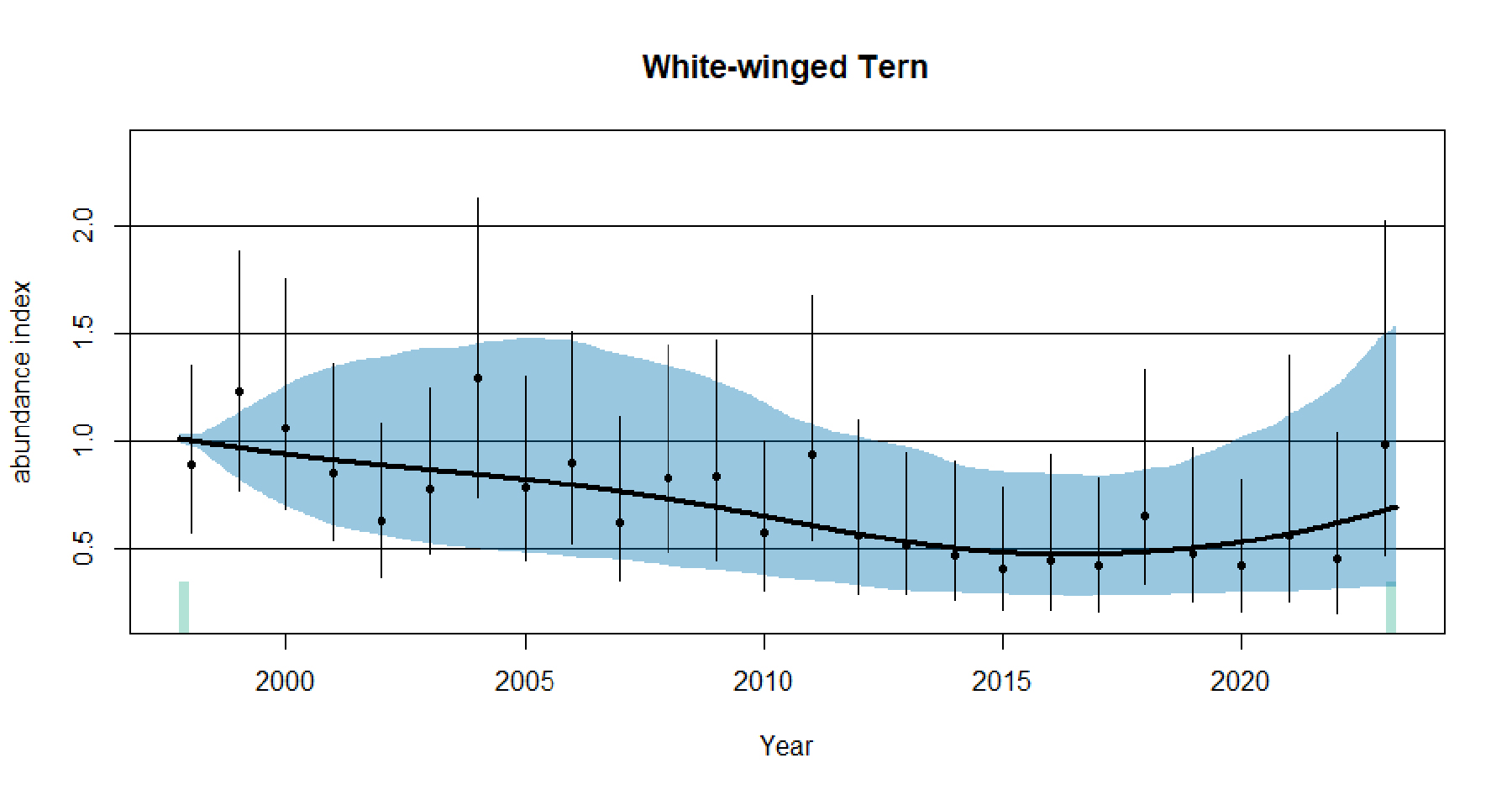
Figure 1: Trends in summer counts for White-winged Tern, from CWAC data, excluding Strandfontein. Including Strandfontein results in significant declines.
However, comparing reporting rate and range change between early SABAP2 (2007-2012) and late (2013-2023) the regional population appears stable. Widespread declines are noted between SABAP1 and SABAP2.
Overall, it appears that White-winged Terns are declining regionally. Confidence in this estimate is medium.
Table 1: Predicted modelled range change from SABAP2 for White-winged Tern. Predicted values indicated the modelled number of pentads White-winged Tern could occur in for the period up to 2015, and then until the end of 2023. The decline indicates a decline in Area of Occupancy (AOO) but this value does not meet the 30% threshold for Vulnerable under Criterion A.
|
Information |
|
|
Pentads 2015 |
2632 |
|
Pentads 2023 |
2528 |
|
Annual rate of change |
0.995 |
|
Percent change (10 years or 3 generations) |
-4.10% |
|
Category (A2) |
LC |
Table 2: Coefficient table for model in Figure 1 (all data from 1998, seasons in W, S and O): glmer (Count ~ scale (Year) + Season +(1|LocationCode), data = CWAC, family = poisson) (from Lee 2024).
|
Variables |
Estimate |
se |
Z |
p |
N_Locations |
N_Obs |
|
(Intercept) |
-0.743 |
0.145 |
-5.125 |
0 |
293 |
8540 |
|
scale(Year) |
-0.511 |
0.003 |
-146.695 |
0 |
293 |
8540 |
|
SeasonS |
1.696 |
0.008 |
222.218 |
0 |
293 |
8540 |
|
SeasonW |
-2.049 |
0.019 |
-108.410 |
0 |
293 |
8540 |
Biology & Ecology
Taxonomy
This species is monotypic with no recent changes noted (Gill et al. 2024).
Identification
23–27 cm; 42–79 g (mean 66 g in eastern Europe, 54 g in winter in South Africa), wingspan 58–67 cm. A medium sized tern; regionally occurs in non-breeding plumage of pale grey above, white below, and head white, with dusky crown and ear-coverts patch; very like non-breeding Whiskered Tern C. hybrida, but dark of crown and ear-coverts usually separated by white supercilium, usually shows darker grey band across lesser coverts, and often diagnostic black bar on underwing. Distinguished from similar but regionally rare Black Tern C. niger by lack of dark breast-side patches and paler head markings and upperwings; shorter-billed than that species. Moults back into breeding plumage in mid -March. Juvenile blackish-brown saddle and silver-grey wings, contrasting with white rump and collar; much more contrasting in plumage than juvenile C. niger and lacks dark neck-side patches of latter (Gochfeld et al. 2020).
Distribution
Widespread global distribution in Africa, eastern Europe and Asia (Figure 3). Breeds in northwest Italy and central and eastern Europe through Siberia, Transbaikalia and northern Mongolia to southeast Russia (Amur region) and adjacent northeast China. Some breeding records exists from New Zealand.
Non-breeding visitor in Africa, and from south Asia to New Guinea, Australia and New Zealand.
In South Africa, largely concentrated at inland wetlands, including ephemeral water bodies (Figure 3, Hockey and Tree 2005). Regularly at artificial water bodies, including sewage works and salt pans (Hockey and Tree 2005). Less common at coastal wetlands and estuaries, but large numbers occasionally forage over estuarine salt marshes (Hockey and Tree 2005). Uncommon on the coast (Figure 3, Hockey and Tree 2005).
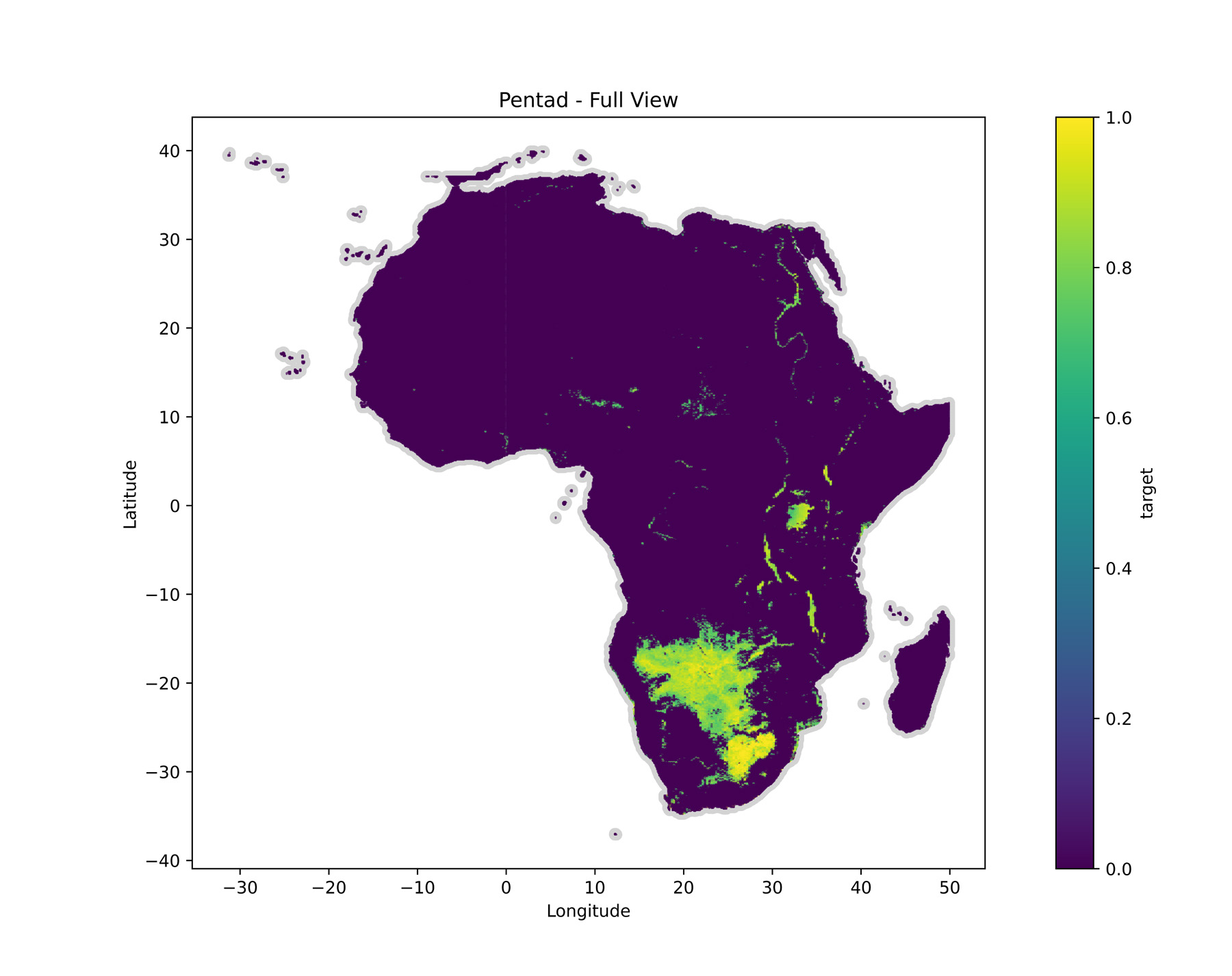
Figure 2: Africa White-winged Tern probability distribution map produced from African Bird Atlas Project (ABAP), iNaturalist and eBird data using a Random Forest model and various predictor variables. Colour gradient is predicted probability of occurrence, with a 0.5% threshold applied. Brighter colours = higher probability of occurrence (from Lee 2024).
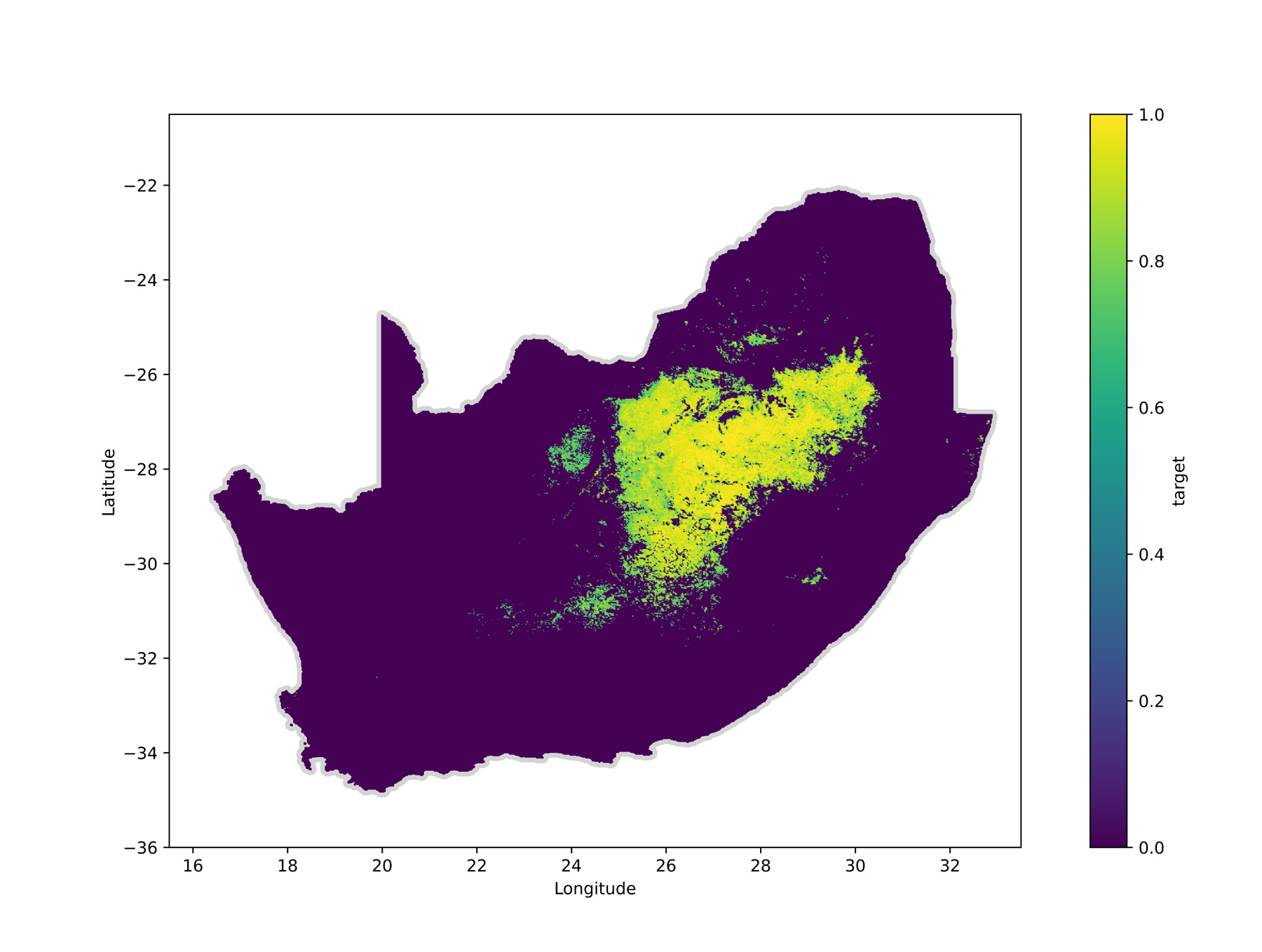
Figure 3: South Africa White-winged Tern probability distribution map, produced from BirdLasser location data at 2×2 km grid scale, using iNaturalist and eBird as absence data only. This represents the predicted range for the 2016-2023 period, and pentad scale p > 0.5 (from Lee 2024).
Ecology
Non-breeding visitor. Long-distance migrant. Generalist feeder, mainly aquatic insects but will also feed on fish, caterpillar and moth outbreaks and tadpoles (Gochfeld et al. 2020). Known to forage away from water, over terrestrial habitats, including valley bushveld and agricultural land (Vesey-FitzGerald 1955, Walter 1993, Hockey and Tree 2005, Gochfeld et al. 2020). Shows a preference for aquatic habitats, in South Africa, largely concentrated at inland wetlands, including ephemeral water bodies including artificial water bodies (Figure 3, Hockey and Tree 2005).
Threats & Conservation
Threats
No species-specific threats known. Presumably indirectly affected by trend in a decline in the quality of freshwater habitats. Phenology in South Africa known to be shifting due to climate change, the birds having advanced their departure from South Africa between the two atlas periods: 1987–1991 (SABAP1) and 2007–2012 (early SABAP2) (Bussière et al. 2015).
Conservation Measures Underway
Protected regionally by the Convention on the Conservation of Migratory Species of Wild Animals (CMS) and by the Agreement on the Conservation of African-Eurasian Migratory Waterbirds (AEWA) (https://www.cms.int/en/country/south-africa, Accessed on 19 August 2024).
White-winged Tern are present in 191 pentads that have a protection status, and present in 570 unprotected pentads, offering a relatively low protection ratio of 0.34 (Lee 2024).
Conservation Measures Proposed
Given that there are no key threats known regionally there are no specific conservation measures proposed. White-winged Terns would likely benefit from the improved conservation of freshwater habitats and a better understanding of the use of agrochemicals.
Research Priorities and Questions
- Establish an updated estimate of the regional population size.
- Ascertain whether there are regional factors causing a decline in White-winged Stork or whether the declines in the SABAP2 data represent declines outside of the region.
- Ascertain non-breeding ground habitat conditions that may be more favourable and therefore influence the presence in South Africa, i.e., declines in reporting are not because of population declines.
- Investigate whether there are specific threats facing this species regionally which can be addressed.
Contributors & References
Assessor/s
Sanjo Rose
Reviewer/s
David Ehlers Smith
References
BIRDIE. 2024. An online platform for African wetland and waterbird data. https://biodiversityadvisor.sanbi.org/contentmanagement/index?guid=42305260-12b0-4a92-912e-7d801d15fdac. [Accessed on 8 September 2024].
BirdLife International. 2016. Chlidonias leucopterus. The IUCN Red List of Threatened Species 2016: e.T22694782A86772583. https://dx.doi.org/10.2305/IUCN.UK.2016-3.RLTS.T22694782A86772583.en. [Accessed on 12 September 2024].
Bussière EMS, Underhill LG, Altwegg R. 2015. Patterns of bird migration phenology in South Africa suggest northern hemisphere climate as the most consistent driver of change. Global Change Biology 21: 2179–2190.
Convention on the Conservation of Migratory Species of Wild Animals: South Africa. https://www.cms.int/en/country/south-africa. [Accessed on 19 August 2024].
Gochfeld M, Burger J, Christie DA, Kirwan GM, Garcia EFJ. 2020. White-winged Tern (Chlidonias leucopterus), version 1.0. In: del Hoyo J, Elliott A, Sargatal J, Christie DA, de Juana E (eds), Birds of the World. Ithaca, NY, USA: Cornell Lab of Ornithology. https://doi.org/10.2173/bow.whwter.01
Gill F, Donsker D, Rasmussen P (eds). 2024. IOC World Bird List v14.1. https://doi.org/10.14344/IOC.ML.14.1
Harebottle DM, Williams AJ, Weiss Y, Tong GB. 2008. Waterbirds at Paarl wastewater treatment works, South Africa, 1994–2004: seasonality, trends and conservation importance. Ostrich 79: 147–163.
Hockey PAR, Tree AJ. 2005. White-winged Tern. In: Hockey PAR, Dean WRJ, Ryan PG (eds), Roberts birds of southern Africa 7th Edn. Cape Town: Trustees of the John Voelcker Bird Book Fund. pp 469–471.
Kalejta-Summers B, McCarthy M, Underhill LG. 2001. Long-term trends, seasonal abundance and energy consumption of waterbirds at Strandfontein, Western Cape, South Africa, 1953–1993. Ostrich 72: 80–95.
Knape J. 2016. Decomposing trends in Swedish bird populations using generalized additive mixed models. Journal of Applied Ecology 53: 1852–1861.
Lee ATK. 2024. Regional Red Data Book of the Birds of South Africa, Lesotho and Eswatini: SABAP2 Synthesis and Supporting Information and Graphics for White-winged Tern. Unpublished report. Johannesburg: BirdLife South Africa.
Vesey-FitzGerald DF. 1955. Birds as predators of the Red Locust (Nomadacris septemfasciata Serv.). Ostrich 26: 128–133.
Walter A. 1993. Unusual feeding behaviour of terns. Lanioturdus 27: 36.
Wetlands International. 2015. Waterbird Population Estimates. Available at: wpe.wetlands.org. [Accessed on 4 November 2024].
Williams AJ, Underhill LG. 1997. White-winged Tern. In: Harrison JA, Allan DG, Underhill LG, Herremans M, Tree AJ, Parker V, Brown CJ (eds), The Atlas of Southern African Birds. Vol. 1. Johannesburg: BirdLife South Africa. pp 484–485.
Citation
Rose S 2025. White-winged Tern. In: Lee ATK, Rose S, Banda S, Bezeng SB, Maphalala MI, Maphisa DH, Smit-Robinson H (eds), The 2025 Red Data Book of Birds of South Africa, Lesotho and Eswatini. Johannesburg, South Africa: BirdLife South Africa. Available at: https://www.birdlife.org.za/red-list/white-winged-tern/
Our generous sponsors


