


Black-winged Kite
Elanus caeruleus

Number Of Mature
Individuals (Regional)
Unknown

Regional
Population Trend
Decreasing
2025
Regional Category
Near Threatened
Search by species
CONTENTSOverview
Names
|
IOC English Name: |
Black-winged Kite |
|
SA & IOC Scientific Name: |
Elanus caeruleus |
|
BirdLife International Taxonomy (scientific name): |
Elanus caeruleus |
|
Order: |
ACCIPITRIFORMES |
|
Family: |
Accipitridae |
|
Species name author: |
Desfontaines 1789 |
|
Afrikaans: |
Blouvalk |
|
Sesotho (South Africa): |
phakwana-tshwana |
|
Sesotho (Lesotho): |
phakoana-tšoana |
|
Siswati: |
Lohheyane |
|
Zulu: |
udemezane, umazabelweni |
Current Assessment Status
|
2025 Regional Category [Criteria] |
NT [A2bc] |
|
2024 Global Category [Criteria] |
LC (BirdLife International 2019) |
|
Population size (Regional) |
Unknown |
|
Population size (Global) |
Unknown |
|
Distribution size (EOO) (Regional) km2 |
1 553 634 (Lee 2024) |
|
Distribution size (EOO) (Global) km2 |
132 000 000 (BirdLife International 2019) |
|
Distribution size (AOO) (Regional) km2 |
1 101 904 (Lee 2024) |
|
Generation time |
6.6 years |
|
Status change reason |
Genuine change in status |
|
Migrant (in the region) |
No |
|
Regional endemic |
No |
Historic Listing Information
|
2000 Regional Status |
Not Evaluated |
|
2015 Regional Status |
Not Evaluated |
|
Status change reason (if applicable) |
Not applicable |
|
2015 Population size (Regional) |
Unknown |
|
2015 Global Status |
LC |
Reason for Inclusion
Reason for Inclusion in the Assessment
Black-winged Kite Elanus caeruleus was not previously assessed. The species was identified for assessment through analysis of Southern African Bird Atlas Project (SABAP2) data, which suggested a significant decline in the probability of reporting the species.
Category Justification
Category Justification
The Black-winged Kite is assessed as regionally Near Threatened, approaching the threshold for Vulnerable under Criterion A2bc. The SABAP2 trend analysis indicates a significantly lower probability of reporting the species with high confidence (Lee 2024). The change metrics between SABAP1 and SABAP2 provide further evidence of a decline. The bootstrap results of ‘naive’ change metrics show that both the Z and C scores are strongly left-skewed, with peaks around -2, indicating a significant decrease in reporting rates between the two atlas periods (Figures 1, 2). This decline could approach 30% over three generations (19.8 years for this species), nearly meeting the threshold for Vulnerable.
However, the predicted range change based on modelled data suggests only a 4.60% decline over 10 years or three generations, which is less severe than the raw change metrics might suggest (Table 1). This discrepancy adds uncertainty to the assessment. The species has a large Extent of Occurrence (EOO) (1 553 634 km²) and Area of Occupancy (AOO) (1 101 904 km²), which do not meet the thresholds for threatened categories under Criterion B.
Given these factors, the species is assessed as Near Threatened, as it nearly meets the criteria for Vulnerable A2bc. This assessment reflects the apparent decline indicated by atlas data, while acknowledging the uncertainty in the magnitude of this decline and the species’ still widespread distribution in the region.
Table 1: Prediction models of the number of pentads a species could occur in for the period up to 2015, and then until the end of 2023 (from Lee 2024).
|
Information |
|
|
Pentads 2015 |
16547 |
|
Pentads 2023 |
15799 |
|
Annual rate of change |
0.994 |
|
Percent change (10 years or 3 generations) |
-4.60% |
|
Category (A2) |
LC |
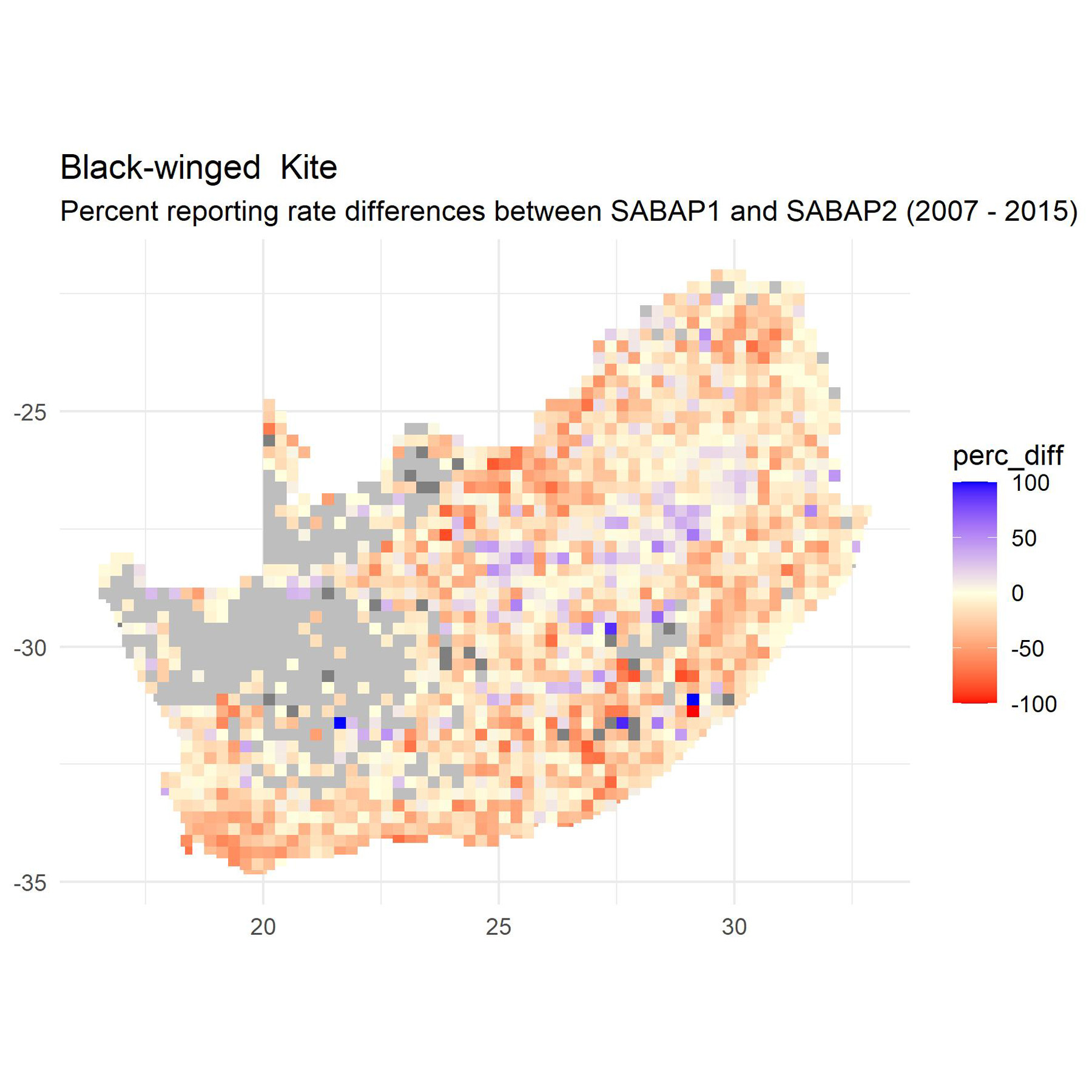
Figure 1: Quarter Degree Grid Cell level change between SABAP1 and the SABAP2 period 2007-2015, being roughly comparable in terms of time and effort (from Lee 2024).
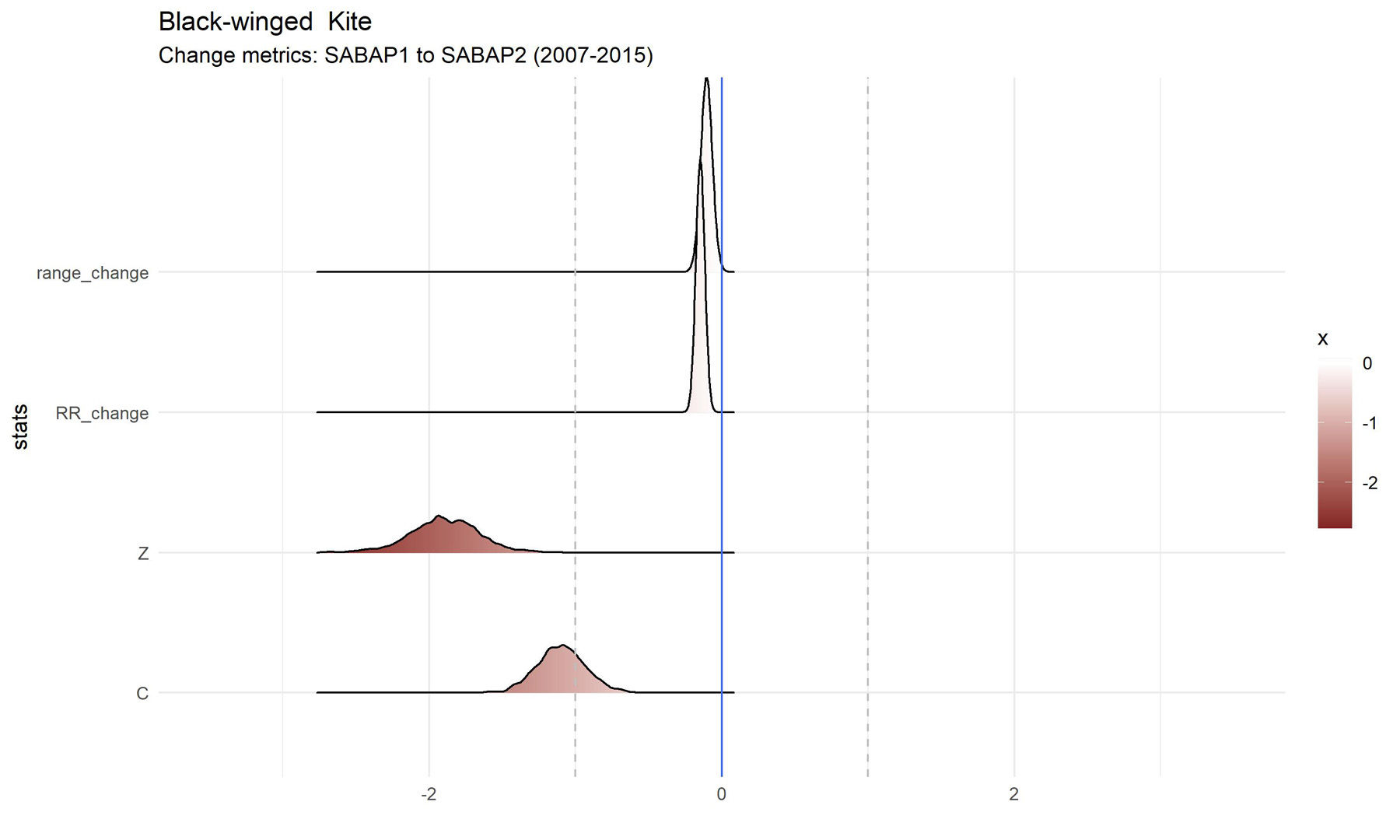
Figure 2: Bootstrap results of ‘naive’ change metrics. Reporting rate and range change are bounded by -1 and 1. The Underhill Z score is confidence in change. The centred C score used here is a potential magnitude of population change.
Population Justification
Globally, the species was described as one of the commonest birds of prey throughout its range (Kemp et al. 2015). Historically the South African population was estimated to be at <100 000 mature individuals (Tarboton and Allan 1984). No recent population estimate exists.
Trend Justification
Globally, the population is suspected to be stable (BirdLife International 2019), which contrasts with the regional data.
The predicted range change based on modelled data suggests a 4.60% decline over 10 years or three generations (Table 1), and the Coordinated Avifaunal Road Counts (CAR) data shows fluctuations in reporting rates and counts over time, with no clear overall trend. However, SABAP2 data indicates a significantly lower probability of reporting Black-winged Kite, with high confidence in the trend (Lee 2024). The change metrics between SABAP1 and SABAP2 provide further evidence of a decline. The bootstrap results of ‘naive’ change metrics show that both the Z and C scores are strongly left-skewed, with peaks around –2 (Figure 2). The Z score, reflecting the confidence in change while accounting for sample size, suggests a high confidence in a decrease in reporting rates across much of the species’ range. The C score, indicating the potential magnitude of population change, also suggests a substantial decline in relative abundance (Figure 2).
Biology & Ecology
Taxonomy
The taxonomy follows that of the IOC World Bird List and BirdLife International. No recent taxonomic changes have been noted for this species. There are three subspecies of Black-winged Kite:
E. c. caeruleus (Desfontaines 1789) – found in southwest Iberian Peninsula, Africa, southwest Arabia.
E. c. vociferus (Latham 1790) – found from Pakistan to east China, Malay Peninsula and Indochina.
E. c. hypoleucus (Gould 1859) – found in the Greater and Lesser Sunda Islands, the Philippines, Sulawesi and New Guinea.
Identification
30 cm, c. 240–260 g. The Black-winged Kite is a small raptor with distinctive plumage. Adults have grey upperparts, white underparts, and black shoulder patches. The eyes are red, and the bill is black. In flight, it shows black wingtips and a white tail. Juveniles have a buffy wash to the plumage and brown eyes. The species can be distinguished from other small raptors in the region by its habit of hovering while hunting and its distinctive plumage pattern (Hustler and Dean 2005).
Distribution
The Black-winged Kite has a wide distribution across Africa, southern Europe, and parts of Asia. Within the assessment region, it is found across much of South Africa, Lesotho, and Eswatini, particularly in open habitats. The species occurs from sea level up to 3000 m asl.
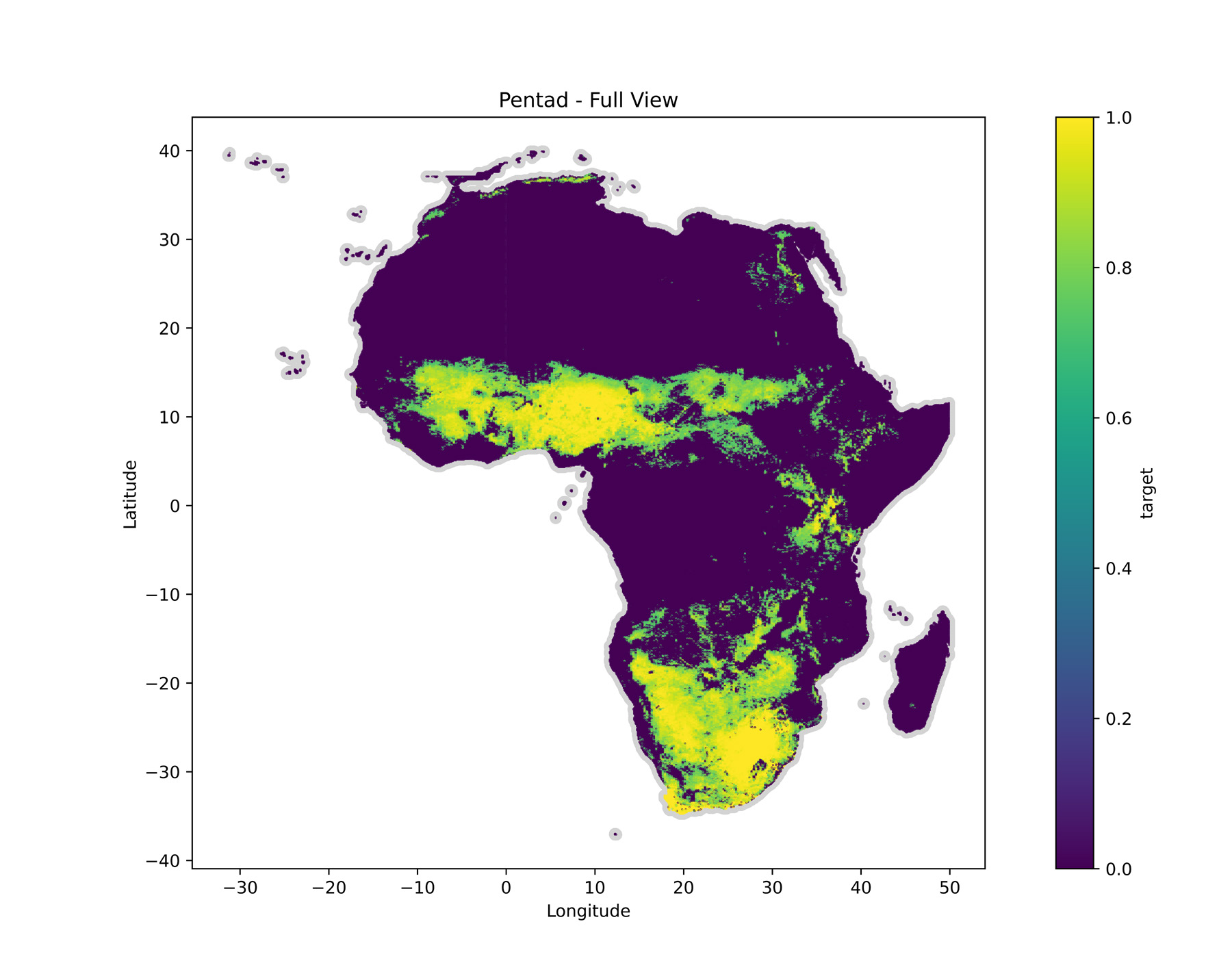
Figure 3: Africa distribution maps for Black-winged Kite produced from ABAP, iNaturalist and eBird data using a Random Forest model and various predictor variables. Colour gradient is predicted probability of occurrence, with a 0.5% threshold applied. Brighter colours = higher probability of occurrence (from Lee 2024).
Ecology
The Black-winged Kite inhabits open habitats including savanna, shrubland, grassland, and agricultural areas. It is primarily a rodent specialist but also feeds on small birds, reptiles, and large insects. The species hunts by hovering or from a perch. Breeding can occur year-round depending on food availability. Nests are built in trees, and clutch size is typically 3–4 eggs. The species is generally sedentary but can be nomadic in response to prey availability (Hustler and Dean 2005).
Threats & Conservation
Threats
This is another poorly studied species in the region. Historical records indicate that causes of mortality include collisions with barbed-wire fences, becoming hooked, spiked or tangled in thorns of Umbrella Thorn Vachellia tortilis, or tangled in clinging seed heads of Klitsgras Setaria verticillata (Mendelsohn 1983). Also recorded as prey of Tawny Eagle, Bateleur and Spotted Eagle Owl (Hustler and Dean 2005).
It is not clear how this species may be affected by the use of rodenticides and pesticides in agricultural areas (Ferguson-Lees and Christie 2001). The species appears to be adaptable to human-modified landscapes, which may buffer it against some habitat changes. However, the apparent decline in reporting rates suggests that there may be unidentified threats affecting the species in the region.
Conservation Measures Underway
No species-specific conservation measures are currently underway. The Black-winged Kite is present in 681 pentads within National Parks or Nature Reserves and an additional 521 pentads in other protected areas (Lee 2024). However, the ratio of the species’ range in protected areas to unprotected areas is 0.33, indicating that most of its range falls outside of formal protection. The species is listed on CITES Appendix II.
Conservation Measures Proposed
- Monitor population trends through continued participation in citizen science projects like SABAP2 and CAR.
- Investigate the potential impacts of pesticide and rodenticide use on the species, particularly in agricultural areas.
- Promote wildlife-friendly farming practices (including for barbed-wire fences) that maintain suitable habitat and prey populations for the Black-winged Kite, and minimise the risk of entanglement in fences.
- Conduct more detailed population studies to obtain accurate estimates of population size and trends in the region.
- Identify and protect key breeding and foraging areas, particularly in regions showing significant declines in reporting rates.
Research Priorities and Questions
- Determine the regional population size and trends through targeted surveys across the species’ range in the region.
- Investigate the factors driving the observed decline in reporting rates, despite the species’ apparent adaptability to human-modified landscapes.
- Study the species’ breeding success and survival rates in different habitat types, including natural and human-modified landscapes.
- Assess the impact of rodenticide and pesticide use on Black-winged Kite populations in agricultural areas.
- Investigate the species’ role in ecosystem services, particularly in rodent control in agricultural landscapes.
- Investigate the causes of the apparent decline in reporting rates between SABAP1 and SABAP2, considering factors such as changes in land use, prey availability, and potential impacts of climate change.
- Conduct targeted surveys to validate the population trends suggested by the atlas data, particularly in areas showing the most significant declines in reporting rates.
Contributors & References
Assessor/s
David Ehlers Smith
Reviewer/s
Sanjo Rose
References
BirdLife International. 2019. Elanus caeruleus. The IUCN Red List of Threatened Species 2019: e.T22695028A152521997. Available: https://dx.doi.org/10.2305/IUCN.UK.2019-3.RLTS.T22695028A152521997.en
Ferguson-Lees J, Christie DA. 2001. Raptors of the world. London: Christopher Helm.
Hustler K, Dean WRJ. 2005. Black-shouldered Kite. In: Hockey PAR, Dean WRJ, Ryan PG (eds), Roberts birds of southern Africa (7th Edn). Cape Town: Trustees of the John Voelcker Bird Book Fund. pp 479–480.
Kemp AC, Kirwan GM, Marks JS, Motis A, Garcia EFJ. 2015. Black-winged Kite (Elanus caeruleus). In: del Hoyo J, Elliott A, Sargatal J, Christie DA, de Juana E (eds), Handbook of the Birds of the World Alive. Barcelona: Lynx Edicions.
Lee ATK. 2024. Regional Red Data Book of the Birds of South Africa, Lesotho and Eswatini: SABAP2 synthesis and supporting information and graphics for Black-winged Kite. Unpublished report. Johannesburg: BirdLife South Africa.
Mendelsohn J. 1983. Causes of mortality in Black-shouldered Kites. Bokmakierie 35: 11–13.
Tarboton WR, Allan DG. 1984 The status and conservation of birds of prey in the Transvaal. Transvaal Museum Monograph 3: 1–115.
Citation
Ehlers Smith DA 2025. Black-winged Kite. In: Lee ATK, Rose S, Banda S, Bezeng SB, Maphalala MI, Maphisa DH, Smit-Robinson H (eds), The 2025 Red Data Book of Birds of South Africa, Lesotho and Eswatini. Johannesburg, South Africa: BirdLife South Africa. Available at: https://www.birdlife.org.za/red-list/black-winged-kite/
Our generous sponsors


