


Grey Plover
Pluvialis squatarola

Number Of Mature
Individuals (Regional)
<10 000

Regional
Population Trend
Decreasing
2025
Regional Category
Near Threatened
Search by species
CONTENTSOverview
Names
|
IOC English Name: |
Grey Plover |
|
SA & IOC Scientific Name: |
Pluvialis squatarola |
|
BirdLife International Taxonomy (scientific name): |
Pluvialis squatarola |
|
Order: |
CHARADRIIFORMES |
|
Family: |
Charadriidae |
|
Species name author: |
Linneaus 1758 |
|
Afrikaans: |
Grysstrandkiewiet |
|
Sesotho (South Africa): |
patapeta-putswa |
|
Sesotho (Lesotho): |
patapeta-putsoa |
|
Siswati: |
|
|
isiZulu: |
umakhwaphamnyama |
Current Assessment Status
|
2025 Regional Status [Criteria] |
NT [A2b] |
|
2024 Global Status [Criteria] |
VU [A2bcd+4bcd] (BirdLife International 2024) |
|
Population size (Regional) |
Unknown |
|
Population size (Global) |
1 000 000 – 2 500 000 (BirdLife International 2024) |
|
Distribution size (EOO) (Regional) km2 |
1 289 361 (Lee 2024) |
|
Distribution size (EOO) (Global) km2 |
19 000 000 (BirdLife International 2024) |
|
Distribution size (AOO) (Regional) km2 |
70 350 (BIRDIE 2024) |
|
Generation time |
7.55 years (BirdLife International 2024) |
|
Status change reason |
Genuine change in status |
|
Migrant (in the region) |
Full migrant (non-breeding) |
|
Regional endemic |
No |
Historic Listing Information
|
2000 Regional Status |
Not Evaluated |
|
2015 Regional Status |
Not Evaluated |
|
Status change reason (if applicable) |
Not applicable |
|
2015 Population size (Regional) |
Unknown |
|
2015 Global Status |
LC |
Reason for Inclusion
Reason for Inclusion in the Assessment
This species was not previously included in the Regional Red List Assessments. This is a non-breeding migrant, with c. 6% of the Extent of Occurrence (EOO) falling within the region. Preliminary analyses of Coordinated Waterbird Counts (CWAC) data indicated possible significant regional declines.
Category Justification
Category Justification
Grey Plover Pluvialis squatarola is widespread throughout the region with a large Area of Occupancy (AOO) and EOO. This species is a non-breeding visitor to the region which was uplisted to globally Vulnerable in 2024 based on widespread population declines (BirdLife International 2024).
The regional population comprises of the subspecies P. s. squatarola and population size is unknown. Analyses of CWAC data indicate that the population has undergone significant declines over the past three generations, reflecting global trends although the regional rate of decline does not yet meet the 30% threshold for Vulnerable.
Grey Plover is assessed as regionally Near Threatened Criterion A2b.
Population Justification
Global population size is estimated at 1 000 000 – 2 500 000 mature individuals (BirdLife International 2024. This species has an immense global distribution, spanning all major flyways. A dated estimate puts the non-breeding (‘over-wintering’) east African and south-west Asia suspected to be c. 90 000 (Wetlands International 2012) while the non-breeding population in Western Europe and West Africa were estimated to number c. 200 000 (von Roomen et al. 2014, Nagy and Langendoen 2020).
The current regional population size is unknown but was estimated by Summer et al. (1987) at 9000 birds.
Trend Justification
Globally, significant declines are reported, warranting a global uplisting to Vulnerable in 2024 (BirdLife International 2024).
Regionally, CWAC totals have declined for this species. While poptrend analyses using generalised additive models estimate very steep declines of -80% (95% CI: -90%, -60%) over three generations caution is needed when interpreting these results. The rate of decline seems to have largely occurred pre-2015, specifically between 2000-2010. Since 2015 the rate seems to have slowed, with no significant declines recorded, although the population does not appear to have recovered (Figure 1).
Within the second Southern African Bird Atlas Project (SABAP2 (2007-2023)) no significant declines in reporting rate or change in modelled AOO are recorded (Lee 2024). Comparing SABAP1 (1987-1997) and SABAP2 (2007-2015) there is evidence of extensive range contraction (Figure 2, Lee 2024). Overall, the regional population is assessed as in decline.
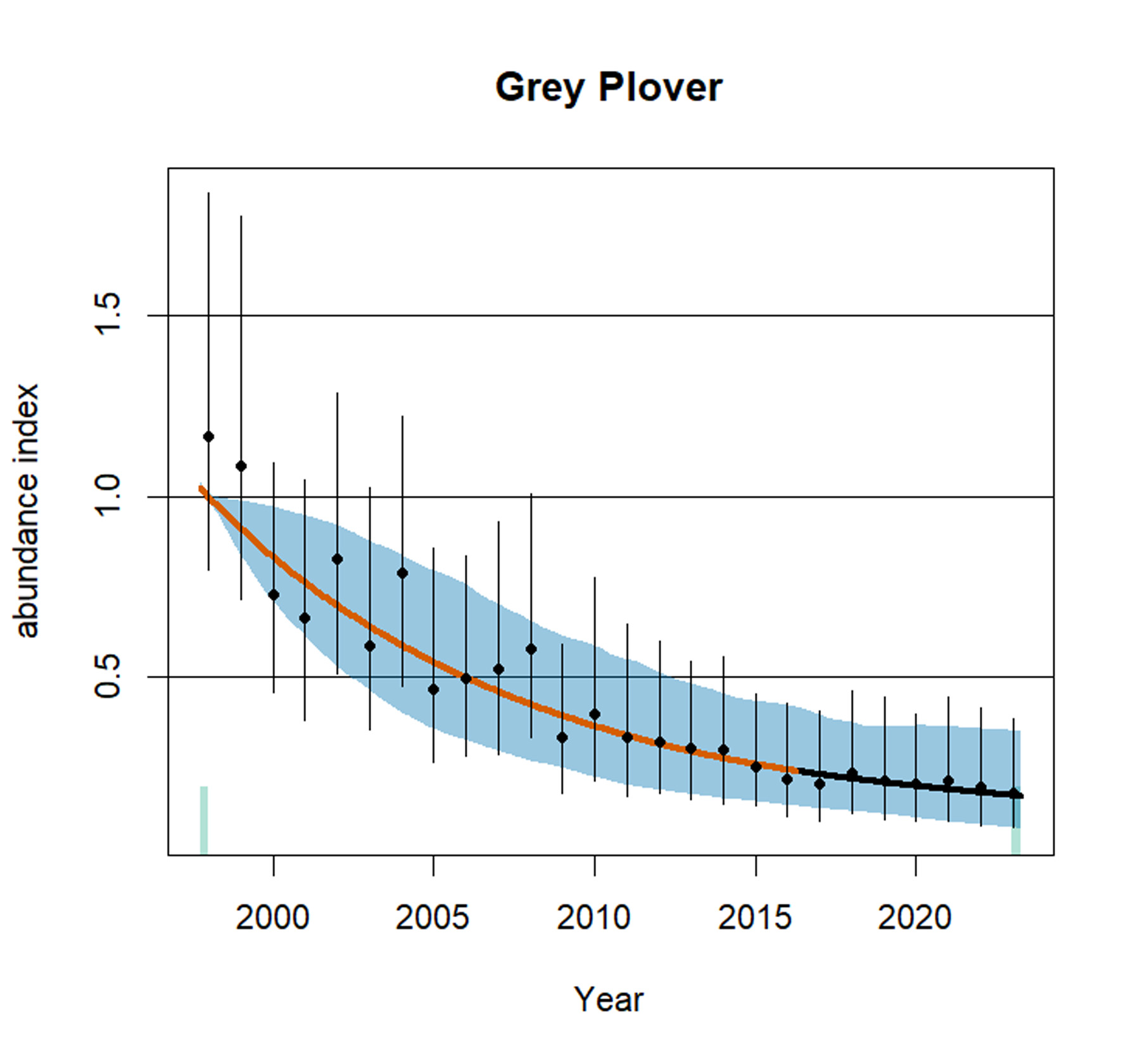
Figure 1: Change in abundance index over three generations for Grey Plover from CWAC data using the poptrend model pathway. Orange indicates significant declines.

Figure 2: Comparison of reporting rates between SABAP1 (1987-1997) and SABAP2 (2007-2015) indicating pentads where reporting rates declined (red), remained stable (cream) or increased (blue). Map from Lee (2024).
Biology & Ecology
Taxonomy
Originally placed in the Tringa genus by Linnaeus, Grey Plover was placed in the genus Pluvialis in 1860 (Brisson) along with its sister taxa (American P. dominica, Pacific P. fulva and European Golden Plovers P. apricaria). Known as ‘Black-bellied Plover’ in the Americas. Three subspecies are described: P. s. squatarola (Linnaeus 1758), is present in the region during the austral summer, and breeds in north Eurasia and Alaska, with a non-breeding distribution in west, south Europe, Africa, south, east Asia and Australasia and west Americas; P. s. tomkovichi (Engelmoer and Roselaar 1998), which breeds on Wrangel Island (northeast Siberia), and P. s. cynosurae (Thayer and Bangs 1914) which breeds north Canada and has a non-breeding distribution along coastal North and South America. The nominate subspecies is larger than P. s. cynosurae, typically less contrasting black and white plumage (Poole et al. 2020).
Identification
27–30 cm with a wingspan of 71–83 cm (Turpie 2005). Sexes are similar in appearance. They have a large body, with large head, thick neck and a stout black pointed bill (Poole et al. 2020). They have large dark brown eyes, and short greyish-black legs and toes, often with a small hind toe (Poole et al. 2020).
The upperparts of male grey plovers display a pattern of white, mottled, and striped markings against a black background (Poole et al. 2020). In comparison, the markings on females are more understated, usually appearing as a mixture of light and dark brown tones (Poole et al. 2020). Males exhibit solid black underparts from the chin to the upper belly, while females have a mixture of black and white in this area, with black colouration heavily interspersed with white patches (Poole et al. 2020). Juveniles’ plumages are duller and mostly buff brown striping (Poole et al. 2020).
Confusing species: The Grey Plover can be mistaken for the American and Pacific Golden Plovers, which are smaller and slenderer with a browner appearance (Snow and Perrins 1998).
Distribution
The Grey Plover is a long-distance migratory bird. The breeding range is immense, extending across the high Arctic tundra regions of North America, Europe, and Asia (Turpie 2005) and extends to the northern parts of Alaska and Canada including regions such as Greenland, Iceland, Scandinavia, and Siberia (Poole et al. 2020). During non-breeding season, they have a distribution along the coastlines (Turpie 2005) and occur along the entire coastline of Africa, with the occasional vagrants inland (Underhill 1997, Turpie 2005).
Ecology
During breeding season, they are usually encountered in high Arctic areas utlilizing stony dry tundra featuring dwarf birch, sedges, grass, moss, and lichens, peat ridges in tundra marshes, riverbanks or sandy or gravel beaches (Johnsgard 1981, del Hoyo et al. 1996, Snow and Perrins 1998). During the non-breeding period, they inhabit intertidal mudflats, bays, estuaries, salt marshes and beaches (Johnsgard 1981, del Hoyo et al. 1996). While migrating, they may also visit inland lakes, pools, and grasslands, although most birds tend to migrate directly to coastal areas after breeding (del Hoyo et al. 1996).
Fully migratory species. Mainly arrives on South African coastlines by September for summer and departs in April in winter (Turpie 2005). Young birds below the age of two years old do not migrate and typically remain on non-breeding grounds (Hayman 1986, Snow and Perrins 1998)
Forages in a typical plover fashion of run-stop-search where they stand motionless for a few seconds before abruptly capturing the prey (Turpie 2005). Typically feeds in exposed mud or sand but can go into shallow water (Turpie 1994). Feed chiefly on polycheate worms, crustaceans such as crabs and prawns, molluscs, insects and their larvae as well as small fishes (Johnsgard 1981, del Hoyo et al. 1996, Turpie 2005).
Threats & Conservation
Threats
Climate change and severe weather are thought to affect this species through various pathways, including habitat alteration such as rising sea levels which can lead to the loss or degradation of coastal habitats (e.g. mudflats, salt marshes, sandy beaches), destroying important non-breeding habitats (Galbraith et al. 2002). Changes in temperature and precipitation patterns may also affect the quality and availability of breeding habitats in the Arctic tundra (Wauchope et al. 2017).
Changes in food availability: Climate change can alter the abundance, distribution, and timing of emergence of invertebrate prey species, such as insects and marine worms, which Grey Plovers rely on for food (Pearce-Higgins et al. 2010). Mismatches between the timing of prey availability and the plovers’ migration and breeding schedules can negatively impact their survival and reproductive success (van Gils et al. 2016).
Extreme weather events: Increased frequency and intensity of storms, hurricanes, and storm surges can cause direct mortality, destroy nests, and alter habitats used by Grey Plovers during breeding and non-breeding seasons (Hüppop and Hüppop 2003, van de Pol et al. 2010).
Disruption of migration patterns: Climate change may affect the timing and routes of Grey Plover migrations, as the birds rely on environmental cues and favourable weather conditions to guide their journeys between breeding and non-breeding grounds (Senner et al. 2017).
Increased competition and disease risk: As climate change alters habitats and species distributions, Grey Plovers may face increased competition for resources with other species that expand their ranges. They may also be exposed to new pathogens or parasites (Mallory et al. 2010).
It is also affected by hunting during migration (Cutts et al. 2009), and oyster farming in intertidal areas by interfering with their complex territorial behavior, the trestles used in oyster farming disrupt their normal territorial activities, which are crucial for their feeding and survival (Gittings and O’Donoghue 2012).
Conservation Measures Underway
The species is protected under the Convention on the Conservation of Migratory Species of Wild Animals (CMS) and Agreement on the Conservation of African-Eurasian Migratory Waterbirds (AEWA). A third of the pentads in which the species was recorded are regionally protected (Lee 2024).
Conservation Measures Proposed
Support management/mitigation measures to mitigate and reduce effluent and pollution runoff into estuaries. Support monitoring efforts to ascertain population status and trends over time. With a relatively low proportion of its regional range protected, support efforts to increase protected area expansion.
Research Priorities and Questions
- Comprehensive abundance estimates across its range to confirm predicted decline.
- Identify whether there are regional drivers of decline which can be addressed.
- Continue support for CWAC and motivate for more sites to be monitored and increased counts during the year to better capture population changes.
Contributors & References
Assessor/s
David Ehlers Smith, Maria Paul
Reviewer/s
Adrian Craig
References
BIRDIE. 2024. An online platform for African wetland and waterbird data. Available at: https://biodiversityadvisor.sanbi.org/contentmanagement/index?guid=42305260-12b0-4a92-912e-7d801d15fdac
BirdLife International. 2019. Pluvialis squatarola. The IUCN Red List of Threatened Species 2019: e.T22693749A154513104. Available: https://dx.doi.org/10.2305/IUCN.UK.2019-3.RLTS.T22693749A154513104.en. [Accessed on 10 May 2024].
BirdLife International. 2024. Pluvialis squatarola. The IUCN Red List of Threatened Species 2024: e.T22693749A254375039. https://dx.doi.org/10.2305/IUCN.UK.2024-2.RLTS.T22693749A254375039.en. [Accessed on 28 January 2025].
Brisson MJ. 1760. Ornithologie, ou, Méthode Contenant la Division des Oiseaux en Ordres, Sections, Genres, Especes and leurs Variétés (in French and Latin). Paris: Jean-Baptiste Bauche.
Cutts N, Phelps A, Burdon D. 2009. Construction and waterfowl – defining sensitivity, response, impacts and guidance. Report to Humber INCA.
del Hoyo J, Elliott, A, Sargatal J. 1996. Handbook of the Birds of the World, vol. 3: Hoatzin to Auks. Barcelona, Spain: Lynx Edicions.
Engelmoer M, Roselaar CS. 1998. Geographical Variation in Waders. Dordrecht, Boston, L: Kluwer Academic Publishers.
Galbraith H, Jones R, Park R, Clough J, Herrod-Julius S, Harrington B, Page G. 2002. Global climate change and sea level rise: potential losses of intertidal habitat for shorebirds. Waterbirds 25: 173–183.
Gittings T, O’Donoghue PD. 2012. The effects of intertidal oyster culture on the spatial distribution of waterbirds. Atkins, Cork: Marine Institute.
Hayman P, Marchant J, Prater AJ. 1986. Shorebirds. London: Croom Helm.
Hüppop O, Hüppop K. 2003. North Atlantic Oscillation and timing of spring migration in birds. Proceedings of the Royal Society of London. Series B: Biological Sciences 270(1512): 233–240.
Johnsgard PA. 1981. The plovers, sandpipers and snipes of the world. Lincoln, U.S.A. and London: University of Nebraska Press.
Knape J. 2016. Decomposing trends in Swedish bird populations using generalized additive mixed models. Journal of Applied Ecology 53: 1852–1861.
Lee ATK. 2024. Regional Red Data Book of the Birds of South Africa, Lesotho and Eswatini: SABAP2 synthesis and supporting information and graphics for Grey Plover. Unpublished report. Johannesburg: BirdLife South Africa.
Linnaeus C. 1758. Systema Naturae per regna tria naturae, secundum classes, ordines, genera, species, cum characteribus, differentiis, synonymis, locis (in Latin). Vol. 1 (10th ed.). Holmiae (Stockholm): Laurentii Salvii. pp 149.
Mallory ML, Robinson SA, Hebert CE, Forbes MR. 2010. Seabirds as indicators of aquatic ecosystem conditions: a case for gathering multiple proxies of seabird health. Marine Pollution Bulletin 60(1): 7–12.
Nagy S, Langendoen T. 2020. Flyway trend analyses based on data from the African-Eurasian Waterbird Census from the period of 1967-2018. The Netherlands: Wageningen. Available: http://iwc.test.wetlands.org/index.php/aewatrends8.
Pearce-Higgins JW, Dennis P, Whittingham MJ, Yalden DW. 2010. Impacts of climate on prey abundance account for fluctuations in a population of a northern wader at the southern edge of its range. Global Change Biology 16(1): 12–23.
Poole AF, Pyle P, Patten MA, Paulson DR. 2020. Black-bellied Plover (Pluvialis squatarola). In: Billerman SM (ed), Birds of the World version 1.0. Ithaca, NY, USA: Cornell Lab of Ornithology. Available: https://doi.org/10.2173/bow.bkbplo.01.
Senner NR, Stager M, Sandercock BK. 2017. Ecological mismatches are moderated by local conditions for two populations of a long-distance migratory bird. Oikos 126(1): 61–72.
Snow DW, Perrins CM. 1998. The Birds of the Western Palearctic, Volume 1: Non-Passerines. Oxford: Oxford University Press.
Summers RW, Underhill LG, Pearson DJ, Scott DA. 1987. Wader migration systems in southern and eastern Africa and western Asia. Wader Study Group Bulletin 49: 15–34.
Turpie JK. 1994. Comparative foraging ecology of two broad-ranging migrants, Grey Plover Pluvialis squatarola and Whimbrel Numenius phaeopus (Aves: Charadrii), in tropical and temperate latitudes of the Western Indian Ocean. PhD Thesis, Universty of Cape Town.
Turpie J. 2005. Grey Plover. In: Hockey PAR, Dean WRJ, Ryan PG (eds), Roberts – Birds of Southern Africa (7th Edn). Cape Town, South Africa: The Trustees of the John Voelcker Bird Book Fund. pp 395–396.
Thayer JE, Bangs O. 1914. Notes on the buds and mammals of the Arctic coast of Fast Siberia. Proceedings of the New England Zoological Club 5: 1–48.
Underhill LG 1997. Grey Plover. In: Harrison JA et al. (eds). The Atlas of Southern African Birds. Vol. 1: 388–389.
van Gils JA, Lisovski S, Lok T, Meissner W, Ożarowska A, de Fouw J, Rakhimberdiev E, Soloviev MY, Piersma T, Klaassen M. 2016. Body shrinkage due to Arctic warming reduces Red Knot fitness in tropical wintering range. Science 352(6287):819-21.
Van de Pol M, Ens BJ, Heg D, Brouwer L, Krol J, Maier M, Exo K-M, Oosterbeek K, Lok T, Eising CM, Koffijberg K. 2010. Do changes in the frequency, magnitude and timing of extreme climatic events threaten the population viability of coastal birds? Journal of Applied Ecology 47(4): 720–730.
van Roomen M, van Winden E, Langendoen T. 2014. The assessment of trends and population sizes of a selection of waterbird species and populations from the coastal East Atlantic Flyway for Conservation Status Report 6 of The African Eurasian Waterbird Agreement.
Wauchope HS, Shaw JD, Varpe Ø, Lappo EG, Boertmann D, Lanctot RB, Fuller RA. 2017. Rapid climate-driven loss of breeding habitat for Arctic migratory birds. Global Change Biology 23(3): 1085–1094.
Wetlands International. 2012. Waterbird Population Estimates: Fifth Edition. Summary Report. Edited by Taej Mundkur and Szabolcs Nagy. Wageningen, The Netherlands: Wetlands International.
Citation
Ehlers Smith DA, Paul M 2025. Grey Plover. In: Lee ATK, Rose S, Banda S, Bezeng SB, Maphalala MI, Maphisa DH, Smit-Robinson H (eds), The 2025 Red Data Book of Birds of South Africa, Lesotho and Eswatini. Johannesburg, South Africa: BirdLife South Africa. Available at: https://www.birdlife.org.za/red-list/grey-plover/
Our generous sponsors


