


Striated Heron
Butorides striata

Number Of Mature
Individuals (Regional)
Unknown

Regional
Population Trend
Decreasing
2025
Regional Category
Least Concern
Search by species
CONTENTSOverview
Names
|
South Africa Name: |
Striated Heron |
|
IOC English Name: |
Striated Heron |
|
SA & IOC Scientific Name: |
Butorides striata |
|
BirdLife International Taxonomy (scientific name): |
Butorides striata |
|
Order: |
PELECANIFORMES |
|
Family: |
Ardeidae |
|
Species name author: |
Linnaeus 1758 |
|
Afrikaans: |
Groenrugreier |
|
Sesotho (South Africa): |
Kokolofitwe ya mokokotlotala |
|
Sesotho (Lesotho): |
|
|
Siswati: |
|
|
Zulu: |
umacutholuhlaza |
Current Assessment Status
|
2025 Regional Status [Criteria] |
LC |
|
2024 Global Status [Criteria] |
LC (BirdLife International 2022) |
|
Population size (Global) |
173 000 – 1 500 000 (BirdLife International 2022) |
|
Population size (Regional) |
Unknown |
|
Distribution size (EOO) (Regional) km2 |
1 269 838 (Lee 2024) |
|
Distribution size (EOO) (Global) km2 |
287 000 000 (BirdLife International 2022) |
|
Distribution size (AOO) (Regional) km2 |
116 850 (BIRDIE 2024) |
|
Generation time |
5.1 years (BirdLife International 2022) |
|
Status change reason |
No change |
|
Migrant (in the region) |
No |
|
Regional endemic |
No |
Historic Listing Information
|
2000 Regional Status |
Not Evaluated |
|
2015 Regional Status |
Not Evaluated |
|
Status change reason (if applicable) |
Not applicable |
|
2015 Population size (Regional) |
Unknown |
|
2015 Global Status |
LC |
Reason for Inclusion
Reason for Inclusion in the Assessment
This species was not assessed previously. Preliminary screening of Coordinated Waterbird Counts (CWAC) trend data indicated a significant decline in the number of Striated Heron Butorides striata counted per year (Figure 1, Lee 2024).
Category Justification
Category Justification
The Striated Heron is assessed as Least Concern in the region because the species has a large regional Extent of Occurrence (EOO) of 1 269 838 km² and Area of Occupancy (AOO) of 116 850 km², which do not approach the thresholds for threatened categories under Criterion B (Lee 2024). While the CWAC data shows a decline, the Southern African Bird Atlas Project (SABAP2) trend analysis indicates a stable probability of reporting with high confidence (Lee 2024). The predicted range change suggests an 8% decrease over 10 years or three generations, which does not meet the threshold for a threatened category under Criterion A (Table 1, Lee 2024). Although the regional population size is unknown, it is believed to exceed 10 000 mature individuals.
Population Justification
Striated Heron has a large global distribution with multiple subspecies. This species remains generally poorly studied and population estimates are difficult to determine due to its secretive and solitary nature (e.g. Hancock and Kushlan 1984, Del Hoyo et al. 1992, Martínez-Vilalta et al. 2018). The global population of Striated Heron is estimated at 173 000 – 1 500 000 mature individuals (BirdLife International 2022). The regional population size is unknown (Louw 2005, Martínez-Vilalta et al. 2018) although it is likely to be a small fraction of the global estimate, given the species’ wide global distribution.
Trend Justification
The regional population trend is uncertain. SABAP2 data analysis shows a stable probability of reporting with high confidence (Lee 2024). However, the predicted range change suggests an 8% decrease over 10 years or three generations (Lee 2024). SABAP2 trend data indicates a significant decline in counts over time (Lee 2024). Given these conflicting trends, more research is needed to determine the actual population trend in the region.
Table 1: Predicted number of pentads Striated Heron occurred in for the period 2007-2015, and 2016-2023 (from Lee 2024).
|
Information |
|
|
Pentads 2015 |
2653 |
|
Pentads 2023 |
2456 |
|
Annual rate of change |
0.99 |
|
Percent change (10 years or 3 generations) |
-8% |
|
Category (A2) |
LC |
Biology & Ecology
Taxonomy
Monotypic. Previously split as B. striata and B. virescens following AOU (2003), and before then as B. striatus and B. sundevalli following Sibley and Monroe (1990, 1993) (BirdLife International 2022). The common name was previously Green-backed Heron.
Identification
35–48 cm. Sexes are alike. Adults breeding: have a black crown with a green gloss and crest, yellow lores, and a white cheek area divided by a black stripe (Louw 2005). Their upper parts are mostly dark green, and the throat is white, with the upper breast and foreneck showing a rufous-brown streak (Louw 2005). The underparts are grey, and their legs and feet are bright orange to yellow and their bill is black (Louw 2005). Adult non-breeding: Juveniles are dark brown with white spots above and heavily streaked and blotched with brown and buff below (Louw 2005).
Confusing species: can be confused with the Dwarf Bittern Ixobrychus sturmii, but Dwarf Bittern is much smaller and has darker upper parts, without white spots. Additionally, adult Dwarf Bitterns have heavily black-streaked underparts, while adult Striated Herons have plain grey underparts (Louw 2005).
Distribution
The Striated Heron has a wide global distribution, occurring in the Americas, southern Asia, Australia, and Africa (Hancock and Kushlan 1984, del Hoyo et al. 1992). In Southern Africa, it is widely distributed in eastern Botswana, Zimbabwe, Namibia, Mozambique, and South Africa (Maclean 1993, Navarro 1997). Within South Africa, it is most common in the northeastern parts (Figure 1), while its presence becomes more scattered and sparser in the Northern Cape, Eastern Cape and the Free State Provinces.
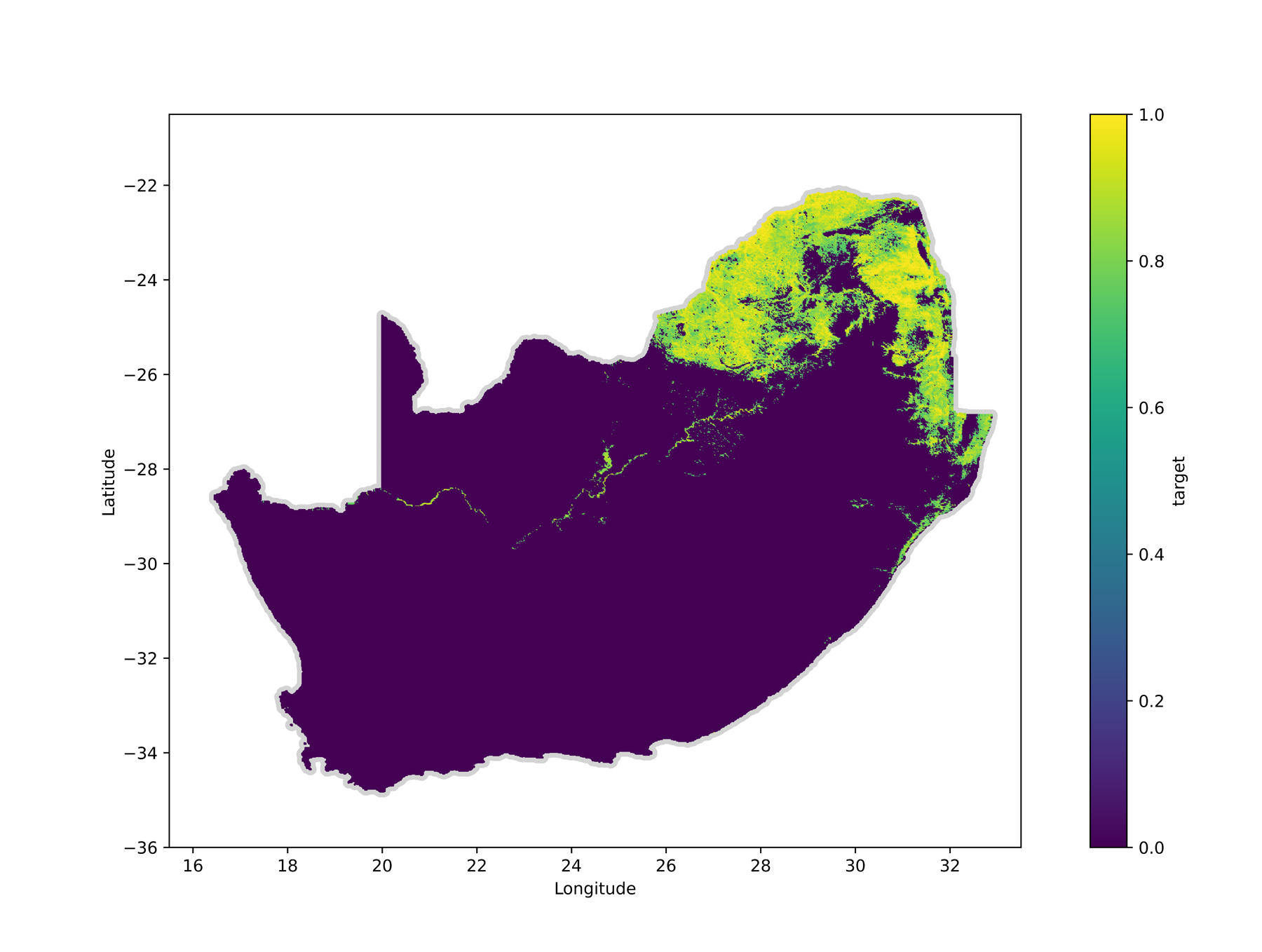
Figure 1: Probability distribution map of Striated Heron at the 2×2 km resolution, with high probability of presence as yellow (from Lee 2024).
Ecology
Habitat:
This species favours areas along water margins that are forested, such as shores lined with mangroves and estuaries, or regions with dense woody vegetation around ponds, rivers, lakes, and streams (Hancock and Kushlan 1984, del Hoyo et al. 1992, Kushlan and Hancock 2005). It can also thrive in various other habitats, including river swamps, canals, artificial ponds, salt-flats, mudflats, tidal zones, reedbeds, grassy marshlands, pastures and other types of flooded agricultural areas (del Hoyo et al. 1992, Kushlan and Hancock 2005).
Migration:
Movement within the region is poorly known although it is assumed to be mainly sedentary in the region, with some local movements in response to rainfall patterns (Louw 2005).
Breeding:
Breeding time varies geographically but aligns with rainfall. The nest is a weak structure made of sticks, twigs and reeds (Brown et al. 1982, Maclean 1993) which is placed near water, within trees or shrubs, concealed by leaves (Brown et al. 1982, Craib 1975, 1976). Females typically lay 2–5 eggs at 2-day intervals and incubation lasts 21–27 days, by both sexes (Brown et al. 1982, Tarboton 2001). Breeding success is unknown in the region. In East Africa, it is likely fewer than two young per nest survive. In one observed nest, a chick attempted to swallow its sibling (Hull 1999).
Diet:
Its diet varies widely across its range but typically includes a large proportion of fish along with amphibians (e.g., frogs), insects (e.g., water beetles, grasshoppers, and dragonflies), spiders, leeches, crustaceans (e.g., crabs and prawns), mollusks, earthworms, polychaete worms, birds, small reptiles, and mice (del Hoyo et al. 1992, Kushlan and Hancock 2005).
Threats & Conservation
Threats
The main threats to this species are assumed to be similar to other small herons, and are related to habitat destruction, particularly the loss of mangroves, human disturbance, and pesticide use (del Hoyo et al. 1992, Kushlan and Hancock 2005). Pollution of waterbodies may indirectly affect the species and its prey availability (Richard et al. 2021).
Conservation Measures Underway
No species-specific conservation measures are known to be in place. However, the species occurs in protected areas within its range, with 276 pentads in National Parks or Nature Reserves and 188 pentads in other protected areas (Lee 2024).
Conservation Measures Proposed
Species-specific research to identify key threats is required before specific conservation measures can be proposed. However, this species will probably benefit from increased protection and better management of key habitats, including mangroves and other wetland areas.
Research Priorities and Questions
- Determine accurate population size and trends for the region.
- Monitor and mitigate the impacts of human disturbance in important breeding and foraging areas.
- Investigate the potential impacts of pesticide use on the species and implement measures to reduce these impacts where necessary.
- Study the local movements and habitat use patterns of the species in response to rainfall and other environmental factors.
- Assess the impacts of habitat loss and degradation, particularly mangrove destruction, on regional populations.
- Evaluate the species’ breeding success and factors affecting it in the region.
Contributors & References
Assessor/s
Maria Paul, David Ehlers Smith
Reviewer/s
Jonah Gula
References
BIRDIE. 2024. An online platform for African wetland and waterbird data. https://biodiversityadvisor.sanbi.org/contentmanagement/index?guid=42305260-12b0-4a92-912e-7d801d15fdac. [Accessed on 8 September 2024].
BirdLife International. 2022. Butorides striata. The IUCN Red List of Threatened Species 2022: e.T22728182A163804848. Available at: https://dx.doi.org/10.2305/IUCN.UK.2022-2.RLTS.T22728182A163804848.en. [Accessed on 11 December 2024].
Brown LH, Urban EK, Newman K. 1982. The Birds of Africa. Vol. 1. Academic Press, London.
Craib CL. 1975. Breeding and roosting of Green-backed Heron, Butorides striatus (R.63). WBC News 89: 6–7.
Craib CL. 1976. Further notes on the Green-backed Heron (R.63). WBC News 95: 5–6.
Del Hoyo J, Elliott A, Sargatal J. 1992. Handbook of the Birds of the World. Vol. 1. Ostrich to Ducks. Lynx Edicions, Barcelona, Spain.
Hancock J, Kushlan J. 1984. The Herons Handbook. Croom Helm, London.
Hull AJ. 1999. Green-backed Heron cannibalism. Honeyguide 45: 17.
Kushlan JA, Hancock JA. 2005. The Herons. Oxford University Press, Oxford, U.K.
Lee ATK. 2024. Regional Red Data Book of the Birds of South Africa, Lesotho and Eswatini: SABAP2 Synthesis and Supporting Information and Graphics for Striated Heron. Unpublished report. Johannesburg: BirdLife South Africa.
Louw K. 2005. Green-backed Heron. In: Hockey PAR, Dean WRJ, Ryan PG (eds). Roberts – Birds of Southern Africa (7th Edn). The Trustees of the John Voelcker Bird Book Fund, Cape Town. pp 596–597.
Maclean GL. 1993. Roberts’ Birds of Southern Africa (6th Edn). John Voelcker Bird Book Fund, Cape Town.
Martínez-Vilalta A, Motis A, Christie DA, Kirwan GM. 2020. Striated Heron (Butorides striata), version 1.0. In: Billerman SM, Keeney BK, Rodewald PG, Schulenberg TS (eds). Birds of the World. Cornell Lab of Ornithology, Ithaca, NY, USA. https://doi.org/10.2173/bow.strher.01.
Navarro RA. 1997. Green-backed Heron. In: Harrison JA, Allan DG, Underhill LG, Herremans M, Tree AJ, Parker V, Brown CJ (eds). The Atlas of Southern African Birds. Vol. 1. BirdLife South Africa, Johannesburg. pp 70–71.
Richard FJ, Southern I, Gigauri M, Bellini G, Rojas O, Runde A. 2021. Warning on nine pollutants and their effects on avian communities. Global Ecology and Conservation 32: e01898.
Tarboton W. 2001. A Guide to the Nests and Eggs of Southern African Birds. Struik, Cape Town.
Citation
Paul M, Ehlers Smith DA 2025. Striated Heron. In: Lee ATK, Rose S, Banda S, Bezeng SB, Maphalala MI, Maphisa DH, Smit-Robinson H (eds), The 2025 Red Data Book of Birds of South Africa, Lesotho and Eswatini. Johannesburg, South Africa: BirdLife South Africa. Available at: https://www.birdlife.org.za/red-list/striated-heron/
Our generous sponsors


