


Knysna Woodpecker
Campethera notata

Number Of Mature
Individuals (Regional)
<5 000

Regional
Population Trend
Stable
2025
Regional Category
Least Concern
Search by species
CONTENTSOverview
Names
|
IOC English Name: |
Knysna Woodpecker |
|
SA & IOC Scientific Name: |
Campethera notata |
|
BirdLife International Taxonomy (scientific name): |
Campethera notata |
|
Order: |
PICIFORMES |
|
Family: |
Picidae |
|
Species name author: |
Lichtenstein 1823 |
|
Afrikaans: |
Knysnaspeg |
|
Sesotho (South Africa): |
Kgatajwe ya moru |
|
Sesotho (Lesotho): |
|
|
Siswati: |
|
|
Zulu: |
isigqobhamithi |
Current Assessment Status
|
2025 Regional Category [Criteria] |
LC |
|
2024 Global Category [Criteria] |
NT [C2a(ii); D1] (BirdLife International 2017) |
|
Population size (Regional) |
Unknown |
|
Population size (Global) |
1000 – 3300 (BirdLife International 2017) |
|
Distribution size (EOO) (Regional) km2 |
201 196 (Lee 2024) |
|
Distribution size (EOO) (Global) km2 |
201 196 (Lee 2024) |
|
Distribution size (AOO) (Regional) km2 |
3260 (Ehlers Smith, unpubl data) |
|
Generation time |
4.2 years (BirdLife International 2017) |
|
Status change reason |
Improved knowledge |
|
Migrant (in the region) |
No |
|
Regional endemic |
Yes |
Historic Listing Information
|
2000 Regional Status |
NT [C1] |
|
2015 Regional Status |
NT [C1] |
|
Status change reason (if applicable) |
No change |
|
2015 Population size (Regional) |
1000 – 3300 |
|
2015 Global Status |
NT [C1] |
Reason for Inclusion
Reason for Inclusion in the Assessment
Endemic in the region. The species was listed as Near Threatened in the 2000 and 2015 regional assessments and is also currently listed as globally Near Threatened (Taylor et al. 2015, BirdLife International 2017).
Category Justification
Category Justification
Although Knysna Woodpecker Campethera notata is a poorly studied regional endemic there is insufficient evidence to warrant keeping this species listed as Near Threatened. Previously, this species was assessed as Near Threatened based on the fact that it is an endemic species and that forested habitats in the Eastern Cape are declining, which could indicate a concomitant population decline (Peacock 2015). However, there is no evidence from atlas data that these declines are taking place at levels approaching 20%, a commonly used threshold for invoking Near Threatened by Criterion A.
It is relatively widespread and there is no evidence from the Southern African Bird Atlas Project 2 (SABAP2) to indicate that the species has declined in the past three generations. In fact, the number of pentads in which the species is recorded appears to have increased. The habitat specificity for Knysna Woodpecker should be investigated although it was recently categorised a forest generalist (Leaver et al. 2019).
Although the population size is unknown, it is estimated the population is likely to number <10 000 (inferred from the number of pentads in which the species has been recorded).
However, without any evidence of decline Criterion C cannot be invoked. While habitat degradation might pose a threat to this species, Knysna Woodpecker may also have benefited from bush encroachment in some areas.
Population Justification
No reliable population estimate has been attempted. The regional (and global) population was estimated at 1000 – 3300 mature individuals by BirdLife International (2017). Siegfried (1992) estimated the population at 1500 – 5000, of which 1000 – 1500 occur in protected areas. Confidence in these population estimates is low. It is likely the population is currently under-estimated.
Trend Justification
There is no survey data from which to generate population trend estimates. The global assessment (BirdLife International 2017) suggested tentatively that the population might be stable. This was based on the conflicting trends presented by Lee et al. (2017) and Taylor et al. (2015). Analyses by Lee (2024) on SABAP2 data suggest that the regional population is stable.
Biology & Ecology
Taxonomy
Roberts (1922) had suggested that the Knysna Woodpecker should be placed in a monotypic genus, Notopicus, based on its different style of colouration, longer tail to wing ratio and more rounded wing shape. Clancey (1958) proposed that the taxon C. n. relicta be used for the smaller, darker and more heavily spotted populations in coastal forests east of the Kei River, but this subspecies has not been recognised by other authors (Short 1982, Fry et al. 1988, Tarboton 2005). Based on similarities in plumage and morphology, Clancey (1958) further suggested that this species and the Golden-tailed Woodpecker C. abingoni may be conspecific; where their ranges marginally overlap in southern KwaZulu-Natal and adjacent Eastern Cape a narrow hybridisation zone may exist (Tarboton 2005). A molecular phylogeny of African woodpeckers confirms that the Knysna Woodpecker is a distinct species within the genus Campethera, with its closest relatives the Golden-tailed Woodpecker and the Mombasa Woodpecker C. mombasica (Fuchs et al. 2017).
Identification
20–21 cm, 70 g. Back, wings and rump dark green with dull yellow spotting and streaking. Tail yellowish olive with yellow barring; feather shafts brownish or golden yellow. Underparts whitish and heavily spotted, forming an incipient gorget in eastern populations. Crown and forehead black with crimson speckling. Malar stripe is black with red speckling. Lores and ear coverts white with heavy speckling. Bill entirely black. Sexes differ in head markings and bill length. Adult female resembles male but crown and forehead olive with fine yellow spotting; malar stripe black with white speckling. Juvenile similar to adult with dimorphic head pattern already apparent (Tarboton 2005). Very similar to Golden-tailed Woodpecker, distinguished by spotted not streaked ventral markings, and different call, a shrill “Skead”.
Distribution
The Knysna Woodpecker is endemic to South Africa where it occurs along the coastal plain of the Western Cape and Eastern Cape provinces, and marginally in southern KwaZulu-Natal (Figure 1). Using MaxEnt ecological niche modelling, an Area of Occupancy (AOO) of 3260 km2 is provided (AOO Ehlers Smith, unpubl data) (Figure 1).
Uys and Macleod (1967) cited the De Hoop area near Bredasdorp as the westernmost limit. Recent atlas data suggest the species occurs further west towards Caledon with unsubstantiated records even further west; this species is known to occupy and breed in stands of alien trees so may benefit locally from afforestation. Its range in KwaZulu-Natal has apparently contracted, since there were early records from Illovo and Ifafa, c. 80 km north of its currently known limit at Oribi Gorge inland of Port Shepstone, suggesting that it was formerly more widespread (Clancey 1958, Schmidt 1961, Nichols 1983). Range retractions in KwaZulu-Natal were attributed to clearance of coastal bush for sugar cane farming (Nichols 1983). This woodpecker also extends inland in dry and often xerophilous scrub-forest habitats (Clancey 1958), and is found inland as far as Queenstown, Somerset East and near Graaff-Reinet in the Eastern Cape; reportedly, specimens were taken as far north as Colesberg in the 1800s (Clancey 1958). It is sedentary throughout its range and there is no evidence of seasonal movements (Tarboton 1997). The species has been recorded from 16 Important Bird Areas (IBAs) (Barnes 1998).
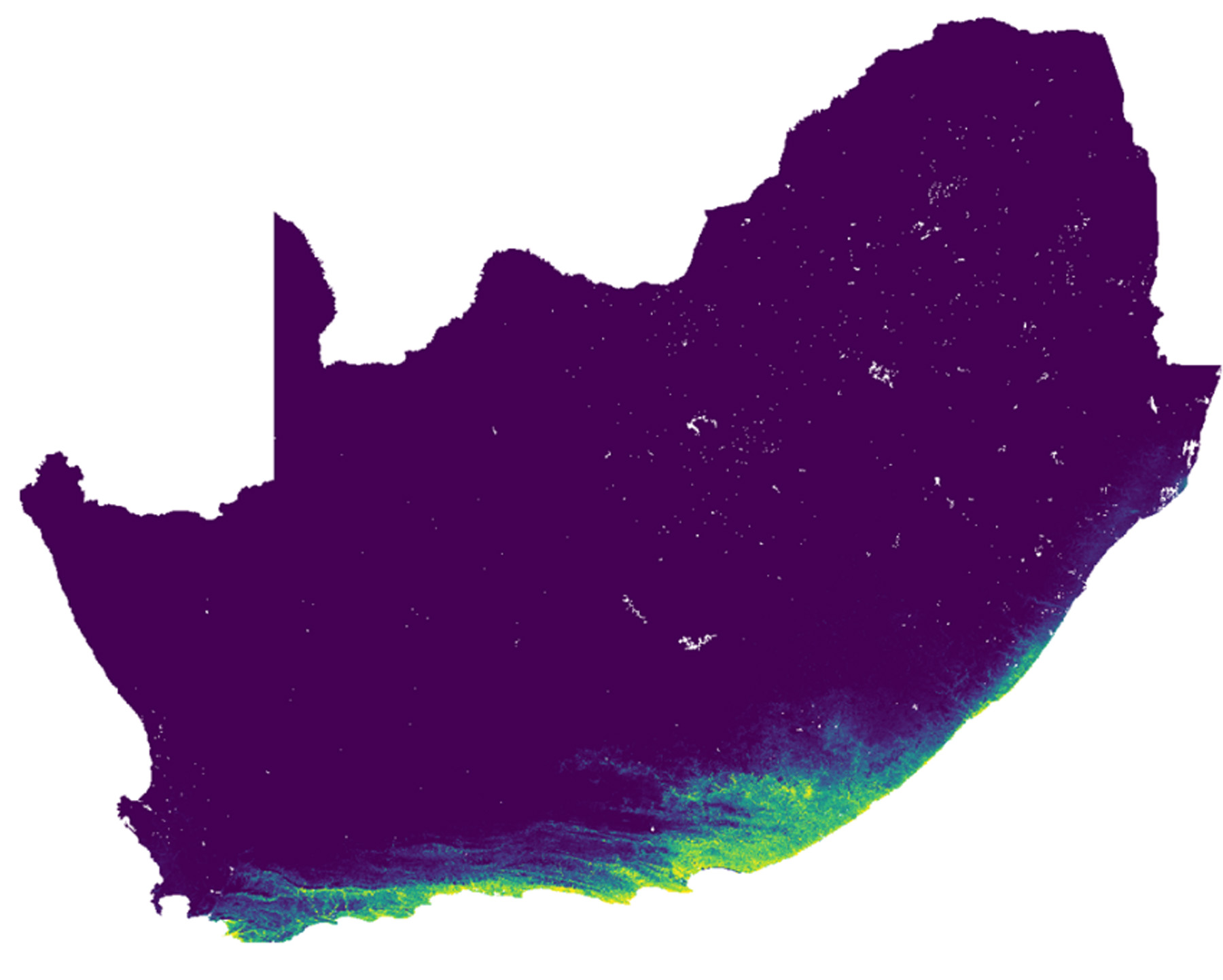
Figure 1: The ecological niche map produced to create the AOO (Ehlers Smith, unpubl data). Yellow is high probability of presence, and dark is low. This represents modelling at the 30 m resolution, using BirdLasser data and MaxEnt. White sections represents waterbodies.
Ecology
The Knysna Woodpecker is a monogamous, solitary hole-nester (Fry et al. 1988) with breeding occurring between August and February (Tarboton 1997). It is found in a variety of dense arboreal habitats, including coastal bush and Milkwood thickets, interior climax and Afromontane forest, dry thornveld, wooded valleys and gorges, Euphorbia thickets, and scrub-forest. It also occurs in tall Protea stands and stands of alien trees (Tarboton 1997), and sporadically in gardens (Fry et al. 1988). The Knysna Woodpecker was categorised as a forest generalist by Leaver et al. (2019), who noted that in Eastern Cape Afromontane forests it was absent from the upper zone above 1400 m.
Threats & Conservation
Threats
The species has not decreased markedly in Extent of Occurrenceor AOO since the 2000 assessment (Barnes 2000). There is no documented evidence that the population is presently in decline, and except for habitat clearing, there are no immediate threats known. However, given its naturally small range and population, the Knysna Woodpecker is vulnerable to habitat modification. Large-scale agriculture in combination with urban development, has brought about habitat destruction and modification in areas of its former range, particularly KwaZulu-Natal (Barnes 2000). In a global review, habitat loss was noted as the major threat to woodpeckers, and the Knysna Woodpecker was one of 28 species “red-listed” without further comment (Lammertink 2014). A shortage of natural nest sites may exist in parts of the range (Tarboton 1997), which makes it vulnerable to the felling of dead trees for firewood. The potential effects of climate change on this range-restricted species have not been investigated to date.
Conservation Measures Underway
There are no current conservation measures in place for this species, but it will undoubtedly benefit from the conservation of Afromontane forests stimulated by projects focused on the Cape Parrot Poicephalus robustus. Rea et al. (2023) reported that the Knysna Woodpecker was detected by call in all the Afromontane forests which were surveyed for Cape Parrots.
Conservation Measures Proposed
The area of suitable habitat with protected status should be increased. The species occasionally breeds in artificial nest boxes (Büttiker 1960) and agave stumps (Ginn et al. 1989), so providing artificial nesting sites may encourage breeding in areas where dead trees are scarce or have been felled. In the Eastern Cape it will nest in suburban gardens (A. Craig, pers obs).
Research Priorities and Questions
- Regional population size needs to be established.
- Integral to the future of Knysna Woodpecker is an understanding of its tolerance to habitat change. At this stage it is not clear what its key habitat requirements are. A thorough survey across its range, establishing estimates of population density in different habitats should be determined.
- Reliable breeding success and longevity data are lacking.
- Surveys of both conservation areas and other unprotected habitats could indicate the extent of current threats.
Contributors & References
Assessor/s
Adrian Craig, David Ehlers Smith
Reviewer/s
James Westrip, Mark Brown
References
Barnes KN. 1998. The Important Bird Areas of Southern Africa. Johannesburg: BirdLife South Africa.
Barnes KN. 2000. Knysna Woodpecker Campethera notata. In: Barnes KN (ed), The Eskom Red Data Book of Birds of South Africa, Lesotho and Swaziland. Johannesburg: BirdLife South Africa. pp 137.
BirdLife International. 2017. Species factsheet: Knysna Woodpecker Campethera notata. Available at https://datazone.birdlife.org/species/factsheet/knysna-woodpecker-campethera-notata.
Brooke RK. 1984. South African Red Data Book: Birds. Pretoria: Foundation for Research Development, Council for Scientific and Industrial Research.
Büttiker W. 1960. Artificial nesting devices in southern Africa. Ostrich 31: 39–48.
Clancey PA. 1958. Geographical variation in the Knysna Woodpecker Campethera notata (Lichtenstein). Bulletin of the British Ornithologists’ Club 78: 31–35.
Fry CH, Keith S, Urban EK. 1988. The Birds of Africa, vol. 3: Parrots to Woodpeckers. London: Academic Press.
Fuchs J, Pons J-M, Bowie RCK. 2017. Biogeography and diversification dynamics of the African woodpeckers. Molecular Phylogenetics and Evolution 108: 88–100.
Ginn P, McIlleron G, Milstein P le S. 1989. The Complete Book of Southern African Birds. Cape Town: Struik Winchester.
Lammertink M. 2014. Trends in threat status and priorities in conservation of the woodpeckers of the world. Acta Ornithologica 49(2): 207–219.
Leaver J, Carstens JC, Cherry MI. 2019. Harvesting of forest products and implications for Afrotemperate forest bird communities in a montane forest of the Eastern Cape, South Africa. Forest Ecosystems 6: 48.
Lee ATK, Altwegg R, Barnard P. 2017. Estimating conservation metrics from atlas data: the case of southern African endemic birds. Bird Conservation International 27: 323–336.
Lee ATK. 2024. Regional Red Data Book of the Birds of South Africa, Lesotho and Eswatini: SABAP2 synthesis and supporting information and graphics for Knysna Woodpecker. Unpublished report. Johannesburg: BirdLife South Africa.
Nichols GR. 1983. The reappearance of the Knysna Woodpecker in Natal. Bokmakierie 35: 44.
Rea M, Elliott J, Carstens JS, Leaver J, Carstens K, Wimberger K, Cherry MI. 2023. Using acoustic recording units to investigate the effects of logging on Cape Parrot Poicephalus robustus breeding and the presence of three primary cavity-excavating species. Bird Conservation International 33: e59, 1–7.
Roberts A. 1922. Review of the nomenclature of South African birds. Annals of the Transvaal Museum 8: 187–272.
Schmidt RK. 1961. Knysna Woodpecker Campethera notata at Breede River mouth (district of Swellendam). Ostrich 32: 182.
Short L. 1982. Woodpeckers of the World. Greenville, DE: Delaware Museum of Natural History.
Siegfried WR. 1992. Conservation status of the South African endemic avifauna. South African Journal of Wildlife Research 22: 61–64.
Taylor MR, Peacock F, Wanless RM (eds). 2015. The Eskom Red Data Book of Birds of South Africa, Lesotho and Swaziland. Johannesburg: BirdLife South Africa.
Tarboton WR. 1997. Knysna Woodpecker Campethera notata. In: Harrison JA, Allan DG, Underhill LG, Herremans M, Tree AJ, Parker V, Brown CJ (eds), The Atlas of Southern African Birds, vol. 1: Non-passerines. Johannesburg: BirdLife South Africa. pp 742–743.
Tarboton WR. 2005. Knysna Woodpecker Campethera notata. In: Hockey PAR, Dean WRJ, Ryan PG (eds), Roberts birds of southern Africa (7th Edn). Cape Town: Trustees of the John Voelcker Bird Book Fund. pp 132–133.
Underhill LG, Brooks M. 2014. Preliminary summary of changes in bird distributions between the first and second Southern African Bird Atlas Projects (SABAP1 and SABAP2). Ornithological Observations 5: 258–293.
Uys CJ, Macleod JGR. 1967. The birds of the De Hoop Vlei region, Bredasdorp, and the effect of the 1957 inundation over a 10-year period on the distribution of species, bird numbers and breeding. Ostrich 38: 233–254.
Citation
Craig A, Ehlers Smith DA 2025. Knysna Woodpecker. In: Lee ATK, Rose S, Banda S, Bezeng SB, Maphalala MI, Maphisa DH, Smit-Robinson H (eds), The 2025 Red Data Book of Birds of South Africa, Lesotho and Eswatini. Johannesburg, South Africa: BirdLife South Africa. Available at: https://www.birdlife.org.za/red-list/knysna-woodpecker/
Our generous sponsors


