


Neergaard’s Sunbird
Cinnyris neergaardi

Number Of Mature
Individuals (Regional)
<1 000

Regional
Population Trend
Decreasing
2025
Regional Category
Vulnerable
Search by species
CONTENTSOverview
Names
|
South Africa Name: |
Neergaard’s Sunbird |
|
IOC English Name: |
Neergaard’s Sunbird |
|
SA & IOC Scientific Name: |
Cinnyris neergaardi |
|
BirdLife International Taxonomy (scientific name): |
Cinnyris neergaardi |
|
Order: |
PASSERIFORMES |
|
Family: |
Nectariniidae |
|
Species name author: |
Grant CHB 1908 |
|
Afrikaans: |
Bloukruissuikerbekkie |
|
Sesotho (South Africa): |
|
|
Sesotho (Lesotho): |
|
|
Siswati: |
|
|
Zulu |
incwincwi yomfomothi |
Current Assessment Status
|
2025 Regional Category [Criteria] |
VU [B1ab(i,ii,iii); D] |
|
2024 Global Category [Criteria] |
NT [C1+2a(ii)] (BirdLife International 2018) |
|
Population size (Regional) |
<1000 (Brown and Peacock 2015) |
|
Population size (Global) |
3300 – 6700 (BirdLife International 2018) |
|
Distribution size (EOO) (Regional) km2 |
8093 (7711 – 9509) (Lee 2024) |
|
Distribution size (EOO) (Global) km2 |
183 000 (BirdLife International 2018) |
|
Distribution size (AOO) (Regional) km2 |
5172 (4176 – 6440) (Lee 2024) |
|
Generation time |
3.6 years (BirdLife International 2018) |
|
Status change reason |
Improved Knowledge |
|
Migrant (in the region) |
No |
|
Regional endemic |
Near endemic |
Historic Listing Information
|
2000 Regional Status |
NT [D1] |
|
2015 Regional Status |
NT [A3c+4c; B1b(i,ii,iii)] |
|
Status change reason (if applicable) |
Not applicable |
|
2015 Population size (Regional) |
3000 mature individuals |
|
2015 Global Status |
NT [C1; D1] |
Reason for Inclusion
Reason for Inclusion in the Assessment
Neergaard’s Sunbird Cinnyris neergaardi is one of four species with a global range of <50 000 km2 defining the Southeast African Coast Endemic Bird Area (Stattersfield et al. 1998). The species was assessed as regionally Near Threatened in 2000 and 2015 (Brown and Peacock 2015).
Category Justification
Category Justification
The regional population of the near-endemic Neergaard’s Sunbird remains poorly studied, with no reliable population size or trend estimate. Conservation concern for this species stems largely from its globally restricted and fragmented range as well as ongoing habitat loss (Cheke and Mann 2020). A precautionary approach warranted that the species be listed as regionally Near Threatened in 2000 and 2015, adopting the Global Red List Category (Brown and Peacock 2015).
Predicated range change over the past three generations using Southern African Bird Atlas (SABAP2) data suggest that the regional population may be stable (Lee 2024). The regional Extent of Occurrence (EOO) is small, 8093 (7711 – 9509) (Lee 2024) meeting the threshold for Vulnerable (Criterion B). Neergaard’s Sunbird is a sensitive habitat specialist and its habitat within the region is declining and fragmented, hence invoking Criterion B1 [ab(i,ii,iii)].
Although no recent population estimate exists, previous estimates indicated a regional population of 580 – 1090 mature individuals (Brown and Peacock 2015). No evidence exists to suggest that this has increased or decreased significantly.
A rescue effect for this species is unlikely as it is a near-endemic and the only the extra-regional population is located in Mozambique, where rapid habitat degradation is taking place (Cheke and Mann 2020).
The small global population and small regional distribution indicate that an uplisting to regionally Vulnerable is now warranted.
Population Justification
No accurate population estimates exist for Neergaard’s Sunbird in South Africa, but it is generally uncommon, highly localised, and elusive. Only historical estimates exist (Johnson et al. 1998) and these are: 80 – 120 pairs (160 – 240 birds) in Ndumo Game Reserve; 20 – 50 birds in Pongola Nature Reserve; ‘100s’ of breeding pairs in Mkuze Game Reserve; and 100 – 150 pairs (200 – 400 birds) in iSimangaliso Wetland Park. These figures suggest a minimum regional population, inside these four IBAs, of c. 290 – 495 pairs, or 580 – 1090 individuals. Proportions of the species’ range are in remote and poorly explored areas, so it is reasonable to assume that it is widely under-recorded, especially outside of protected areas. Consequently, the regional population may be significantly more but at the time of this assessment that is not known. In the absence of significant changes in reporting rate from SABAP2 the population is assumed to still number 5000 (Parker 1999) but this has probably declined due to ongoing habitat loss (Cheke and Mann 2020). Confidence in the regional estimate is low.
Trend Justification
The global population is suspected to be in decline due to reductions in habitat extent and quality (BirdLife International 2018). Regionally very little is known about this species, despite being listed as Vulnerable, Rare, and Near Threatened in the previous four Regional Red List Assessments. Trends are inferred from changes recorded in SABAP data.
Comparing SABAP1 (1986-1997) to SABAP2 (2007-2023), there is little evidence of significant change in reporting rate. In other words, the population appears reasonably stable (Lee 2024). Comparing trends within SABAP2 (2007-2016 with 2008-2023) also suggests relatively stable trends, confirming Johnson’s (1997) prediction that it will continue to be stable and Van Rensburg et al. (2000) assertion that regional conservation assessments need to account for heterogeneity at finer scales where data is available.
Given that this species is a sensitive habitat specialist with a small global population, and a small EOO bespoke monitoring is urgently needed to ascertain the regional population size and trend.
Biology & Ecology
Taxonomy
There are no notable issues. The species is monotypic.
Identification
11 cm, 6 g. A tiny sunbird that is restricted to subtropical thickets in northern KwaZulu-Natal. Sexes are dimorphic in plumage colouration. The male is mostly iridescent green above (including on lesser and median wing coverts), with iridescent blue upper tail coverts. Tail blackish. Greater wing coverts and remiges are blackish brown. The throat and upper breast are green, bordered by a narrow iridescent violet-blue band and a broader crimson-red breast band. The remainder of the underparts are sooty brown to blackish. Normally obscured pectoral tufts are yellow. Bill is black, fairly short, and only slightly decurved. Eyes dark brown. Legs and feet are black. The female is grey-brown above, with a whitish supercilium. Underparts are grey-buff and unstreaked. Central belly with faint yellow wash. Juveniles are similar to females, but gape flanges are prominently yellow (Brown 2005).
Distribution
Neergaard’s Sunbird is endemic to South Africa and Mozambique, where it is found along the eastern littoral from Inhambane Province in Mozambique, south to the western shores of Lake St Lucia in KwaZulu-Natal, South Africa (Johnson 1997, Parker 1999, Allan 2000). More than 80% of its global range lies in Mozambique, where it occurs primarily south of the Save River, extending slightly north of the Save into Sofala Province (Parker 2005). The Mozambique population is divided into two widely separated sub-populations, isolated by the Inkomati and Limpopo River floodplains: a southern population (south of Maputo and contiguous with populations in northern KwaZulu-Natal) occurs mainly in Sand Forest, while a much larger northern population (extending from about Panda, Inhambane northwards) occurs in mixed woodlands away from the coast (Parker 1999, Cheke and Mann 2001).
Within KwaZulu-Natal, Neergaard’s Sunbird is found mainly in stands of coastal sand forest (Johnson 1997), from the Mozambique border in the north to about Hluhluwe in the south. Previous reports mentioned its occurrence south to St Lucia or even Richards Bay, but this is not confirmed by SABAP2 atlas data (Figure 1, Lee 2024). The species is well represented in the regional IBA network with populations in Mkuze Game Reserve, the iSimangaliso Wetland Park complex, Ndumo Game Reserve, and Tembe Elephant Park (Johnson et al. 1998).
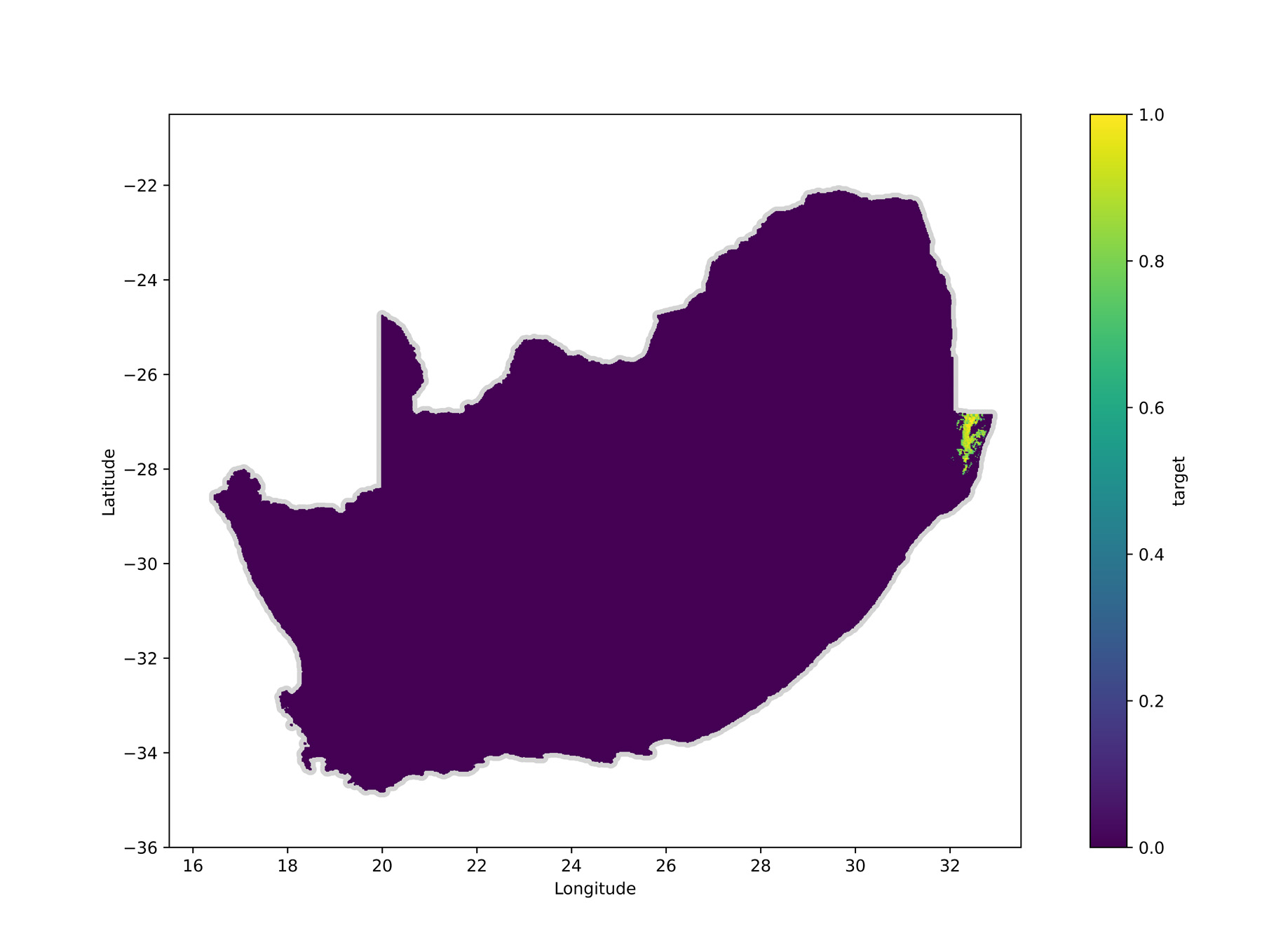
Figure 1: Neergaard’s Sunbird distribution across South Africa based on BirdLasser, Naturalist and eBird data indicating the tight affiliation with coastal sand forest (Lee 2024).
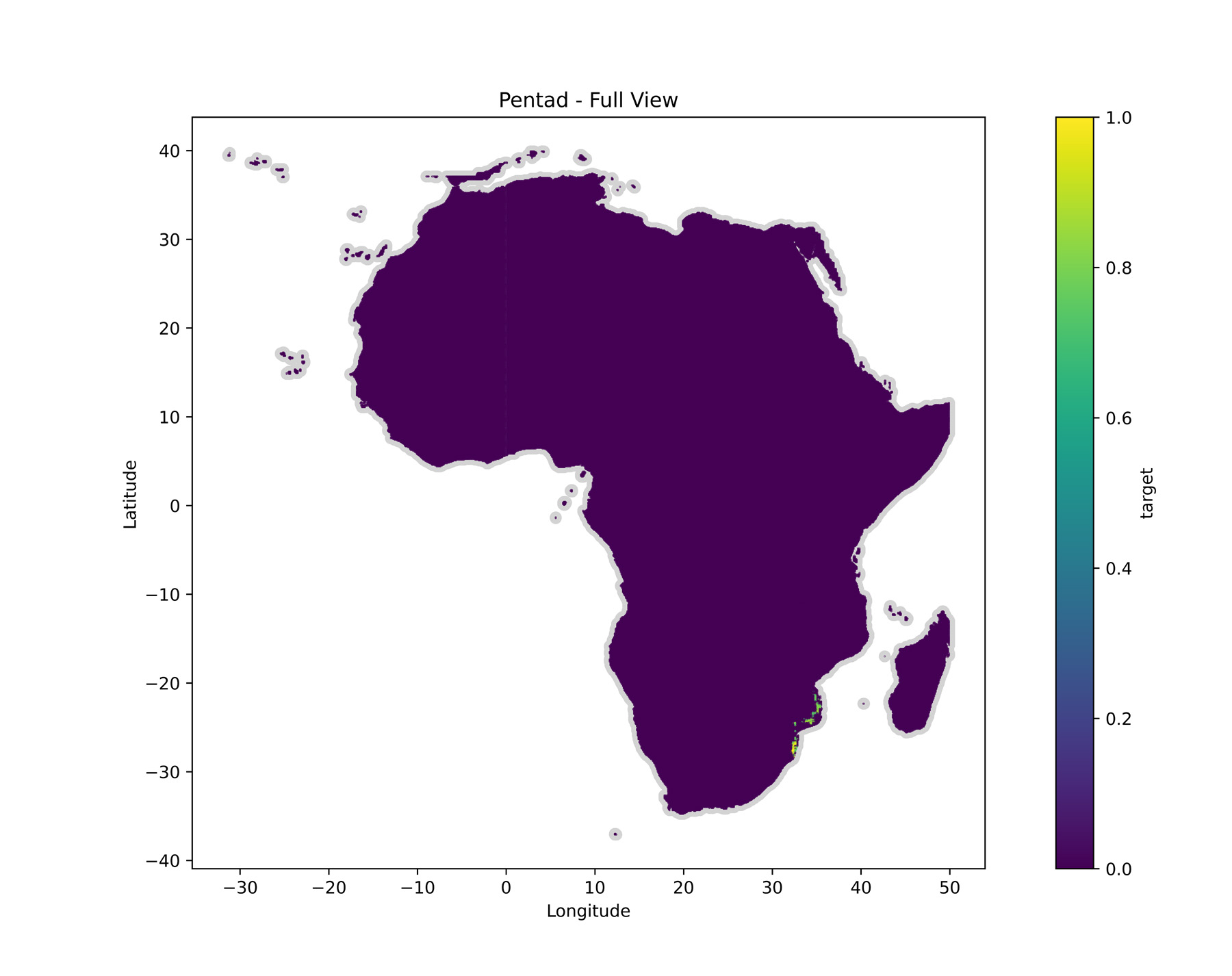
Figure 2: Africa distribution maps produced from ABAP, iNaturalist and eBird data using a Random Forest model and various predictor variables. Colour gradient is predicted probability of occurrence, with a 0.5% threshold applied. Brighter colours = higher probability of occurrence (Lee 2024). Again, this map shows the tight association with coastal sand forests.
Ecology
Neergaard’s Sunbird remains poorly studied in the region with only some of their ecology documented. Neergaard’s Sunbird is a sensitive habitat specialist in the region, restricted to coastal sand forests, especially around the greater iSimangaliso protected area (Brown 2005). There is no evidence of regional migration. Many aspects of Neergaard’s Sunbird breeding ecology remains unstudied. The beard lichens, Usnea, are particularly important for nesting purposes for this monogamous solitary nester. The lichens are used to construct the nest within Sand Forest, binding it together with spider webs and decorating it with old insect larvae. The nest is shaped like an oval ball with a side entrance, with the side entrance often concealed by a flap of nesting material. Two creamy white, speckled eggs are laid between October and December in the region, with the female completing about 75% of the feeding visits to chicks (Brown 2005).
The diet is made up of a range of nectar sources, insects, and spiders. It is also known to pierce Mistletoe Cactus Rhipsalis baccifera fruit and suck nectar from the fruit.
Populations in KwaZulu-Natal mostly inhabit Coastal Sand Forest (Johnson et al. 1998, Van Rensburg et al. 2000), where the species occurs singly or in pairs in the upper and middle canopy. The main nectar sources are creepers, epiphytes, mistletoes, and trees, with species varying seasonally. The diet is supplemented by insects and spiders (Brown 2005).
Threats & Conservation
Threats
Allan (2000) mentions that the species is likely to have suffered from habitat loss in areas outside protected reserves, particularly in densely settled and crop-farming (especially sugarcane) areas. Birds in Tembe Elephant Park may be at risk due to habitat modification by elephants (A Marchant pers comm). Concern for the conservation of Neergaard’s Sunbird is mainly based on its very restricted global range, which means that any significant decline could prove to be disastrous. The rest of the global population in Mozambique is still threatened by ongoing habitat loss, with habitat fragmentation affecting the species (Wilson et al. 2007).
Conservation Measures Underway
There are no species-specific conservation measures in place. The establishment of the iSimangaliso Wetland Park complex, as well as the ongoing protection afforded by Mkuze and Ndumo game reserves, will have secured the long-term conservation of this species in the region. The species has been recorded in 35 SABAP2 pentads, 29 of which fall in protected areas, with most of the range occurring within these protected areas (Lee 2024), but the low number of pentads and ongoing conservation issues within KZN Protected areas is a matter of concern. The species ranks as one of the top 10 most abundant species in suitable habitat where found (Van Rensburg et al. 2000).
Conservation Measures Proposed
Data on population size is crucial for a complete assessment of the species’ status. Ongoing monitoring of the core populations by citizen scientists would enable such population estimates. Ongoing monitoring of logging of natural habitats and afforestation with exotic species across its range should be done, and suitable forest habitats should be protected both inside and outside of protected areas (BirdLife International 2018).
Research Priorities and Questions
- A full survey of the entire range of Neergaard’s Sunbird in South Africa is urgently needed to determine strongholds for the species, with special emphasis on remote habitat patches outside of formally protected areas. Failing access to all potential habitats, satellite imagery may aid in establishing accurate population estimates.
- This species appears reliant on key habitat features. These need to be identified to improve management practices for this species.
Contributors & References
Assessor/s
Mark Brown
Reviewer/s
Dominic Rollinson, David Ehlers Smith
References
Allan DG. 2000. Neergard’s Sunbird Nectarinia neergaardi. In: Barnes KN (ed), The Eskom Red Data Book of Birds of South Africa, Lesotho and Swaziland. Johannesburg, South Africa: BirdLife South Africa. pp 149.
BirdLife International. 2018. Cinnyris neergaardi. The IUCN Red List of Threatened Species 2018: e.T22717903A131980130. https://dx.doi.org/10.2305/IUCN.UK.2018-2.RLTS.T22717903A131980130.en. [Accessed on 07 April 2025].
Brown M. 2005. Neergaard’s Sunbird Cinnyris neergaardi. In: Hockey PAR, Dean WRJ, Ryan PG (eds), Roberts – Birds of Southern Africa 7th Edn. Cape Town, South Africa: The Trustees of the John Voelcker Bird Book Fund. pp 991–992.
Brown M, Peacock F. 2015. Neergaard’s Sunbird Cinnyris neergaardi. In: Taylor MR, Peacock F, Wanless RM (eds), The Eskom Red Data Book of Birds of South Africa, Lesotho and Swaziland. BirdLife South Africa, Johannesburg: South Africa. pp 391–392.
Cheke RA, Mann CF. 2001. Sunbirds: a guide to the sunbirds, flowerpeckers, spiderhunters and sugarbirds of the world. London, United Kingdom: A&C Black.
Cheke R, Mann C. 2020. Neergaard’s Sunbird (Cinnyris neergaardi). In: del Hoyo J, Elliott A, Sargatal J, Christie DA, de Juana E (eds), Brds of the World (v 1.0). USA, Ithaca, New York: Cornell Lab of Ornithology. Available at https://doi.org/10.2173/bow.neesun2.01
Johnson DN. 1997. Neergaard’s Sunbird Nectarinia neergaardi. In: Harrison JA, Allan DG, Underhill LG, Herremans M, Tree AJ, Parker V, Brown CJ (eds), The atlas of southern African birds Vol II: Passerines. Johannesburg, South Africa: BirdLife South Africa. pp 499.
Johnson DN, Barnes KN, Taylor B. 1998. Important Bird Areas of Kwa Zulu-Natal. In: Barnes KN (ed), The Important Bird Areas of southern Africa. Johannesburg: BirdLife South Africa. pp 141–196.
Lee ATK. 2024. Regional Red Data Book of the Birds of South Africa, Lesotho and Eswatini: SABAP2 synthesis and supporting information and graphics for Neergaard’s Sunbird. Unpublished report. Johannesburg: BirdLife South Africa.
Parker V. 1999. The atlas of the birds of Sul do Save, southern Mozambique. Cape Town, South Africa: University of Cape Town.
Parker V. 2005. The atlas of the birds of central Mozambique. Cape Town, South Africa: Endangered Wildlife Trust and the Avian Demography Unit.
Stattersfield AJ, Crosby MJ, Long AJ, Wege DC. 1998. Global Directory of Endemic Bird Areas. Cambridge, United Kingdom: BirdLife International.
Van Rensburg BJ, Chown SL, Van Jaarsveld AS, McGeoch MA. 2000. Spatial variation and biogeography of sand forest avian assemblages in South Africa. Journal of Biogeography 27: 1385–1401.
Wilson JW, van Aarde RJ, van Rensburg BJ. 2007. Effects of habitat fragmentation on bird communities of sand forests in southern Mozambique. Ostrich 78: 37–42.
Citation
Brown M 2025. Neergaard’s Sunbird. In: Lee ATK, Rose S, Banda S, Bezeng SB, Maphalala MI, Maphisa DH, Smit-Robinson H (eds), The 2025 Red Data Book of Birds of South Africa, Lesotho and Eswatini. Johannesburg, South Africa: BirdLife South Africa. Available at: https://www.birdlife.org.za/red-list/neergaards-sunbird/
Our generous sponsors


