


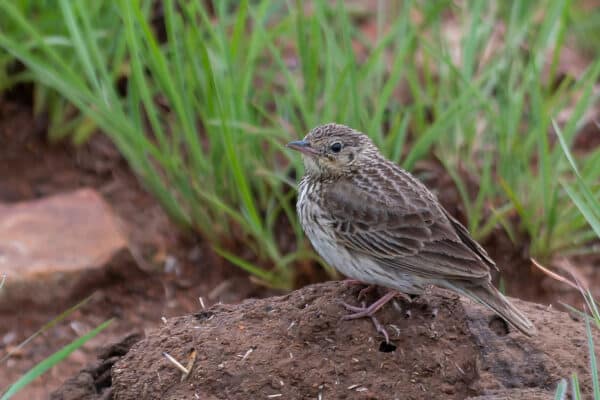
Short-tailed Pipit
Anthus brachyurus

Number Of Mature
Individuals (Regional)
8 440 – 33 750

Regional
Population Trend
Decreasing
2025
Regional Category
Vulnerable
Search by species
CONTENTSOverview
Names
|
IOC English Name: |
Short-tailed Pipit |
|
SA & IOC Scientific Name: |
Anthus brachyurus |
|
BirdLife International Taxonomy (scientific name): |
Anthus brachyurus |
|
Order: |
PASSERIFORMES |
|
Family: |
Motacillidae |
|
Species name author: |
Sundevall 1850 |
|
Afrikaans: |
Kortstertkoester |
|
Sesotho (South Africa): |
tshaase-hatlanyane |
|
Sesotho (Lesotho): |
tšaase-hatlanyane |
|
Siswati: |
|
|
Zulu: |
umngcelwana |
Current Assessment Status
|
2025 Regional Category [Criteria] |
VU [B2b(ii,iii)] |
|
2024 Global Category [Criteria] |
LC (BirdLife International 2018) |
|
Population size (Regional) |
8440 – 33 750 mature individuals (DA. Ehlers Smith, unpubl data) |
|
Population size (Global) |
Unknown (BirdLife International 2018) |
|
Distribution size (EOO) (Regional) km2 |
149 897 (140 265 – 181 971) (Lee 2024) |
|
Distribution size (EOO) (Global) km2 |
5 840 000 (BirdLife International 2018) |
|
Distribution size (AOO) (Regional) km2 |
1350 (DA. Ehlers Smith, unpubl data) |
|
Generation time |
3.7 years (BirdLife International 2018) |
|
Status change reason |
No change |
|
Migrant (in the region) |
No |
|
Regional endemic |
No |
Historic Listing Information
|
2000 Regional Status |
VU [B1+2c; C1+2a] |
|
2015 Regional Status |
VU [B2ab; C1] |
|
Status change reason (if applicable) |
No change |
|
2015 Population size (Regional) |
Unknown |
|
2015 Global Status |
LC |
Reason for Inclusion
Reason for Inclusion in the Assessment
This species was assessed as regionally Vulnerable in 2000 and 2015 (Peacock 2015). Considerable uncertainty exists around both the regional and global population estimates for this species. The regional population might be less than 5% of the global population but that is not known. Precautionary approach dictates that Short-tailed Pipit Anthus brachyurus still be included in this Regional Red List.
Category Justification
Category Justification
The Short-tailed Pipit is a cryptic poorly known species. Insufficient population data exists to invoke Criteria A, C or D. Known to have specific habitat requirements; an updated Area of Occupancy (AOO) was estimated by calculating the amount of grassland habitat remaining within the species’ niche (DA. Ehlers Smith, unpubl data). This estimate is <2000 km2. Within the region, the habitat for this species is declining or being altered, leading to habitat loss and degradation due to overgrazing, unfavourable fire regimes, mining, afforestation, and agricultural expansion (e.g. Peacock 2006, Tyler and Motis 2020). This loss of habitat is inferred to lead to population declines as no other suitable habitat exists in the region.
There is an urgent need to establish up to date range and population estimates to ensure adequate protection measures are put in place. The fragmented global range of this species means is a poor candidate for a rescue effect, hence the assessment outcome of Vulnerable.
Population Justification
The AOO was estimated by calculating the amount of grassland habitat remaining within the species’ niche (DA. Ehlers Smith, unpubl data). Based on the reported density of five pairs per 40 hectares in Vernon Crookes Nature Reserve, KwaZulu-Natal (Davies and Christian 2006), and the calculated AOO of 1350 km2 (Ehlers Smith, unpubl data), the maximum carrying capacity could support a regional population size is estimated at approximately 33 750 mature individuals. This estimate assumes a uniform density across the species’ range, which is unlikely, given the species appears nomadic according to veld condition (Voelker 2005). The actual population size is likely to be lower than this estimate; analogous species with similar reporting rates of mean 6.0 (Lee 2024) suggest population estimates could be 25% of carrying capacity, implying a lower population threshold of 8440 mature individuals. Further research is needed to refine this estimate and determine the extent of suitable habitat across the species’ range size, etc.
Trend Justification
The global population is suspected to be stable in the absence of evidence for any declines or substantial threats (BirdLife International 2018). However, regionally the population is considered to be in decline, based on declines in the grassland habitat preferred by Short-tailed Pipits which is under pressure from commercial afforestation, sugar-cane farming, overgrazing, agricultural intensification, unsympathetic fire regimes, and increasing and dense rural human populations (Peacock 2006, Tyler and Motis 2020). More precise data are needed to quantify the rate of decline and determine whether it meets the thresholds for a threatened category under Criterion A. Considering the observed decline and the ongoing threats to the species’ habitat, the AOO of <2000 km2 and the potentially small population size, the precautionary approach of assigning a Vulnerable status is warranted until more conclusive data becomes available.
Biology & Ecology
Taxonomy
Several subspecies have been described, but most authorities recognise only two: the nominate brachyurus from southern Africa and leggei further north in the Afrotropics (Clancey 1990).
Identification
The Short-tailed Pipit is a small, compact grassland pipit, measuring 12–13 cm in length. It has a plain face, heavy streaking above and below, and a short white-sided tail that is not wagged. In flight, the tail appears short and narrow with conspicuous white outer panels, and the wings look broad-based and triangular. The throat is whitish, often with dark speckling concentrated along the malar stripe and in the sub-moustachial band. The breast is off-white in the centre, washed pale buff at the sides or with a faint citrine-yellow tinge. The flanks usually have a buffy wash continuous with the sides of the breast. The belly and undertail coverts are buffy white to greyish white. The breast is profusely streaked with broad blackish-brown streaks that become sharper and narrower on the flanks. The crown, mantle, rump, and upper tail coverts are medium grey-brown, often with an olive-green or yellowish cast when fresh, streaked or mottled darker. The eyes are brown, and the legs are short and pink. The claws are short and strongly curved, with the hind-claw measuring 6–7 mm. The base of the lower mandible is pink (Clancey 1990, Keith et al. 1992, Peacock 2006).
Distribution
The Short-tailed Pipit is restricted to south-central and southern Africa. The bulk of the global distribution occurs in a band stretching from Gabon, through Congo and southwards over much of western and southern Democratic Republic of the Congo to eastern Angola and Zambia. An isolated population occurs in the grasslands of Uganda and possibly in adjacent Democratic Republic of the Congo and Rwanda. Within the region, the species is sparsely distributed in mesic grasslands of Mpumalanga, the south-eastern Free State and KwaZulu-Natal provinces, from sea-level to approximately 1850 m above sea level (Peacock 2006, Figure 1).

Figure 1: Species distribution map for Short-tailed Pipit derived from SABAP2 data and produced in MaxEnt (DA. Ehlers Smith, unpubl data).
Ecology
The Short-tailed Pipit inhabits short, moist, open grassland, 10–20 cm high, with or without light woody cover (Davies and Christian 2006). It shows a strong preference for grasslands regenerating after winter burns, with coarse grass tufts and scattered wildflowers and small forbs, interspersed with open soil patches to allow for terrestrial foraging, mobility, and visibility (Tarboton et al. 1987). The species reportedly breeds from 300–1850 m above sea level in KwaZulu-Natal (Davies and Christian 2006). Its movements are poorly known, with current evidence suggesting a partial exodus from higher grasslands to coastal areas after breeding (late summer). In lower altitude subtropical or coastal grasslands, it may be found in moist, short, tussocky grassland often in the general vicinity of water, such as along margins of pans and dams, on floodplains, or in depressions. The diet is little known, but the species is likely to be primarily insectivorous. Breeding occurs in green, tussocky grassland regenerating from winter burns in October to February, peaking in November.
Threats & Conservation
Threats
Major threats for the species are habitat alteration and degradation (e.g. Peacock 2006, Tyler and Motis 2020). Local habitat losses and population reductions or extinctions can be attributed to over- or under-grazing by domestic livestock, resulting in changes in plant species composition, habitat structure, prey availability, and breeding success. These impacts are compounded by unfavourable fire regimes, although some localised burning during the non-breeding season may be beneficial or essential to the species (Davies and Christian 2008). Further threats related to habitat loss include open-cast coal mining, commercial afforestation, and agricultural expansion.
Conservation Measures Underway
The range of the Short-tailed Pipit is well-represented in formally protected areas (Lee 2024). The ratio of the species’ range (number of pentads) in both protected categories to unprotected areas is 1.24, indicating that a significant portion of its range falls within protected areas. However, no dedicated conservation or research efforts focused on this species are currently underway.
Conservation Measures Proposed
Conservation measures should focus on maintaining suitable breeding habitat, focusing particularly on suitable grazing pressure and frequency and timing of burns. Species-specific management practices in grasslands, both on privately- and state-owned properties, as well as in existing conservation areas, could prove beneficial. Given the Vulnerable status of the Short-tailed Pipit, it is important to prioritize research and monitoring efforts to better understand the species’ population size and trends, habitat requirements, and the impacts of various threats. This information will be crucial for developing targeted conservation strategies and preventing the species from qualifying for a threatened category in the future.
Research Priorities and Questions
- While this assessment provides an updated desktop generated AOO, it is essential that this be ground-truthed through intensive surveys in areas where this species is known to occur, could potentially occur, or has been recorded in the past is essential.
- More accurate population density estimates, and other basic demographic data are required to refine the population size estimate.
- The degree of fragmentation of the distribution range of the Short-tailed Pipit should be determined, and the anthropogenic and intrinsic factors responsible for fragmentation identified and mitigated as far as possible.
- Investigations into macro- and micro-habitat requirements of this species, with emphasis on grazing pressure levels and fire regimes, are needed.
- Research on the movements would be beneficial to identify key conservation sites and formulate an effective, population-level management plan.
Contributors & References
Assessor/s
David Ehlers Smith
Reviewer/s
John Kinghorn
References
BirdLife International. 2018. Anthus brachyurus. The IUCN Red List of Threatened Species 2018: e.T22718532A131985053. Available: https://dx.doi.org/10.2305/IUCN.UK.2018-2.RLTS.T22718532A131985053.en [Accessed 19 June 2024].
Clancey PA. 1990. A review of the indigenous pipits (Genus Anthus Bechstein: Motacillidae) of the Afrotropics. Durban Museum Novitates 15: 42–72.
Davies M, Christian GBP. 2006. Short-tailed Pipit Anthus brachyurus (Aves: Motacillidae) breeding data from Vernon Crookes Nature Reserve, KwaZulu-Natal, South Africa. Durban Museum Novitates 31: 37–41.
Ehlers Smith DA. Unpublished data. Species distribution map for Short-tailed Pipit.
Keith S, Urban EK, Fry CH (eds). 1992. The Birds of Africa. Vol. 4. London: Academic Press.
Lee ATK. 2024. Regional Red Data Book of the Birds of South Africa, Lesotho and Eswatini: SABAP2 synthesis and supporting information and graphics for Short-tailed Pipit. Unpublished report. Johannesburg: BirdLife South Africa.
Peacock F. 2006. Pipits of Southern Africa. Pretoria: Published by the author.
Peacock F. 2015. Short-tailed Pipit. In: Taylor MR, Peacock F, Wanless RW (eds), The Eskom Red Data Book of Birds of South Africa, Lesotho and Swaziland. Johannesburg, South Africa: BirdLife South Africa. pp 258–260.
Tarboton WR, Kemp MI, Kemp AC. 1987. Birds of the Transvaal. Pretoria: Transvaal Museum.
Tyler S, Motis A. 2020. Short-tailed Pipit (Anthus brachyurus). In: del Hoyo J, Elliott A, Sargatal J, Christie DA, de Juana E (eds), Birds of the World version 1.0. Ithaca, NY, USA: Cornell Lab of Ornithology. Available: https://doi.org/10.2173/bow.shtpip1.01
Voelker G. 2005. Short-tailed Pipit. In: Hockey PAR, Dean WRJ, Ryan PG (eds), Roberts – Birds of Southern Africa, 7th Edn. Cape Town: The Trustees of the John Voelcker Bird Book Fund. pp 1112–1111.
Citation
Ehlers Smith DA 2025. Short-tailed Pipit. In: Lee ATK, Rose S, Banda S, Bezeng SB, Maphalala MI, Maphisa DH, Smit-Robinson H (eds), The 2025 Red Data Book of Birds of South Africa, Lesotho and Eswatini. Johannesburg, South Africa: BirdLife South Africa. Available at: https://www.birdlife.org.za/red-list/short-tailed-pipit/
Our generous sponsors


