


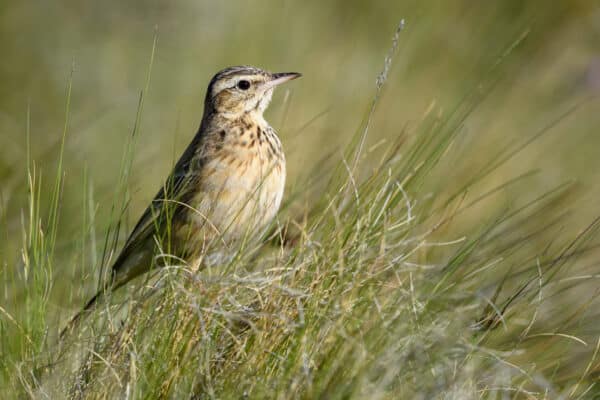
Mountain Pipit
Anthus hoeschi

Number Of Mature
Individuals (Regional)
9 999 (8 000 – 40 000)

Regional
Population Trend
Decreasing
2025
Regional Category
Near Threatened
Search by species
CONTENTSOverview
Names
|
IOC English Name: |
Mountain Pipit |
|
SA & IOC Scientific Name: |
Anthus hoeschi |
|
BirdLife International Taxonomy (scientific name): |
Anthus hoeschi |
|
Order: |
PASSERIFORMES |
|
Family: |
Motacillidae |
|
Species name author: |
Stresemann 1938 |
|
Afrikaans: |
Bergkoester |
|
Sesotho (South Africa): |
tshaase-ya-maloti |
|
Sesotho (Lesotho): |
tshaase-ea-maloti |
|
Siswati: |
|
|
Zulu: |
umngcelu wentaba |
Current Assessment Status
|
2025 Regional Category [Criteria] |
NT [A3c; C1] |
|
2024 Global Category [Criteria] |
NT [C1+2a(ii)] (BirdLife International 2021) |
|
Population size (Regional) |
9999 (8000 – 40 000) |
|
Population size (Global) |
2500 – 9999 (BirdLife International 2021) |
|
Distribution size (EOO) (Regional) km2 |
225 856 (Lee 2024) |
|
Distribution size (EOO) (Global) km2 |
225 856 (Lee 2024) |
|
Distribution size (AOO) (Regional) km2 |
4000 – 6850 (Ehlers Smith, unpubl data) |
|
Generation time |
2.21 years (Bird et al. 2020) |
|
Status change reason |
No change |
|
Migrant (in the region) |
No |
|
Regional endemic |
Yes |
Historic Listing Information
|
2000 Regional Status |
LC |
|
2015 Regional Status |
NT [A3c; C1] |
|
Status change reason (if applicable) |
Criteria revision |
|
2015 Population size (Regional) |
<10 000 |
|
2015 Global Status |
LC |
Reason for Inclusion
Reason for Inclusion in the Assessment
The Mountain Pipit Anthus hoeschi is a breeding endemic in the region with >80% of its global breeding range in Lesotho. The species was assessed as Near Threatened in 2015 (Peacock 2015).
Category Justification
Category Justification
Mountain Pipit is estimated to have a regional population size of <10 000 mature individuals based on modelled available habitat. Much of the biology of this species remains unclear, including its migratory behaviour and taxonomic status.
This species is poorly studied, cryptic and easily misidentified, limited to habitats that are remote and inaccessible. This means that this species is almost certainly under-reported in the Southern African Bird Atlas Project (SABAP2) which makes determining population trends challenging. Mountain Pipit appears to have breeding range limited to the Maloti-Drakensberg grasslands (Scholtz and Twidwell 2022), a region under immense pressure from grazing, renewable energy developments and is predicted to decline in future climate change scenarios.
In the absence of new and contrary data, the 2015 regional assessment of Near Threatened is maintained, based on a small, declining population with future threats that are not likely to cease in the immediate future. Population surveys and taxonomic studies are urgently required to establish the true threat status of this species. It is very possible that Mountain Pipit qualifies are regionally Vulnerable but robust data is currently lacking to justify this uplisting.
Population Justification
An approximate regional population size was calculated based on the availability of suitable habitat. The population size is calculated based on a revised Area of Occupancy (AOO) of 6850 km2, of which c. 4000 km2 comprised suitable habitat (Ehlers Smith, unpubl data). The AOO was calculated by creating an ecological niche model using Maximum Entropy Modelling (MaxEnt; Phillips et al. 2006) based on locality sightings and refined by verified presence in SABAP2. The niche model was trained by numerous climatic, environmental and topographic layers, and then clipped at the 0.5 likelihood level. The resultant likelihood niche was then clipped by the grassland cover layer from the 2022 South African National Land Cover layer (DFFE 2024) to create a detailed AOO (Figure 2). Taking this AOO and a mean of 1 nest/ 100–500 m (Voelcker 2005) or 1 – 5 pairs per km2, the population estimate is 8000 – 40 000 mature individuals, but more likely <10 000.
It must be noted that that nest density estimate cannot be assumed to be consistent across the distribution but does at least allow for a tentative estimate. This estimate is also in line with the global red list assessment for the species which puts the population estimate at 2500 – 9999 (BirdLife International 2021). Tarboton (2011) described the species as locally common on its breeding grounds, with widely spaced breeding pairs. In optimal habitat in Lesotho (relatively flat, grazed plains) Mountain Pipits can occur at high densities although estimates vary. Updated surveys are required for this species to establish reliable population estimates for this species.
Trend Justification
Without population level monitoring data, and clear taxonomic consensus, determining regional and global rates of decline are very difficult for Mountain Pipit. Citizen science data is not reliable for this species, given its cryptic nature, potential for confusion with other pipits, and remote distribution: most of Lesotho remains unvisited by SABAP2 participants.
The global assessment indicates that Mountain Pipit are in decline, inferred from habitat shifting caused by climate change, as temperatures in South Africa have been rising (van Wilgen et al. 2016, BirdLife International 2021). Lee et al. (2017) commented that while the Mountain Pipit is infrequently reported, there is little change in reporting rate or distribution, although it clearly has a small breeding range. A comparison of SABAP1 and SABAP2 suggests a decline in its range (and therefore possibly population size). This decline is assumed to be mainly due to habitat change because of heavy grazing and displacement as most areas in the Maloti face increasing pressure from expanding homesteads and pastures. The rate of decline is not known but Lee et al. (2017) suggest the range may have declined by 9% between SABAP1 and SABAP2. This would put the rate of decline at 1–19% over 10 years.
It is critical that surveys across the range for Mountain Pipit are prioritised to establish key breeding areas, breeding densities, breeding success and population estimates.
Biology & Ecology
Taxonomy
The Mountain Pipit has a complex taxonomic history. Two specimens collected in northern Namibia were described as a new species, Anthus hoeschi (Stresemann 1938). Subsequently birds collected in north-western Zambia were described as Anthus richardi (=cinnamomeus) lwenarum (White 1946). Finally, breeding pipits collected in the Lesotho Highlands were described as Anthus richardi (=cinnamomeus) editus (Vincent 1951). Based on their similarity in plumage, Clancey (1978) proposed that specimens of editus collected in the summer breeding season in the Lesotho highlands, and specimens of lwenarum collected during the winter non-breeding season in Zambia, were conspecific.
Further investigation prompted Clancey (1984) to lump all three independently described taxa (hoeschi, lwenarum and editus) on the grounds of similarities in biometrics and plumage (Clancey 1990), with the name A. hoeschi taking precedence. The Mountain Pipit was initially considered synonymous with the African Pipit A. cinnamomeus, but now considered separate species mostly by DNA or using museum skins and not so much through identification in the field. An initial genetic analysis suggested that the Mountain Pipit was allied to the Striped/African Rock Pipit A. crenatus sister-pair (Voelcker 1999), but this was not supported by phenotypical, behavioural and ecological characters. Recent genetic work suggests that the samples used by Voelcker (1999) included mis-identified specimens, and that the Mountain Pipit is a valid species, not closely related to the African Pipit (Pietersen et al. 2019).
However, a re-examination of the original type specimens of the taxa hoeschi, editus and lwenarum and comparison with other pipit specimens from museum collections concluded that hoeschi and lwenarum are not the same species as the birds breeding in the Drakensberg region, and that there is no good evidence for long-distance migration by Mountain Pipits. Thus Craig (2015) concluded that the name of the Mountain Pipit should be Anthus editus (Vincent 1951) with its breeding range in the central highlands of South Africa and Lesotho, and only altitudinal migration in the non-breeding season, primarily to lowland areas of South Africa east and south-east of the Drakensberg escarpment. This had also been suggested by other authors (Peacock 2006).
Identification
This species closely resembles the African Pipit, and the morphological differences are subtle. The eyes of the Mountain Pipit appear much darker brown; legs and feet are brownish pink. The dorsal plumage has darker feathers with pale feather margins, creating a scaly appearance; ventrally Mountain Pipits are more heavily patterned than African Pipits, with rounded streaks, and the malar and moustachial stripes are darker (Keith et al. 1992, Peacock 2006). The base of the lower mandible is pinkish flesh in colour, not yellowish (Clancey 1990, Voelcker 2005). Juvenile and immature plumages are poorly documented and are likely like those of the African Pipit; the base of the lower mandible may be yellowish in juvenile Mountain Pipits. This makes accurate discrimination in the field very difficult; the two species are best distinguished by song for an observer who is familiar with African Pipit songs – Mountain Pipits sing and display above their territory, with a more metallic song, best described by Dowsett-Lemaire (1989). Although some local overlap occurs, Mountain Pipits generally replace African Pipits on high-altitude plateaus above 2000 m (Clancey 1997).
In the hand or as a museum specimen, the Mountain Pipit is best distinguished from the African Pipit by its larger size, smoky buff or dusky fawn margins to the outer rectrices, very reduced pale markings on the penultimate tail feathers, and a more heavily marked mantle, crown and breast, darker buff underparts (Clancey 1990, Voelcker 2005). Differences in the colour of the lower mandible are not evident in museum specimens.
Distribution
Together with the Drakensberg Rockjumper Chaetops aurantius and the Drakensberg Siskin Crithagra symonsi, it is one of three species that have most of their global breeding ranges (>80%) in Lesotho (Barnes 1998). In Lesotho, it is locally common at high altitude of the central and eastern parts of the country, across Thaba-Putsoa range and may well extend into KwaZulu-Natal escarpment and Eastern Cape also possibly Mpumalanga. It is largely absent from the western sandstone-grassland lowlands, as well as the lower-lying Senqu (Orange) River Valley in the south-west.
Its range may be more extensive in high-altitude habitats of Eastern Cape, and it has recently been recorded near Queenstown. Elsewhere it occurs locally at Matatiele in KwaZulu-Natal, and in the Golden Gate Highlands National Park Park in the Free State Province (de Swardt 1994).
The non-breeding range of the Mountain Pipit is little known and depends on the taxonomic assessment of specimens from neighbouring countries. Sight records are difficult to assess, since identifying pipits in the field is notoriously difficult, and the validity of claims needs to be re-examined and verified to confirm this species’ status and movements (Mendelsohn 1984). Furthermore, the Mountain Pipit closely resembles African Pipit Anthus cinnamomeus in non-breeding plumage. Specimens from Botswana are more like hoeschi and lwenarum than to editus (Craig 2015). The species is occasionally recorded in winter on its breeding grounds (Ryan 2006), and some observers have suggested that the Mountain Pipit is simply an overlooked resident or local altitudinal migrant; this hypothesis may be supported by a range of possible sight records during winter months in Eastern Cape and KwaZulu-Natal (DA. Ehlers Smith, unpubl data; I. Weiersbye, unpubl data). The statement, now found in some texts, that the Mountain Pipit winters along the Zambezi-Congo watershed in the Democratic Republic of Congo, in north-western Zambia and possibly in eastern Angola relies entirely on the conclusion by Clancey (1990) that editus, hoeschi and lwenarum are members of the same population.
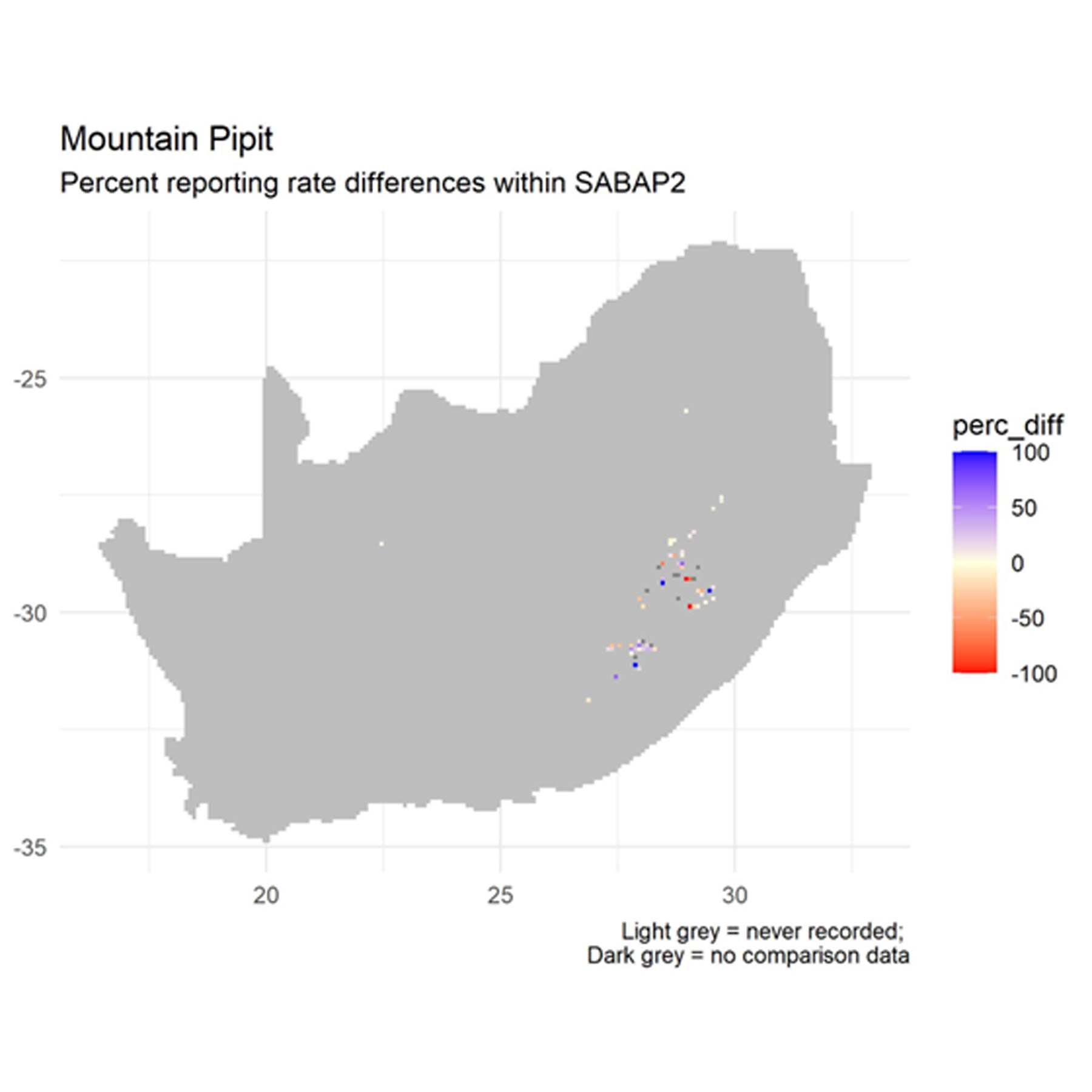
Figure 1: Pentad level distribution map for Mountain Pipit. Also shown are the changes in reporting rate within SABAP2 (comparing the time periods 2007-2015 and 2016-2023). Blue indicates region in which reporting rate has increased, red regions of decrease and cream indicating no change (from Lee 2024).
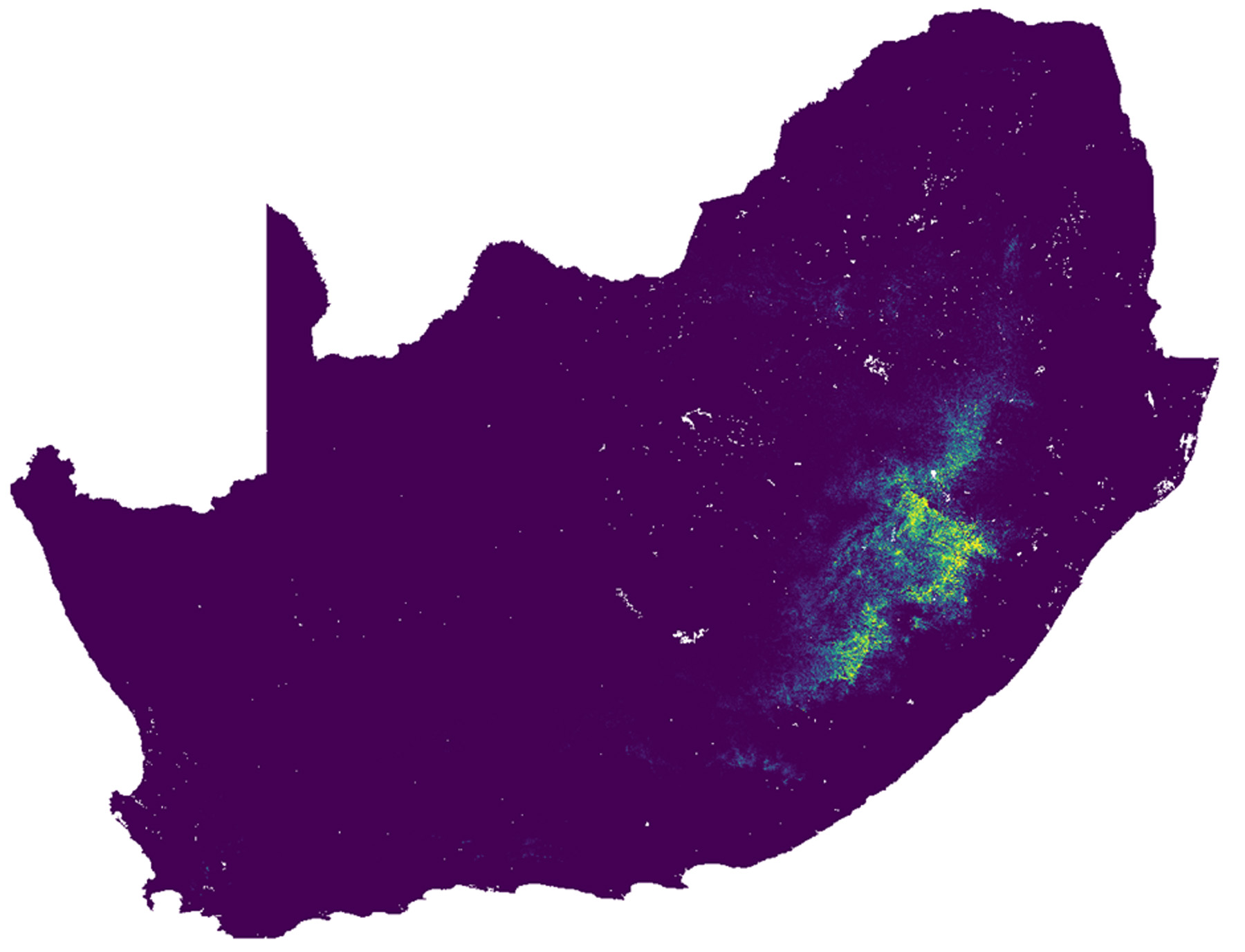
Figure 2: The ecological niche map produced using MaxEnt from BirdLasser location data to calculate the AOO (DA. Ehlers Smith, unpubl data).
Ecology
Breeding occurs from between 2000–3000 m, and less commonly down to 1800 m (Clancey 1990), in karroid scrublands, ericoid heathlands and alpine grassland. The species becomes more numerous as the slope angle decreases (Peacock 2006) and reaches its highest densities on flat or gently undulating terrain, but it reportedly also breeds on 30–40° slopes (Tarboton 2011). It shows a preference for areas with short, heavily grazed grass, sparse scrub and recently burnt vegetation. Mountain Pipits generally avoid steep rocky slopes, where they are replaced by African Rock Pipits and Nicholson’s Pipits. Mountain Pipits are presumed to be entirely insectivorous.
Threats & Conservation
Threats
In a global review of threatened grasslands, the Maloti-Drakensberg grasslands are listed as sole breeding habitat for the Mountain Pipit (Scholtz and Twidwell 2022). The regional Mountain Pipit population is naturally small (Clancey 1997). The effects of climate change are predicted to have a significant effect on the Mountain Pipit due to its reliance on mountain tops and its restricted range. This species was given the rank of ‘high risk’ in an investigation of the potential influences of climate change on southern African birds (Simmons et al. 2004). Indeed, of six species whose ranges were modelled, Simmons et al. (2004) found that the Drakensberg Rockjumper (terrestrial, insectivorous, high-altitude specialist, sympatric with the Mountain Pipit) would likely experience the highest degree of range loss (69%) in the next 3–5 decades. Suggested wind farm project plans in Lesotho are a cause for concern, and the Mountain Pipit is one of 14 species selected for mapping in relation to the impact of such developments. However, it was ranked lowest of 32 species in terms of its sensitivity based on collision risk, displacement risk and conservation status (Sands 2015).
Conservation Measures Underway
No species-specific conservation actions are currently underway, as this species was not previously considered a conservation priority. The Mountain Pipit is protected in 17 pentads in which it occurs, and unprotected in 29 pentads, yielding a protection ratio of 0.59 (Lee 2024). The species would benefit from increased visits to Lesotho as part of the SABAP2 project. Expansive areas of high-altitude habitat where Mountain Pipit occur are heavily grazed by domestic animals and clearing or burning of dense natural scrub to support low-intensity subsistence agriculture which may benefit this species.
Conservation Measures Proposed
Not enough is known about this species to propose detailed conservation measures. It is very likely that Mountain Pipit will benefit from grassland conservation generally. It is recommended that continued monitoring, estimation of more accurate demographic statistics and research into the ecology of the Mountain Pipit be carried out urgently. The species may be an ideal indicator of climate change (Simmons et al. 2004). As >80% of its global range is restricted to Lesotho, adequate protection and land-management in that country is paramount for the Mountain Pipit’s long-term survival.
Research Priorities and Questions
- A re-assessment of the Mountain Pipit’s taxonomic status is an essential first step. Is this species restricted to southern Africa, or is it truly a long-distance migrant beyond the region?
- Accurate population size and population density estimates are required, particularly from the Lesotho Highlands and other areas surveyed during SABAP1 but not yet fully exploring during SABAP2.
- Investigations into the seasonal dispersal of the species are required to confirm the extent of its movements, the routes it follows, and to identify its non-breeding grounds. Only three (3) Mountain Pipits so far have been ringed in Lesotho and South Africa (D. de Swardt pers comm).
- Climatic modelling should be performed to identify at-risk populations and areas that may become critical from a conservation perspective in the future.
Contributors & References
Assessor/s
Adrian Craig, David Ehlers Smith
Reviewer/s
Dawie de Swardt, David Maphisa, Sanjo Rose
References
Barnes KN. 1998. The Important Bird Areas of South Africa. Johannesburg: BirdLife South Africa.
Bird JP, Martin R, Akçakaya HR, Gilroy J, Burfield U, Garnett SG, Symes A, Taylor J, Sekersioglu CH, Butchart SHM. 2020. Generation lengths of the world’s birds and their implications for extinction risk. Conservation Biology 34: 1252–1261.
BirdLife International. 2021. Anthus hoeschi. The IUCN Red List of Threatened Species 2021: e.T22718467A178978931. https://dx.doi.org/10.2305/IUCN.UK.2021-3.RLTS.T22718467A178978931.en. [Accessed on 07 April 2025].
Clancey PA. 1978. On some enigmatic pipits associated with Anthus novaeseelandiae (Gmelin) from central and southern Africa (Aves: Motacillidae). Bonner zoologische Beiträge 29: 148–164.
Clancey PA. 1984. On the so-called Mountain Pipit of the Afrotropics. Durban Museum Novitates 13: 189–194.
Clancey PA. 1990. A review of the indigenous pipits (Genus Anthus Bechstein Motacillidae) of the Afrotropics. Durban Museum Novitates 15: 42–72.
Clancey PA. 1997. Mountain Pipit. In: Harrison JA, Allan DG, Underhill LG, Herremans M, Tree AJ, Parker V, Brown CJ (eds), The atlas of southern African birds. Vol. II: Passerines. Johannesburg: BirdLife South Africa. pp 397.
Craig AJFK. 2015. The Mountain Pipit Anthus hoeschi: museum specimens revisited. Durban Natural Science Museum Novitates 38: 28–40.
de Swardt DH. 1994. Bergkoesters in die Lesotho-hooglande en omliggende gebiete. Culna 47: 35–36.
Department of Forestry, Fisheries and the Environment. 2024. South African National Land Cover. Dataset available from https://egis.environment.gov.za/sa_national_land_cover_datasets
Dowsett-Lemaire F. 1989. On the voice of the Mountain Pipit. Ostrich 60: 85–87.
Keith S, Urban E, Fry CH. 1992. The birds of Africa. Vol. IV: Broadbills to Chats. London: Academic Press.
Lee ATK, Altwegg R, Barnard P. 2017. Estimating conservation metrics from atlas data: the case of southern African endemic birds. Bird Conservation International 27: 323–336.
Lee ATK. 2024. Regional Red Data Book of the Birds of South Africa, Lesotho and Eswatini: SABAP2 synthesis and supporting information and graphics for Mountain Pipit. Unpublished report: Johannesburg: BirdLife South Africa.
Mendelsohn JM. 1984. The Mountain Pipit in the Drakensberg. Bokmakierie 36: 40–44.
Peacock F. 2006. Pipits of southern Africa. Pretoria: The Author.
Peacock F. 2015. Mountain Pipit Anthus hoeschi. In: Taylor MR, Peacock F, Wanless RM (eds), The Eskom Red Data Book of Birds of South Africa, Lesotho and Swaziland. Johannesburg: BirdLife South Africa. pp 360–362.
Phillips SJ, Anderson RP, Schapire RE. 2006. Maximum entropy modeling of species geographic distributions. Ecological Modelling 190: 231–259.
Pietersen DW, McKechnie AE, Janson R, Little IT, Bastos ADS. 2019. Multi-locus phylogeny of African pipits and longclaws (Aves: Motacillidae) highlights taxonomic inconsistencies. Ibis 161: 781–792.
Ryan PG. 2006. Naude’s Nek – On a high in the Drakensberg. Africa – Birds and Birding 11: 28–31.
Sands D. 2015. Mapping the sensitivity of Lesotho’s avifauna to windfarm developments. MSc Thesis: University of Cape Town, South Africa.
Scholtz R, Twidwell D. 2022. The last continuous grasslands on earth: identification and conservation importance. Conservation Science and Practice 4: e626.
Simmons RE, Barnard P, Dean WRJ, Midgley GF, Thuiller W, Hughes G. 2004. Climate change and birds: perspectives and prospects from southern Africa. Ostrich 75: 295–308.
Tarboton WR. 2011. Roberts nests and eggs of southern African birds. Cape Town: Trustees of the John Voelcker Bird Book Fund.
van Wilgen, NJ, Goodall V, Holness S, Chown SL, McGeoch MA. 2016. Rising temperatures and changing rainfall patterns in South Africa’s national parks. International Journal of Climatology 36: 706-721.
Vincent J. 1951. The description of a new race of Richard’s Pipit Anthus richardi Vieillot from Basutoland. Annals of the Natal Museum 12: 135–136.
Voelcker G. 1999. Molecular evolutionary relationships in the avian genus Anthus (Pipits: Motacillidae). Molecular Phylogenetics and Evolution 11: 84–94.
Voelcker G. 2005. Mountain Pipit Anthus hoeschi. In: Hockey PAR, Dean WRJ, Ryan PG (eds), Roberts birds of southern Africa 7th Edn. Cape Town: Trustees of the John Voelcker Bird Book Fund. pp 1105.
White CMN. 1946. Notes on pipits of the Anthus richardi group and a new race of waxbill from Northern Rhodesia. Bulletin of the British Ornithologists’ Club 67: 8–10.
Citation
Craig A, Ehlers Smith DA 2025. Mountain Pipit. In: Lee ATK, Rose S, Banda S, Bezeng SB, Maphalala MI, Maphisa DH, Smit-Robinson H (eds), The 2025 Red Data Book of Birds of South Africa, Lesotho and Eswatini. Johannesburg, South Africa: BirdLife South Africa. Available at: https://www.birdlife.org.za/red-list/mountain-pipit/
Our generous sponsors


