


Short-clawed Lark
Certhilauda chuana

Number Of Mature
Individuals (Regional)
9 073 (7 777 – 10 674)

Regional
Population Trend
Decreasing
2025
Regional Category
Near Threatened
Search by species
CONTENTSOverview
Names
|
IOC English Name: |
Short-clawed Lark |
|
SA & IOC Scientific Name: |
Certhilauda chuana |
|
BirdLife International Taxonomy (scientific name): |
The same as SA & IOC |
|
Order: |
PASSERIFORMES |
|
Family: |
Alaudidae |
|
Species name author: |
Smith 1836 |
|
Afrikaans: |
Kortkloulewerik |
|
Sesotho (South Africa): |
tsirwane-mekwejana |
|
Sesotho (Lesotho): |
tsiroane-mekoejana |
|
Siswati: |
|
|
Zulu: |
umntoloziphonyana |
Current Assessment Status
|
2025 Regional Category [Criteria] |
NTo [A2c; C1] |
|
2024 Global Category [Criteria] |
LC (BirdLife International 2024) |
|
Population size (Regional) |
9073 (7777 – 10 674) mature individuals |
|
Population size (Global) |
33 000 – 67 000 (BirdLife International 2024) |
|
Distribution size (EOO) (Regional) km2 |
174 652 (173 050 – 185 240) (Lee 2024) |
|
Distribution size (EOO) (Global) km2 |
254 000 (BirdLife International 2024) |
|
Distribution size (AOO) (Regional) km2 |
11 380 (8148 – 15 496) (Lee 2024) |
|
Generation time |
3.54 years (BirdLife International 2024) |
|
Status change reason |
No Change |
|
Migrant (in the region) |
No |
|
Regional endemic |
No |
Historic Listing Information
|
2000 Regional Status |
NT [A2c] |
|
2015 Regional Status |
NT [A2c; C1] |
|
Status change reason (if applicable) |
No Change |
|
2015 Population size (Regional) |
<5000 |
|
2015 Global Status |
LC |
Reason for Inclusion
Reason for Inclusion in the Assessment
Between 40–45% of the global range of the Short-clawed Lark Certhilauda chuana occurs within the region according to recent modelling (Lee 2024). In addition, the species was assessed as regionally Near Threatened in 2015 (Engelbrecht and Grosel 2015).
Category Justification
Category Justification
The Short-clawed Lark is assessed as Near Threatened (NT) under Criteria A2c and C1 due to evidence of significant population declines and habitat pressures. The regional Extent of Occurrence (EOO) and Area of Occupancy (AOO) have shown contractions, particularly in South Africa, where a 73% reduction in EOO was observed during the Southern African Bird Atlas Projects, SABAP1 to SABAP2 periods, extending into the SABAP2 period, where a decline >30% over 3 generations is possible. While global estimates suggest a population of 33 000 – 67 000 individuals, regional subpopulations are smaller and disjunct. The eastern population (Polokwane Plateau) has seen localized declines, attributed to habitat loss and bush encroachment, with fewer than 30 individuals remaining in protected areas. The western population shows ongoing range contraction, with no recent records in South Africa’s Free State province. Applying density-based estimates to suitable habitats, the regional population of mature individuals is only slightly over 10 000, with declines exceeding 10% over three generations, suggesting Vulnerable by Criterion C1. However, potential recolonization from Botswana and uncertainty around some data justify the NT classification instead of a higher threat category.
Population Justification
Conservative estimates for the global population of the Short-clawed Lark range from 33 000 to 67 000 individuals, although confidence in these estimates is low (BirdLife International 2024). The majority of the global population (80–90%) is concentrated in Botswana, where population estimates range between 20 000 and 43 000 individuals (Brewster et al. 2010, Engelbrecht and Grosel 2015). These estimates suggest that Botswana represents the species’ core range, with its relatively stable population benefiting from extensive semi-arid savanna habitats maintained by traditional subsistence farming practices.
In South Africa, the population is smaller and is divided into two disjunct subpopulations:
Eastern Population (Polokwane Plateau): Previously estimated at 760 mature individuals (Grosel 2007, Engelbrecht and Grosel 2015), this population is now thought to have been underestimated (Engelbrecht 2023), which is supported by the extent of this population in SABAP2. Recent observations indicate the species is more abundant in rural farmland habitats on the Polokwane Plateau than initially recognized, which were not extensively surveyed during earlier assessments (Engelbrecht 2023). However, numbers within protected areas like the Polokwane Game Reserve have declined sharply, from an estimated 120 individuals in 2005 to fewer than 30 in 2021 (Engelbrecht 2023, unpubl data), attributed to bush encroachment and habitat loss.
Western Population (South-eastern Botswana and North West Province, South Africa): While the population in Botswana appears stable, the South African portion of this subpopulation has shown a marked range contraction. A 73% reduction in EOO was observed in South Africa between SABAP1 and SABAP2 at its start, with no records from the Free State Province during the latter period (Engelbrecht et al. 2007). This situation does not appear to have changed as of 2023, with no SABAP2 records, no iNaturalist records, and one improbable BirdLasser record from near Bloemfontein (Lee 2024, Figure 1). Previous estimates for the western subpopulation ranged between 500 and 5000 individuals (Brewster et al. 2010).
Short-clawed Lark can occur at high densities in preferred habitat, up over 1 individual/ha (Herremans and Herremans 1992, Herremans 2005). However, it is a habitat specialist (Engelbrecht 2023), so such high densities represent an unusual case, and it would be unusual to assume 100 ind/km2 across the species range. If we presume a background density estimate within its range is in line with ecologically and morphologically similar Karoo Long-billed Lark, which is also a habitat specialist (1.19 ind/km2, CI: 1.02 – 1.4) (Lee and Wright 2024) applying this to the mean AOO from Lee (2024), the total population may be 13 542 (CI: 11 607 – 15 932). Assuming 67% of these are mature individuals (BirdLife International standard conversion), this results in 9073 (7777 – 10 674). Confidence in this is low given recent ‘range extension’ (Engelbrecht and Grosel 2019), i.e., the regional population could be much higher. If the population is 10% over 3 generations (see below), this would qualify the species Vulnerable under Criterion C1. However, given the uncertainty and interim likelihood of recolonisation (the regional ‘rescue effect’) from Botswana, Near Threatened is a more appropriate classification.
Trend Justification
Despite a higher revised population estimate, there are several lines of evidence that point to a decline in the regional population: the decline in numbers in Polokwane Game Reserve (Engelbrecht 2023) and the range contraction between SABAP1 and SABAP2 (Engelbrecht et al. 2007, Lee 2024). However, Herremans (1997) noted the potential for the confusion of this species with other species. As such, there is some doubt as to the original extent of the SABAP1 distribution. There is no ecological or dramatic pattern of land use change to explain this contraction: the area is still predominantly rangeland for game and wildlife. More broadly though, bush encroachment and changes in agricultural practise, notably agricultural intensification and increase in croplands, are clearly diminishing available habitat. Lee (2024) modelled a contraction of 41% over 3 generations based on SABAP2 occurrence, using records from the 2007-2015 and 2016-2023 periods. However, there is a notable lack of atlassing effort from the North West during the second period, which likely accounts for this value (Figure 1). The same report also suggests a stable probability of reporting during SABAP2, but the lack of North West data would mean this is for the Eastern population (in Polokwane) only. Taken together, habitat loss and associated population declines are likely over 20% over 3 generations, which coupled with observed population declines, qualifies this species as Near Threatened under Criterion A2ac (ongoing population declines observed and observed in EOO contraction).
Biology & Ecology
Taxonomy
The Short-clawed Lark (Certhilauda chuana, previously Mirafra chuana) is a member of the family Alaudidae, a diverse group of ground-dwelling passerines known for their complex vocalizations and cryptic plumage. This species was first described by Andrew Smith in 1836. It has a complicated systematics history (see Engelbrecht 2023 for a comprehensive summary).
Historically, the taxonomic status of the disjunct eastern and western populations has been debated. The eastern population, found on the Polokwane Plateau in Limpopo Province, South Africa, is highly localized and geographically isolated from the larger western population in south-eastern Botswana and the North West Province, South Africa. Early suggestions posited that the eastern population might represent a distinct subspecies or even a separate species (Barnes 2000, Herremans 2005).
However, subsequent genetic, morphometric, and vocal analyses by Grosel (2007) found no significant differences between the two populations, supporting their classification as a single taxon. This finding was corroborated by Engelbrecht and Grosel (2015), who emphasized the ecological similarities and shared habitat preferences of both populations, as well as Alström et al. (2013).
The Short-clawed Lark is sister to the monophyletic Long-billed lark (Certhilauda) complex, which includes the Eastern Long-billed Lark Certhilauda semitorquata, Karoo Long-billed Lark Certhilauda subcoronata, and Cape Long-billed Lark Certhilauda curvirostris. These four species appear to be nested within a clade that also includes Gray’s Lark Ammomanopsis grayi, Spike-heeled Lark Chersomanes albofasciata, and Greater Hoopoe-Lark Alaemon alaudipes (Alström et al. 2013).
Identification
The Short-clawed Lark is a medium-sized, long-billed lark measuring 18–20 cm and weighing 30–39 g. Both sexes appear similar, but males are larger. Key identification features include a prominent cream supercilium extending from the bill base to the nape, contrasting with a dark brown eye stripe, and rufous to brownish-buff ear coverts. Its upperparts are rusty-brown with dark streaking, and its broad rufous rump, faintly streaked, is a distinctive characteristic. The underparts are pale with streaked upper breasts, and its long, slightly decurved bill is dark grey-brown with a pale base.
Confusion may arise with the Eastern Long-billed Lark, which shares similar size and general coloration. Differences in vocalizations and habitat preferences can also assist in distinguishing the two species, with Eastern preferring grassland habitats and with a range generally disjunct from Short-clawed Lark. Observers should pay particular attention to subtle plumage differences and bill shape when both species occur in overlapping ranges or similar habitats.
Distribution
The Short-clawed Lark is endemic to southern Africa, with a global distribution restricted to Botswana and South Africa (Figure 2). Within Africa, the species has two disjunct populations: a larger western population in south-eastern Botswana and adjacent North West Province, South Africa, and a smaller eastern population on the Polokwane Plateau in Limpopo Province, South Africa. The species occupies semi-arid savanna habitats, primarily in rural areas with heavy grazing and scattered low bushes.
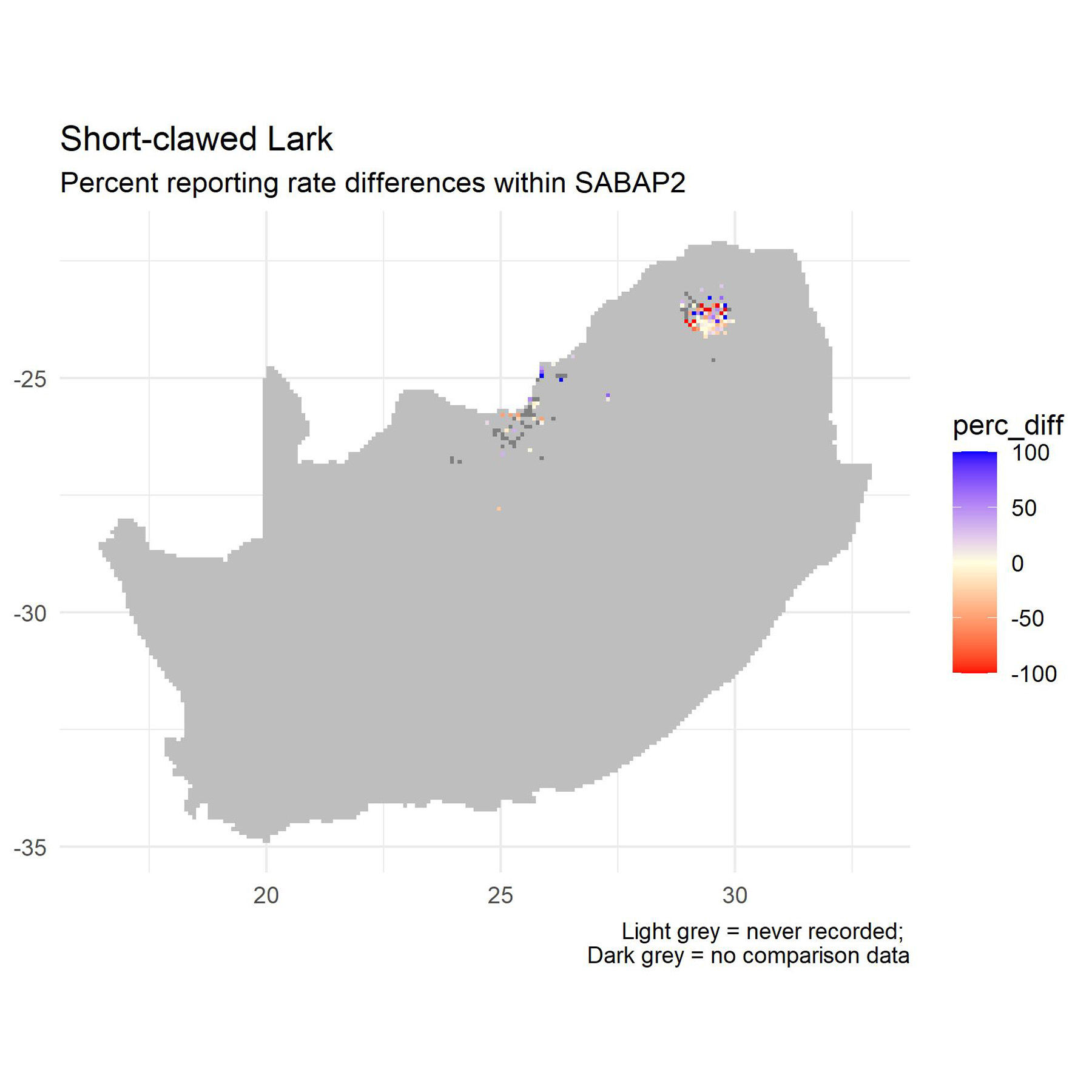
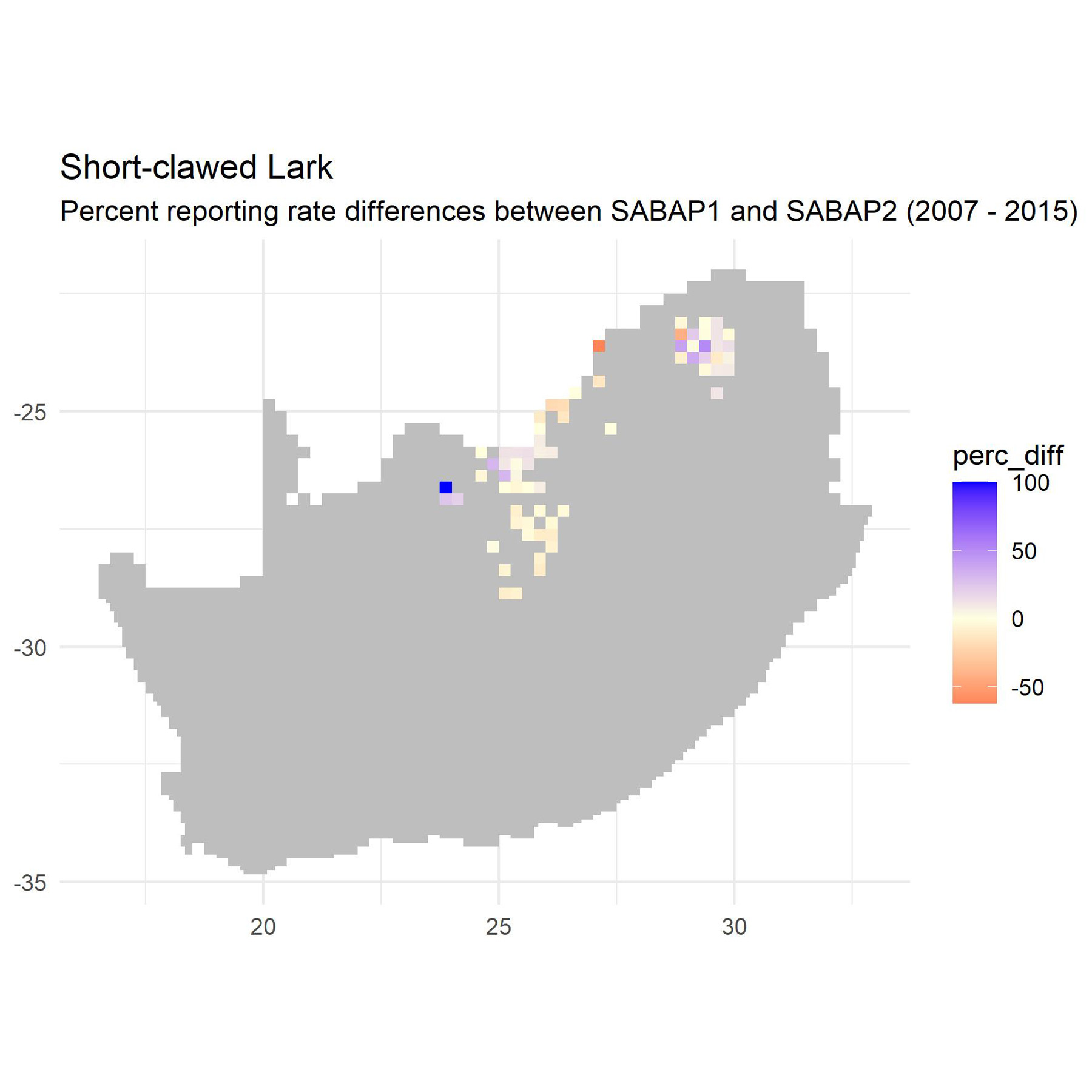
Figure 1: Distribution maps of Short-clawed Lark based on SABAP2 distribution records (top) and SABAP1 to SABAP2 (bottom). Note the lack of records north of Kimberley for the SABAP2 reporting period (2007-2023, left).
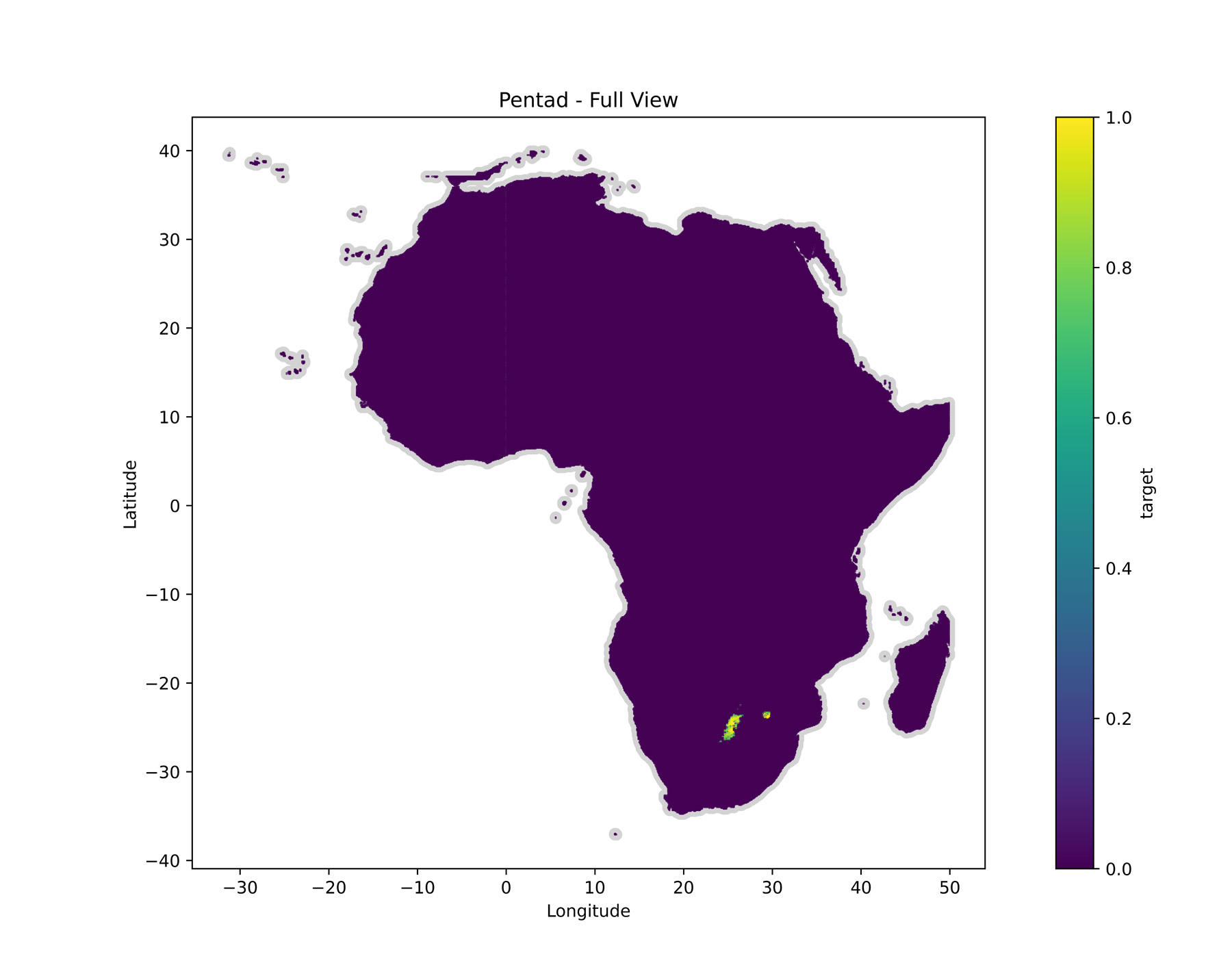
Figure 2: Modelled global distribution of the Short-clawed Lark (pentad level) based on SABAP2, eBird and iNaturalist records using a Random Forest model and various predictor variables. Colour gradient is predicted probability of occurrence, with a 0.5% threshold applied. Brighter colours = higher probability of occurrence.
Ecology
The Short-clawed Lark is a habitat specialist found in semi-arid savanna ecosystems, where it relies on specific vegetation structure maintained by grazing, wood harvesting, and periodic fire (Engelbrecht et al. 2007). It is particularly sensitive to bush encroachment, tall grasses, and increased basal cover, which develop when natural disturbance regimes are absent (Engelbrecht and Grosel 2015). The species predominantly occupies rural, subsistence agricultural areas and avoids commercial farming landscapes. Breeding occurs in ground nests, with poor to moderate success due to predation, trampling, and occasional flooding (Herremans 2005, Engelbrecht and Grosel 2015). Its diet consists mainly of insects and seeds, aligning with its terrestrial foraging behavior (Herremans 2005, Engelbrecht 2023).
Threats & Conservation
Threats
The most significant threat to the Short-clawed Lark is habitat change, particularly shifts in vegetation structure. Ironically, this species thrives in semi-arid savanna degraded by traditional livestock centric agricultural practices. In Botswana and on much of the Polokwane plateau, the species occupies rural areas where moderate to heavy grazing, trampling by livestock, wood harvesting, and large fallow fields create and maintain its preferred habitat (Engelbrecht 2023). However, habitat becomes unsuitable when grazing is limited, fire is withheld, or annual commercial cultivation occurs (Herremans 2005, Engelbrecht 2023).
Intensified farming and grazing practices, particularly in Botswana, have led to increased bush encroachment, reducing the availability of suitable habitats. Habitat can become unsuitable in as little as 2–3 years if grazing, browsing, or fire is withheld (Engelbrecht 2023). In South Africa, controlled grazing regimes, restricted wood harvesting, and suppression of fire in protected areas have similarly led to bush encroachment and declines in local populations, as seen in Polokwane Game Reserve.
Road verges, frequently maintained through mowing and burning, create suitable habitats for the Short-clawed Lark (Engelbrecht 2023). The species often nests along road verges and can be seen perched on roadside fences. However, these maintenance activities, particularly during the breeding season, can destroy nests. While this impact appears negligible at a population level, its effects on local nesting success warrant further study (Engelbrecht 2023, unpubl data).
Urban expansion presents another threat, leading to direct habitat loss, habitat degradation from refuse dumping and rubble, increased disturbance, and fragmentation (Engelbrecht 2023). Despite this, the Short-clawed Lark has adapted to the edges of rural villages, where overgrazing, pedestrian and vehicular traffic, and wood harvesting mimic its natural habitat conditions. In some rural areas, it is even considered a common garden bird. However, the presence of free-roaming cats and dogs near urban areas introduces additional predation pressures, potentially impacting adult survival and nesting success (Engelbrecht 2023).
The availability of suitable habitat is also influenced by climatic fluctuations. During drought years, the habitat expands due to reduced vegetation growth, whereas wet years lead to increased basal cover and habitat contraction. This dynamic interplay between land-use practices and climatic cycles makes the species particularly vulnerable to habitat changes at both local and regional scales (Engelbrecht 2023).
Conservation Measures Underway
The species is afforded protection under provincial legislation in three provinces in South Africa. In the Limpopo Province, it is a Schedule 2 ‘Specially Protected Wild Animal’ (Limpopo Environmental Management Act, Act No. 7 of 2003), a Schedule 2 ‘Specially Protected Species’ (North West Biodiversity Management Act, Act No. 4 of 2016) in the North West Province, and a Schedule 2 ‘Protected Species’ (Northern Cape Nature Conservation Act, Act No. 9 of 2009) in the Northern Cape Province. Short-clawed Lark does not receive any legal protection in Botswana, but it is a key species in the Southeast Botswana Important Bird Area (Engelbrecht 2023).
Conservation Measures Proposed
To improve the conservation status of the Short-clawed Lark, the following actions are recommended:
Habitat Management and Restoration:
- Implement rotational grazing systems and controlled wood harvesting in areas prone to bush encroachment to maintain the species’ preferred habitat structure.
- Reintroduce fire as a management tool in protected areas where grazing and browsing are limited, to reduce basal cover and bush encroachment.
- Protect and restore road verges and other marginal habitats through sustainable maintenance practices, such as limiting mowing and burning during the breeding season.
Community Engagement and Awareness:
- Work with local communities to promote traditional land-use practices that create and sustain suitable habitats, such as moderate grazing and wood harvesting.
- Raise awareness about the ecological value of the species and the importance of sustainable habitat management.
Urban Planning, Policy and Legislation:
- Design urban development plans that minimize habitat loss and fragmentation.
- Implement measures to mitigate predation by free-roaming cats and dogs in rural and peri-urban areas.
- Strengthen and enforce existing environmental management laws to prevent habitat degradation and protect key habitats, especially on the Polokwane Plateau.
- Advocate for incorporating the species into regional and local conservation planning frameworks, with a focus on maintaining its preferred habitat.
Climate Adaptation and Protected Area Expansion:
- Develop adaptive management strategies to account for habitat availability fluctuations caused by climatic variability, such as drought or above-average rainfall years.
- Identify and secure additional areas of suitable habitat for conservation, prioritizing rural landscapes with traditional agricultural practices.
- Integrate suitable habitat corridors into conservation planning to promote connectivity between fragmented subpopulations.
Research Priorities and Questions
- Population Dynamics: Conduct systematic surveys to update population estimates and assess trends for both eastern and western subpopulations, particularly in under-surveyed rural areas.
- Habitat Requirements: Investigate the species’ habitat preferences in different land-use contexts, including rural agricultural areas, road verges, and protected areas, to better understand its reliance on anthropogenically altered landscapes.
- Impact of Habitat Change: Study the effects of grazing, fire suppression, and bush encroachment on habitat suitability, particularly in protected areas like the Polokwane Game Reserve.
- Breeding Success and Nest Survival: Assess breeding success, nest predation rates, and survival outcomes across different habitats, including road verges, rural farmlands, and protected reserves.
- Response to Land Management Practices: Evaluate the effectiveness of various land management strategies, such as rotational grazing, controlled wood harvesting, and fire regimes, in maintaining suitable habitats.
- Urban Adaptation: Investigate how the species adapts to urban and peri-urban environments, focusing on factors like predation pressure from domestic cats and dogs and the impacts of vehicular and pedestrian disturbance.
- Climatic Influences: Study the influence of climatic variability on habitat availability and population dynamics, with a focus on drought and above-average rainfall cycles.
- Range Connectivity: Explore dispersal patterns and potential connectivity between fragmented populations to identify corridors for conservation.
- Long-term Monitoring: To answer many of the above, a long-term monitoring program to track changes in population size, distribution, and habitat conditions over time is required.
Contributors & References
Assessor/s
Alan Lee
Reviewer/s
Ditiro Moloto
References
Alström P, Barnes KN, Olsson U, Barker FK, Bloomer P, Khan AA, Qureshi MA, Guillaumet A, Crochet P-A, Ryan PG. 2013. Multilocus phylogeny of the avian family Alaudidae (larks) reveals complex morphological evolution, non-monophyletic genera and hidden species diversity. Molecular Phylogenetics and Evolution 69: 1043–1056. https://doi.org/10.1016/j.ympev.2013.06.005.
Barnes KN. 2000. The Eskom Red Data Book of Birds of South Africa, Lesotho and Swaziland. Johannesburg: BirdLife South Africa.
BirdLife International. 2024. Certhilauda chuana. The IUCN Red List of Threatened Species 2024: e.T22717164A263809845. https://dx.doi.org/10.2305/IUCN.UK.2024-2.RLTS.T22717164A263809845.en.
Brewster CA, Mooketsa K, Herremans M. 2010. Status of Short-clawed Lark Certhilauda chuana in south-eastern Botswana. Bulletin of the African Bird Club 17(1): 32–42.
Engelbrecht D, Grosel J, Dippenaar S. 2007. The western population of the Short-clawed Lark in South Africa revisited. Bulletin of the African Bird Club 14(1): 58–61.
Engelbrecht GD, Grosel JI. 2015. Short-clawed Lark Certhilauda chuana. In: Taylor MR, Peacock F, Wanless RM (eds), The Eskom Red Data Book of Birds of South Africa, Lesotho and Swaziland. Johannesburg, South Africa: BirdLife South Africa. pp 325–327.
Engelbrecht D, Grosel J. 2019. Short-clawed Lark range extension. The Lark 26: 61–63.
Engelbrecht GD. 2023. Short-clawed Lark (Certhilauda chuana), version 2.0. In: Allan DG (ed). Birds of the World. Ithaca, NY, USA: Cornell Lab of Ornithology. https://doi.org/10.2173/bow.shclar1.02.
Grosel JI. 2007. Genetic and ecological uniformity of the Short-clawed Lark (Certhilauda chuana). Unpublished report. BirdLife South Africa.
Herremans M, Herremans D. 1992. Breeding of the Short-clawed Lark Mirafra chuana in Botswana. Babbler 23: 6–17.
Herremans M. 1997. Short-clawed Lark. In: Harrison JA, Allan DG, Underhill LG, Herremans M (eds), The Atlas of Southern African Birds. Volume 2. Passeriformes. Johannesburg, South Africa: BirdLife South Africa. pp 20–21.
Herremans MLJ. 2005. Short-clawed Lark Certhilauda chuana. In: Hockey PAR, Dean WRJ, Ryan PG (eds), Roberts Birds of Southern Africa, 7th Edn. Cape Town, South Africa: Trustees of the John Voelcker Bird Book Fun. pp 884–885.
Lee AT, Wright DR. 2024. A conservation assessment of birds in the Karoo region of South Africa: densities, populations, ranges, and trend estimates. Ostrich 95(2): 129–139. https://doi.org/10.2989/00306525.2024.2331162
Lee ATK. 2024. Regional Red Data Book of the Birds of South Africa, Lesotho and Eswatini: SABAP2 synthesis and supporting information and graphics for Short-clawed Lark. Unpublished report. Johannesburg: BirdLife South Africa.
Citation
Lee ATK 2025. Short-clawed Lark. In: Lee ATK, Rose S, Banda S, Bezeng SB, Maphalala MI, Maphisa DH, Smit-Robinson H (eds), The 2025 Red Data Book of Birds of South Africa, Lesotho and Eswatini. Johannesburg, South Africa: BirdLife South Africa. Available at: https://www.birdlife.org.za/red-list/short-clawed-lark/
Our generous sponsors


