


Rudd’s Lark
Heteromirafra ruddi

Number Of Mature
Individuals (Regional)
1000 (630 – 1580)

Regional
Population Trend
Decreasing
2025
Regional Category
Endangered
Search by species
CONTENTSOverview
Names
|
IOC English Name: |
Rudd’s Lark |
|
SA & IOC Scientific Name: |
Heteromirafra ruddi |
|
BirdLife International Taxonomy (scientific name): |
Heteromirafra ruddi |
|
Order: |
Passeriformes |
|
Family: |
Alaudidae |
|
Species name author: |
Grant CHB 1908 |
|
Afrikaans: |
Drakensberglewerik |
|
Sesotho (South Africa): |
semphoma |
|
Sesotho (Lesotho): |
semphoma |
|
siSwati: |
|
|
Zulu: |
unonhlozi |
Current Assessment Status
|
2025 Regional Status [Criteria] |
EN [A2ac+4ac; C1] |
|
2024 Global Status [Criteria] |
EN [A2bc+3bc+4bc] (BirdLife International 2021) |
|
Population size (Regional) |
1000 (630 – 1580) (Colyn et al. 2024) |
|
Population size (Global) |
1000 (630 – 1580) (Colyn et al. 2024) |
|
Distribution size (EOO) (Regional) km2 |
45 923 (Colyn et al. 2024) |
|
Distribution size (EOO) (Global) km2 |
45 923 (Colyn et al. 2024) |
|
Distribution size (AOO) (Regional) km2 |
1900 (Colyn et al. 2024) |
|
Generation time |
3.1 years (BirdLife International 2021) |
|
Status change reason |
No change |
|
Migrant (in the region) |
No |
|
Regional endemic |
Yes |
Historic Listing Information
|
2000 Regional Status |
CR [A2c] |
|
2015 Regional Status |
EN [A2c+3c+4c; B2ab(i,ii,iii,iv,v); C1] |
|
Status change reason (if applicable) |
Genuine (recent) |
|
2015 Population size (Regional) |
<10 000 |
|
2015 Global Status |
VU [A3c; C2a(i)] |
Reason for Inclusion
Reason for Inclusion in the Assessment
Rudd’s Lark Heteromirafra ruddi is endemic to the region. The species was assessed as regionally Endangered in 2015 and is currently listed as globally Endangered by the IUCN (BirdLife International 2021).
Category Justification
Category Justification
The status of Rudd’s Lark Heteromirafra ruddi has fluctuated as our understanding of this cryptic species – and the threats that it faces – has evolved. In the 2015 regional assessment, it was listed as Endangered, having satisfied the population criterion for this category (reduction of >50% in the past three generations). While this severe decline appears to have been moderated overall when taking the latest Southern African Bird Atlas (SABAP2) data into account, the population size is estimated to be small (c. 1000 mature individuals; Colyn et al. 2024) and has continued to disappear from former strongholds in the historical core of its range, notably in southern Mpumalanga. The species is still only known from a handful of localities, with persisting subpopulations in the eastern Free State and new discoveries in the Eastern Cape apparently buffering a more extensive collapse (cf. Botha’s Lark Spizocorys fringillaris). Very few of these sites are afforded any form of protection. Habitat loss continues to be a threat, with fears that climate change may exacerbate this, as well as an emerging concern regarding the interaction between this species and wind energy developments. Nearly 800 km2 (30%) of all grassland habitat within the species core range has already been irrevocably converted to other land-use types, whilst a recent study assessing grassland patch dynamics and functional state estimated that on average only 40% (c. 1000 km2) of the remaining grassland is in a suitable state for the species (Colyn et al. 2024).
For these reasons the Regional Red List outcome remains Endangered under Criteria A and C.
Population Justification
The species is generally scarce and patchily distributed even within the core of its range (Dean and Ryan 2005). In optimal habitats it can occur at relatively high densities e.g. 15 singing males in approximately 4 km2 were documented at Matatiele (Hockey et al. 1988). In the Wakkerstroom district in Mpumalanga, one of the main strongholds (Hockey et al. 1988), it was at one time locally common, e.g. five nests were located in 8 ha hectares of grassland fringing a small pan, where 11 displaying males were estimated to be present (Tarboton et al. 1987). However, these “hotspots” are now much diminished, with the former no longer supporting a known population, and the latter having experienced significant decline between two surveys conducted in 2004 and 2016 (Gush et al. 2019) that may have continued to the point of local extinction. Early crude estimates suggest that Rudd’s Lark has a global population of 1500 – 5000 individuals (Siegfried 1992), but estimates for the proposed Grassland Biosphere Reserve suggest that 2500 individuals is a more realistic lower limit for the species (Barnes 2000). This range is roughly equivalent to 1700 – 3300 mature individuals (BirdLife International 2021). The most recent estimates put the population at approximately 1000 mature individuals (Colyn et al. 2024), which is in line with the declines in former strongholds, despite the discovery of some new pockets in the Eastern Cape. This population estimate was derived through distance sampling techniques used on a walked transect dataset collected across the species range. The species yielded a 14.5% naive occupancy across all transects. A precautionary approach warrants that the global population should be considered to at least fall below the threshold of 2500 mature individuals, thus classifying this species as regionally (and by default) globally Endangered. In the absence of more complete population and distribution data, confidence in this estimate is low.
Trend Justification
Barnes (2000) suggested that the population may decline by up to 80% over the next 15–20 years or three generations, thus classifying this species as Critically Endangered. Its status was downgraded to Vulnerable in 2006, because the threats facing this species were not as severe as initially thought, but upgraded to Endangered in subsequent assessments (Peacock 2015, BirdLife International 2021) due to the presumed decrease in the population and disappearance from former strongholds (Maphisa et al. 2009, Gush et al. 2019) and the markedly reduced reporting rate between SABAP1 and SABAP2 suggesting a reduction in Area of Occupancy (AOO) of c. 55%. This reduction appears to have been somewhat mitigated by the discovery of new subpopulations in the Eastern Cape, and the most recent analysis of SABAP2 data suggests an increase in pentads from 20 in 2015 to 25 in 2023, at an annual rate of change of 1.028, and a stable probability of reporting (Lee 2024). This regional shift can clearly be seen in the predictive model difference between “early” (2007-2015) and “late” (2016-2023) SABAP2 periods (Figure 1). However, given the specific habitat requirements of Rudd’s Lark, it is valuable to refer to the recently derived Species Distribution Model (SDM) for this species that is based on extrapolation from dedicated transect searches and habitat assessment in the field (Colyn 2024a). This SDM derived an estimated distribution size (AOO) of just 1900 km2, a 45% reduction from the 2015 assessment of 3425 km2.
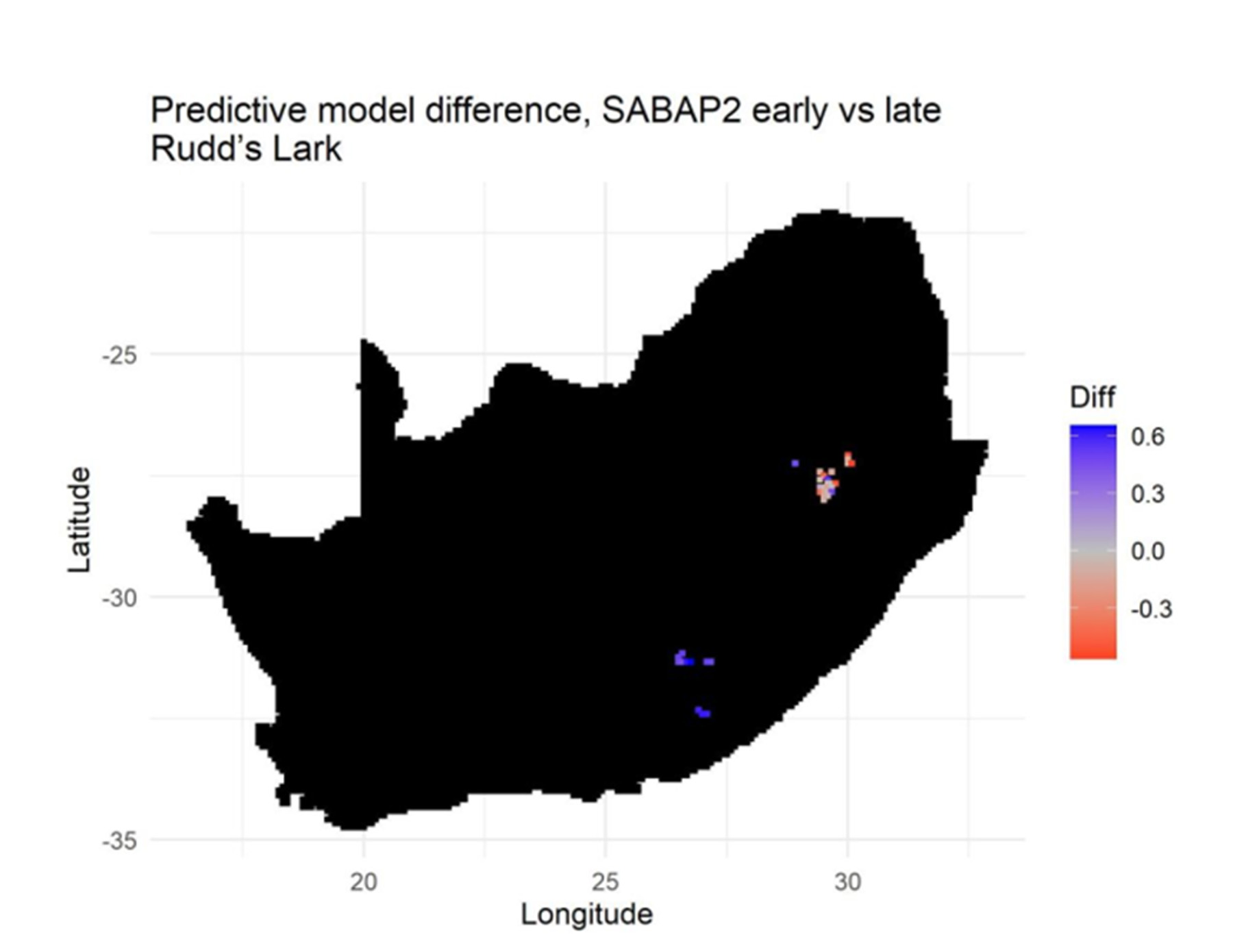
Figure 1: Predictive model difference between SABAP2 early (2007-2015) and late (2016-2023) in probability of recording Rudd’s Lark. Blue = higher probability, red = lower (from Lee 2024).
Biology & Ecology
Taxonomy
The genus Heteromirafra was formerly represented by three species of highly localised larks that formed a superspecies (Keith et al. 1992): Rudd’s Lark H. Ruddi, endemic to South Africa’s upland grasslands; Archer’s Lark H. archeri, known from northwest Ethiopia but not recorded since 1955; and Sidamo or Liben Lark H. sidamoensis, restricted to a single grassland site in southern Ethiopia. Subsequently, Archer’s and Liben Lark were found to be conspecific, with the consolidated species retaining the common name “Liben Lark” and the scientific designation of Heteromirafra archeri (Spottiswoode et al. 2009, BirdLife International 2021). Rudd’s Lark remains highly distinct, and the continent thus retains these two cryptic and localised Heteromirafra (or “different lark”) species. While H. archeri’s situation is markedly worse than H. ruddi, both are in the crosshairs of extinction, due to a combination of habitat loss and highly specific ecological requirements (Hockey et al. 1988). The two species are similar in morphology and plumage, with short, thin tails, distinctively large heads, pale median crown stripes, disproportionately large legs and feet, extremely long and straight hind-claw spikes and upright postures.
Identification
(retained unchanged from Peacock 2015)
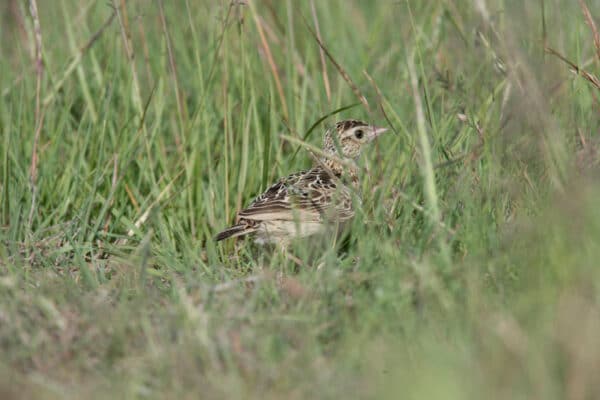
14–15 cm, 26 g. Sexes alike. A highly localised lark, most often located by its song given during an extended aerial display flight. Distinctive in plumage and morphology, with bulbous head, short thin tail and upright posture; hind-claw spikes straight and long (12–20 mm in length). Attractively patterned on mantle and crown, with dark feather interiors and golden-buff feather edges creating scalloped markings. Crown blackish with a pale creamy line down centre; long erectile crown feathers extend down paler nape. Face plain greyish, with pale band around eye. Breast rich buff, lightly streaked darker. Rest of underparts pale buff to whitish. Tail thin and short with white panels on outer rectrices. Flight feathers dark brown with narrow rufous outer edges, forming dull rufous patch in flight. Wing coverts, tertials and scapulars dark with buff margins. Bill horn to pink with darker patch around nostrils. Eyes grey-brown. Legs and feet pale pink. Birds in worn plumage are duller, greyer and less vividly marked. Juveniles are similar to adults (Peacock 2012).
Distribution
Rudd’s Lark is a highly localised resident species, endemic to the high-altitude grasslands of eastern South Africa (Hockey et al. 1988). It has precise habitat requirements and therefore a naturally restricted range and small population; this situation is exacerbated by habitat modification by humans (Hockey et al. 1988). Being notoriously inconspicuous unless singing, this species is easily overlooked, and increased observer awareness has led to discoveries, or rediscoveries, in several areas. Conversely, populations in some localities appear to have disappeared. Historically, the core of the known range for Rudd’s Lark has been centred on south-eastern Mpumalanga (Wakkerstroom, Amersfoort, Belfast, Waterval Boven, Ermelo, Volksrust districts), eastern Free State (Warden, Verkykerskop, Memel) and north-western KwaZulu-Natal (KZN) (Barnes 2000). The species once reached its northern limits in the Steenkampsberg range near Dullstroom in Mpumalanga (Dean and Allen 1997), but this population has not been recorded there during SABAP2 (2007- present) and is believed to be locally extinct. There is now doubt over the persistence of Rudd’s Lark even in southern Mpumalanga, with extensive searches by birders and bird guides in the greater Wakkerstroom area coming up empty handed over the past few years, even at historically reliable microsites such as Fickland Pan, with the “go-to” site shifting south to the Groenvlei area just inside KZN (J Nicolau and D Nkosi in litt 2024). The eastern Free State sites appear to be more stable, with populations spilling over slightly into KZN along the border of these two provinces.
Knowledge of the species’ range in the Eastern Cape has had a checkered history but may yet prove to be a critical portion of Rudd’s Lark’s extent of occurrence. Surveys in the 1980s confirmed that a small but dense population existed at Matatiele (Hockey et al. 1988), and additional localities were subsequently discovered 200 km further south near Ncora Dam in the Transkei as well as near Molteno in the 1990s (Dean and Allan 1997). Today, Matatiele no longer appears to have a viable population, reflected in the distribution maps of SABAP2 as well as dedicated but unsuccessful searches (Colyn et al. 2024). By contrast, recent discoveries of the species have been made in the Dordrecht area, not far east of the Molteno site, with high densities recorded (Colyn et al. 2024). Another high-density pocket of the species appears to be well established even further south in the Cathcart district (W Rossouw in litt 2024). Finally, the Transkei remains something of a mystery, with SABAP2 records at Cofimvaba (not far from Ncora Dam) and at Butterworth, where an individual was found at just above 900 m above sea level, a much lower elevation than what would typically be expected for the species (W Rossouw in litt 2024). Inconsistent detection during surveys at some of these lower elevation sites (e.g. Ncora Dam, Cathcart; 2018-2020) could indicate stochastic occupation based on fluctuating habitat suitability. Given the combination of the cryptic nature of the species, imperfect knowledge of habitat requirements and the Transkei’s extensive rural grasslands, this region may yet prove to be occupied by Rudd’s Lark to a greater extent than is currently known.
Initial distribution modelling suggests that Rudd’s Lark may indeed have a larger distribution than current records suggest (Maphisa et al. 2009). However, more recent distribution modelling (Colyn et al. 2024) incorporating climate, topography and land-cover variables suggests the species’ range is highly fragmented and currently only includes approximately 2000 km2 of remaining grassland habitat in the core range. Of this remaining grassland, given the patch dynamics (size and fragmentation) and functional state (cover and biomass), it is estimated that on average only 40% is in a suitable state meeting the species’ requirements. During SABAP2 data gathering, the species was reported only from the Memel-Verkykerskop area and northwest of Vrede in the Free State, the Wakkerstroom-Amersfoort area of Mpumalanga, and a number of disparate sites in the Eastern Cape as mentioned above. The picture, in a nutshell, is unclear, with the evidence suggesting a fragmented population occupying pockets of suitable habitat across four provinces. Ultimately, however, it remains one of the most range-restricted birds in the region.
Ecology
Even within its restricted range, this species is limited to a very specific habitat, determined by a range of biotic, altitudinal, topographic and climatic variables; its distribution is therefore naturally fragmented and highly localised, both temporally and spatially (Barnes 2000). This produces challenges for accurately assessing habitat availability. Formative work on the species in its historical core range, indicated a preference for sour grassland on flat or gently sloping plateaus and hilltops at altitudes of 1700–2200 m (mostly >1800 m; Maphisa et al. 2009) in areas with high rainfall, typically >600 mm per year (Tarboton et al. 1987). However, the detection of Rudd’s Lark at lower altitude sites in the Eastern Cape (e.g. Molteno, Cathcart, Ncora Dam; W Rossouw in litt 2024) in years with above average rainfall suggests local movements based on rainfall regimes and a reliance on a wider array of grassland habitat during drier periods. Rudd’s Larks also occur at the edges of pans and vleis (Tarboton et al. 1987), but avoid valley bottoms and lowlands, as well as dense cover, old croplands, ploughed fields, rocky areas, valley bottoms, lowlands, intensely modified grasslands, and slopes of >10° (Maphisa 2004, Gush 2019).
Based on Low and Rebelo’s 1996 vegetation map, Rudd’s Lark was virtually restricted to Sandy Highveld Grassland. Dominant grass species within its preferred habitat included Themeda triandra, Tristachya leucothrix, Trachypogon spicatus, Heteropogon contortus and Eragrostis curvula (Hockey et al. 1988). In optimal habitats, the cover of Eragrostis curvula/E. chloromelas was high relative to Themeda triandra (Hockey et al. 1988). Updates to the vegetation map of South Africa by Mucina and Rutherford (2006) show that the Sandy Highveld grassland historically occupied by Rudd’s Lark may be broken down into several sub-types including Low Escarpment Moist Grassland, Northern KZN Moist Grassland, East Free State Sandy Grassland, Amersfoort Highveld Clay Grassland, Wakkerstroom Montane Grassland and Lydenburg Montane Grassland.
Rudd’s Lark typically breeds in sites with moderately to heavily grazed grass with short tussocks (Hockey et al. 1988), selecting sites with shorter than average grass height early in the breeding season (Gush et al. 2019). Hockey et al. (1988) noted that the species is often most numerous in intensively grazed grasslands, usually with trampled or bare patches, which suggests that high grazing pressure does not necessarily affect the birds adversely, but Maphisa (2009) contended that few breeding attempts occur in these heavily grazed sites, possibly due to higher predation rates. Indeed, surveys in the Wakkerstroom area reported that birds were absent from the most heavily grazed sites, and that an increase in the extent of bare ground, possibly due to excessive grazing, may lead to territory desertion (Maphisa et al. 2009, Gush et al. 2019). Conversely, territories may also be abandoned if grass becomes too tall and dense. If some open ground for terrestrial foraging remains, birds may remain in grassland up to 40 cm in height (Maphisa 2004). An absence of forbs has been suggested as an important habitat requirement (Hockey et al. 1988), but pairs do occasionally nest in sites where forbs occur (Maphisa 2004); nevertheless, the presence of forbs (such as spinescent forb Acalypha spp.) may be a sign of deteriorating and overgrazed grasslands (Maphisa 2004). A recent study found the highest densities recorded in management units with mixed livestock (cattle and sheep) or sheep dominant grazing regimes, winter cattle grazing regimes, and/or stringent rotational grazing regimes (Colyn et al. 2024). No study units with persistent year-round cattle grazing and annually burnt grasslands yielded any breeding records. Exclusive cattle grazing for extended periods can lower grass cover and increase forb composition (Toth et al. 2016), thereby possibly reducing habitat suitability for Rudd’s Lark (Colyn et al. 2024). Conversely, sheep-dominant grazing regimes and/or mixed livestock grazing lower forb composition while increasing grass composition, percentage organic matter, and basal cover (Abaye et al. 1997) which in turn favours Rudd’s Lark habitat suitability (Colyn et al. 2024). Between 2007 and 2017, the South African government reported a 28% decrease in sheep farming, coupled with an 11% and 8% increase in cattle and mixed (crops and cattle) farming respectively (Census of Commercial Agriculture 2017). Initial surveys in the Wakkerstroom area in the late 1980s (Tarboton et al. 1987) reported sheep as the predominant livestock farmed, while recent surveys only recorded sheep on 5% of study sites in the area. Livestock type may indeed play a more important role in habitat suitability for the species than grazing intensity and requires further investigation (Colyn et al. 2024).
Suitable breeding habitat was thought to be maintained by annual burning and heavy winter grazing (Hockey et al. 1988); the latter was likely sustained in the pre-agricultural past by large herds of grazing ungulates, but today mostly by domesticated livestock (Maphisa et al. 2009). As nesting attempts appear to be clustered in the second half of the breeding season (with egg-laying occurring between October and April, with peaks in January to February), late burning of grasslands may shorten the breeding season, and could account for population decreases (Maphisa et al. 2009). Maphisa et al. (2009) suggested that this species does best in grassland burned before the start of the breeding season, and indeed adult birds have been found in recently burned sites (W Rossouw in litt 2024). However, the species has also been detected at sites that are never burned, and grass length is maintained instead by grazers (Colyn et al. 2024). Primary defoliation through the use of fire, as opposed to functional grazing regimes, decreases habitat suitability (He et al. 2019), which may have been the driver of the absences recorded in recent surveys (2017-2020) at numerous (>10) annually burnt local study sites in Wakkerstroom, Memel and Amersfoort.
Habitat suitability modelling from transect data collected across the species’ range suggests that larger intact grassland patches (>100 ha) that incorporate well managed rotational grazing regimes with lower fire prevalence and higher basal cover increased the probability of species presence (Colyn et al. 2024). This extensive habitat specialisation, combined with extensive (30%) historic habitat loss, has resulted in a highly fragmented range with <1000 km2 (40%) of highland grassland within the species’ range being suitable (Colyn et al. 2024). Habitat use and suitability within the recently discovered sites and peripheral areas of the Eastern Cape require further study. The more recent surveys in the Dordrecht area yielded sightings of birds utilising a tame (artificially seeded) pasture, which is a first for the species. If grassland structure and composition requirements can be mimicked within tame pastures and meet the needs of the species, it can become a significant conservation/rehabilitation tool used to promote the persistence of Rudd’s Lark (and other species) by alleviating the primary threat, namely habitat loss and degradation.
Threats & Conservation
Threats
Rudd’s Lark is a highly specialised and naturally localised inhabitant of grassland, the most threatened but least protected habitat in southern Africa (Dean and Allan 1997). Siegfried (1992) estimated that <1% of the maximum global population (c. 100 birds) occurred in formally protected areas, (even before the disappearance of the species from Verloren Vlei Nature Reserve near Dullstroom). The recent SABAP2 assessment reports that 5 out of 28 (or 18%) of pentads where Rudd’s Lark has been recorded during the project have some form of protection (Lee 2024). As with most threatened grassland species, loss, degradation and fragmentation of its habitat are the main threats faced by Rudd’s Lark and has resulted in local population reductions (Barnes 2000, Gush 2019). Changes in its sensitive grassland habitat are mostly brought about by commercial afforestation, agricultural intensification or unfavourable pasture management. At least 30% of the suitable highland grasslands within the species’ range has been lost to direct land-use alteration, and as much as 60% of currently remaining grassland habitat is unsuitable due to associated management regimes (Colyn et al. 2024). Even seemingly innocuous changes, such as the shift from sheep to cattle, may be detrimental if the preferred grass height and structure is altered enough, although populations of Rudd’s Lark do persist under certain cattle-only regimes (Colyn et al. 2024). A close relationship between grassland management, especially in terms of grazing pressure and fire regimes, the length of the breeding season, and nest success has been postulated (Maphisa et al. 2009).
In this regard, unfavourable burning practices may also be detrimental to Rudd’s Larks; for example, nesting success is higher in territories that were burned earlier in the breeding season, compared to territories that were burned later in the season, resulting in a shortened breeding windows and increased predation rates (Maphisa et al. 2009). Extensive wildfires or deliberately frequent burning may lead to local population declines and nest destruction. Although previously believed to be at low risk from climate change, a modelling study in 2012 identified the birds of South Africa’s grassland and fynbos biomes as those predicted to be the most vulnerable to climate change (Huntley and Barnard 2012). Indeed, Rudd’s Lark and Botha’s Lark were predicted to be the worst-affected species, with both potentially losing all suitable climatic space by 2085 under two of the four future climate scenarios modelled, due to the high elevation nature of their preferred habitat.
Direct habitat destruction for the purposes of mining, housing and human settlements and agricultural initiatives to alleviate food shortages also have a negative impact on this species (Barnes 2000). Most recently, the attention of renewable energy developers, particularly for wind energy facilities and solar power arrays, has been drawn to the grasslands of South Africa. This has had an unexpected benefit to our knowledge of Rudd’s Lark, with environmental impact assessment (EIA) surveys revealing new pockets of the species in places like Dordrecht (Wessel Rossouw in litt 2024). However, given the availability of grid infrastructure within the Highland Grassland Ecoregion, a surge of applications (numbering in the hundreds) is expected in the short term, which could pose a significant risk to Rudd’s Lark if approved. Significant fatality rates associated with wind turbine collisions have been recorded for grassland-associated lark species that exhibit extended aerial displays within wind turbine rotor swept heights, such as Horned Lark Eremophila alpestris and Skylark Alauda arvensis (Bose et al. 2020, Garvin et al. 2024). The cumulative impact of wind farms on Skylark breeding populations, for example, accounted for an estimated 184% increase in the mortality rate of breeding individuals between 2007 and 2021 (Bastos et al. 2016). Rudd’s Larks are noted to conduct extensive aerial displays during the breeding season (October–April) and a recent study estimated that >70% of flight display time is within average rotor sweep height, making them highly susceptible to collision risk (Colyn et al. 2024). However, these factors and the species’ current IUCN status (Endangered) are accounted for in the EIA process which (with due diligence from the assessors) would flag Rudd’s Lark as a Species of Conservation Concern and preclude the installation of wind turbines at sites where the species occurs.
Conservation Measures Underway
Understanding how this species responds to different land-use practices is central to conservation planning and it is critical to identify management regimes suitable to maintaining its preferred habitat. Research has been conducted on the fine-scale habitat requirements of this species (Maphisa 2004, Maphisa et al. 2009, Gush 2019) and further analyses are underway to develop new distribution models and incorporate the recently discovered Eastern Cape subpopulations (Colyn et al. in prep 2024). Site-based and regional conservation actions, such as developing land stewardship programmes, contribute towards the success of initiatives such as the Grassland Important Bird and Biodiversity Area identified by BirdLife South Africa and centred around the towns of Volksrust, Wakkerstroom and Memel.
At a State level, Mesic Highveld Grasslands have been earmarked for expansion by the National Protected Areas Expansion Strategy. The associated proposed Grassland Biosphere Reserve would cover an expansive area, consisting primarily of private and state-owned land, with a few small, protected areas including Wakkerstroom and Seekoeivlei Nature Reserves. Additionally, a number of sites occupied by Rudd’s Lark both currently and historically have been identified by the IUCN-led Key Biodiversity Area initiative, including the Wakkerstroom grasslands (100975), Chrissie Pans (100747), Matatiele (100853) and the Eastern Free State Escarpment (100720) (keybiodiversityareas.org 2024).
Conservation Measures Proposed
The long-term survival of Rudd’s Lark is largely reliant on beneficial management of grasslands by private land-owners. In particular, this would entail maintaining suitable grazing levels, as under- and overgrazed sites appear to support fewer larks. Fire is used extensively as a tool to control ticks and disease, improve forage for livestock, remove accumulated litter and promote grass regeneration in some areas, but would need to accommodate the important relationship for Rudd’s Lark between timing of breeding, length of breeding season and nesting (Maphisa et al. 2009). This kind of land stewardship is now critical in the portions of the historical core range such as the eastern Free State sites where Rudd’s Lark persists, in light of the apparent and highly concerning losses in southern Mpumalanga. Implementation or continuation of appropriate land-use practices should be encouraged through education and awareness campaigns, and possibly through financial incentives (Tarboton et al. 1987) or through the encouragement of sustainable ecotourism. At some of the key sites for the species, conservation of intact avian communities is desirable, as Rudd’s Lark often overlaps with other threatened bird species such as Botha’s Lark, Southern Bald Ibis Geronticus calvus, Yellow-breasted Pipit Anthus chloris, Bush Blackcap Sylvia nigricapillus, White-winged Flufftail Sarothrura ayresi and all three of South Africa’s crane species.
Further research into the ecological requirements of Rudd’s Lark, and the effects that different management practices have on the species, should also be undertaken. This is particularly important in light of recent discoveries of sites in the Eastern Cape, where factors such as altitude, burning regimes and livestock management may differ from previously assumed preferences for Rudd’s Lark. Extensive surveys have already been conducted and key sites should be revisited to engage with relevant landowners on the topic of land stewardship and grassland conservation. In areas of the Transkei where Rudd’s Lark may occur on communal land or subsistence farms, lessons may be learned from projects aimed at protecting the Liben Lark. In 2015, a multi-organisation collaboration spearheaded by BirdLife International developed an initiative to help local communities create communally-managed grassland reserves on the Liben Plain, the last stronghold of the Liben Lark. These reserves, or kallos, are designed to serve as fodder for livestock during the dry season and importantly also provide suitable breeding and foraging for the Liben Lark during the wet seasons. More knowledge of Rudd’s Lark in the Transkei would assist in determining if a similar project would be viable or necessary in this part of the species’ range.
Research Priorities and Questions
- Field surveys and monitoring programs are required to ascertain whether this species is still present at some of the sites where it was known to occur previously, as well as to track fluctuations. Surveys should be conducted by experienced observers, preferably at the onset of breeding when Rudd’s Larks are most vocal and conspicuous.
- The recent observed use of a tame (artificially seeded) pasture in the Eastern Cape should be further investigated as it could offer a significant rehabilitation tool for severely degraded grasslands and/or fallow land in core areas of the species’ range.
- The impact of displacement, collision (fatality rates) and noise disturbance of wind energy facility infrastructure on Rudd’s Lark should be closely studied if wind facilities are developed within the species’ range.
- Where local disappearances or decreases in abundance have occurred, the causes of this should be investigated (emphasis on Wakkerstroom, Amersfoort, Matatiele and Dullstroom).
- Further research into the ecological requirements of the species, and land-uses suitable for fulfilling these requirements, should be undertaken (emphasis on E Cape sites).
- Biodiversity stewardship and land conservation strategies in areas where healthy subpopulations are known to occur, whether through private stewardship programs or formal protected areas, must be identified as a priority.
Contributors & References
Assessor/s
Wesley Gush, Robin Colyn
Reviewer/s
Rael Loon
References
Abaye OA, Allen VG, Fontenot JP. 1997. Grazing sheep and cattle together or separately: effect on soils and plants. Agronomy Journal 89: 380–386.
Barnes KN. 2000. Rudd’s Lark Heteromirafra ruddi. In: Barnes KN (ed), The Eskom Red Data Book of Birds of South Africa, Lesotho and Swaziland. Johannesburg, South Africa: BirdLife South Africa. pp 30–31.
BirdLife International. 2021. Heteromirafra ruddi. The IUCN Red List of Threatened Species 2021: e.T22717153A177889023. https://dx.doi.org/10.2305/IUCN.UK.2021-3.RLTS.T22717153A177889023.en. [Accessed on 02 June 2024].
Bose A, Durr T, Klenke RA, Henle K. 2020. Assessing the spatial distribution of avian collision risks at wind turbine structures in Brandenburg, Germany. Conservation Science and Practice 2: https://doi.org/10.1111/csp2.199.
Colyn RB, Rossouw W, Lee A, Smit-Robinson H, Ryan P. 2024. The distribution, population status and habitat requirements of three threatened endemic avian species in South Africa. PhD chapter.
Dean WRJ, Allan DG. 1997. Rudd’s Lark Heteromirafra ruddi. In: Harrison JA, Allan DG, Underhill LG, Herremans M, Tree AJ, Parker V, Brown CJ (eds), The atlas of southern African birds Vol II: Passerines. Johannesburg, South Africa: BirdLife South Africa. pp 26.
Dean WRJ, Ryan PG. 2005. Rudd’s Lark Heteromirafra ruddi. In: Hockey PAR, Dean WRJ, Ryan PG (eds), Roberts – Birds of southern Africa, 7th Edn. Cape Town, South Africa: The Trustees of the John Voelcker Bird Book Fund. pp 867–868.
Garvin JC, Simonis JL, Taylor JL. 2020. Does size matter? Investigation of the effect of wind turbine size on bird and bat mortality. Biological Conservation 291: 110474.
Gush WG, Maphisa DH, Reynolds C, Donald PF, Spottiswoode CN. 2019. Declines of the globally threatened Rudd’s Lark Heteromirafra ruddi in one of its last remaining strongholds. Bird Conservation International 29: 644–56.
He T, Lamont BB, Pausas JG. 2019. Fire as a key driver of Earth’s biodiversity. Biological Reviews/Biological Reviews of the Cambridge Philosophical Society 94: 1983–2010.
Hockey PAR, Allan DG, Rabelo AG, Dean WRJ. 1988. The distribution, habitat requirements and conservation status of Rudd’s Lark Heteromirafra ruddi in South Africa. Biological Conservation 45: 255–266.
Huntley B, Barnard P. 2012. Potential impacts of climatic change on southern African birds of fynbos and grassland biodiversity hotspots. Diversity and Distributions 18: 769– 781.
Keith S, Urban E, Fry CH. 1992. The Birds of Africa, Vol IV: Broadbills to Chats. New York, United States of America: Academic Press, New York.
Lee ATK. 2024. Regional Red Data Book of the Birds of South Africa, Lesotho and Eswatini: SABAP2 synthesis and supporting information and graphics for Rudd’s Lark. Unpublished report. Johannesburg: BirdLife South Africa.
Low A, Rebelo A (eds). 1996. Vegetation of South Africa, Lesotho and Swaziland. Pretoria, South Africa: Department of Environmental Affairs and Tourism.
Maphisa DH. 2004. Habitat selection and breeding biology of Rudd’s Lark Heteromirafra ruddi: implications for conservation. MSc thesis, University of Cape Town, South Africa.
Maphisa DH, Donald PF, Buchanan GM, Ryan PG. 2009. Habitat use, distribution and breeding ecology of the globally threatened Rudd’s Lark and Botha’s Lark in eastern South Africa. Ostrich 80: 19–28.
Peacock F. 2012. Chamberlain’s LBJs The definitive guide to Southern Africa’s Little Brown Jobs. Pretoria, South Africa: Mirafra Publishing.
Peacock F. 2015. Rudd’s Lark Heteromirafra ruddi. In: Taylor MR, Peacock F, Wanless RM (eds), The Eskom Red Data Book of Birds of South Africa, Lesotho and Swaziland. Johannesburg, South Africa: BirdLife South Africa. pp 136–139.
Powlesland, R.G. 2009. Impacts of wind farms on birds: a review. Science for Conservation 289.
Siegfried W. 1992. Conservation status of the South African endemic avifauna. South African Journal of Wildlife Research 22: 61–64.
Spottiswoode CN, Olsson U, Mills MS, Cohen C, Francis JE, Toye N, Hoddinott D, Dagne A, Wood C, Donald PF, Collar NJ. 2013. Rediscovery of a long lost lark reveals the conspecificity of endangered Heteromirafra populations in the Horn of Africa. Journal of Ornithology 154: 813–825.
Szymanski P, Deoniziak K, Losak K, Osiejuk TS. 2017. The song of Skylarks Alauda arvensis indicates the deterioration of an acoustic environment resulting from wind farm start-up. Ibis 159: 769–777.
Tarboton WR, Kemp MI, Kemp AC. 1987. Birds of the Transvaal. Pretoria, South Africa: Transvaal Museum.
Toth E, Deak B, Valko O, Keleman A, Miglecz T, Tothmeresz B, Torok P. 2016. Livestock type is more crucial than grazing intensity: traditional cattle and sheep grazing in short-grass Steppes. Land Degradation and Development 29: 231–239.
Citation
Gush W, Colyn R 2025. Rudd’s Lark. In: Lee ATK, Rose S, Banda S, Bezeng SB, Maphalala MI, Maphisa DH, Smit-Robinson H (eds), The 2025 Red Data Book of Birds of South Africa, Lesotho and Eswatini. Johannesburg, South Africa: BirdLife South Africa. Available at: https://www.birdlife.org.za/red-list/rudds-lark/
Our generous sponsors


