


Blue Korhaan
Eupodotis caerulescens

Number Of Mature
Individuals (Regional)
2 500 – 10 000

Regional
Population Trend
Decreasing
2025
Regional Category
Vulnerable
Search by species
CONTENTSOverview
Names
|
IOC English Name: |
Blue Korhaan |
|
SA & IOC Scientific Name: |
Eupodotis caerulescens |
|
BirdLife International Taxonomy (scientific name): |
Blue Bustard (Eupodotis caerulescens) |
|
Order: |
OTIDIFORMES |
|
Family: |
Otididae |
|
Species name author: |
Vieillot 1820 |
|
Afrikaans: |
Bloukorhaan |
|
Sesotho (South Africa): |
lekakarane-phutswa |
|
Sesotho (Lesotho): |
lekakarane-putsoa |
|
Siswati: |
|
|
Zulu: |
Umbhukwane |
Current Assessment Status
|
2025 Regional Category [Criteria] |
VU [A2b; C1] |
|
2024 Global Category [Criteria] |
NT [A3c; C1] (BirdLife International 2017) |
|
Population size (Regional) |
2500 – 10 000 |
|
Population size (Global) |
8000 – 10 000 (BirdLife International 2017) |
|
Distribution size (EOO) (Regional) km2 |
345 784 (Lee 2024) |
|
Distribution size (EOO) (Global) km2 |
356 000 (BirdLife International 2017) |
|
Distribution size (AOO) (Regional) km2 |
161 280 (Lee 2024) |
|
Generation time |
10.3 years (BirdLife International 2017) |
|
Status change reason |
Genuine Change in Status |
|
Migrant (in the region) |
No |
|
Regional endemic |
Yes |
Historic Listing Information
|
2000 Regional Status |
NT |
|
2015 Regional Status |
LC |
|
Status change reason (if applicable) |
Lack of evidence for a decline |
|
2015 Population size (Regional) |
Unknown |
|
2015 Global Status |
NT |
Reason for Inclusion
Reason for Inclusion in the Assessment
Blue Korhaan is a regional endemic with a global Red List status of Near Threatened (BirdLife International 2017). Blue Korhaan was assessed as regionally Near Threatened in 2000 (Barnes 2000) but downlisted to Least Concern in 2015 (Taylor et al. 2015). The rationale behind the downlisting was the lack of evidence of decline in range or population size (Taylor et al. 2015).
Blue Korhaan was included for reassessment in the 2025 Regional Red List given its global threat status and its status as a regional endemic coupled with evidence for declines from citizen science.
Category Justification
Category Justification
Citizen science data, from the Coordinated Avifaunal Road Counts (CAR) and Southern African Bird Atlas Project (SABAP2), show that the population of Blue Korhaan has declined over the past three generations (30.9 years). While rates vary, the population has almost certainly declined by at least 10% over the past three generations. Despite the rate of decline in numbers recorded from CAR (64.5%, CI: 51 – 73%) meeting the threshold of Endangered (Criterion A) the modelled rate of range contraction from SABAP2 data over the same time period is considerably less (7.9%). Due to falling participation, CAR is considered less robust than SABAP2, so uplisting to Vulnerable only is recommended in this assessment as declines are likely > 10% but may be < 50%. Considerable uncertainty exists around the size of the population of Blue Korhaan. Existing estimates are all at least twenty years old and are from localised studies. However, all these estimates put the population at less than 10 000 mature individuals (Hockey et al. 2005, BirdLife International 2017). With a small declining population, this regional endemic is assessed as Vulnerable A2b; C1.
Population Justification
Various population estimates exist for Blue Korhaan, varying from 1500 – 5000 (Siegfried 1997) to 8000 – 10 000 (BirdLife International 2017). These estimates are almost certainly outdated, and considerable uncertainty exists about the current population size. Nevertheless, given the evidence of declines over the past three generations (Lee 2024, Figures 1 and 2) the population is assumed to be less than 10 000 but greater than 2500.
Trend Justification
The Blue Korhaan population is in decline (BirdLife International 2017, Lee 2024). Abundance estimates from CAR estimate an annual rate of decline of 3.3% per year, with a 95% confidence interval of -4.2% to -2.4% per year (Lee 2024, Figure 1). The range of the Blue Korhaan is well covered by CAR routes across the Free State province, the core of its distribution. Over three generations this translates into an estimated decline of approximately 64.5% (95% CI: 51 – 73%)) according to a negative binomial model with season, observers and controlling for route nested in precinct. There are concerns the species is heading for extinction in Lesotho (D Maphisa pers comm). The predicated modelled change in Area of Occupancy (AOO) (at the SABAP2 pentad scale) estimates a 7.9% decline over the past three generations (Lee 2024, Figure 2). The species has been reported in >20% fewer pentads for the 2016-2023 SABAP2 period compared to the 2007-2015 period (800 vs 1049). The loss of range suggests the species declines are related to the species becoming less common within their range.
The drivers of decline are poorly understood but are thought to be connected to habitat loss and transformation, specifically habitat loss linked to intensive agriculture and afforestation, specifically in the east of its range (Collar et al. 2021).
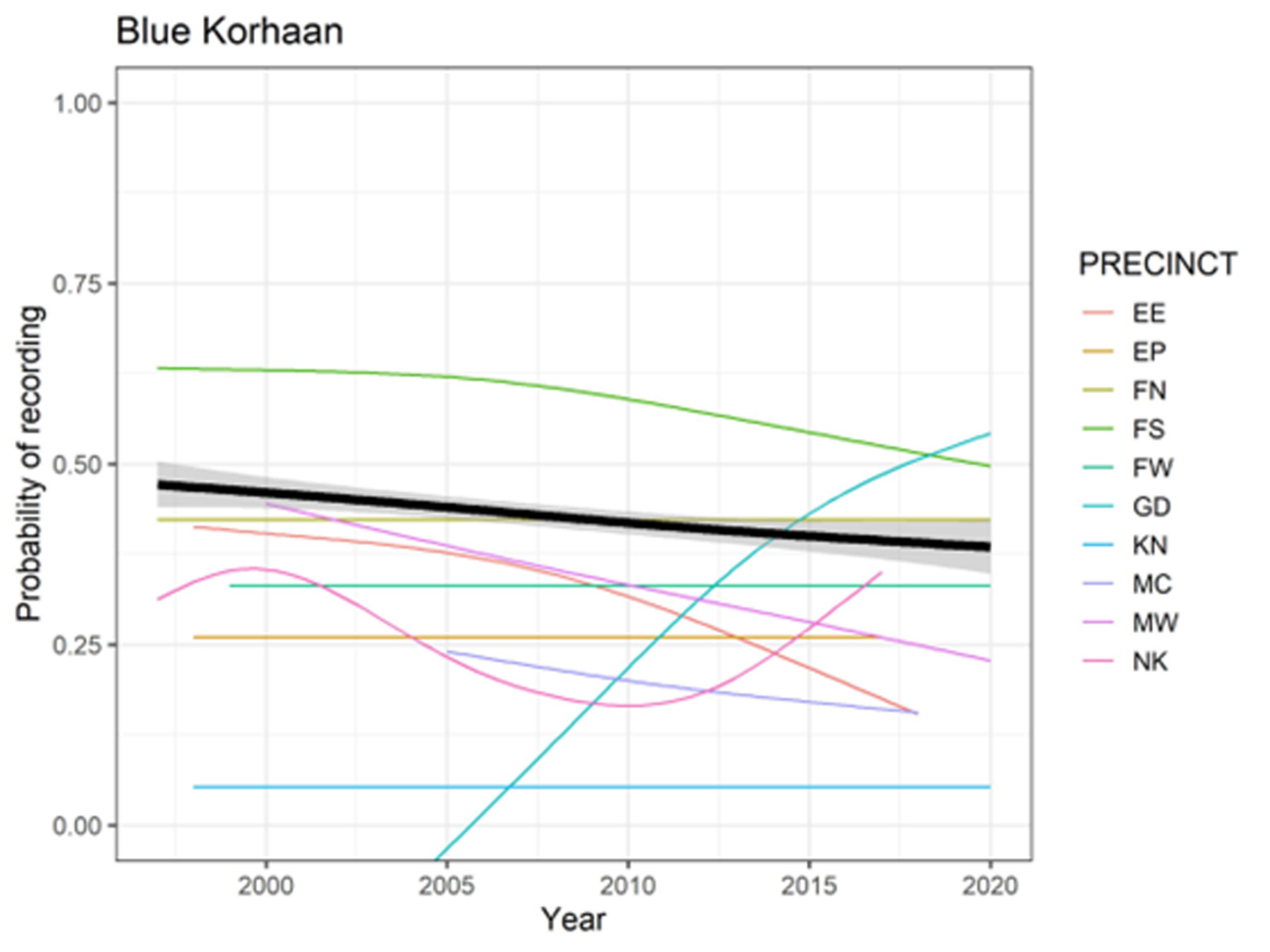
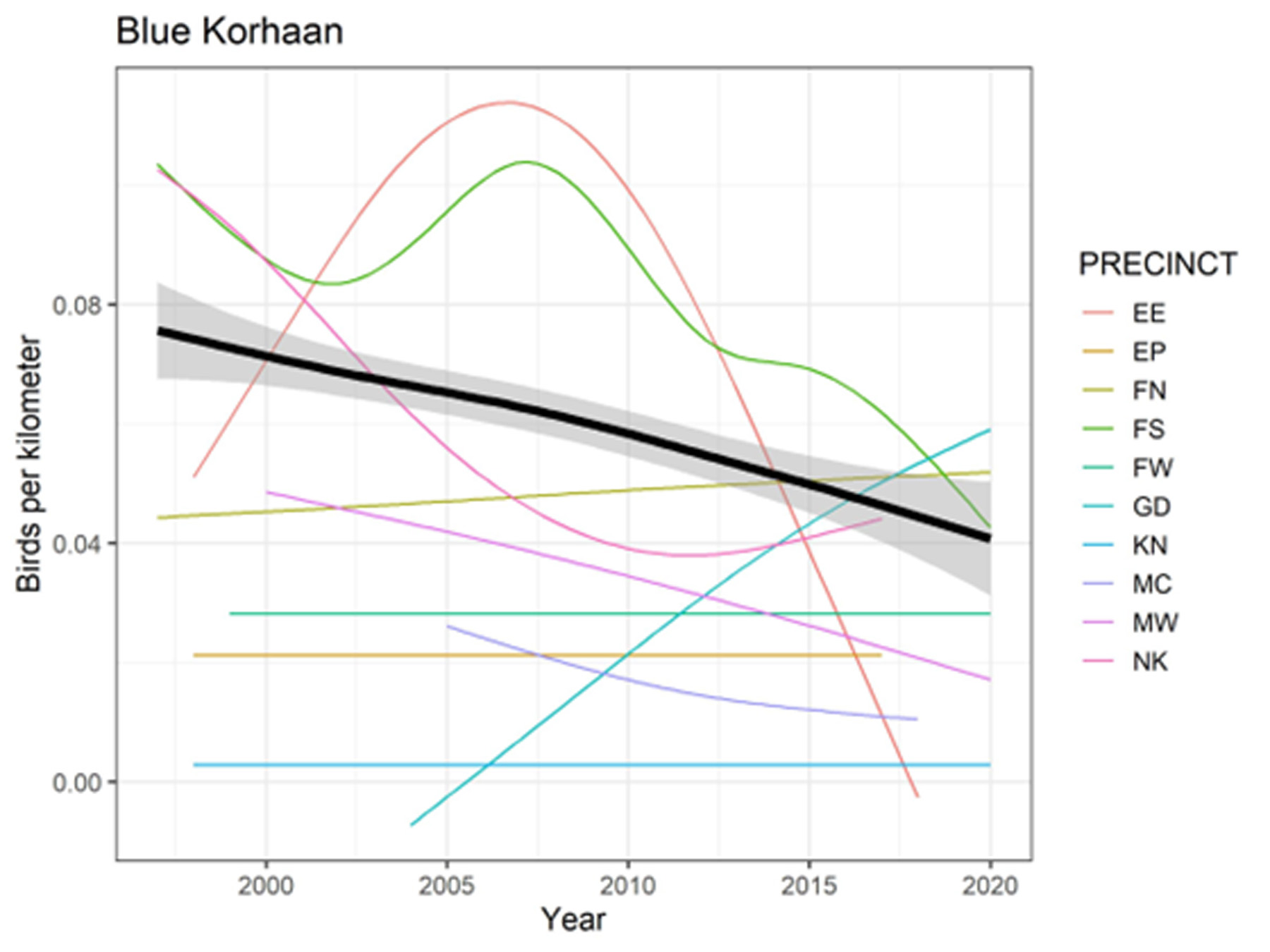
Figure 1: Showing the change in probability of reporting (top) and number of birds counted per kilometre (bottom) during the bi-annual Coordinated Avifaunal Road Counts (CAR) counts between 1998-2020. Each colour line denotes results for the separate precincts while the black line corresponds to the overall trend, with 95% confidence intervals in grey shading.
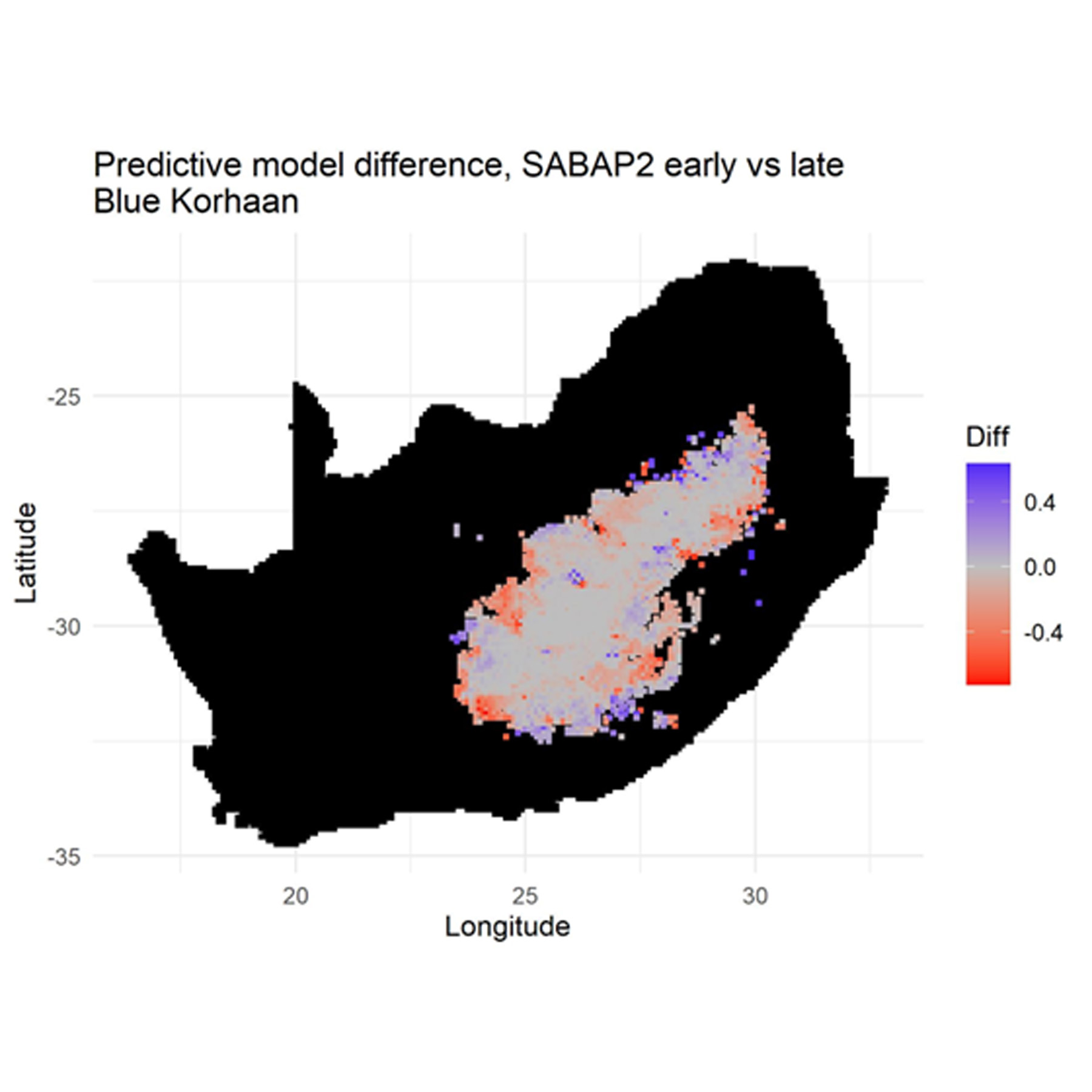
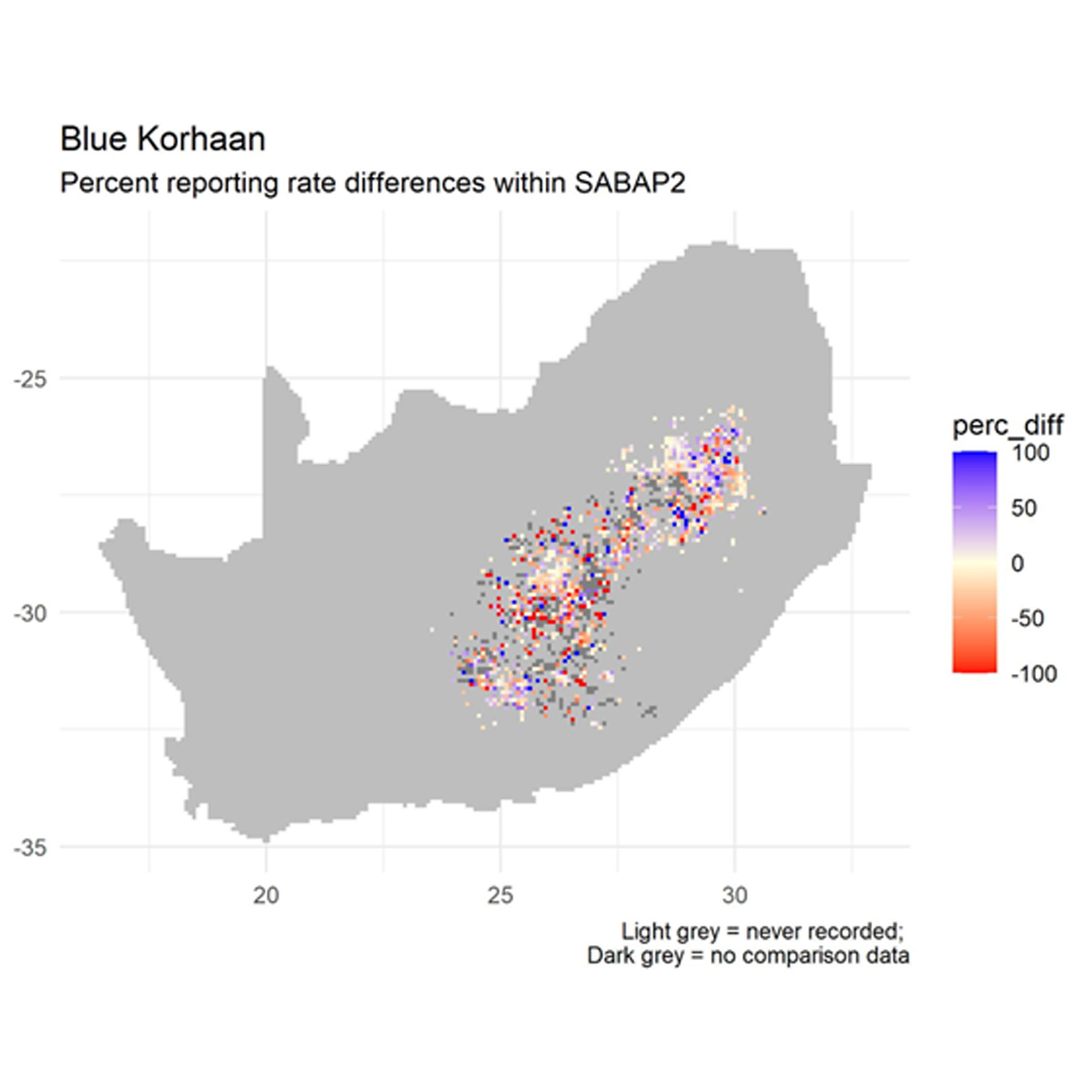
Figure 2: SABAP distribution maps for Blue Korhaan comparing predictive model difference in AOO (top) and change in reporting rate per pentad (bottom) (Lee 2024). In both plots, red indicates areas of decline, blue areas of increase and grey or cream areas of no change.
Biology & Ecology
Taxonomy
Monotypic. Unsettled nomenclature, usually attributed to Vieillot (1821) with spelling caerulescens although this appears predated by Temminck (1807) with spelling coerulescens but with no detailed description (Gill et al. 2024). Following prevailing usage, caerulescens is used here. There is also some disagreement regarding genus, at times isolated in the monotypic genus Trachelotis (Sharpe 1894, Peters 1934). While other authors (e.g. Dickinson and Remsen 2013, Gill et al. 2024) have treated this species and White-bellied Bustard E. senegalensis as the sole members of the genus Eupodotis.
Identification
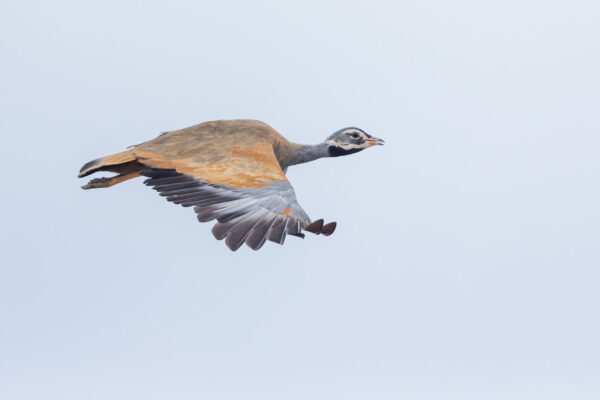
50–58 cm, sexes differ in plumage colouration (Allan 2005). Male Blue Korhaans have a distinctive black-and-white face, bluish-grey underparts, and a bluish-grey neck, complemented by a dull-chestnut back (Collar et al. 2021). While both sexes share similar features, females typically have a less vibrant grey neck and more muted, buff-coloured ear coverts (Collar et al. 2021). This species is unique among bustards, as it is the only one with a blue-grey neck and underparts, and it is also known for displaying blue hues on its wings when in flight (Collar et al. 2021).
Can be confused with the White-bellied Korhaan, which has a tawny hind neck (instead of the blue-grey) and a white belly, rather than a blue-grey one (Allan 2005). Moreover, the Karoo Korhaan is a duller brown colour, with no white markings on its face (Allan 2005). Both of these species also differ in flight, as their outer wing panels are creamy-buff rather than blue (Allan and Davies 1995).
Distribution
This species is endemic to South Africa with a marginal range in western Lesotho (Allan 1997). Within South Africa, Blue Korhaan is restricted to Mpumalanga, northwest KwaZulu-Natal, Free State, Eastern Cape and the southeast Northern Cape (Figure 3).

Figure 3: Probability distribution map for Blue Korhaan from iNaturalist, eBird and SABAP2 data. Yellow indicates regions of greater probability of occurrence. Map from Lee (2024).
Ecology
The Blue Korhaan is generally found in high grassveld areas, usually above 1500 meters, where short-grazed grassland (1 km from water (Mostert 1982).
The Blue Korhaan breeds from September to February, with most records occurring in October and November (del Hoyo et al. 1996). It typically lays one to two eggs, rarely three, in a shallow ground scrape (del Hoyo et al. 1996). Incubation lasts 24 to 28 days, carried out solely by the female (Kemp and Tarboton 1976, Mostert 1982, Maclean 1993, Tarboton 2001). Chicks provisioned by male and female, with a fledging period of about five weeks (Maclean 1993). Breeding success is not well-documented, recorded cause of failure included fire and farm machinery (Collett 1982). The average brood size is 1.47, and information regarding life expectancy is not specified (Allan DG and Tarboton WR, unpubl data).
Blue Korhaan is a regional endemic and is considered sedentary (Allan 2005, Collar et al. 2021).
Highly variable diet including insects such as grasshoppers, beetles, termites, scorpions, lizards and/or vegetable matter like grass, seeds and, flowers (Clancey 1967, Mostert 1982, Urban et al.1986, Kok and Hewitt 1990, Maclean 1993, Del Hoyo et al. 1996).
Threats & Conservation
Threats
Blue Korhaan is poorly studied and as such specific threats are not well understood. However, the overlap between its distribution in high grasslands and increasing pressures such as human settlement, mining, large-scale agriculture and afforestation are all assumed to be contributing to the observed declines (e.g. Collar et al. 2021, Taylor et al. 2015). Of particular concern is habitat loss across its range (Barnes 2000). Historically intensive agriculture was identified as the primary threat (del Hoyo et al. 1996). Collision fatalities at wind energy farms do not at this stage appear to be a significant threat for this species (Perold et al. 2020).
Conservation Measures Underway
No species-specific measures are currently underway.
Conservation Measures Proposed
Most of the Blue Korhaan distribution falls outside of protected areas (Lee 2024). This is concerning the lack of understanding as to whether this species can use transformed landscapes and habitat loss throughout the range. It is critical that habitat is set aside and protected in order to ensure the continued survival of this endemic.
In 2024, the NGO Bustards Without Borders initiated a collaboration between bustard experts that aims to complete a multi-species action plan for bustards globally. This will include a conservation action plan for southern African species, with a strong focus on endemic species such as the Blue Korhaan.
A Blue Korhaan tracking study has been initiated in Mpumalanga Province, which aims to investigate the movement ecology of the species and how this may influence its vulnerability to emerging threats such as renewable energy development.
Research Priorities and Questions
- An updated population size estimate is urgently required. Closely linked is an understanding of the relative densities throughout the range of the Blue Korhaan.
- Understanding differences in the population size, density and movement patterns of Blue Korhaan in and between the various habitat types throughout its range should be determined. Understanding these differences should help to assess the changes in the size of the bird’s population more directly and accurately over time and assess its risk of extinction.
- Determining the breeding success of Blue Korhaan specifically in the centre and along the edges of its range (i.e. the quarter degree grid cells in which the species was recorded in SABAP2 and not SABAP1) would improve our understanding of which parts of its range represent source and sink populations.
- Other priorities are determining whether the network of protected areas, critical biodiversity areas, and ecosystem support areas are sufficient to conserve a viable population of Blue Korhaan, and whether habitat patch area and/or fragmentation thresholds exist below which the population would decline more rapidly than the current rate at which it is declining (as discussed for Southern Black Korhaan, Evans 2023).
- In addition to habitat loss, it is also important to determine the magnitude of the other threats facing the species, for example afforestation, climate change, and human disturbance.
Contributors & References
Assessor/s
Sanjo Rose, Maria Paul
Reviewer/s
Matt Pretorius
References
Allan DG. 1997. Blue Korhaan. In: Harrison JA, Allan DG, Underhill LG, Herremans M, Tree AJ, Parker V, Brown CJ (eds), The Atlas of Southern African Birds. Vol. 1. pp 358–359. Johannesburg: BirdLife South Africa.
Allan DG. 2005. Blue Korhaan. In: Hockey PAR, Dean WRJ, Ryan PG (eds), Roberts – Birds of Southern Africa, 7th ed. Cape Town: The Trustees of the John Voelcker Bird Book Fund. pp 302–304.
Allan DG, Davies RAG. 1995. The field identification of the bustards and korhaans (Otididae) of Southern Africa. Bulletin of the African Bird Club 2: 16–24.
Clancey PA. 1967. Gamebirds of Southern Africa. Cape Town: Purnell.
Collett J. 1982. Birds of the Cradock District. Southern Birds 9: 1–65.
Collar N, Garcia E, Kirwan GM. 2021. Blue Bustard (Eupodotis caerulescens), version 2.0. In: Keeney BK, Rodewald PG (eds), Birds of the World. Ithaca, NY: Cornell Lab of Ornithology. Available: https://doi.org/10.2173/bow.blubus1.02.
Del Hoyo J, Elliott A, Sargatal J. 1996. Handbook of the Birds of the World. Vol. 3. Barcelona: Lynx Edicions.
Dickinson EC, Remsen JV (eds). 2013. The Howard and Moore Complete Checklist of the Birds of the World, 4th ed. Vol. 1. Eastbourne, UK: Aves Press. https://www.aviansystematics.org/4th-edition-checklist.
Gill F, Donsker D, Rasmussen P (eds). 2024. IOC World Bird List (v14.2). https://doi.org/10.14344/IOC.ML.14.2.
Harrison JA, Allan DG, Underhill LG, Herremans M, Tree AJ, Parker V, Brown CJ (eds). 1997. The Atlas of Southern African Birds. Johannesburg: BirdLife South Africa.
Kemp A, Tarboton W. 1976. Small South African bustards. Bokmakierie 28: 40–43.
Kok OB, Hewitt PH. 1990. Bird and mammal predators of the harvester termite Hodotermes mossambicus (Hagan) in semi-arid regions of South Africa. South African Journal of Science 86: 34–37.
Lee ATK. 2024. Regional Red Data Book of the Birds of South Africa, Lesotho and Eswatini: SABAP2 synthesis and supporting information and graphics for Blue Korhaan. Unpublished report. Johannesburg: BirdLife South Africa.
Maclean GL. 1993. Roberts’ Birds of Southern Africa, 6th Edn. Cape Town: John Voelcker Bird Book Fund.
Mostert DJ. 1982. ‘n Padsensus van die verteenwoordigende korhane en poue in die Oranje-Vrystaat. Orange Free State Provincial Administration, unpublished report.
Peters JL. 1934. Check-list of Birds of the World. Vol. 2. Cambridge, MA: Harvard University Press. https://doi.org/10.5962/bhl.title.14581.
Sharpe RB. 1894. Catalogue of the Birds in the British Museum. Vol. 23. London: Trustees of the British Museum (Natural History). https://www.biodiversitylibrary.org/page/8378883#page/7/mode/1up.
Tarboton W. 2001. A Guide to the Nests and Eggs of Southern African Birds. Cape Town: Struik.
Tarboton WR, Kemp MI, Kemp AC. 1987. Birds of the Transvaal. Pretoria: Transvaal Museum.
Taylor MR, Peacock F, Wanless RM. 2015. The 2015 Eskom Red Data Book of Birds of South Africa, Lesotho and Swaziland. Johannesburg: BirdLife South Africa.
Urban EK, Fry CH, Keith S (eds). 1986. The Birds of Africa. Vol. 2. London: Academic Press.
Citation
Rose S, Paul M 2025. Blue Korhaan. In: Lee ATK, Rose S, Banda S, Bezeng SB, Maphalala MI, Maphisa DH, Smit-Robinson H (eds), The 2025 Red Data Book of Birds of South Africa, Lesotho and Eswatini. Johannesburg, South Africa: BirdLife South Africa. Available at: https://www.birdlife.org.za/red-list/blue-korhaan/
Our generous sponsors


