


Southern Bald Ibis
Geronticus calvus

Number Of Mature
Individuals (Regional)
10 000

Regional
Population Trend
Decreasing
2025
Regional Category
Near Threatened
Search by species
CONTENTSOverview
Names
|
IOC English Name: |
Southern Bald Ibis |
|
SA & IOC Scientific Name: |
Geronticus calvus |
|
BirdLife International Taxonomy (scientific name): |
Geronticus calvus |
|
Order: |
PELECANIFORMES |
|
Family: |
Threskiornithidae |
|
Species name author: |
Boddaert 1783 |
|
Afrikaans: |
Kalkoenibis |
|
Sesotho (South Africa): |
Mokhotlo |
|
Sesotho (Lesotho): |
Mokhotlo |
|
Siswati: |
Inkondla |
|
Zulu: |
uNkondlo/umZwagele |
Current Assessment Status
|
2025 Regional Status [Criteria] |
NT [A3c; C2a(ii)] |
|
2024 Global Status [Criteria] |
NT [A3c; C2a(ii)] (Birdlife International 2024) |
|
Population size (Regional) |
c. 10 000 individuals (c. 7000 – 8000 breeding population, BirdLife International 2024) |
|
Population size (Global) |
Same as regional |
|
Distribution size (EOO) (Regional) km2 |
348 759 (Lee 2024) |
|
Distribution size (EOO) (Global) km2 |
Same as regional |
|
Distribution size (AOO) km2 |
170 288 (Lee 2024) |
|
Generation time |
c. 10 years (Kopij et al. 2000, BirdLife International 2024) |
|
Status change reason |
Genuine change in status |
|
Migrant (in the region) |
No |
|
Regional endemic |
Yes |
Historic Listing Information
|
2000 Regional Status |
VU [A2; C1+2b] |
|
2015 Regional Status |
VU [C1+2a(ii)] |
|
Status change reason (if applicable) |
No change |
|
2015 Population size (Regional) |
3290 – 4010 |
|
2015 Global Status |
VU [A3c+4c; C2a(ii)] |
Reason for Inclusion
Reason for Inclusion in the Assessment
The Southern Bald Ibis Geronticus calvus is endemic to the region, was assessed as regionally Vulnerable in 2015 (Henderson 2015) and was listed as globally Near Threatened at the start of 2024.
Category Justification
Category Justification
The Southern Bald Ibis satisfies the population criterion for regionally Near Threatened (population size estimated to number c.10 000 mature with only one subpopulation containing 100% of all individuals [C2a(ii)]). This is a downlisting from the 2015 assessment of Vulnerable (Henderson 2015), based on an improved conservation status for the species. Detailed habitat modelling has predicted a future decline in suitable habitat equivalent to 29% over the next three generations. While the magnitude of the effect on the population of this predicted change is unclear, it is suspected to result in a slow to moderately rapid future population reduction if the loss of habitat is not compensated by productivity increases.
With a small population that is suspected to suffer a future population reduction, and with the rate of this reduction suspected to approach threatened thresholds, the species is assessed as Near Threatened. Recent analysis of citizen science databases suggests a stable or even increasing overall population. However, abandonment of colonies is still a concern (Lee et al. 2024), the species is still consumed in rural areas, coupled with habitat loss due to alien invasive plant species and modelled range contractions due to the impacts of climate change ([A3c], Colyn et al. 2020).
Population Justification
Using an extensive database of colony counts between 2007 and 2011, including publications from Siegfried (1971) and Manry (1985a), Colyn et al. (2020) estimated that the population size was <4000 breeding birds throughout their range. However, Lee et al. (2024) used a combination of citizen science databases, including trends in reporting rates from Southern African Bird Atlas Projects (SABAP), trends in numbers of nests reported through colony monitoring, and contributions made to the ‘Threatened Species Cause’ from the BirdLasser mobile application, to propose a new population estimate.
Lee et al. (2024) determined that a large portion of the population is not present at the colonies during the breeding season to be counted, and therefore the previous population estimates using only colony counts may have under-estimated the actual population size. The new population estimate could also indicate a population increase, although methods differed between estimation methods. Lee et al. (2024) suggested a more realistic population size to be approximately 10 000 individuals, of which 7000 – 8000 would be mature individuals. Confidence in this estimate is medium as it was based on conservative numbers of birds in pentads.
Trend Justification
The regional population is stable or slightly increasing according to SABAP2 data. Since the regional assessment contains all the known population, this extends to the global population. Analysing two different citizen science datasets SABAP2 and Coordinated Avifaunal Roadcounts (CAR) by using a variety of modelling strategies, no evidence could be found for declines of Southern Bald Ibis populations, and some evidence for increase over the last two decades (Lee et al. 2024). No significant change in reporting rates (as proxy for population change) could be found when using comparisons between SABAP1 (1987-1991) vs SABAP2 (2007-now), and within SABAP2 (2007-2015 vs 2016-2023), and repeated visits to 42 breeding and roosting colonies during the breeding season since 2000 revealed non-significant declines in 17 colonies, and non-significant increases in 25. Confidence in this population trend estimate is high (Lee 2024).
Biology & Ecology
Taxonomy
Monotypic. One of only two species in the genus Geronticus, the other being the globally Endangered Northern Bald (or Waldrapp) Ibis G. eremita that breeds in Morocco, Syria, and Turkey, and migrates to Ethiopia (BirdLife International 2024).
Identification
70–81 cm. A peculiar ibis with a unique bald, fleshy, bulging red crown and bill. The sexes are alike in plumage although males are longer-billed and longer-legged. Plumage dark with green-blue iridescence; maroon to copper iridescence on shoulder. Feathered ruff around base of neck; hackles of ruff reduced in non-breeding adults. Face and upper throat bare and white. Neck dark and feathered. Bill, eye, legs and feet red. Immature similar but with feathered, duller grey to pinkish, less domed crown, off-white face and less pronounced neck-ruff, depending on the age. Juveniles lack iridescence and have duller bare parts, and pale pink bill with a grey base (Henderson 2015).
Distribution
The Southern Bald Ibis is endemic to the region, occurring in the high- and mid-altitude mesic grasslands of the Free State, Mpumalanga, Limpopo, KwaZulu-Natal, and northern Eastern Cape in South Africa, most of Lesotho and western Eswatini (previously known as Swaziland) (Figure 1). Southern Bald Ibis have been seen as far north as Polokwane (Limpopo) and Ezemvelo Nature Reserve, Bronkhorstspruit region (Gauteng/Mpumalanga); south-west to Ladybrand (Free State); south to Lady Grey, Barkly East, Naudesnek and Lusikisiki (Eastern Cape); and east to Oribi Gorge, Amatikulu Game Reserve, and Hluhluwe-iMfolozi Park (KwaZulu-Natal). In Eswatini, the species occurs in the high-lying western grasslands and in three protected areas, namely Malolotja National Park, Mantenga Nature Reserve, and Mahamba Protected Landscape (Monadjem, pers comms 2022). The birds occur in most of Lesotho, but breeding colonies are mainly centered around the northern parts, especially Katse and Mokhotlong catchments, and at Semonkong Lodge. Some anecdotal evidence suggests seasonal altitudinal migration into the lower-lying west of Lesotho, and out of the breeding range of Eswatini into South Africa during the winter.
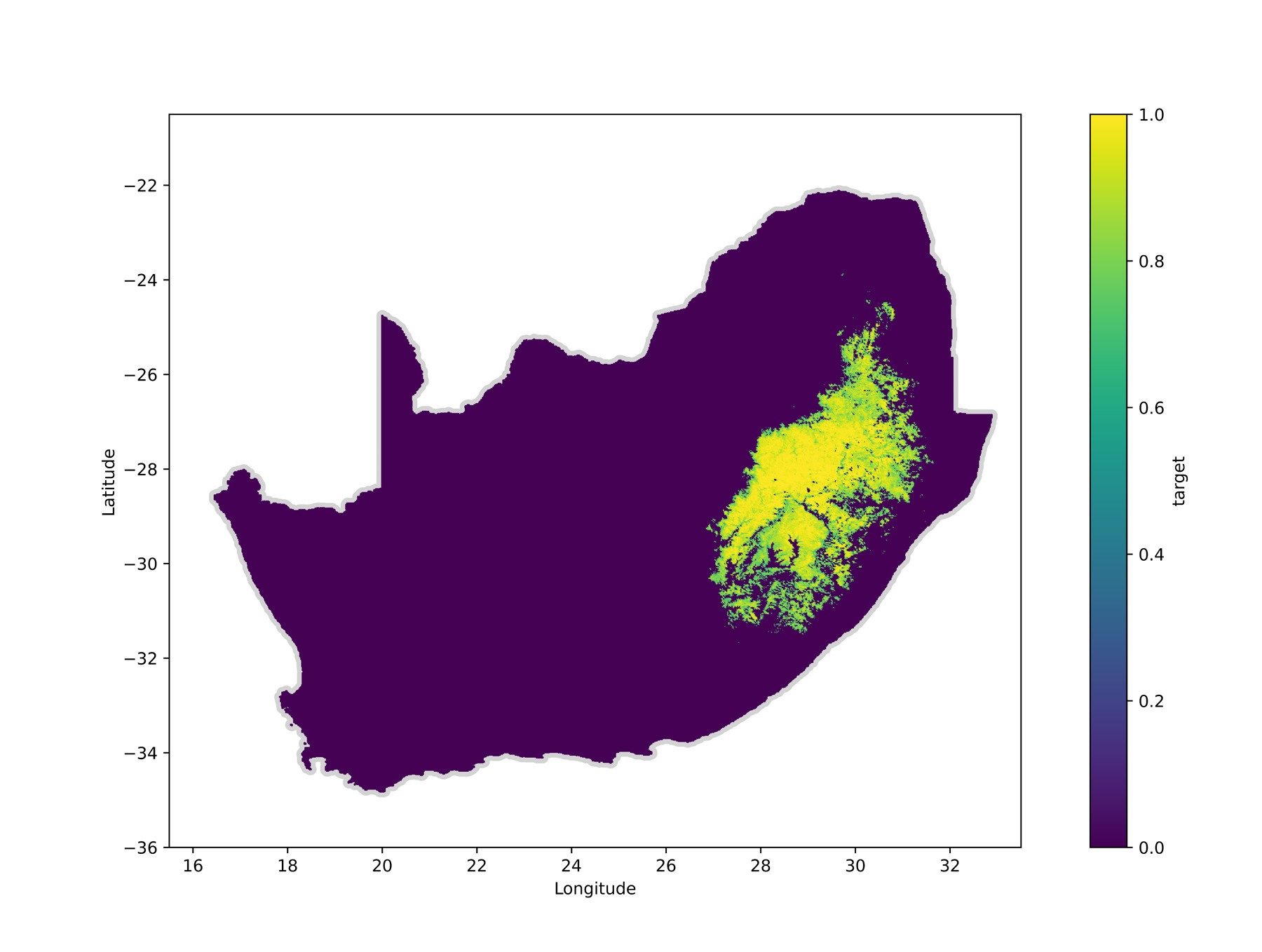
Figure 1: Probability distribution map for Southern Bald Ibis from iNaturalist, eBird and SABAP2 data. Yellow indicates regions of greater probability of occurrence. (from Lee 2024).
Ecology
Southern Bald Ibis are found mostly in high-altitude (>1000 m asl) grasslands and croplands (especially harvested maize fields) with high rainfall (>700 mm), although they can also use grasslands right down to the coast, including artificial grassland such as sports fields, golf courses and irrigated meadows (Manry 1985a). Favoured foraging habitat includes a short dense grass sward, including heavily grazed, recently burnt and mowed grass (Manry 1982, Manry 1985a). For breeding, the species requires cliffs with suitable ledges, generally above or near water.
Recent mesic grassland surveys (2018-2023) conducted across southern Mpumalanga and eastern Free State have identified >30 tree roost sites. These sites are often scattered throughout the respective landscape surrounding breeding colonies. These non-breeding roost sites were often (c. 70%) located in stands of large trees near waterbodies and were generally utilized outside of the breeding season. However, year-round occupied non-breeding roost sites have recently been identified, which hosted a mix of both adults and immature birds throughout the year in large flocks (c. 60 birds).
The peak breeding season within South Africa is September to December, with timing of breeding commencement correlated to increased rainfall events per month (Colyn et al. In prep). Clutch sizes of 1–3 eggs are laid at the commencement of the breeding season, which are incubated for 27–31 days (Kopij 2000). Multiple chicks can hatch at a given nest site, although multiple successful fledglings from one nest site are rare. Significant breeding failure can be recorded during very wet years, when breeding colonies are flooded or washed out from adjacent waterfalls (Manry 1985a). Predation of nestlings is well recorded by species including Verreauxs’ Eagle Aquila verreauxii, Jackal Buzzard Buteo rufofuscus, White-necked Raven Corvus albicollis, Pied Crow C. albus, Cape Eagle Owl Bubo capensis and other cliff line associated raptors (Manry 1985a, 1985b, Henderson 2015).
Threats & Conservation
Threats
The Southern Bald Ibis is most threatened by habitat transformation due to climate change, bush encroachment, transformation of virgin grasslands to large-scale commercial agriculture, open-cast mining, and urban development (Colyn et al. 2020, Lee et al. 2024). The effect of poachers taking eggs and young from breeding ledges, pesticides and poisons used in agriculture, and emerging wind energy developments in their range have not been quantified, but could have a cumulative impact on the species. In certain areas, the species’ habit of using electricity pylons as roost sites results in some mortality from collisions with powerlines. Hunting has also been reported as a threat.
Conservation Measures Underway
The Southern Bald Ibis is listed as Vulnerable under the National Environment Management: Biodiversity Act, 2004 (Act 10 of 2004) and under Schedule 2: Specially Protected Wild Animal Under the Limpopo Environmental Management Act No 7 of 2003. It is listed as Vulnerable in Eswatini and is protected by the Swaziland Game Act 1991 (Henderson 2015). In broad terms, the species is protected in Lesotho as a “species threatened with extinction” by the Environment Act of 2008. A species action plan exists for this species, but needs updating (Gaynor et al. 2003). Finally, the species is protected by various provincial ordinances in the Free State, KwaZulu-Natal, and Mpumalanga in South Africa.
Historical measures include the Southern Bald Ibis programme by BirdLife South Africa over >20 years and historical Species Champion, Eskom Holdings (SOC) Ltd, to assess threats to the species and its habitat, mitigating impacts of these threats, maintaining current population levels, and establishing practical guidelines for landowners and avitourism operators to protect breeding colonies.
Current actions include annual monitoring of breeding colonies throughout the species range, the fitment of tracking devices to determine the spatial habitat use of juveniles and adults, and a partnership between BirdLife South Africa and Eskom to monitor and conserve the species, and BirdLife South Africa and the Lesotho Highlands Development Authority to conserve and construct artificial breeding cliffs for the existing colonies threatened by the construction of the Polihali Dam.
Conservation Measures Proposed
- Compilation of effective habitat conservation guidelines for landowners with colonies or frequent foraging flocks on their property for increased environmental awareness.
- Continued colony monitoring.
- Implement guidelines for responsible wind energy and other infrastructural developments.
Research Priorities and Questions
The following aspects of Southern Bald Ibis ecology and conservation strategy require attention:
- Assess the potential impact of pesticide poisoning and exposure on Southern Bald Ibis within agricultural – grassland mosaic habitats.
- Given the rapid expansion of renewable energy facility prospecting in the Mesic Grassland region, assessing the potential collision risk of the species is required. Fitting adult birds with GPS tracking devices in areas that have wind energy developments being constructed would allow for the quantification of wind turbine collisions risk. Estimation of breeding success and first-year survival rates of juveniles at known breeding sites.
- Determine the potential impact of continued habitat loss, including the construction of hydroschemes and dams, and global climate change impacts on the species.
Species ecology:
- Conduct home range, habitat use and activity pattern analyses to determine the current foraging requirements of the species.
- Conduct continuous habitat suitability modelling (HSM), as necessary, to determine and quantify suitable habitat across southern Africa. Also, refine the current HSM and develop breeding HSM to determine the extent of suitable breeding cliffs surrounded by sufficient intact grassland that will ensure viable breeding colonies.
- Utilise the distribution model and current breeding colony data to identify core areas of conservation significance based on colony size and available habitat.
- Utilise the distribution model and current breeding colony data to determine what proportion of breeding colonies and available habitat fall under formal protection and within other types of conservation areas (incl. Important Bird and Biodiversity Areas, Key Biodiversity Areas, Other Effective Land-Based Conservation Measures, etc.)
- Mapping of movements between colonies and roosts, and research into the causes and consequences of variation in colony sizes, colony decreases, and the influence of the surrounding landscape on such trends.
- Conduct coordinated detailed counts at colonies and associated non-breeding roosts to further understand the population structure across perennial non-breeding roosts, seasonal non-breeding roosts and breeding colonies in a given area.
Contributors & References
Assessor/s
Carina Pienaar, Alan Lee
Reviewer/s
Robin Colyn
References
Colyn RB, Henderson CL, Altwegg R, Smit-Robinson HA. 2020. Habitat transformation and climate change: Implications for the distribution, population status, and colony extinction of Southern Bald Ibis (Geronticus calvus) in southern Africa. The Condor 122(1): duz064.
BirdLife International. 2024. Geronticus calvus. The IUCN Red List of Threatened Species 2024: e.T22697496A234993178. https://dx.doi.org/10.2305/IUCN.UK.2024-2.RLTS.T22697496A234993178.en. [Accessed on 08 April 2025].
Gaynor H, Gaynor D, Nel D, Schra C, Ramke G, Chiweshe N, Van Der Westhuizen E, Monadjem A, Venter G, Kershaw P, Colahan B, Pienaar K, Bowden C, Jordan M, De Smidt A, Evans SW (eds). 2003. Southern Bald Ibis (Geronticus calvus) Action Plan. Johannesburg, South Africa: BirdLife South Africa.
Henderson K. 2015. Southern Bald Ibis Geronticus calvus. In: Taylor MR, Peacock F, Wanless RM (eds), The 2015 Eskom Red Data Book of Birds of South Africa, Lesotho and Swaziland. Johannesburg: BirdLife South Africa. pp 225 –226.
Kopij G, Ordino B, Nuttall RD. 2000. Breeding cycle of the Southern Bald Ibis, Geronticus calvus. Ostrich 71(3&4): 393–399.
Lee ATK, Pienaar C, Chetty K, Colyn R. 2024. Reassessing the population and distribution of the Southern Bald Ibis: insights from diverse citizen science data sources. Waterbirds 46(2-4): 229–242.
Lee ATK. 2024. Regional Red Data Book of the Birds of South Africa, Lesotho and Eswatini: SABAP2 synthesis and supporting information and graphics for Southern Bald Ibis. Unpublished report. Johannesburg: BirdLife South Africa.
Manry DE. 1982. Habitat use by foraging Bald Ibises Geronticus calvus in western Natal. South African Journal of Wildlife Research 12: 85–93.
Manry DE. 1985a. Distribution, abundance and conservation of the bald ibis Geronticus calvus in southern Africa. Biological Conservation 33(4): 351–362.
Manry DE. 1985b. Reproductive performance of the Bald Ibis Geronticus calvus in relation to rainfall and grass‐burning. Ibis 127(2): 159–173.
Siegfried WR. 1971. The status of the Bald Ibis of southern Africa. Biological Conservation 3: 88–91. doi:10.1016/0006-3207(71)90004-8.
Citation
Pienaar C, Lee ATK 2025. Southern Bald Ibis. In: Lee ATK, Rose S, Banda S, Bezeng SB, Maphalala MI, Maphisa DH, Smit-Robinson H (eds), The 2025 Red Data Book of Birds of South Africa, Lesotho and Eswatini. Johannesburg, South Africa: BirdLife South Africa. Available at: https://www.birdlife.org.za/red-list/southern-bald-ibis/
Our generous sponsors


