


White-backed Night Heron
Calherodius leuconotus

Number Of Mature
Individuals (Regional)
500 – 1 000

Regional
Population Trend
Decreasing
2025
Regional Category
Vulnerable
Search by species
CONTENTSOverview
Names
|
IOC English Name: |
White-backed Night Heron |
|
SA & IOC Scientific Name: |
Calherodius leuconotus |
|
BirdLife International Taxonomy (scientific name): |
Calherodius leuconotus |
|
Order: |
PELECANIFORMES |
|
Family: |
Ardeidae |
|
Species name author: |
Wagler 1827 |
|
Afrikaans: |
Witrugnagreier |
|
Sesotho (South Africa): |
Kokolofitwe ya mokokotlosweu |
|
Sesotho (Lesotho): |
|
|
Siswati: |
|
|
Zulu: |
umacuthobomvu |
Current Assessment Status
|
2025 Regional Category [Criteria] |
VU [D1] |
|
2024 Global Category [Criteria] |
LC (BirdLife International 2018) |
|
Population size (Regional) |
500 – 1000 (Peacock 2015) |
|
Population size (Global) |
25 000 – 100 000 (Wetlands International 2018) |
|
Distribution size (EOO) (Regional) km2 |
649 842 (Lee 2024) |
|
Distribution size (EOO) (Global) km2 |
20 900 000 (BirdLife International 2018) |
|
Distribution size (AOO) (Regional) km2 |
5450 (BIRDIE 2024 [only one year of data available] / 5960 (Lee 2024) |
|
Generation time |
6.7 years (BirdLife International 2018) |
|
Status change reason |
No change |
|
Migrant (in the region) |
No |
|
Regional endemic |
No |
Historic Listing Information
|
2000 Regional Status |
VU [A1a+2bc; C1] |
|
2015 Regional Status |
VU [A2c; B2ab(iii); C2a(i); D1] |
|
Status change reason (if applicable) |
No change |
|
2015 Population size (Regional) |
500 – 1000 |
|
2015 Global Status |
LC |
Reason for Inclusion
Reason for Inclusion in the Assessment
The White-backed Night Heron Calherodius leuconotus was previously assessed as regionally Vulnerable (Peacock 2015). A shy nocturnal species that is poorly studied throughout its African range. Regionally subspecies Calherodius leuconotus natalensis occurs (Martínez-Vilalta et al. 2023). While atlas data indicates that only c. 3% of the Extent of Occurrence (EOO) for C. l. natalensis falls within the region. The lack of robust distribution or population estimate data for this species makes that estimate unreliable and hence the species is again included in the Regional Red List.
Category Justification
Category Justification
Very little is known about this species throughout its range. Regionally, both Area of Occupancy (AOO) (5960 km²) and EOO (649 842 km²) exceeds the threshold for Vulnerable under Criteria B2 and B1. While no recent population estimates exist, the regional population of White-backed Night Heron is still estimated at 500 – 1000 mature individuals (Peacock 2015), hence meeting the Vulnerable threshold (Criterion D).
While the population is assumed to be declining based on declines in suitable freshwater habitats, due to cutting down of waterside trees and silting up of clear pools used for foraging (e.g. Martínez-Vilalta et al. 2023), there is insufficient evidence on the rate of that decline to invoke either Criteria C or A. Its cryptic nature makes trends from citizen science data unreliable and too sparse for robust modelling.
This species is considered a poor candidate for a rescue effect, given the lack of knowledge on potential migratory behaviour and population data.
In the absence of new or contrary evidence, the 2015 assessment outcome of Vulnerable is maintained.
Population Justification
The global trend indicates that White-backed Night Heron numbers are decreasing (BirdLife International 2018). Based on the trends from the Coordinated Waterbird Counts (CWAC) data, the regional population is still estimated to number fewer than 1000 mature individuals (Peacock 2015). However, there is low confidence in this estimate as this is a highly cryptic species which makes monitoring challenging. It is assumed that White-backed Night Herons are habitat specialists, with limited suitable habitat available in the region so it is likely to have a small regional population.
Trend Justification
The population trend for the White-backed Night Heron in the region is uncertain due to conflicting trends between data sources. CWAC data indicates a significant decline in counts over time (coefficient -0.485, p = 0.034; Lee 2024, Figure 1).
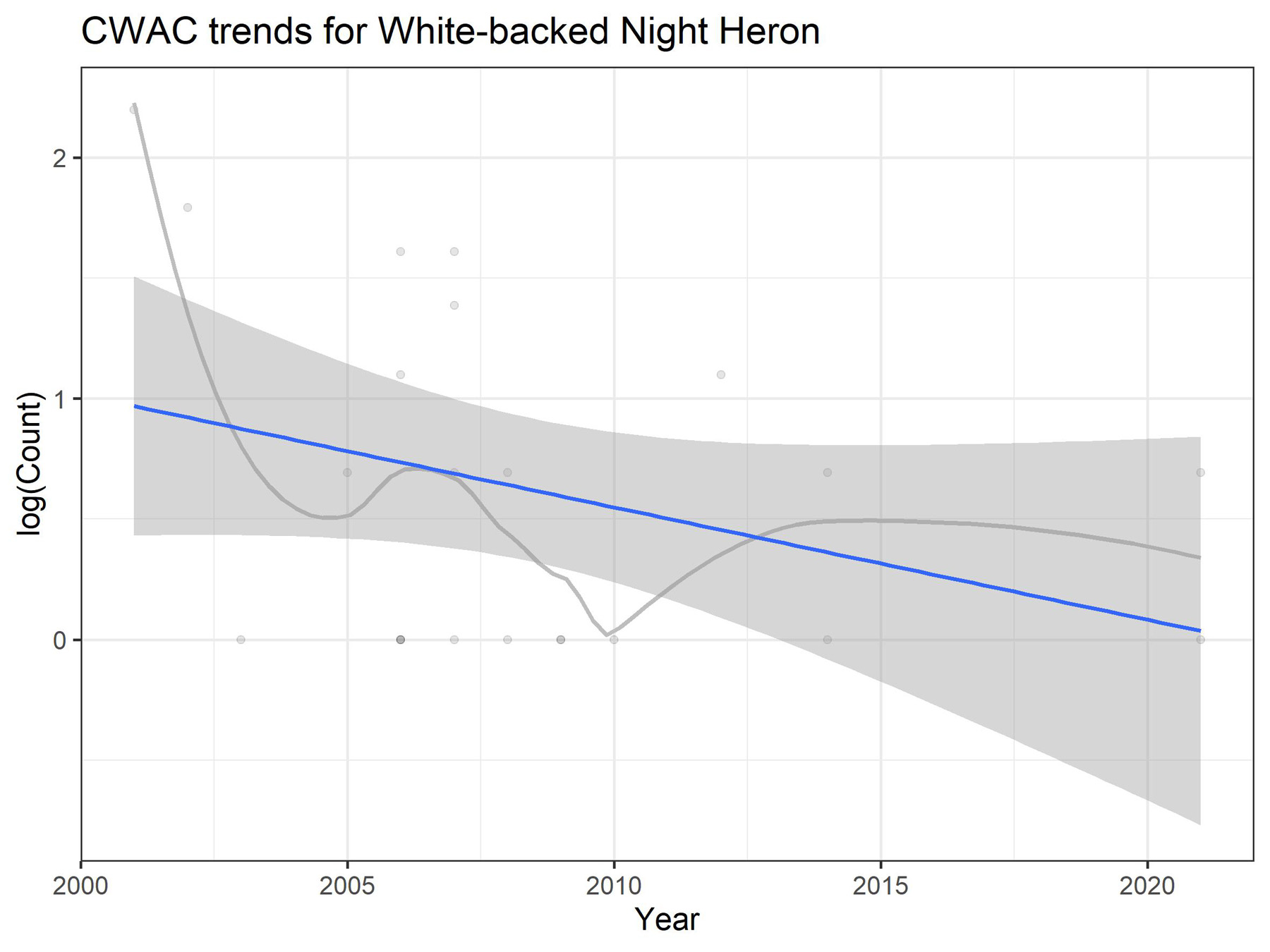
Figure 1: Trends from Coordinated Waterbird Counts (CWAC) showing a significant decline in the number of White-backed Night Heron counted bi-annually. Log transformed values of total counts per site per year are shown, with a linear regression as blue line with standard error as grey shading (from Lee 2024).
Modelled predicated AOO from Southern African Bird Atlas Project (SABAP2) data shows that reporting rate for this species has increased in the past three generations. This increase however may be due to increased observer effort and awareness rather than a genuine population increase, especially given the species’ cryptic nature. Results from CWAC, which represent repeat counts at specific wetland sites, may provide a more accurate picture of population trends over time. However, the CWAC dataset is limited to only 12 locations with 428 observations, hence probably only representing a subset of the entire regional population.
Given this conflicting information, ongoing habitat degradation, and the global population trend reported as decreasing (BirdLife International 2018), a continuing decline in the regional population is still inferred, although the rate of decline is highly uncertain.
Biology & Ecology
Taxonomy
The species was previously placed in the genus Gorsachius but is now recognised as Calherodius leuconotus following del Hoyo and Collar (2014). Two subspecies are recognised: C. l. leuconotus occurring from Senegal east to Nigeria. C. l. natalensis occurring from Cameroon south to northwestern Angola and east to eastern Sudan, western Ethiopia, and northeastern Democratic Republic of Congo, south through eastern Africa to southeastern Angola, northern Botswana, and eastern South Africa.
Identification
50–55 cm, c. 440 g. A medium-sized, nocturnal heron with a stocky build, short legs, stout bill, and large eyes. Adults have a black face and hood, greyish-brown mantle and back, contrasting with a white patch formed by lanceolate scapulars. Neck and breast are rufous-chestnut, grading to white on the belly. Bill is black, and legs are green to orange-yellow. The juvenile is browner with large white terminal spots on wing coverts and boldly streaked underparts (Allan 2005).
Distribution
Widespread but generally sparse throughout its extensive Afrotropical range. In Southern Africa, it occurs very sparsely in low-lying, high-rainfall areas of northern and eastern South Africa and Eswatini, extending westwards along the south coast to approximately Knysna, Western Cape (Peacock 2015, Figure 2). Considerable uncertainty exists with regards to the current range of this secretive species.

Figure 2: Probability distribution map for White-backed Night Heron from BirdLasser location data at 2×2 km grid scale, using iNaturalist and eBird as absence data only. This represents the predicted range for the 2016-2023 period. Yellow indicates regions of greater probability of occurrence (from Lee 2024).
Ecology
The species inhabits densely vegetated forest along rivers and streams, mangroves, wooded margins of marshes, and occasionally reedbeds (del Hoyo et al. 1992). It is strictly nocturnal hunter of small fish, amphibians, molluscs, crustaceans, and insects. Usually solitary or in pairs but occasionally in small groups of up to 12 birds at least seasonally (Portier 2005). During the day they roost high in trees making them very difficult to locate during monitoring. Breeding has been recorded year-round but thought to peak August – November. Nests are usually built low over water in thick vegetation (Tarboton 2001).
Threats & Conservation
Threats
The species is poorly studied in the region. Threats are assumed to include the generalised threats to the small heron species such as:
- Habitat loss and degradation due to clearance of sensitive riverbank habitats for agriculture and through overgrazing (Peacock 2015).
- Water pollution and siltation of rivers and wetlands (BirdLife International 2018).
- Potential threat through infestation of alien vegetation along riverine habitat.
- Climate change impacts on water availability and habitat quality (Hole et al. 2009).
Conservation Measures Underway
The White-backed Night Heron is one of the priority bird species considered in the latest conservation plan for Gauteng (Desmet et al. 2024). The plan designates the mainstem and buffers of ten rivers in the north of the province as Important River Reaches and categorises these as CBA1 (Critical Biodiversity Area – irreplaceable sites). The species occurs in several protected areas, with 39 pentads in National Parks or Nature Reserves and 14 pentads in other protected areas, yielding a relatively high protected area ratio of 1.26 (Lee 2024).
Conservation Measures Proposed
- Protect and restore riparian habitats, particularly in areas outside formal protected areas.
- Implement stricter controls on water pollution and extraction in key habitats.
- Conduct targeted surveys to better understand population size and trends.
- Raise awareness among landowners about the importance of maintaining riverine vegetation.
- Expand the CWAC program to include more sites within the White-backed Night Heron’s range, ensuring consistent long-term monitoring.
- Develop and implement a standardised survey protocol specifically designed for cryptic nocturnal species like the White-backed Night Heron to improve population estimates and trend data.
Research Priorities and Questions
- Conduct comprehensive surveys to determine accurate population size and trends, with specific reference to potential sub-population sizes.
- Investigate the effects of alien invasive vegetation on occupancy probability.
- Study the impact of climate change on the species’ distribution and habitat quality, with reference to water security, habitat fragmentation and the ability to track the environmental niche under climate change.
- Examine the species’ tolerance to habitat disturbance and fragmentation.
- Elucidate the discrepancy between SABAP2 reporting rates and CWAC count trends, possibly through targeted surveys at both CWAC sites and newly reported SABAP2 pentads.
- Expand CWAC monitoring to include more sites, and increase frequency at which sites are counted, within the species’ range to obtain a more comprehensive understanding of population trends.
Contributors & References
Assessor/s
David Ehlers Smith
Reviewer/s
James Westrip
References
Allan D. 2005. White-backed Night Heron. In: Hockey PAR, Dean WRJ, Ryan PG (eds), Roberts birds of southern Africa (7th Edn). Cape Town, South Africa: Trustees of the John Voelcker Bird Book Fund. pp 598–599.
BIRDIE. 2024. An online platform for African wetland and waterbird data. https://biodiversityadvisor.sanbi.org/contentmanagement/index?guid=42305260-12b0-4a92-912e-7d801d15fdac. [Accessed on 8 September 2024].
BirdLife International. 2018. Calherodius leuconotus. The IUCN Red List of Threatened Species 2018: e.T22697226A130187384. https://dx.doi.org/10.2305/IUCN.UK.2018-2.RLTS.T22697226A130187384.en. [Accessed on 03 October 2024].
Carboneras C, Kirwan GM. 2020. White-backed Duck, version 1.0. In: del Hoyo J, Elliott A, Sargatal J, Christie DA, de Juana E (eds). Birds of the World. Ithaca, NY, USA: Cornell Lab of Ornithology. Available at: https://doi.org/10.2173/bow.wfwduc1.01 [Accessed on 27 May 2024].
del Hoyo J, Collar NJ, Christie DA, Elliott A, Fishpool LDC. 2014. HBW and BirdLife International Illustrated Checklist of the Birds of the World. Volume 1: Non-passerines. Barcelona, Spain and Cambridge, UK: Lynx Edicions, BirdLife International.
del Hoyo J, Elliott A, Sargatal J. 1992. Handbook of the Birds of the World, vol. 1: Ostrich to Ducks. Barcelona, Spain: Lynx Edicions.
Desmet PG, Kani L, Hawley G. 2024. Revision of the Gauteng Province C-Plan (v4.0, 2023) Unpublished technical report prepared for Gauteng Department of Environment, Johannesburg.
Hole DG, Willis SG, Pain DJ, Fishpool LD, Butchart SH, Collingham YC, Rahbek C, Huntley B. 2009. Projected impacts of climate change on a continent‐wide protected area network. Ecology Letters 12(5): 420–431.
Lee ATK. 2024. Regional Red Data Book of the Birds of South Africa, Lesotho and Eswatini: SABAP2 synthesis and supporting information and graphics for White-backed Night Heron. Unpublished report. Johannesburg: BirdLife South Africa.
Martínez-Vilalta A, Motis A, Kirwan GM. 2023. White-backed Night Heron (Calherodius leuconotus). In: del Hoyo J, Elliott A, Sargatal J, Christie DA, de Juana E (eds), version 1.1. Birds of the World. Ithaca, NY, USA: Cornell Lab of Ornithology. Available: https://doi.org/10.2173/bow.wbnher1.01.1.
Peacock F. 2015. White-backed Night Heron. In: Taylor MR, Peacock F, Wanless RM (eds), 2015. The Eskom Red Data Book of Birds of South Africa, Lesotho and Swaziland. Johannesburg, South Africa: BirdLife South Africa. pp 222–224.
Portier B. 2005. White-backed Night Heron Gorsachius leuconotus at Nazinga Game Ranch, Burkina Faso. Bulletin of the African Bird Club 12(1): 18–23.
Tarboton W. 2001. Roberts Nests and Eggs of Southern African Birds. Cape Town: John Voelcker Bird Book Fund.
Wetlands International. 2018. Waterbird Population Estimates. Available at: wpe.wetlands.org. [Accessed on 03 October 2024].
Citation
Ehlers Smith DA 2025. White-backed Night Heron. In: Lee ATK, Rose S, Banda S, Bezeng SB, Maphalala MI, Maphisa DH, Smit-Robinson H (eds), The 2025 Red Data Book of Birds of South Africa, Lesotho and Eswatini. Johannesburg, South Africa: BirdLife South Africa. Available at: https://www.birdlife.org.za/red-list/white-backed-night-heron/
Our generous sponsors


