


African Marsh Harrier
Circus ranivorus

Number Of Mature
Individuals (Regional)
3 500 – 5 800

Regional
Population Trend
Decreasing
2025
Regional Category
Vulnerable
Search by species
CONTENTSOverview
Names
|
IOC English Name: |
African Marsh Harrier |
|
SA & IOC Scientific Name: |
Circus ranivorus |
|
BirdLife International Taxonomy (scientific name): |
Circus ranivorus |
|
Order: |
ACCIPITRIFORMES |
|
Family: |
Accipitridae |
|
Species name author: |
Daudin 1800 |
|
Afrikaans: |
Afrikaanse Vleivalk |
|
Sesotho (South Africa): |
mmankgodi-wa-mehlaka |
|
Sesotho (Lesotho): |
’mankholi-oa-mehlaka |
|
Siswati: |
|
|
Zulu: |
umamhlangenonsundu |
Current Assessment Status
|
2025 Regional Category [Criteria] |
VU [A2c+3c; C1] |
|
2024 Global Category [Criteria] |
LC (BirdLife International 2024) |
|
Population size (Regional) |
3500 – 5800 |
|
Population size (Global) |
Unknown (BirdLife International 2024) |
|
Distribution size (EOO) (Regional) km2 |
1 309 706 (Lee 2024) |
|
Distribution size (EOO) (Global) km2 |
9 470 000 (BirdLife International 2024) |
|
Distribution size (AOO) (Regional) km2 |
288 888 (Lee 2024) |
|
Generation time |
6.1 years (BirdLife International 2024) |
|
Status change reason |
Error Correction |
|
Migrant (in the region) |
No |
|
Regional endemic |
No |
Historic Listing Information
|
2000 Regional Status |
VU [A1c+2bc; C1] |
|
2015 Regional Status |
EN [A2c+3c+4c; C1] |
|
Status change reason (if applicable) |
Genuine Change in Status |
|
2015 Population size (Regional) |
<2500 |
|
2015 Global Status |
LC |
Reason for Inclusion
Reason for Inclusion in the Assessment
The African Marsh Harrier Circus ranivorus was previously assessed as regionally Endangered (Taylor 2015).
Category Justification
Category Justification
Estimates of the regional population number 3500 – 5800 mature individuals meeting the threshold of Vulnerable (<10 000) under the small population size and decline criteria (C1). The modelled decline in Area of Occupancy (AOO) is estimated to be 42% satisfying the threshold for Vulnerable (31–50%) under the population size reduction criteria (A2c) and these declines are projected to continue (A3c). The species is well represented in countries adjacent to South Africa and a regional rescue effect is possible. However, due to the poor understanding of the species movement patterns, it was deemed cautionary not to infer any rescue through migration from surrounding countries
The regional population is assessed as Vulnerable [A2c+3c; C1]. Previously, Taylor (2015) gave a population estimate of 3500 – 4500 mature individuals, but applied the C1 Criterion to a population of 50% for Criterion A to justify the Endangered category. The change in status is thus considered an Error Correction as the information provided in the previous assessment satisfied the Vulnerable category by the criteria provided.
Population Justification
Accurate population data is unavailable for the African Marsh Harrier. The global population estimate is unknown (BirdLife International 2024). Globally the species is listed as Least Concern despite evidence of population declines because of wetland habitat loss. Cohen (2000) estimated the regional population to number 6000 – 10 000 mature individuals. Taylor (2015) estimated that the regional population was 3500 – 4500 mature individuals. Using the decline in AOO predicted by Lee (2024) from modelling Southern African Bird Atlas Project (SABAP2) data (see below) and the figures of Cohen (2000) it is estimated that the regional population is 3500 – 5800 mature individuals. The confidence in this regional estimate is low.
Trend Justification
The global population is in decline (BirdLife International 2024). Cohen (2000) speculated that the African Marsh Harrier had declined by 20%. Taylor (2015) agreed with this decline based on declines in AOO suggested by the data in the SABAP2 database at the time and indicated that the decline had occurred more rapidly than predicted. Lee (2024) applied prediction models to SABAP2 data for the periods 2007-2015 and 2016-2023. The analysis indicated a 42% decline in AOO over 3 generations, which aligns with Taylor (2015) 46% AOO decline. There was also a significant decline from CWAC data (Lee 2024).
Biology & Ecology
Taxonomy
Monotypic. Based on their smaller size, birds from eastern and central Africa are sometimes placed in a separate race, aequatorialis. The validity of this separation is, however, doubtful (Kemp and Kirwan 2020), and not supported by the IOC (v14.1). They are sister species to the Western Marsh Harrier C. aeruginosus, and diverged only 300 000 to 600 000 years ago (Oatley et al. 2015)
Identification
44–49 cm, 430–570 g. The birds are sexually dimorphic in both size and plumage colouration. Females are 28% larger than males based on average body mass (Simmons and Simmons 2000). Thus, adult males as well as being smaller also have extensive grey in the secondaries, whereas the females are generally brown. Old males can become very pale grey. The upperparts are dark brown with rufous edged feathers, while the underparts are a lighter brown with the throat, breast and flanks streaked with white and brown. Undersides of flight feathers are pale buff and are prominently barred (Simmons 2005). Relatively long-tail, barred grey and brown with wingtips falling well short of the tip of the tail when the bird is perched (Kemp and Kirwan 2020). Bill is grey with dull yellow cere, and the eyes, legs and feet are yellow (Simmons 2005).
The African Marsh Harrier may be confused with the juvenile Black Harrier C. maurus female and juvenile, Pallid Harrier C. macrourus and Montagu’s Harrier C. pygargus and Western Marsh Harrier. The latter three are uncommon migrants to the region. The Pallid and Montagu’s Harriers have white upper tail coverts not rufous. The Western Marsh Harrier has a plain tail and underwing not barred. The juvenile Black Harriers are proportionally shorter winged and longer tailed than African Marsh Harriers (Simmons 2005).
Distribution
The African Marsh Harrier can be found in South Sudan, Ethiopia, Somalia, Eastern Democratic Republic of the Congo, Uganda and Kenya, and then southwards to South Africa (Kemp and Kirwin 2020). It occurs at high density in the Okavango Swamps of northern Botswana (Simmons 1997). Extent of Occurrence (EOO) and AOO values are from range modelled with BirdLasser data at the 2×2 km grid level from Lee (2024). Within the region, it occurs in high densities in higher rainfall coastal regions from Zululand down to Western Cape, as well as in Mpumalanga, Gauteng, Limpopo and North West provinces (Figure 1, Simmons 2005). It is absent from the drier parts of Northern Cape and inland areas parts of Western Cape. In Eswatini, the species is patchily distributed across the Highveld in the west of the country and is a non-breeding visitor to the eastern Lowveld (Parker 1994).
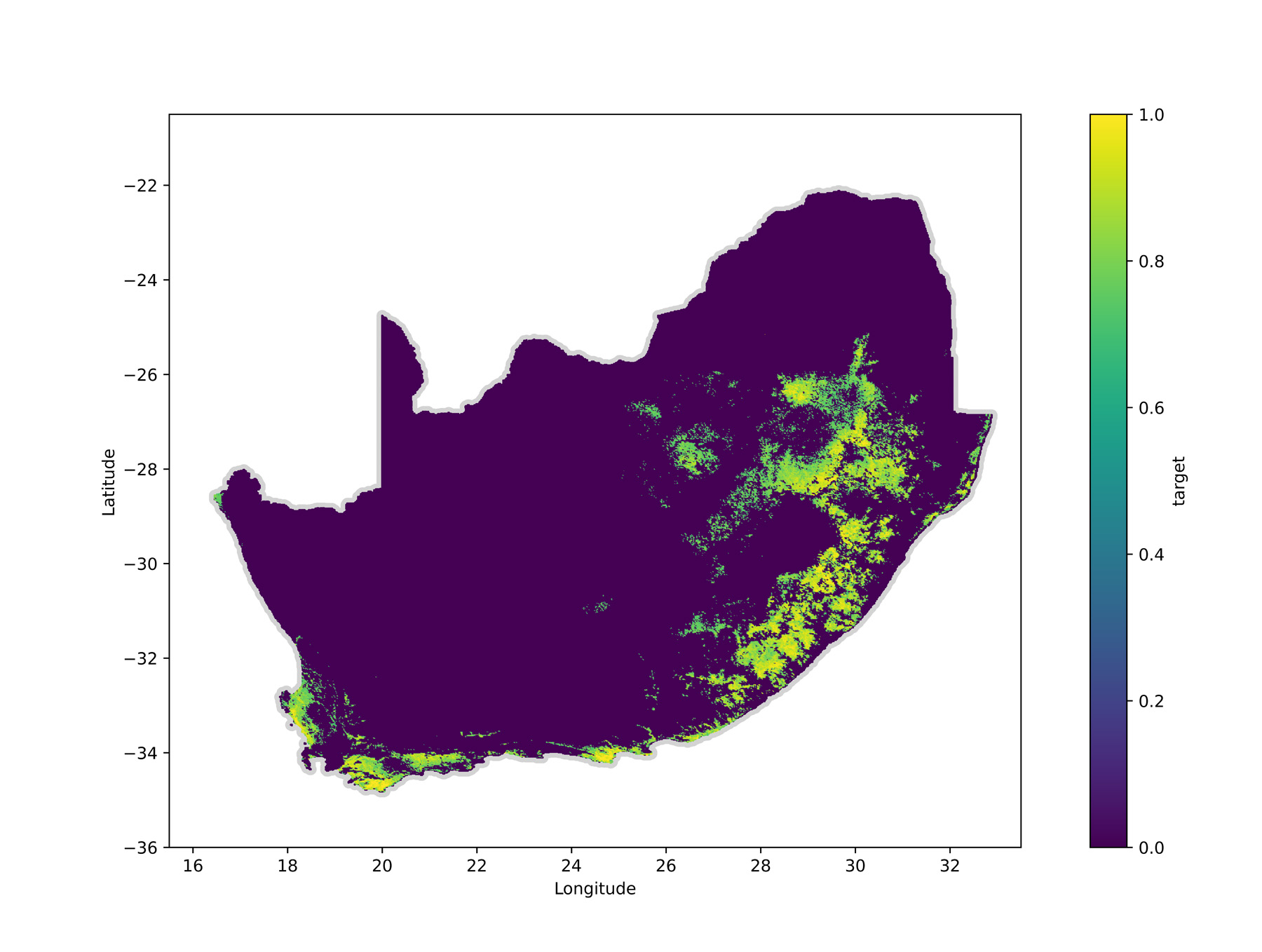
Figure 1: Modelled distribution of African Marsh Harrier based on SABAP2, eBird and iNaturalist records (from Lee 2024).
Ecology
Habitat:
The African Marsh Harrier occurs almost exclusively on coastal and inland wetlands (Simmons 2005) but may use adjacent grassland and croplands when foraging (Kemp and Kirwin 2020). Tarboton and Allan (1984) estimated that each harrier pair in the vleis of the former Transvaal required about 100 ha of intact marsh land to breed. A figure identical to that estimated for the Black Harrier in their preferred fynbos habitat (Curtis 2005).
Migration:
Adult breeding birds are largely sedentary (Simmons 2005) and no substantial seasonal difference in reporting rates (consistent with large scale migration) were found during the SABAP1 period (Simmons 1997), nor during SABAP2 (Lee 2024). Nomadic wanderings were observed of two marked immature birds (Simmons 1986).
Breeding:
The species is monogamous and has high mate fidelity. African Marsh Harrier are solitary or semi-colonial nesters and highly territorial (Simmons 2005). Nests are built in marshy vegetation usually positioned 0.5–2.5 m above the water. 3–4 eggs are laid mainly between Aug-Nov and incubated for 30–34 days by the female only. Fledgling period is 38–41 days during which the female broods and mainly feeds the young birds. The male provides food to the female during the incubation period and then later to both female and young until they fledge from the nest (Tarboton 2001). Young generally disperses from their natal areas from about December and January.
Diet:
African Marsh Harrier feed mostly on small mammals (74%), but other prey includes passerines and waterbirds (23%) frogs (2%) and fish (1%) (Kemp and Dean 1988, Simmons et al. 1991). They forage by quartering over and flashing into vegetation to strike at mammals and birds (Simmons 2005). They may raid heron, egret and weaver colonies eating eggs and chicks and may on occasion scavenge on large fish carcasses (Steyn 1982, Simmons et al. 1991).
Threats & Conservation
Threats
Loss and degradation of African Marsh Harrier wetland habitat through drainage, burning and grazing is the primary threat faced by this species (Monadjem et al. 2003, Taylor 2015). Adeeyo et al. (2022) estimate that the conversion of wetlands to residential areas and agricultural lands has resulted in a decline in nearly 50% of South Africa’s wetlands. Encroachment of wetlands by alien vegetation may also contribute to loss of habitat (Hockey et al. 1989). It is however possible that these threats may be partly mitigated by the species adaptation to wetlands created by dams (Ginn et al. 1989) and sewage works (Cohen 2000).
De Kock and Simmons (1988) found organochlorine contamination in unhatched eggs of the African Marsh Harrier, which may have been the reason why they did not hatch. The authors however found that this did not appear to influence adult reproductive output.
Conservation Measures Underway
There are no specific conservation measures currently in place for this species. African Marsh Harrier is listed under Appendix II of the Convention on International Trade in Endangered Species of Wild Fauna and Flora (CITES 2024), but as the primary threat to the species is habitat loss this offers little protection to the species. There are several wetlands which are declared Ramsar Sites (e.g. Wilderness Lakes, Verlorenvlei-WC, Strandfontein Sewage Works, and Lake St Lucia) where relatively high numbers of the species have been recorded (CWAC unpublished data). Several of these sites are formally protected (e.g. Wilderness Lakes is sited within the Wilderness National Park and Lake St Lucia is within the iSimangaliso Wetland Park).
Conservation Measures Proposed
- Undertake surveys to identify priority sites for the species and implement conservation measures (e.g. protection, habitat restoration, etc.) to ensure long term site integrity.
- Use results from habitat preference studies to implement habitat modification on artificial wetlands to the benefit of the species.
- Buffers identified as per research below to be incorporated into landscape conservation planning and to identify appropriate management scales at which the species can be conserved.
- Wetland rehabilitation interventions need to consider the habitat requirements of the species and appropriate measure taken to see that these requirements are catered for.
Research Priorities and Questions
- An accurate estimate of the regional population is required.
- Determine the habitat preferences of the species and which threats are impacting on these habitats.
- Research the foraging requirements of this species specifically habitat required adjacent to wetlands.
- The impact of organochlorine on especially breeding within the species need to be researched.
- Determine to what degree artificial wetlands are used by the species and the role these can play in the conservation of the species.
- Undertake GPS-tracking studies to understand movement patterns of the African Marsh Harrier.
Contributors & References
Assessor/s
Kevin Shaw
Reviewer/s
Cassie Carstens, John Kinghorn, Rob Simmons
References
Adeeyo AO, Ndlovu SS, Ngwagwe LM, Mudau M, Alabi MA, Edokpayi JN. 2022. Wetland resources in South Africa: threats and metadata study. Resources 11: 54.
BirdLife International. 2024. Circus ranivorus. The IUCN Red List of Threatened Species 2024: e.T22695352A263617631. [Accessed on 18 December 2024].
CITES. 2024. Convention text and appendices. Available: https://cites.org/eng/disc/text.php. [Accessed on 20 December 2024].
Curtis O. 2005. Responses of raptors to habitat fragmentation: from individual responses to population susceptibility. MSc thesis. University of Cape Town.
Cohen C. 2000. African Marsh Harrier (Circus ranivorus). In: Barnes KN (ed), The Eskom Red Data Book of Birds of South Africa, Lesotho and Swaziland. Johannesburg, South Africa: BirdLife South Africa. pp 88–90.
de Kock AC, Simmons RE. 1988. Chlorinated hydrocarbon residues in African Marsh Harrier eggs and concurrent reproductive trends. Ostrich 59: 180–181.
Ginn PJ, McIlleron WG, Milstein P le S. 1989. The complete book of southern African birds. Cape Town: Struik Winchester.
Hockey PAR, Underhill LG, Neatherway M, Ryan PG. 1989. Atlas of the birds of the southwestern Cape. Cape Town, South Africa: Cape Bird Club.
Kemp A, Dean R. 1988. Diet of African Marsh Harriers from pellets. Gabar 3: 54–55.
Kemp AC, Kirwan GM. 2020. African Marsh Harrier (Circus ranivorus). In: del Hoyo J, Elliott A, Sargatal J, Christie DA, de Juana E (eds), Birds of the World. Ithaca, NY, USA: Cornell Lab of Ornithology. https://doi.org/10.2173/bow.afmhar1.01.
Lee ATK. 2024. SABAP2 synthesis and supporting information and graphics for African Marsh Harrier. Unpublished report. Johannesburg: BirdLife South Africa.
Monadjem A, Boycott RC, Parker V, Culverwell J. 2003. Threatened vertebrates of Swaziland: Swaziland red data book: fishes, amphibians, reptiles, birds and mammals. Ministry of Tourism, Environment and Communications, Mbabane, Swaziland.
Oatley G, Simmons RE, Fuchs J. 2015. A molecular phylogeny of the harriers (Circus, Accipitridae) indicates the role of long-distance dispersal and migration in diversification. Molecular Phylogenetics and Evolution 85: 150–160.
Parker V. 1994. Swaziland bird atlas, 1985–1991. Mbabane, Swaziland: Websters.
Simmons R. 1986. A tagged African Marsh Harrier. Bee-eater 37: 26–27.
Simmons RE, Avery DM, Avery G. 1991. Biases in diets determined from pellets and remains: correction factors for a mammal and bird-eating raptor. Journal of Raptor Research 25(3): 63–67.
Simmons RE. 1997. African Marsh Harrier (Circus ranivorus). In: Harrison JA, Allan DG, Underhill LG, Herremans M, Tree AJ, Parker V, Brown CJ (eds), The atlas of southern African birds. Vol. 1: Non-passerines. Johannesburg: BirdLife South Africa. pp 236–237.
Simmons RE, Simmons JR. 2000. Harriers of the World: Their Behaviour and Ecology. Oxford: Oxford University Press.
Simmons RE. 2005. African Marsh Harrier (Circus ranivorus). In: Hockey PAR, Dean WRJ, Ryan PG (eds), Roberts – Birds of Southern Africa 7th Edn. Cape Town: The Trustees of the John Voelcker Bird Book Fund. pp 501–502.
Steyn P. 1982. Birds of prey of southern Africa. David Phillip, Cape Town.
Tarboton W. 2001. A guide to the nests & eggs of southern African birds. Cape Town: Struik Publishers (Pty) Ltd.
Taylor MR. 2015. African Marsh Harrier (Circus ranivorus). In: Taylor MR, Peacock F, Wanless RW (eds), The Eskom Red Data Book of Birds of South Africa, Lesotho and Swaziland. Johannesburg, South Africa: BirdLife South Africa. pp 122–124.
Citation
Shaw K 2025. African Marsh Harrier. In: Lee ATK, Rose S, Banda S, Bezeng SB, Maphalala MI, Maphisa DH, Smit-Robinson H (eds), The 2025 Red Data Book of Birds of South Africa, Lesotho and Eswatini. Johannesburg, South Africa: BirdLife South Africa. Available at: https://www.birdlife.org.za/red-list/african-marsh-harrier/
Our generous sponsors


