


African Pygmy Goose
Nettapus auritus

Number Of Mature
Individuals (Regional)
<10 000

Regional
Population Trend
Decreasing
2025
Regional Category
Near Threatened
Search by species
CONTENTSOverview
Names
|
IOC English Name: |
African Pygmy Goose |
|
SA & IOC Scientific Name: |
Nettapus auritus |
|
BirdLife International Taxonomy (scientific name): |
Nettapus auritus |
|
Order: |
ANSERIFORMES |
|
Family: |
Anatidae |
|
Species name author: |
Boddaert 1783 |
|
Afrikaans: |
Dwerggans |
|
Sesotho (South Africa): |
Sehutsana |
|
Sesotho (Lesotho): |
Lefalwana |
|
Siswati: |
|
|
Zulu: |
iVevenyane |
Current Assessment Status
|
2025 Regional Category [Criteria] |
NT° [C1] |
|
2024 Global Category [Criteria] |
LC (BirdLife International 2024) |
|
Population size (Regional) |
<10 000 |
|
Population size (Global) |
38 300 – 213 000 (BirdLife International 2024) |
|
Distribution size (EOO) (Regional) km2 |
502 815 (Lee 2024) |
|
Distribution size (EOO) (Global) km2 |
25 300 000 (BirdLife International 2024) |
|
Distribution size (AOO) (Regional) km2 |
5824 (Lee 2024) |
|
Generation time |
4.62 years (BirdLife International 2024) |
|
Status change reason |
Improved Knowledge |
|
Migrant (in the region) |
No |
|
Regional endemic |
No |
Historic Listing Information
|
2000 Regional Status |
NT [A1c+2c] |
|
2015 Regional Status |
VU [A2bc] |
|
Status change reason (if applicable) |
Genuine |
|
2015 Population size (Regional) |
<2500 |
|
2015 Global Status |
LC |
Reason for Inclusion
Reason for Inclusion in the Assessment
The African Pygmy Goose Nettapus auritus was listed as regionally Vulnerable in the 2015 Regional Red List (Taylor and Coverdale 2015), because of a limited distribution in the region and a suspected declining population.
Category Justification
Category Justification
The African Pygmy Goose is uncommon within the region, with a small and declining population. No species-specific monitoring scheme is in place regionally, trends and population size are therefore inferred from citizen science data.
Coordinated Waterbird Counts (CWAC) count totals and the modelled Area of Occupancy (AOO) from the Southern African Bird Atlas Project (SABAP2) indicate that the species is in decline. The latter suggests a rate of decline of 27.4% in AOO over the past three generations (Lee 2024). A comparison of the change in reporting rate per pentad compared to modelled, suggests that the modelled rate of decline may be an overestimate, influenced by declines at Isimangaliso Wetland Park (Figure 1).
Past population estimates have varied considerably. The regional population is thought to fluctuate greatly in response to rainfall and the availability of pans in rural regions such as the north-eastern KwaZulu-Natal. Many of these regions are poorly represented by citizen science data. Considerable uncertainty therefore exists in the regional population size estimate although it is considered unlikely to exceed 10 000.
African Pygmy Goose meets criteria C for Vulnerable based on the rate of decline and probable population size. However, given the uncertainty in the population size estimate and the proximity of the population in southern Mozambique (thought to be substantial, supporting a rescue effect into the region), the outcome is adjusted to Near Threatened.
Population Justification
The global population size is estimated at 3830 – 213 000 (BirdLife International 2024). West African population estimated at 20 000 – 30 000 individuals (Kear 2005). Considered very common in the Okavango Delta, Kafue Flats in Zambia and southern Mozambique (Cizek 2008, Dowsett et al. 2008, Carboneras and Kirwan 2020). Unfortunately, the size of the regional population is still unknown. The previous regional assessments either provided no estimate (Barnes 2000), while Taylor and Coverdale (2015) suggested a regional population of <2500 mature individuals. Carboneras and Kirwan (2020) mention flocks of c. 1000 individuals being recorded in Northern Zululand during the dry season. The regional population is assumed to still number <10 000. Confidence in this estimate is low.
Trend Justification
The global population is suspected to be stable over the past three generations (13.86 years, BirdLife International 2024). Within the region predicted change in AOO (SABAP2) and CWAC count totals indicate that the population has declined over the past three generations (Figures 1 and 2, Lee 2024). African Pygmy Goose respond rapidly to suitable conditions and occur in wetlands and seasonal pans in rural regions which are poorly represented by citizen science data. This and the fact that trend is assumed to be linked to rainfall, makes confidently establishing regional trends challenging. Nevertheless, the SABAP2 trend analyses, predicated change in AOO over three generations and CWAC count totals all indicate declines means that there is high confidence in this trend (Lee 2024).
Drivers of decline are not known but are assumed to be at least partly explained by declining habitat quality and availability. African Pygmy Goose prefers clear, still inland waters, whether permanent or seasonal, with plentiful emergent and surface vegetation (Maclean 1997). These habitats are declining within the region (e.g. Jewitt 2018).
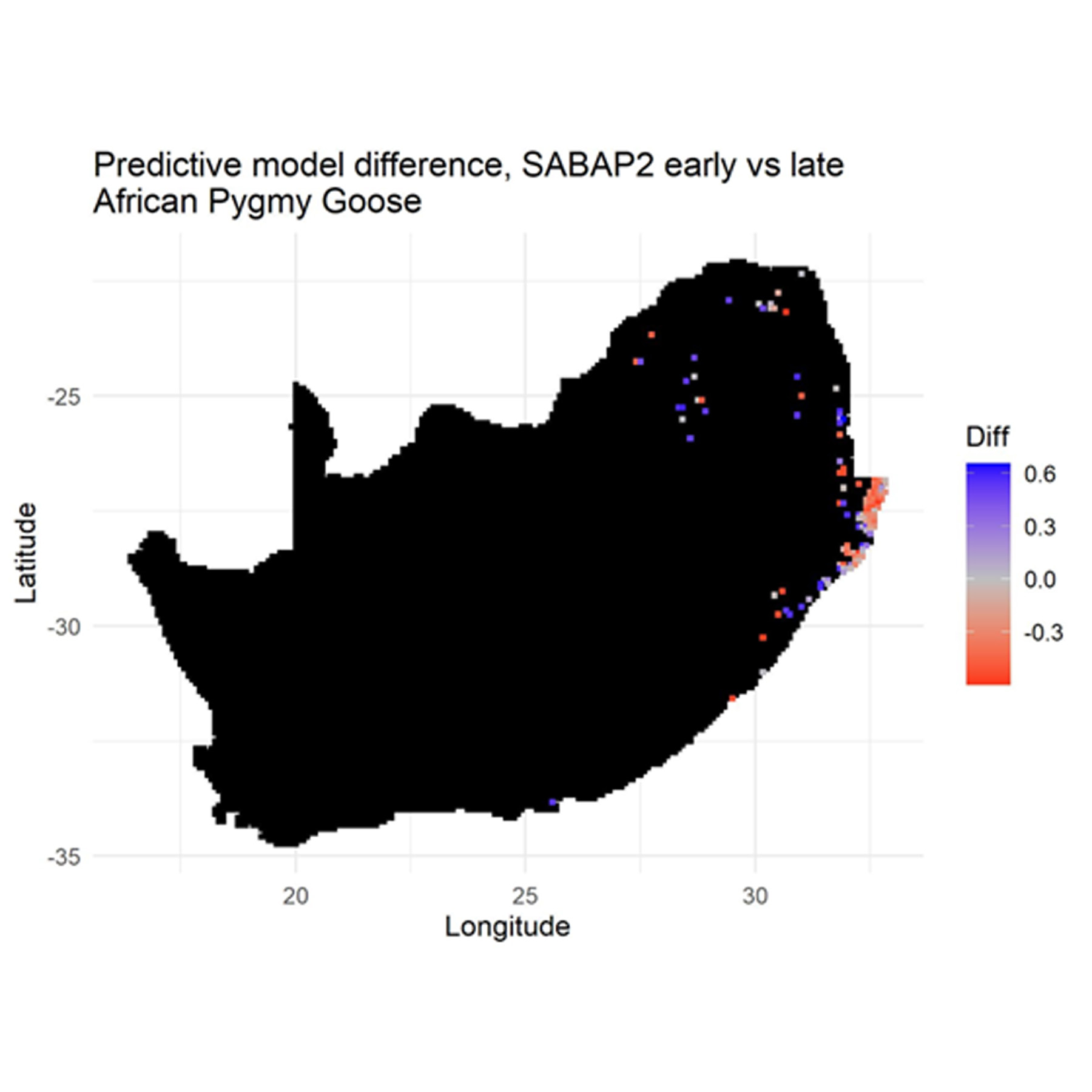
Figure 1: SABAP distribution map for African Pygmy Goose, showing the change in the predictive modelled difference in area of occupancy over three generations. Blue indicates region of increase, red decrease and cream or grey no change. Plots from Lee (2024).
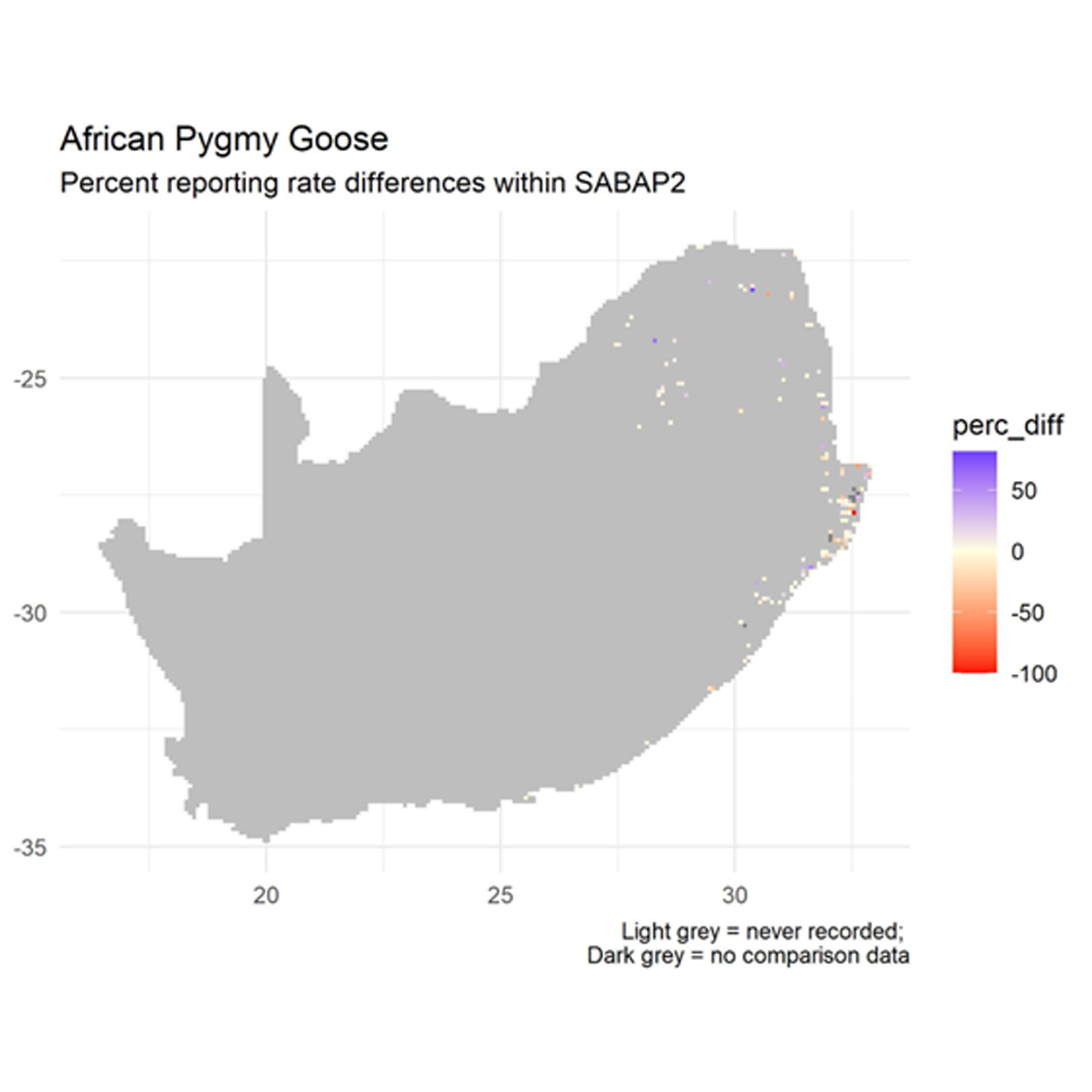
Figure 2: SABAP distribution maps for African Pygmy Goose, showing pentad level change in the reporting rate time periods between 2007-2015 and 2016-2023. Blue indicates region of increase, red decrease and cream or grey no change. Plots from Lee (2024).
Biology & Ecology
Taxonomy
The species is monotypic.
Identification
27–33 cm, 260–290 g (Carboneras and Kirwan 2020). Sexes differ in plumage colouration with the male exhibiting a distinctive oval green patch on the side of the head. A tiny, colourful duck of tropical areas. Forehead, face and neck white with brilliant green patches on sides of head. Crown and upperparts dark metallic green. Upper breast, sides and flanks chestnut; central breast and belly whitish. Tail black. Bill bright yellow. Eyes dark brown. Legs and feet grey. Female is duller than male, lacking black-bordered neck patches (Colahan 2005). It may be confused with the Blue-billed Teal Spatula hottentota in flight.
Distribution
The African Pygmy Goose has a wide albeit fragmented distribution across sub-Saharan Africa and Madagascar (Carboneras and Kirwan 2020, Figure 2). Within southern Africa it occurs in Mozambique, Zimbabwe, Namibia and Botswana where the Okavango Delta forms the regional stronghold (Maclean 1997). In Zimbabwe the species occurs on the larger pan systems but is absent from the Zambezi Valley (Irwin 1981). Within the region it is an uncommon visitor to eastern Eswatini (Parker 1994) although it is relatively common in neighbouring southern Mozambique (Cizek 2008). It is uncommon in north-eastern South Africa with the only permanent populations (given sufficient rainfall) occurring on the Nyl River Floodplain and in Kruger National Park. Distribution tied to the presence of Nymphaea and submerged vegetation (Carboneras and Kirwan 2020). It is more numerous in KwaZulu-Natal, and can be locally common in the extensive wetland, floodplain and pan systems of Maputaland. The species is partially migratory (Colahan 2005), dependent on suitable habitat and water availability during the dry season (Carboneras and Kirwan 2020).
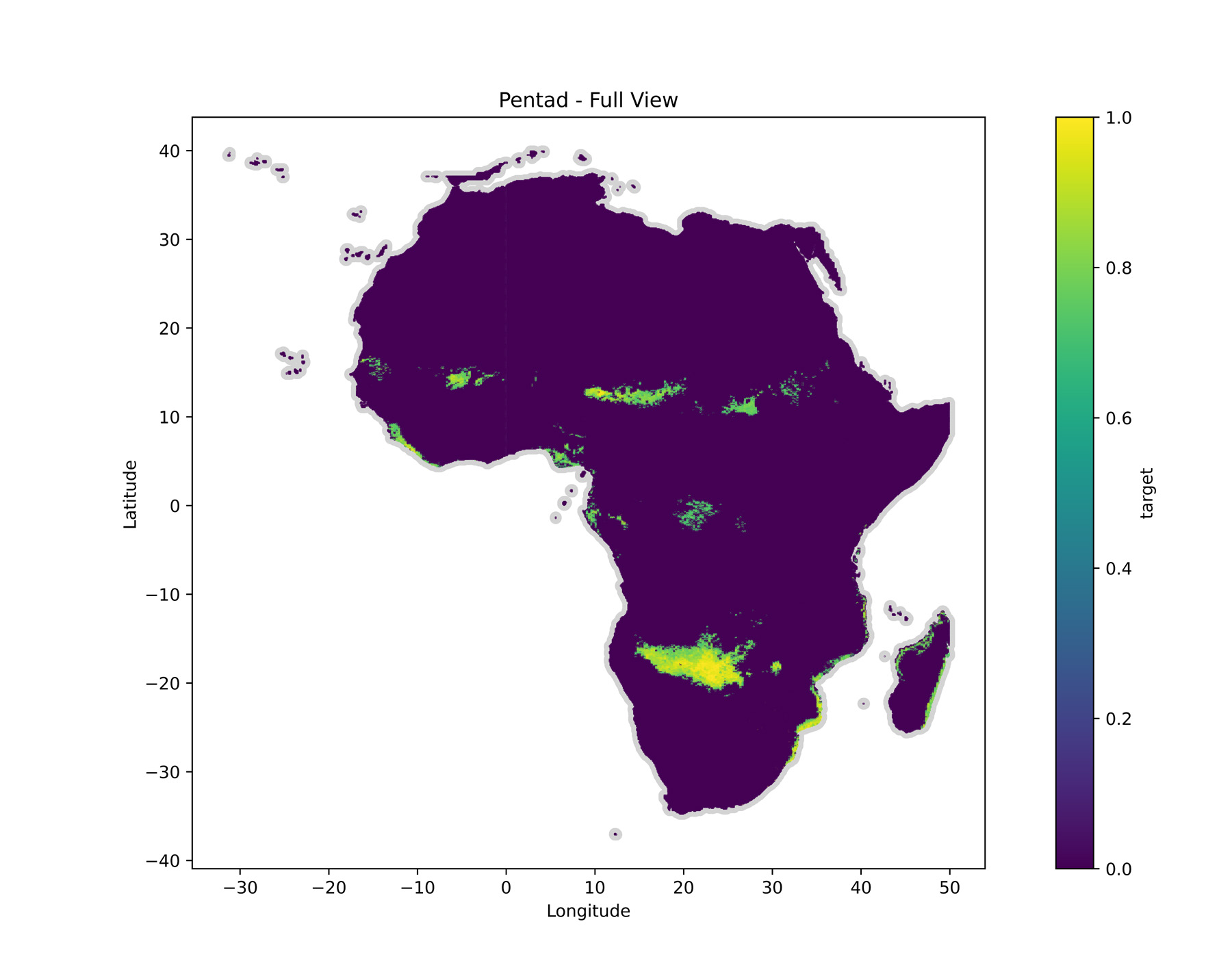
Figure 3: Africa distribution maps for African Pygmy Goose produced from ABAP, iNaturalist and eBird data using a Random Forest model and various predictor variables. Colour gradient is predicted probability of occurrence, with a 0.5% threshold applied. Brighter colours = higher probability of occurrence, pentad scale p>0.5 (right) (from Lee 2024).
Ecology
The African Pygmy Goose prefers clear, still inland waters, whether permanent or seasonal, with plentiful emergent and surface vegetation (Maclean 1997). It is unlikely to be found in completely open waters or coastal lagoons (Maclean 1997). The species is a monogamous, solitary nester, breeding October-May (Colahan 2005). Nests are made in tree holes, preferentially in trees either in standing water or close to it, but also in dense vegetation such as papyrus and old Hamerkop Scopus umbretta nests (Tarboton 2001, Kear 2005) and occasionally on thatched roofs, palm crowns or crevices in cliffs (Safford and Hawkins 2013). The species is primarily herbivorous. A generation length of 4.62 years is provided by BirdLife International (2024).
Threats & Conservation
Threats
The threats facing African Pygmy Geese are not dissimilar to those relevant to other waterbirds, such as Lesser Jacana Microparra capensis, which have similar habitat requirements. Major threats include wetland degradation, pollution (especially from herbicides), and destruction and interference with floodplain ecology, particularly through impoundments such as Pongolapoort Dam (Taylor and Coverdale 2015). Siltation (Macdonald and Birkenstock 1980), and sand mining (Department of Water and Sanitation 2022) in the region’s rivers pose a threat to water quality. Climate change may constitute the largest threat, with parts of north-eastern KwaZulu-Natal experiencing a decline in rainfall of >50% over a fifteen-year period, which has an adverse effect on habitat availability. Furthermore, increased rainfall will limit breeding opportunities, with routine breeding declining in months when the rainfall exceeds the annual mean (Cumming et. al. 2016). Invasive alien species such as water hyacinth Eichhornia crassipes may decrease the amount of available habitat (Dowsett-Lemaire and Dowsett 2006). Kear (2005) speculated that predation by snakes may limit dry-land nesting; however, natural predation must be seen as a lesser threat.
Conservation Measures Underway
There are no species–specific measures in place. The establishment of the 332 000 ha iSimangaliso Wetland Park in 1999 and, in particular, the removal of plantations from both the Western Shores and Eastern Shores sections of the park, has probably greatly benefited this species.
Conservation Measures Proposed
The conservation of the African Pygmy Goose in the region depends chiefly on the protection of wetlands, floodplain systems and pans in north-eastern KwaZulu-Natal and the species should be included in future conservation planning initiatives. Control of invasive alien plant species and increased catchment management to reduce siltation would be beneficial. A practical measure would be to provide suitable nest boxes to encourage breeding at some wetland sites.
Research Priorities and Questions
- The size of the regional population needs to be established through regular systematic monitoring.
- Movement in and out of the region would help establish the extent to which this species is threatened by local extinction.
- Whether or not this species is affected by the pet trade should be investigated.
- It is critical that regular monitoring of the regional population and sub-populations at key sites continues at the current CWAC sites. Increasing the number of CWAC sites as well as the frequency at which sites are counted would help improve the understanding of population trends and numbers across the range.
Contributors & References
Assessor/s
Brent Coverdale, Sanjo Rose
Reviewer/s
Steve McKean
References
Barnes KN. 2000. Pygmy Goose Nettapus auritus. In: Barnes KN (ed), The Eskom Red Data Book of Birds of South Africa, Lesotho and Swaziland. Johannesburg, South Africa: BirdLife South Africa. pp 138–139.
BirdLife International. 2024. Nettapus auritus. The IUCN Red List of Threatened Species 2024: e.T22680095A264986462. https://dx.doi.org/10.2305/IUCN.UK.2024-2.RLTS.T22680095A264986462.en. [Accessed on 05 February 2025].
Carboneras C, Kirwan GM. 2020. African Pygmy-Goose Nettapus auritus. In: del Hoyo J, Elliott A, Sargatal A, Christie DA, de Juana E (eds), In Birds of the World Cornell Lab of Ornithology version 1.0. Ithaca, NY: USA. Available: https://doi.org/10.2173/bow.afrpyg1.01.
Cizek A. 2008. Interesting records from Vilancoulos, Mozambique, with a breeding record of the Lemon-breasted Canary. Honeyguide 54: 63–68.
Colahan BD. 2005. African Pygmy Goose Nettapus auritus. In: Hockey PAR, Dean WRJ, PG (eds), Roberts – Birds of Southern Africa (7th Edn). Cape Town: The Trustees of the John Voelcker Bird Book Fund. pp 99–101.
Cumming G, Harebottle D, Mundava J, Otieno N, Tyler S. 2016. Timing and location of reproduction in African waterfowl: An overview of >100 years of nest records. Ecology and Evolution 6: 10.1002/ece3.1853.
Department of Water and Sanitation (DWS). 2022. River EcoStatus Monitoring Programme: State of River Report 2020-2021. Pretoria: Resource Quality Information Services. pp 225.
del Hoyo J, Collar NJ, Christie DA, Elliott A, Fishpool LDC. 2014. HBW and BirdLife International Illustrated Checklist of the Birds of the World. Volume 1: Non-passerines. Barcelona, Spain and Cambridge, UK: Lynx Edicions and BirdLife International.
Dowsett-Lemaire F, Dowsett RJ. 2006. The birds of Malawi: an atlas and handbook. Liège, Belgium: Tauraco Press.
Irwin MPS. 1981. The Birds of Zimbabwe. Harare, Zimbabwe: Quest Publishing (Pvt) Ltd.
Jewitt D. 2018. Vegetation type conservation targets, status and level of protection in KwaZulu-Natal in 2016. Bothalia-African Biodiversity & Conservation 48(1): 1–10.
Kear J. 2005. Ducks, Geese and Swans. Oxford, United Kingdom: Oxford University Press.
Lee ATK. 2024. Regional Red Data Book of the Birds of South Africa, Lesotho and Eswatini: SABAP2 synthesis and supporting information and graphics for African Pygmy Goose. Unpublished report. Johannesburg: BirdLife South Africa.
Macdonald IAW, Birkenstock PJ. 1980. Birds of the Hluhluwe-Umfolozi Game Reserve Complex. Pietermaritzburg, South Africa: Natal Parks, Game and Fish Preservation Board.
Maclean GL. 1997. Pygmy Goose Nettapus auritus. In: Harrison JA, Allan DG, Underhill LG, Herremans M, Tree AJ, Parker V, Brown CJ (eds), The atlas of southern African birds Vol I: Non-passerines. Johannesburg, South Africa: BirdLife South Africa. pp 144–145.
Parker V. 1994. Swaziland bird atlas, 1985-1991. Mbabane, Swaziland: Websters.
Safford R, Hawkins AFA. 2013. The Birds of Africa, Vol. VIII. The Malagasy region. London, United Kingdom: Christopher Helm.
Tarboton W. 2001. Guide to the nests and eggs of southern African birds. Cape Town, South Africa: Struik Publishers.
Taylor MR, Coverdale BM. 2015. African Pygmy Goose Nettapus auritus. In: Taylor MR, Peacock F, Wanless RM (eds), The Eskom Red Data Book of Birds of South Africa, Lesotho and Swaziland. Johannesburg, South Africa: BirdLife South Africa. pp 220–221.
Citation
Coverdale B, Rose S 2025. African Pygmy Goose. In: Lee ATK, Rose S, Banda S, Bezeng SB, Maphalala MI, Maphisa DH, Smit-Robinson H (eds), The 2025 Red Data Book of Birds of South Africa, Lesotho and Eswatini. Johannesburg, South Africa: BirdLife South Africa. Available at: https://www.birdlife.org.za/red-list/african-pygmy-goose/
Our generous sponsors


