


Tawny Eagle
Aquila rapax

Number Of Mature
Individuals (Regional)
500 – 800

Regional
Population Trend
Decreasing
2025
Regional Category
Endangered
Search by species
CONTENTSOverview
Names
|
IOC English Name: |
Tawny Eagle |
|
SA & IOC Scientific Name: |
Aquila rapax |
|
BirdLife International Taxonomy (scientific name): |
Aquila rapax |
|
Order: |
ACCIPITRIFORMES |
|
Family: |
Accipitridae |
|
Species name author: |
Temminck 1828 |
|
Afrikaans: |
Roofarend |
|
Sesotho (South Africa): |
ntsu-soothwana |
|
Sesotho (Lesotho): |
ntsu-soothoana |
|
Siswati: |
Lusweti |
|
Zulu: |
ukhozolunsundu |
Current Assessment Status
|
2025 Regional Category [Criteria] |
EN [A2bc+3bc; C1] |
|
2024 Global Category [Criteria] |
VU [A2ace+3ce+4ace] (BirdLife International 2021) |
|
Population size (Regional) |
c 500 – 800 mature individuals |
|
Population size (Global) |
100 000 – 499 999 (BirdLife International 2021) |
|
Distribution size (EOO) (Regional) km2 |
1 144 690 (Lee 2024) |
|
Distribution size (EOO) (Global) km2 |
52 700 000 (BirdLife International 2021) |
|
Distribution size (AOO) (Regional) km2 |
267 476 (Lee 2024) |
|
Generation time |
13.7 years (BirdLife International 2021) |
|
Status change reason |
No change |
|
Migrant (in the region) |
Nomadic |
|
Regional endemic |
No |
Historic Listing Information
|
2000 Regional Status |
VU [A1a+2b; C1] |
|
2015 Regional Status |
EN [A2bc+3bc; C1] |
|
Status change reason (if applicable) |
Genuine (recent) |
|
2015 Population size (Regional) |
500 – 800 |
|
2015 Global Status |
LC |
Reason for Inclusion
Reason for Inclusion in the Assessment
>5% of the global distribution of this species occurs within the region. In addition, the species was listed as regionally Endangered in 2015 (Taylor 2015).
Category Justification
Category Justification
The regional population of Tawny Eagle Aquila rapax is suspected to have decreased at a rate >50% over three generations, satisfying the thresholds for regionally Endangered under Criterion A2. In addition, the regional population of 20% in two generations, satisfying the population Criterion C1 for regionally Endangered (Taylor 2015). The current assessment outcome is the same as the 2015 assessment, based on continued indications of declines with are projected to continue, coupled with poor data available across the species’ full regional distribution.
Population Justification
The global population is estimated at 100 000 – 499 999 mature individuals (BirdLife International 2021). African Raptor DataBank data suggests that given available habitat, of varying suitability, there could be a population size of 73 860 pairs in Africa.
The population status in southern Africa remains poorly known. Simmons (1997) provided an estimate of 5000 mature individuals in southern Africa. Simmons (2015) estimated the Namibian population to number c. 1510 mature individuals. The population in southern Mozambique was estimated at approximately 40 mature individuals (Parker 1999).
Estimation of a regional population is difficult due to wide variation in population densities across the species’ range (Simmons 1997). Barnes (2000) provided a population estimate of c. 1600 mature individuals for South Africa, Lesotho and Eswatini. Extrapolation of the published density estimates (Tarboton and Allan 1984, Brown 1991), taking into account the ratio of protected areas to unprotected areas, results in a population of c. 700 – 1150 mature individuals in the region. This may be an overestimate given that Murn et al. (2012), based upon a nest survey, provided a breeding population for Kruger National Park (the stronghold for the species in South Africa) of just 172 mature individuals.
The Birds of Prey Programme of the Endangered Wildlife Trust undertook annual aerial surveys from 2018 to 2022 along a 1400 km span of Eskom transmission lines traversing the central and southwestern Karoo and recorded 26 active Tawny Eagle nests (Tate 2022). This suggests that the national powerline grid may too have facilitated the range expansion for the species into the arid, largely treeless regions of South Africa, and thus support a notable population that needs further quantification. The regional population is consequently more likely to be c. 500 – 800 mature individuals. The confidence in this population estimate is low and requires further investigation.
Trend Justification
The global population is considered to be in decline (BirdLife International 2021).
Declines have been reported from northern, western and southern Africa (Global Raptors Information Network 2015, Shaw et al. 2024).
In South Africa reliable trend data is lacking. For areas where the species has shown declines, these results reveal that Tawny Eagle populations had declined more rapidly than the threshold rates used to define their current global threat status, highlighting the need to reassess their status at the earliest opportunity (Shaw et al. 2024).
Previously, the rate of decline in the region was estimated at >60% over the past 50 years (Taylor 2015). In South Africa, historical information suggests that the Tawny Eagle has decreased in numbers, as well as range, in the western Karoo in the previous century (Boshoff et al. 1983). Recent SABAP2 analyses indicate there might be an increase in Area of Occupancy (AOO) in recent years. However, this does not necessarily translate into an increase in population size as this may reflect dispersing behavior facilitated by increased powerlines, or an increase in citizen science effort. Further research is urgently required to establish regional trends. The confidence in this trend estimate is medium.
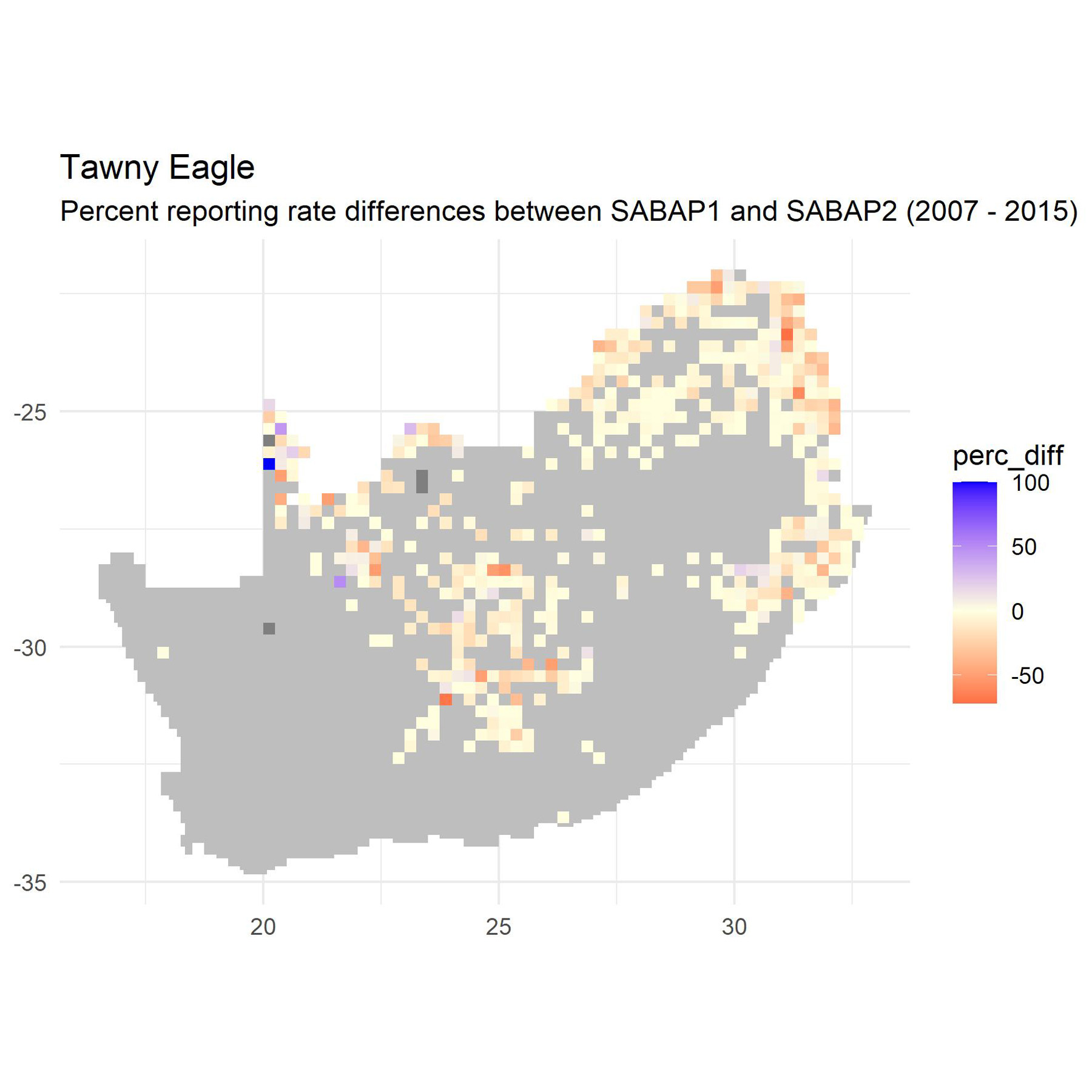
Figure 1: Percent reporting rate differences between Southern African Bird Atlas Projects, SABAP1 and SABAP2. Above is a map of Quarter Degree Grid Cell level change between SABAP1 and the SABAP2 period 2007-2015, being roughly comparable in terms of time and effort. The measure is a simple subtraction of percentage reporting rate for each period. Blue indicates higher reporting rate, red indicates lower, while cream is no change. Grey is not recorded, which could be either the species was not recorded or there is no data. Given protocol differences between SABAP1 and SABAP2, these results are indicative or supportive of change, but further evidence would be required to support a position of population change from these results alone (from Lee 2024).
Biology & Ecology
Taxonomy
Globally, three subspecies of Tawny Eagle are recognised: A. r. vindhiana in Pakistan and India; A. r. belisarius in North Africa, Arabia and tropical Africa; and the nominate A. r. rapax in south Kenya and southern Africa (Sibley and Monroe 1990). The Tawny Eagle has on occasion been lumped with the Steppe Eagle Aquila nipalensis, but they differ in immature plumage, morphology and genetics (Clark 1992, Ferguson-Lees and Christie 2001).
Identification
65–77 cm; 1.6–2.4 kg. Sexes are similar, but the female is larger and often darker and more heavily marked. The plumage is extremely variable in overall colour and intensity of markings, ranging from ‘blonde’ to dark brown. Most birds in southern Africa are tan or rufous brown. The undersides of the remiges are greyish and lightly barred. The tail is fairly long and rounded, often with light barring. The bill is dark grey, with a yellow cere and gape. Toes are yellow and the talons dark. Eyes become yellow after about two years. Juveniles differ subtly from adults in being generally paler and less marked, having whitish uppertail coverts which may form an indistinct pale patch, and having pale tips to the inner primaries and secondaries, as well as initially dark brown eyes (Simmons 2005). Field identification of brown eagles is notoriously difficult, and despite vetting efforts, a certain degree of error may be present in datasets.
Distribution
The Tawny Eagle is widespread throughout sub-Saharan Africa (Ferguson-Lees and Christie 2001). In southern Africa, it is largely concentrated in protected areas in the north-east and central parts of the region (Simmons 1997), which is confirmed by more recent SABAP2 data (Lee 2024). The species is well represented in the IBA network, with Kruger National Park having the highest reporting rates, followed by Kgalagadi Transfrontier Park in Northern Cape and the northern KwaZulu-Natal parks of Ndumo, Mkuze, Hluhluwe-iMfolozi and the iSimangaliso Wetland Park (Figures 2 and 3). Outside of protected areas, the Tawny Eagle has disappeared from large parts of its former range, with reporting rates being substantially lower in SABAP2 than in SABAP1, or with the species now completely absent from certain grid cells. This is consistent with findings by Herremans and Herremans-Tonnoeyr (2000) who found that Tawny Eagle densities in Botswana declined significantly with an increase in distance away from protected land. In particular, the species seems to have disappeared from large parts of the Northern Cape, Free State and Limpopo provinces. A small, sparsely distributed population persists in the grassy Karoo where they have capitalised on power-lines, using pylons as nest structures (Simmons 1997, Tate 2022). There are no clear seasonal movements, and the species appears to be sedentary (Steyn 1982). It is considered to be a vagrant to Lesotho (Osborne and Tigar 1990). In different parts of southern Africa, population densities depend on soil types and primary productivity (Hustler and Howells 1986) and on the extent of protected areas (Tarboton and Allan 1984, Brown 1991), with densities much higher (1.5 pairs/100 km2) within conservation areas than outside (0.3–1 pair/100 km2) recorded in the 1980s. The AOO provided by the recent SABAP synthesis is 267 476 km2 (Lee 2024).
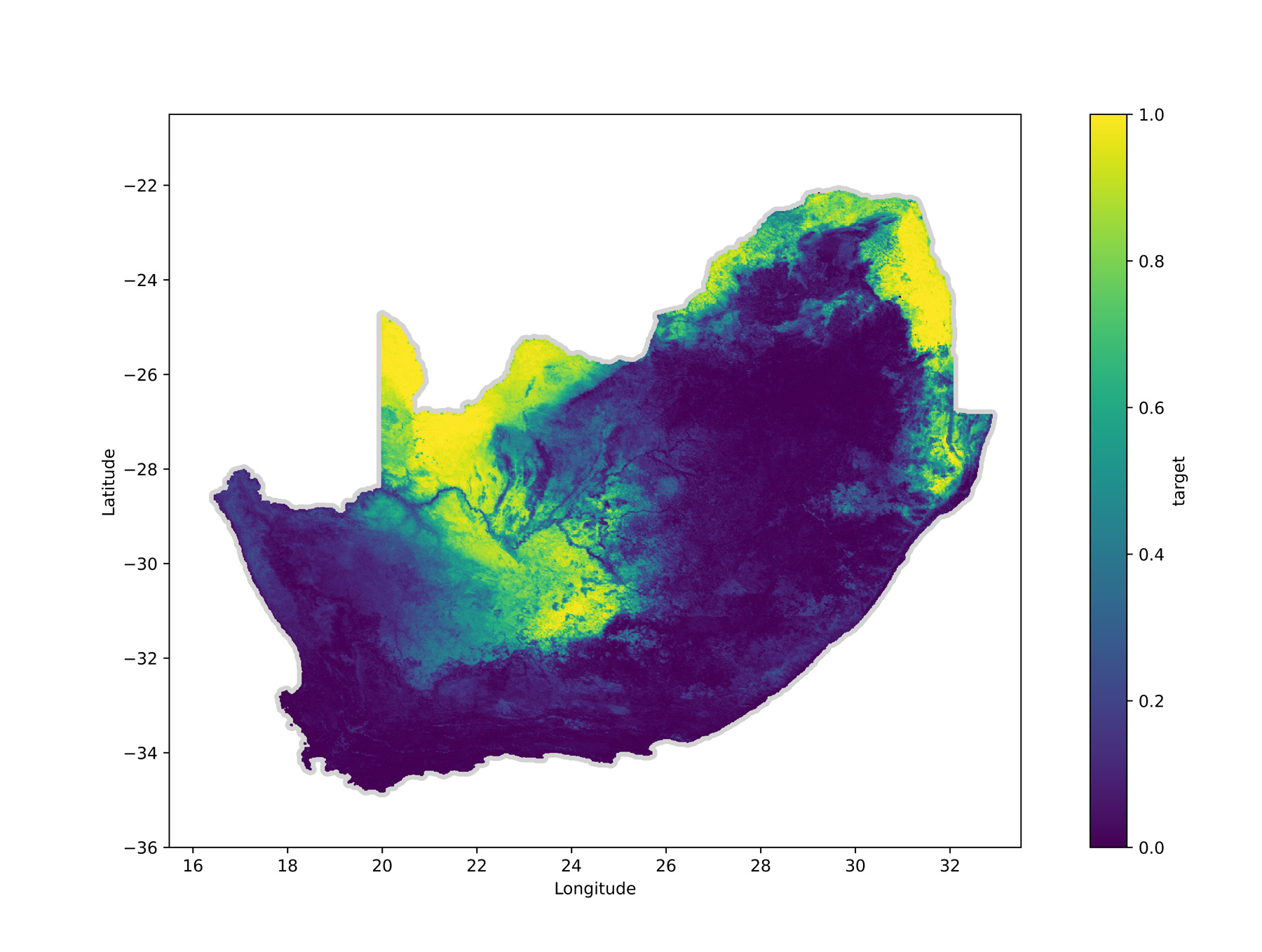

Figure 2: South Africa Tawny Eagle probability distribution map, produced from BirdLasser location data at 2x2km grid scale, using iNaturalist and eBird as absence data only. This represents the predicted range for the 2016-2023 period, pentad scale (top) and pentad scale p>0.5 (bottom) (from Lee 2024).
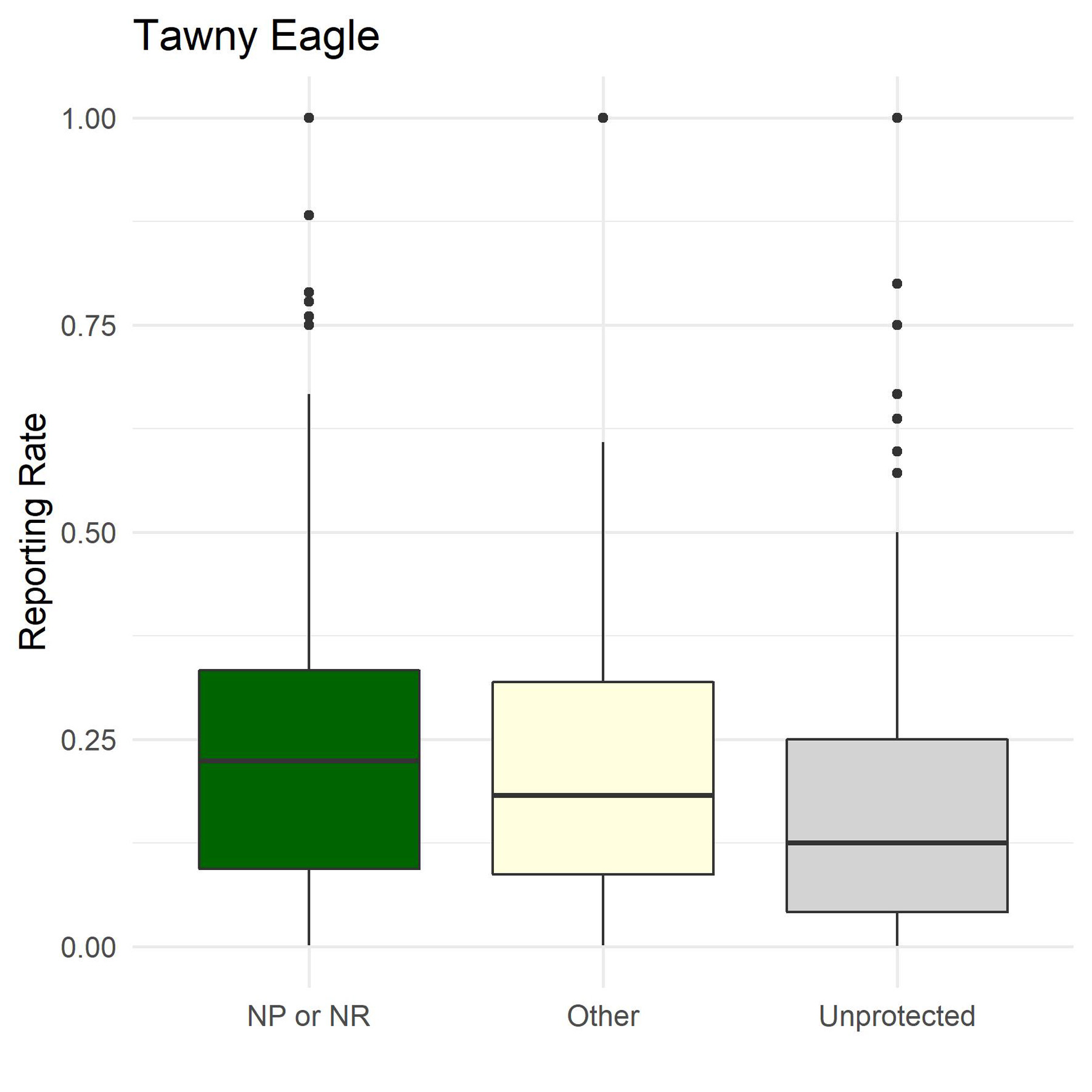
Figure 3: The above is an indication of reporting rate by protected area status. NP or NR is National Park or Nature Reserve. ‘Other’ indicates other protected area types (conservancies, Biosphere Reserves etc). These are boxplots of reporting rates (relative abundance) within each pentad category. The ratio of range (number of pentads) in both protected categories to unprotected is 1.93. Values over 1 indicate most of the range is in a protected area. For the Tawny Eagle 336 pentads were reported in NP or NR; 100 pentads were reported for “Other” and 226 pentads were reported for “Unprotected” areas (from Lee 2024).
Ecology
Tawny Eagles are found in lightly wooded savannah and thornveld, as well as semi-desert (Simmons 1997), but avoid dense forest and highlands. Adults maintain a year-round territory of approximately 70 km2 (Tarboton and Allan 1984), but do respond to temporarily favourable environmental conditions, or biological phenomena such as irruptions of Red-billed Quelea Quelea quelea or Armoured Ground Crickets Acanthoplus discoidalis. Their prey and feeding habitats are similar to that of the Bateleur Terathopius ecaudatus, with scavenging and piracy being two of the most important foraging strategies (Watson et al. 1984). Breeding occurs in the austral winter (Hustler and Howells 1989). Reproductive success in parts of South Africa and Zimbabwe ranged between 0.65–0.68 young/pair/year (Tarboton and Allan 1984, Hustler and Howells 1989). The generation length of 13.7 years is the mean of two calculated values derived from published and/or extrapolated estimates of mean age at first breeding, maximum longevity in the wild and mean annual adult survival (BirdLife International 2021).
Threats & Conservation
Threats
The Tawny Eagle is one of the most threatened eagles in South Africa (Barnes 2000), with a high sensitivity to land transformation making it largely dependent on conservation areas to survive (Lee 2024, White et al. 2024). Isolating woody cover as a single variable, it is predicted that the Tawny Eagle may lose a further 50% of its regional occupancy within 20 years if woody plant encroachment continues unabated (White et al. 2024). Heavy losses have been documented for large raptors venturing outside of protected areas (Herholdt and Kemp 1997) and the Tawny Eagle is no exception. Owing to its habit of scavenging, Tawny Eagles, together with Bateleurs, suffer the most from deliberate and inadvertent poisoning (Tarboton and Allan 1984) with 66 fatalities due to poisoning recorded on the African Wildlife Poisoning database from 1990-2024 (The Endangered Wildlife Trust and the Peregrine Fund 2024). Livestock farmers directly persecute the species because of the perception that the birds catch domestic livestock and poultry, or foul drinking water (Simmons 1997, Anderson 2000). Birds are also inadvertently killed or injured in gin traps set to capture mammalian predators (Anderson 2000). A decrease in wildlife populations in cattle-farming regions of Namibia resulted in a decrease in Tawny Eagle densities (Brown 1988), although it is unknown if similar decreases have taken place in South Africa.
Tawny Eagles, in addition to several other raptor species in South Africa, are susceptible to drowning in sheer-walled reservoirs (Anderson et al. 1999). Birds have been killed by electrocution (Anderson 2000, Barnes 2000) although, conversely, the Tawny Eagle has benefited from using electricity pylons as nesting sites (Anderson 2000). Individuals feeding on road-killed carrion are occasionally killed by motor vehicles (Oatley et al. 1998). Monadjem and Rasmussen (2008) attributed declines of the Eswatini population to habitat loss and nest disturbance. Tawny Eagles have also been killed on operational wind farms in South Africa, and the marked increase in Wind Energy Facility developments have potential to negatively impact Tawny Eagles within ranges that overlap with wind development.
Conservation Measures Underway
This species is listed under the Raptors MOU and is on Appendix II of CITES. The Raptors MOU falls under the Convention on the Conservation of Migratory Species of Wild Animals (CMS) and is an international agreement focused on conserving migratory birds of prey across Africa, Eurasia, and the Middle East. It is also protected under the Cape Province Nature and Environmental Conservation Ordinance No. 19, and the Swaziland Game Act, no. 51 (Taylor 2015). The species is now becoming increasingly dependent on protected areas (e.g. Thiollay 2006, 2007, Virani et al. 2011, Simmons 2015, Taylor 2015, Lee 2024). Awareness campaigns are underway to reduce the number of poisoning incidents, and there are local monitoring projects underway in South Africa (Taylor 2015). Vulture restaurants may also be used by this species (Taylor 2015).
Two projects run under the auspices of the Birds of Prey Programme of the Endangered Wildlife Trust assist with the conservation of Tawny Eagles. The programme has been active with an awareness and education programme for landowners and stock farmers in Northern Cape, which has been successful in reducing the number of poisoning incidents (G. Tate pers comm). The Arid Raptors Project focuses on the monitoring and conservation of all raptors in the Kalahari region of South Africa, including Tawny Eagles, with a focus on the Kgalagadi Transfrontier Park and adjacent areas.
Conservation Measures Proposed
Amongst others, Taylor (2015) recommends the following actions:
1) a Population and Habitat Viability Assessment in addition to a management plan to result in a Species Recovery Plan.
2) Manage large buffer zones around protected areas, and conduct research to decide what the minimum size these should be.
3) Promote more vulture restaurants, which this species will use.
4) Install bird-friendly structures to prevent electrocution. 5) Attempt to decrease poisoning as much as possible.
6) Conduct further research into breeding densities inside and outside of protected areas, and further to this research across wider areas can give a better idea of the overall population trend.
7) Measure the success of awareness programmes. Simmons (2015) additionally proposes the production of further education and awareness materials to try to reduce poisoning incidents, as well as training for law enforcers.
8) Stricter enforcement on the sale of toxic substances and legislation for severe penalties for those who do commit such poisoning offences (Simmons 2015).
Research Priorities and Questions
- A thorough investigation of the densities of breeding pairs inside and outside of conservation areas throughout the region is needed.
- The minimum area of buffer zones adjacent to protected areas in the region needs to be ascertained. The viability and delineation of these areas need to be investigated.
- The role that habitat transformation has on reduction of the prey base, and consequently on Tawny Eagle densities, needs to be investigated.
- Estimations of immigration and emigration are necessary since the main regional populations are along international boundaries.
- The success of awareness programmes to reduce Tawny Eagle mortalities should be investigated, and if necessary, their design should be improved.
- Investigate the potential impact of wind energy development on Tawny Eagles in South Africa; investigating effective mitigation buffer sizes and variables associated with collision risk, investigating population level impacts of collision mortalities, understanding the effectiveness of mitigation.
Contributors & References
Assessor/s
Gareth Tate
Reviewer/s
Meg Murgatroyd
References
Anderson MD, Maritz AWA, Oosthuysen E. 1999. Raptors drowning in farm reservoirs in South Africa. Ostrich 70(2): 139–144.
Anderson MD. 2000. Raptor conservation in the Northern Cape Province, South Africa. Ostrich 71: 25–32.
Barnes KN. 2000 Tawny Eagle Aquila rapax. In: Barnes KN (ed), The Eskom Red Data Book of Birds of South Africa, Lesotho and Swaziland. Johannesburg, South Africa: BirdLife South Africa. pp 81–83.
BirdLife International. 2021. Aquila rapax. Available: https://dx.doi.org/10.2305/IUCN.UK.2021-3.RLTS.T22696033A203852137.en. [Accessed on 18 June 2024].
Brown CJ. 1988. Scavenging raptors on farmlands: What is their future? African Wildlife 42: 103–105.
Brown CJ. 1991. Declining martial Polemaetus bellicosus and tawny Aquila rapax eagle populations and causes of mortality on farmlands in central Namibia. Biological Conservation 56: 49–62.
Clark WS. 1992. The taxonomy of Steppe and Tawny Eagles, with criteria for separation of museum specimens and live eagles. Bulletin of the British Ornithologists’ Club 112: 150–157.
Ferguson-Lees J, Christie DA. 2001. Raptors of the World. New York, United States of America: Houghton Mifflin Company.
Garbett R, Herremans M, Maude G, Reading RP, Amar A. 2018. Raptor population trends in northern Botswana: A re-survey of road transects after 20 years. Biological Conservation 224: 87–99. DOI: 10.1016/j.biocon.2018.05.020.
Global Raptors Information Network. 2015. Species account: Tawny Eagle Aquila rapax. Available: http://www.globalraptors.org/grin/SpeciesResults.asp?specID=8350 [Accessed on 19 June 2024].
Herholdt JJ, Kemp AC. 1997. Breeding status and ecology of the Martial eagle in the Kalahari Gemsbok National Park, South Africa. Ostrich 68: 80–85.
Herremans MJL, Herremans-Tonnoeyr D. 2000. Land use and the conservation status of raptors in Botswana. Biological Conservation 94: 31–41.
Hustler K, Howells WW. 1986. A population study of tawny eagles in the Hwange National Park, Zimbabwe. Ostrich 57: 101–106.
Lee ATK. 2024. Regional Red Data Book of the Birds of South Africa, Lesotho and Eswatini: SABAP2 synthesis and supporting information and graphics for Tawny Eagle. Unpublished report. Johannesberg: BirdLife South Africa.
Monadjem A, Rasmussen MW. 2008. Nest distribution and conservation status of eagles, selected hawks and owls in Swaziland. Gabar 19: 1–22.
Murn C, Potter L, Botha A (eds). 2012. Raptor real estate in Kruger National Park: conservation and management in a changing world. Savannah Science Network Meeting. Skukuza, South Africa.
Parker V. 1999. The atlas of the birds of Sul do Save, southern Mozambique. Cape Town, South Africa: University of Cape Town.
Oatley TB, Oschadleus HD, Navarro RA, Underhill LG (eds). 1998. Review of Ring Recoveries of Birds of Prey in Southern Africa: 1948-1998. Johannesburg, South Africa: Endangered Wildlife Trust.
Osborne PE, Tigar BJ. 1990. The status and distribution of birds in Lesotho. Newbury, United Kingdom: Nature Conservation Bureau Ltd.
Shaw P, Ogada D, Dunn L, Buij R, Amar A, Garbett R, Herremans M, Virani MZ, et al. 2024. African savanna raptors show evidence of widespread population collapse and a growing dependence on protected areas. Nature Ecology & Evolution 8 DOI: 10.1038/s41559-023-02236-0.
Sibley C, Monroe B. 1990. Distribution and Taxonomy of Birds of the World. Yale, United States of America: Yale University Press.
Simmons RE. 1997. Tawny Eagle Aquila rapax. In: Harrison JA, Allan DG, Underhill LG, Herremans M, Tree AJ, Parker V, Brown CJ (eds), The atlas of southern African birds Vol I: Non-passerines. Johannesburg, South Africa: BirdLife South Africa. pp 178–179.
Simmons RE. 2015. Tawny Eagle Aquila rapax. In: RE Simmons, CJ Brown, Kemper J (eds), Birds to watch in Namibia: red, rare and endemic species. Ministry of Environment and Tourism, Namibia Nature Foundation. pp 127–129.
Tate GJ. 2022. Distribution, status and population dynamics of the pylon nesting Martial Eagle. Report prepared for Eskom Research, Testing and Development.
Tarboton WR, Allan DG. 1984. The status and conservation of birds of prey in the Transvaal. Species accounts-secretary bird, vultures, kites, hawks, eagles, bataleur. Transvaal Museum Monographs 3(1).
Taylor MR. 2015. Tawny Eagle Aquila rapax. In: Taylor MR. Peacock F, Wanless RM (eds), The 2015 Eskom Red Data Book of Birds of South Africa, Lesotho and Swaziland. Johannesburg, South Africa: BirdLife South Africa. pp 116–118.
The Endangered Wildlife Trust and the Peregrine Fund. 2024. The African Wildlife Poisoning Database. Available: www.awpd.cloud [Accessed on 19 June 2024].
Thiollay J-M. 2006. The decline of raptors in West Africa: long term assessment and the role of protected areas. Ibis 148: 240–254.
Thiollay J-M. 2007. Raptor declines in West Africa: comparisons between protected, buffer and cultivated areas. Oryx 41: 322–329.
Virani MZ, Kendall C, Njoroge P, Thomsett S. 2011. Major declines in the abundance of vultures and other scavenging raptors in and around the Masai Mara ecosystem, Kenya. Biological Conservation 144: 746–752.
White JDM, Stevens N, Fisher JT, Reynolds C. 2024. Woody plant encroachment drives population declines in 20 % of common open ecosystem bird species. pp 1–14. DOI: 10.1111/gcb.17340.
Citation
Tate G 2025. Tawny Eagle. In: Lee ATK, Rose S, Banda S, Bezeng SB, Maphalala MI, Maphisa DH, Smit-Robinson H (eds), The 2025 Red Data Book of Birds of South Africa, Lesotho and Eswatini. Johannesburg, South Africa: BirdLife South Africa. Available at: https://www.birdlife.org.za/red-list/tawny-eagle/
Our generous sponsors


