


Green Barbet
Cryptolybia olivacea

Number Of Mature
Individuals (Regional)
400 – 600

Regional
Population Trend
Decreasing
2025
Regional Category
Endangered
Search by species
CONTENTSOverview
Names
|
IOC English Name: |
Green Barbet |
|
SA & IOC Scientific Name: |
Cryptolybia olivacea |
|
BirdLife International Taxonomy (scientific name): |
Cryptolybia olivacea |
|
Order: |
PICIFORMES |
|
Family: |
Lybiidae |
|
Species name author: |
Shelley 1880 |
|
Afrikaans: |
Groenhoutkapper |
|
Sesotho (South Africa): |
Mankotlo wa leramasehla |
|
Sesotho (Lesotho): |
Mankotlo wa thamasehla |
|
siSwati: |
|
|
Zulu: |
unongoyana |
Current Assessment Status
|
2025 Regional Category [Criteria] |
EN [B1ab(iii)+2ab(iii)] |
|
2024 Global Category [Criteria] |
LC (BirdLife International 2016) |
|
Population size (Regional) |
400 – 600 (Chittenden et al. 1999) |
|
Population size (Global) |
Unknown (BirdLife International 2016) |
|
Distribution size (EOO) (Regional) km2 |
128 (Lee 2024) |
|
Distribution size (EOO) (Global) km2 |
1 260 000 (BirdLife International 2016) |
|
Distribution size (AOO) (Regional) km2 |
39 (Brown 2015), 60 (Lee 2024) |
|
Generation time |
8.5 years (BirdLife International 2016) |
|
Status change reason |
No Change |
|
Migrant (in the region) |
No |
|
Regional endemic |
No |
Historic Listing Information
|
2000 Regional Status |
VU [A2c; C2b; D1+2] |
|
2015 Regional Status |
EN [B1ab(iii)+2ab(iii)] |
|
Status change reason (if applicable) |
Criteria revision |
|
2015 Population size (Regional) |
400 – 600 |
|
2015 Global Status |
LC |
Reason for Inclusion
Reason for Inclusion in the Assessment
The species was assessed as regionally Vulnerable in 2000 and Endangered in 2015 (Berruti 2000, Brown 2015). The regional sub-population occurs at a single locality and is separated by 2300 km from its closest apparent congener in the forests of the Rondo Plateau, Tanzania.
Category Justification
Category Justification
The regional population of Green Barbet Cryptolybia olivacea satisfies the range Criterion of B1 for regionally Endangered (Extent of Occurrence (EOO) <5000 km2, occurring at a single location and a predicted decline in extent and quality of habitat) as well as B2 (Area of Occupancy (AOO) <500 km2, occurring at a single location and a predicted decline in extent and quality of habitat).
Regionally the small population restricted to oNgoye appears stable according to Southern African Bird Atlas (SABAP2) trend analysis (confidence high) and change metrics comparing reporting rates between SABAP1 and SABAP2 (confidence moderate; Lee 2024), but the small size and single location mean it is still at risk.
Population Justification
The global population has yet to be quantified (BirdLife International 2016). The most recent estimate of the regional population is that of Chittenden et al. (1999), who provided a figure of 400 – 600 mature individuals. The population is considered stable (Lee 2024), so this figure is taken as the current population size.
Trend Justification
Globally the population is considered to be in decline, despite the population size being unknown (Short et al. 2023). Regionally the population is considered stable although estimates are dated. In the most recent revision of the species, Chittenden (2005) chose not to adjust the population estimate from the 1999 estimate. The reporting rate within SABAP2 indicates a stable population over the past three generations (c. 24 years). Confidence in this estimate is moderate.
Biology & Ecology
Taxonomy
The taxonomy of this species has been unclear for some time. Clancey (1964) considered the Green Barbet to comprise two isolated populations (oNgoye Forest and Rondo Plateau) and that two more species, C. belcheri and C. olivacea, exist in Malawi, Kenya, and Tanzania. An alternative view is that the group comprises one species with five subspecies (Fry et al. 1988, Short et al. 2023), with the regional population being part of Cryptolybia olivacea woodwardia (Short et al. 2023). The conservation status of the Green Barbet is heavily dependent upon its taxonomic status, and this should be reviewed.
Identification
16–18.5 cm. 50 g. Sexes are alike. Forehead to nape dark olive-brown. Upperparts bronzy green. The throat, belly, and underparts are light green. Underwing coverts yellowish white. Bill and legs are dark brown to blackish. Eyes red. The oNgoye Forest and Rondo Plateau birds differ from C. belcheri and C. olivacea by having distinctive lemon-yellow superciliary streaks, ear coverts, and temporal surfaces (Clancey 1989).
Distribution
The Green Barbet group is distributed in a disrupted chain of isolated populations from coastal Kenya, north-eastern Kenya, Malawi, and Mozambique to South Africa (Clancey 1989). Within the region, it occurs in a single locality, oNgoye Forest in KwaZulu-Natal (Berruti 2000, Chittenden 2005), a patch of relict Afromontane and coastal forest (Berruti 1997) (Figure 1). Birds are more common in the higher-lying parts of the western side of the forest and scarcer in the eastern sector (Johnson et al. 1998, Lee 2024). The EOO is 128.1 km2 (Lee 2024), while the AOO is just 39 km2 (Brown 2015). The Green Barbet is not known to undertake any movements outside the forest (Cyrus and Robson 1980).
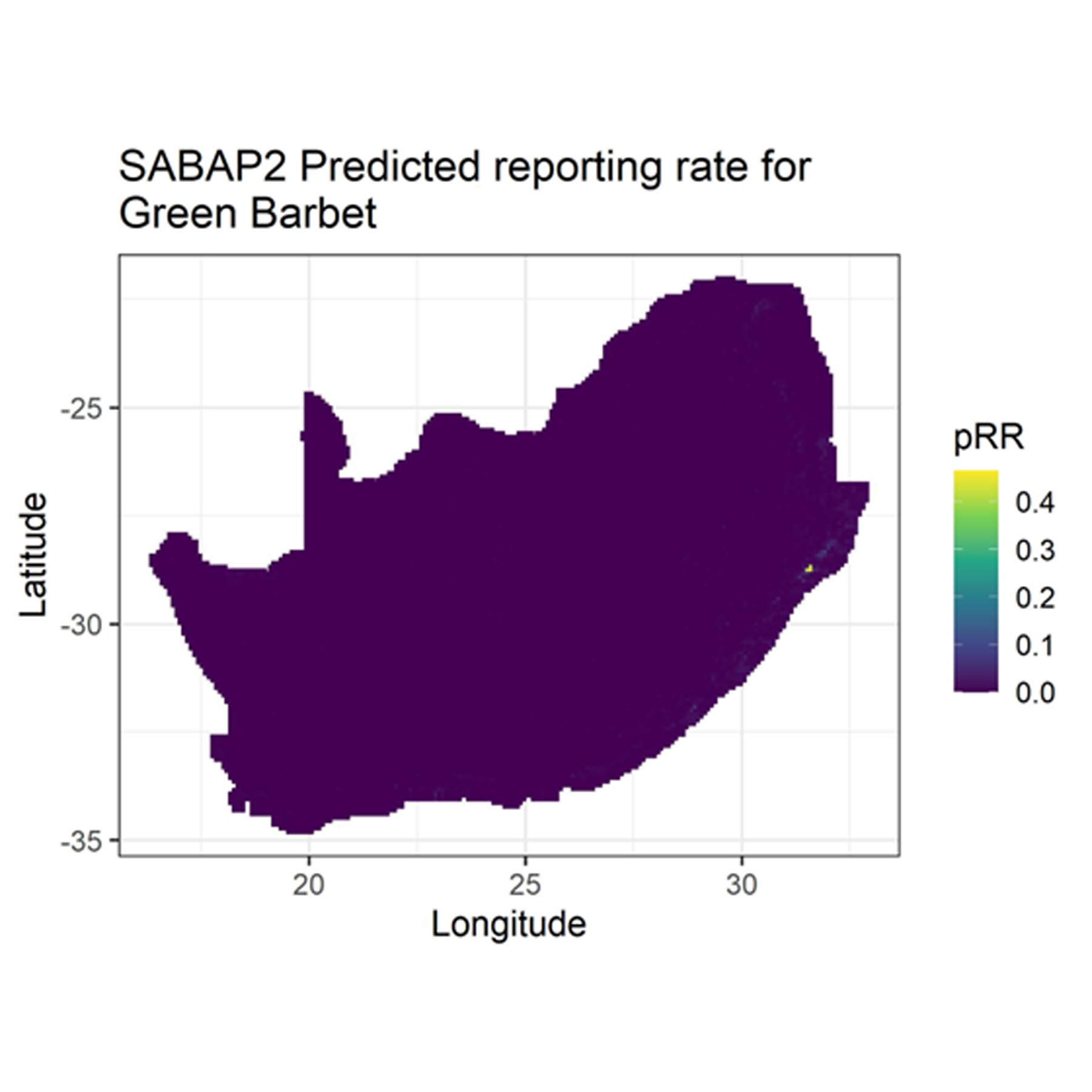
Figure 1: SABAP2 Reporting Rate used here as a proxy for abundance, showing the ‘density’ within a species distribution. Reporting Rates is predicted at the pentad level using a Random Forest type model. This map shows the very restricted and fragmented (from the rest of the African range) distribution of Green Barbet. Map from Lee (2024).
Ecology
The Green Barbet is restricted to a single locality, oNgoye Forest (Berruti 2000, Chittenden 2005). Within this area, it is confined to coastal scarp forest with a tall canopy (Chittenden et al. 1999, Chittenden 2005). This species may be particularly dependent on the fruit of wild figs, Ficus spp., of which seven species occur in oNgoye Forest and on its edges (Dowsett-Lemaire and Dowsett 1987). The bird occurs in small groups of 3–8 in the upper half of the forest canopy during the non-breeding season, breaking up into pairs from about October (Chittenden 2005) to breed. It nests in holes in tree trunks from November to February (Holliday and Tait 1953). BirdLife International provides a generation length of 8.5 years (BirdLife International 2016).
Threats & Conservation
Threats
Ongoing human exploitation of the forest is a concern that has been raised repeatedly (Johnson et al. 1998, Chittenden 2005) but appears to be unchanged. Damage and death to some fruiting trees (e.g., Onionwood Cassipourea malosana) and other favored medicinal trees within the forest pose a problem. Cattle grazing has affected forest understorey and surrounding grasslands, and increased firewood collection within the forest has been implicated as a possible cause of the absence of cavity-nesting species along forest-edge habitat (Kruger and Lawes 1997). The forest’s edge is subjected to burning, which may gradually reduce the forest area. Although the oNgoye Forest Reserve Tourism Development Project is in the pipeline, it is currently under investigation with a section 24G application (Ezemvelo KZN Wildlife 2023). Conflict and tension between local communities and Ezemvelo KZN Wildlife has been identified as a critical problem.
Conservation Measures Underway
The oNgoye Forest is listed as a Provincial Nature Reserve under the administration of Ezemvelo KwaZulu-Natal Wildlife. Although the Green Barbet’s entire regional population thus falls within a protected area, inadequate resources are currently available for the reserve’s management. There are no current conservation actions for the species. Although an integrated management plan for the oNgoye Forest Nature Reserve exists (Ezemvelo KZN Wildlife 2009), there are continued concerns over resource utilization, lack of protection, and a lack of a coordinated tourism strategy.
Conservation Measures Proposed
A Population and Habitat Viability Assessment (PHVA) is recommended, as is a Biodiversity Management Plan, culminating in a National Species Recovery Plan. Adequate protection of oNgoye Forest is critical to ensure the longevity of this population. Improved forest management is also essential, including an immediate reduction in illegal forest utilization. A research program directed at estimating population size and monitoring the breeding success of the Green Barbet at oNgoye Forest should be initiated. The species is sought-after by birdwatchers, and a responsible ecotourism program could encourage local communities’ involvement and the forest’s safeguarding.
Research Priorities and Questions
- An updated population estimate is urgently required.
- An investigation into genetic variation and taxonomy of the broader Green Barbet complex should be performed.
- An updated report on the effectiveness of the integrated management plan of oNgoye Forest is needed to assess its long-term effectiveness.
Contributors & References
Assessor/s
Mark Brown
Reviewer/s
Brent Coverdale
References
Berruti A. 1997. Green Barbet Cryptolybia woodwardii. In: Harrison JA, Allan DG, Underhill LG, Herremans M, Tree AJ, Parker V, Brown CJ (eds), The atlas of southern African birds Vol I: Non-passerines. Johannesburg, South Africa: BirdLife South Africa. pp 716.
Berruti A. 2000. Woodward’s Barbet Cryptolybia woodwardi. In: Barnes KN (ed), The Eskom Red Data Book of Birds of South Africa, Lesotho and Swaziland. Johannesburg, South Africa: BirdLife South Africa. pp 119–120.
BirdLife International. 2016. Cryptolybia olivacea. The IUCN Red List of Threatened Species 2016: e.T22681732A95210724. https://dx.doi.org/10.2305/IUCN.UK.2016-3.RLTS.T22681732A95210724.en. [Accessed 04 November 2024].
Brown M. 2015. Green Barbet Stactolaema olivacea. In: Taylor MR, Peacock F, Wanless RM (eds), The Eskom Red Data Book of Birds of South Africa, Lesotho and Swaziland. Johannesburg, South Africa: BirdLife South Africa. pp 91–92.
Chittenden HN, Coley D, Coley V. 1999. Woodward’s Barbet: a unique forest specialist. African Wildlife 52: 18–21.
Chittenden HN. 2005. Green Barbet Stactolaema olivacea. In: Hockey PAR, Dean WRJ, Ryan PG (eds), Roberts – Birds of Southern Africa, 7th Edn. Cape Town, South Africa: The Trustees of the John Voelcker Bird Book Fund. pp 140.
Clancey PA. 1964. The birds of Natal and Zululand. Edinburgh, Scotland: Oliver and Boyd.
Clancey PA. 1989. The taxonomy of the Green Barbets (Aves: Lybiidae) of the eastern Afrotropics. Bonner Zoologische Beiträge 40: 11–18.
Cyrus DP, Robson N.1980. Bird Atlas of Natal. Pietermaritzburg, South Africa: University of Natal Press.
Dowsett-Lemaire F, Dowsett RJ. 1987. Vocal responses of Green Barbet populations, and the taxonomic implications. Ostrich 58: 160-163.
Ezemvelo KZN Wildlife. 2009. Integrated Management Plan: Ongoye Forest Nature Reserve, South Africa. Ezemvelo KZN Wildlife, Pietermaritzburg. 85 pp. and 5 maps (4 x A4 and 1 x A3).
Ezemvelo KZN Wildlife. 2023. Annual Report 2022-2023. Pietermaritzburg: Ezemvelo KZN Wildlife. pp 154.
Fry CH, Keith S, Urban E. 1988. The Birds of Africa, Vol. III: Parrots to Woodpeckers. London, United Kingdom: Academic Press.
Holliday CS, Tait IC. 1953. Note on the identification of: Buccanodon olivacea woodwardi (Shelley). Ostrich 24: 115–117.
Johnson DN, Barnes KN, Taylor B. 1998. Important Bird Areas of Kwa Zulu-Natal. The Important Bird Areas of southern Africa. Johannesburg: BirdLife South Africa. pp 141-196.
Kruger SJ, Lawes MJ. 1997. Edge effects at an induced forest–grassland boundary: forest birds in the Ongoye Forest Reserve, KwaZulu-Natal. South African Journal of Zoology 32: 82–91.
Lee ATK. 2024. Regional Red Data Book of the Birds of South Africa, Lesotho and Eswatini: SABAP2 synthesis and supporting information and graphics for Green Barbet. Unpublished report. Johannesburg: BirdLife South Africa.
Short LL, Horne JFM, Kirwan GM. 2023. Green Barbet (Cryptolybia olivacea). In: del Hoyo J, Elliott A, Sargatal J, Christie DA, de Juana E (eds), Birds of the World version 1.1. New York, USA: Cornell Lab of Ornithology, Ithaca. https://doi.org/10.2173/bow.grebar2.01.1
Citation
Brown M 2025. Green Barbet. In: Lee ATK, Rose S, Banda S, Bezeng SB, Maphalala MI, Maphisa DH, Smit-Robinson H (eds), The 2025 Red Data Book of Birds of South Africa, Lesotho and Eswatini. Johannesburg, South Africa: BirdLife South Africa. Available at: https://www.birdlife.org.za/red-list/green-barbet/
Our generous sponsors


