


Gentoo Penguin
Pygoscelis papua

Number Of Mature
Individuals (Regional)
2 600

Regional
Population Trend
Decreasing
2025
Regional Category
NA
Search by species
CONTENTSOverview
Names
|
IOC English Name: |
Gentoo Penguin |
|
SA & IOC Scientific Name: |
Pygoscelis papua |
|
BirdLife International Taxonomy (scientific name): |
Pygoscelis papua |
|
Order: |
SPHENISCIFORMES |
|
Family: |
Spheniscidae |
|
Species name author: |
Forster 1781 |
|
Afrikaans: |
Witoorpikkewyn |
|
Sesotho (South Africa): |
|
|
Sesotho (Lesotho): |
|
|
Siswati: |
|
|
Zulu: |
inguzemqhelomhlophe |
Current Assessment Status
|
2025 Regional Category [Criteria] |
NA |
|
2024 Global Category [Criteria] |
LC (BirdLife International 2019) |
|
Population size (Regional) |
2600 mature individuals |
|
Population size (Global) |
774 000 mature individuals |
|
Distribution size (EOO) (Regional) km2 |
<2500 (foraging; breeding) |
|
Distribution size (EOO) (Global) km2 |
16 500 000 (breeding/resident) |
|
Distribution size (AOO) (Regional) km2 |
<334 (breeding) |
|
Generation time |
8.56 years (derived from Lynch 2013) |
|
Status change reason |
Application of criteria |
|
Migrant (in the region) |
No |
|
Regional endemic |
No |
Historic Listing Information
|
2000 Regional Status |
NT [A1a; B1+2d+3d] |
|
2015 Regional Status |
EN [A2ab; C1] |
|
Status change reason (if applicable) |
Genuine (recent) |
|
2015 Population size (Regional) |
1000 – 1250 pairs |
|
2015 Global Status |
NT [A2be+3be+4be] |
Reason for Inclusion
Reason for Inclusion in the Assessment
The species breeds on the Prince Edward Islands and the regional population was listed as Near Threatened in 2000 and Endangered in 2015 (Dyer and Crawford 2015).
Category Justification
Category Justification
The small population on Marion Island is much less than <5% of the global population, the national filter level for applying a regional category. However, for consistency, a rationale for a category in relation to historical categories is provided here [Editor].
The available population data for the regional Gentoo Penguin population include annual counts from Marion Island (1994-2022) and a single count from Prince Edward Island in 2001. Observations of Gentoo Penguins breeding at Marion Island indicate a population decrease of approximately 36% over the last three generations (c. 1994-2022), attributed to declining habitat quality and food availability. This decline represents an improvement compared to the previous 52% decrease recorded between 1994 and 2012, which led to the species being listed as regionally Endangered under Criteria A2ab and C1 in 2015.
Currently, the 36% decline at Marion Island would classify the population as Vulnerable (VU) under Criteria A2abc if assessed independently from the Prince Edward Island population. However, the fluctuating population trend on Marion Island requires ongoing monitoring to determine if the population is genuinely recovering. The population would also qualify as VU under Criterion C1, with 10% over 3 generations.
For Prince Edward Island, the 2001 count was for fewer than 1000 mature individuals. The current population trend on Prince Edward Island is unknown. A category of VU [A2a; C1] would reflect the status of the population on the Prince Edward Island group.
Population Justification
The global population is estimated to be c. 432 144 (338 059 – 534 114) breeding pairs (Herman et al. 2020) and is considered of Least Concern (BirdLife International 2020). In 2022, 824 pairs of Gentoo Penguin bred at Marion Island (Department of Forestry, Fisheries and Environment, DFFE, unpubl data). In 2001, an estimated 475 pairs bred at Prince Edward Island (Ryan et al. 2003). The overall population of Gentoo Penguins at the PEIs in 2012 was estimated at 1000 – 1250 pairs or 2000 – 2500 breeding individuals (Dyer and Crawford 2015). Assuming the number at Prince Edward Island has remained unchanged, the overall number at the PEIs in 2022 would have been c. 1300 pairs or 2600 breeding individuals. Since there is uncertainty about the current size of the Prince Edward Island population, this estimate is of medium confidence.
Trend Justification
Earlier this century the global population was thought to have decreased substantially, although fluctuations made it difficult to ascertain long-term trends (Lynch 2013). Herman et al. (2020) later estimated an 11% increase since 2013, with notable data gaps at South Georgia and the sub-Antarctic islands in the Indian Ocean. In 2023, the global population continued to be considered stable by the IUCN (BirdLife International 2020).
At Marion Island, 1345 pairs of Gentoo Penguin bred during 1974-1977 (Siegfried et al. 1978) and 888 pairs in 1984 (Adams and Wilson 1987). Numbers breeding at Marion Island were since counted annually between 1994 and 2022. About 1350 pairs bred in both 1994 and 1995. This decreased to <800 pairs in 2003, and then increased to c. 1100 pairs in 2008 (Crawford et al. 2003, 2009). Numbers subsequently decreased to 556 pairs in 2012, the lowest value yet recorded (Crawford et al. 2014, Dyer and Crawford 2015), but increased again to 824 pairs in 2022. Hence there have been large fluctuations in numbers breeding. To calculate generation time (G): Median age at first breeding (A) was three years and median adult survival (ϕa) was 0.82 p.a. (Lynch 2013). Given G = A + (1 / (1 − ϕa)) (Birdlife International 2000), G = 8.56 years. Dyer and Crawford (2015) assumed G = 8.57 years. Overall, numbers of Gentoo Penguins breeding at Marion Island decreased by 39% between 1994 and 2022, a period of 28 years or 3.27 generations. This is equivalent to a 36% decline in three generations. The trend for the Prince Edward Island population is unknown.
Biology & Ecology
Taxonomy
The Gentoo Penguin Pygoscelis papua shares the genus Pygoscelis with the Chinstrap Penguin P. antarcticus and the Adélie Penguin P. adeliae. There are two subspecies of the Gentoo Penguin: the smaller P. p. ellsworthi breeds on the Antarctic Peninsula and at the South Shetland, South Orkney and South Sandwich groups of islands in the south-west Atlantic Ocean. The larger, nominate subspecies P. p. papua breeds farther north at Martillo Island, Tierra del Fuego (southern South America), the Falkland Islands and South Georgia in the southwest Atlantic Ocean, the Prince Edward, Crozet, Kerguelen and Heard groups of islands in the south Indian Ocean and Macquarie Island south-east of Australia (Lynch 2013).
Identification
51–90 cm; 5–5.5 kg. The world’s third largest penguin, although body size is variable across its range. Males are larger than females. Face, head and back black. Flippers have a narrow white trailing edge on the upper surface and a dark tip on the underside. Tail is long and black. Conspicuous, but variable, white ear-patches above eyes, typically meeting across the crown. Variable amounts of white filoplumes are present on the head. The bill is bright red-orange with black along the upper mandible and at the tip. Eye brown. Feet bright orange with black nails. Juveniles are similarly marked except for greyer eyes and lack of distinct white ear patches and filoplumes (Ryan 2005, Lynch 2013).
Distribution
The Gentoo Penguin has a circumpolar breeding distribution (Figure 1) that ranges in latitude from Cape Tuxon on the Antarctic Peninsula (65°16’S) to the Crozet Islands (46°00’S) (Lynch 2013). The Prince Edward Islands (PEIs), together with the Crozet Islands, are at the northern extremity of the species’ range (Marchant and Higgins 1990). Gentoo Penguins breed around the coasts of Prince Edward and Marion islands, which have surface areas of about 45 km2 and 290 km2, respectively. The Area of Occupancy of Gentoo Penguins at the PEIs will be <335 km2, the sum of these areas. Prince Edward and Marion islands have coastlines of c. 72 and c. 34 km, respectively, totalling c. 106 km. At these islands, which are 19 km apart, Gentoo Penguins predominantly forage within 20 km of the coast (Carpenter-Kling et al. 2017). Hence, their marine feeding area would have an extent less than 2120 km2 and their Extent of Occurrence would be <2500 km2.
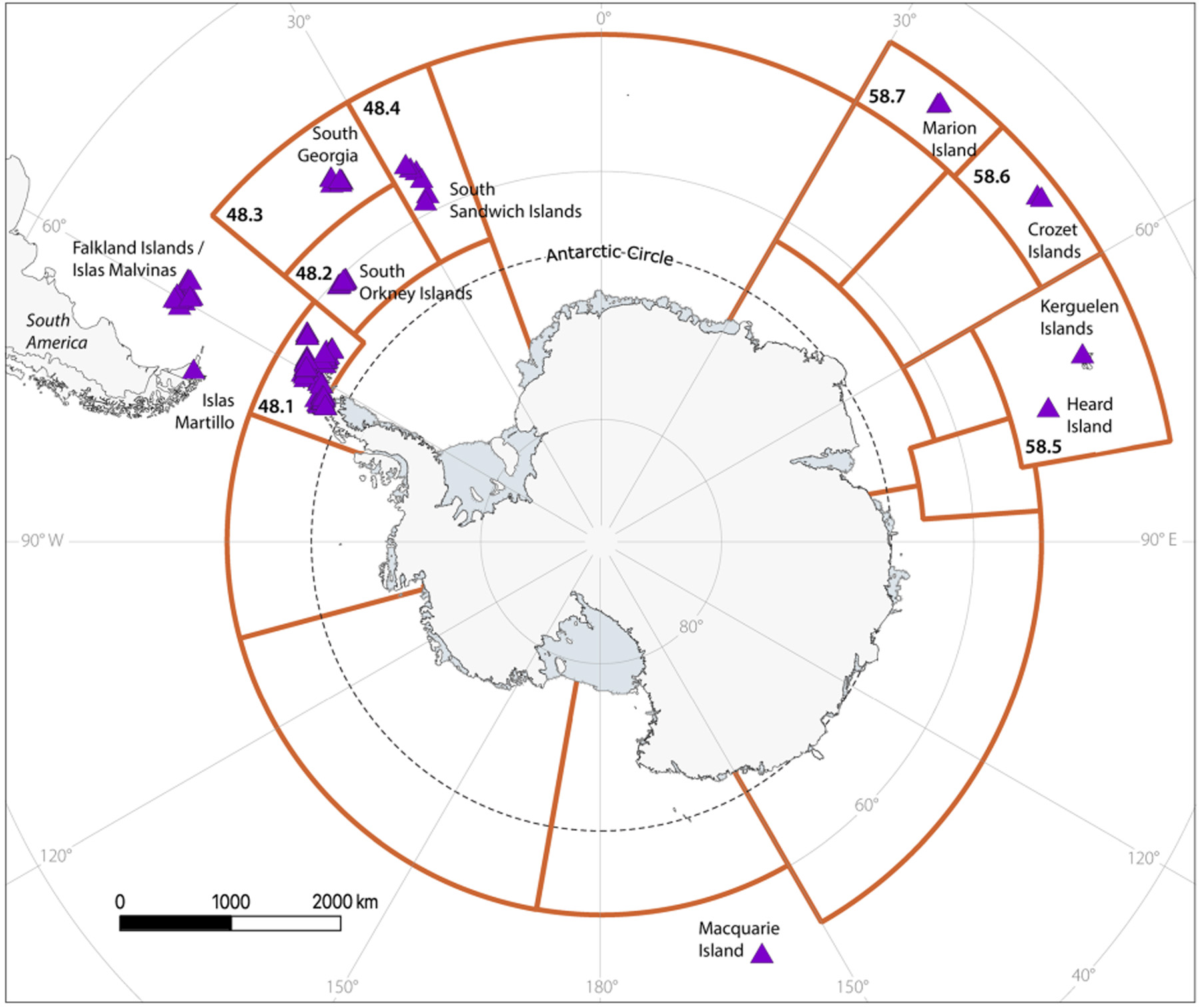
Figure 1: Global breeding distribution of Gentoo Penguins, with the purple triangles depicting their breeding colonies. The orange shapes are the area managed by the Convention for the Conservation of Antarctic Marine Living Resources (CCAMLR), which is divided into three areas: Area 48 (Atlantic Ocean sector), Area 58 (Indian Ocean sector where the regional population is) and Area 88 (Pacific Ocean sector). Map is from Herman et al. (2020).
Ecology
At the northern reaches of their range, Gentoo Penguins breed in small colonies that have nests well-spaced out. At Marion Island their nests are made with grasses, especially Poa cooki and Cotula plumbens as well as mosses (Dyer and Crawford 2015). Clutches have two eggs and incubation is by both parents. Breeding at Marion Island commences in mid-winter and is mostly complete by the end of December, with laying being recorded from early June until early November (Crawford et al. 2003). At Marion Island, breeding success has shown substantial variability, ranging from nearly complete failure to an average production of almost one chick per pair (Crawford et al. 2003, 2009). Late arrivals risk breeding failure because eggs and small chicks are vulnerable to Subantarctic Skuas Stercorarius antarcticus that return to the island in late August (Crawford et al. 2003). Re-layers may be more successful because, after Eudyptes penguins arrive to breed, skuas feed on their eggs. Gentoo Penguins can breed as early as two years old, and most are breeding by 3–4 years (Marchant and Higgins 1990, Lynch 2013). Relatively large annual fluctuations in numbers breeding at a given site are probably related to absenteeism from breeding among mature individuals and delayed recruitment of first-time breeders (Croxall and Rothery 1995, Lynch 2013). At the Crozet Islands, Gentoo Penguins that bred late in one year, often either did not breed or had their breeding delayed in the following year (Bost and Jouventin 1990). Gentoo Penguins feed predominantly on crustaceans, fish, and squid, but with considerable variation in the diet between years and among the different localities at which they breed (Lynch 2013). At Marion Island, prey assemblages within the diet were influenced by the proximity of the sub-Antarctic front to the island (Carpenter-Kling et al. 2019).
Threats & Conservation
Threats
At Marion Island, compared to other localities, the population, breeding success and meal size of Gentoo Penguins are small and the breeding season is protracted, suggesting their numbers are limited by food (Adams and Klages 1989), and their breeding is later. Food availability may be influenced by environmental factors (Carpenter-Kling et al. 2019) and probably affects onset of breeding and breeding success, which in instances has been too low to sustain the population of Gentoo Penguins at Marion Island (Crawford et al. 2003). A decrease in Gentoo Penguins at Iles Kerguelen was likely related to reduced food availability (Lescroël and Bost 2006). Growing populations of Antarctic Fur Seals Arctocephalus gazella at the PEIs (Bester et al. 2009) may inflict increased mortality on Gentoo Penguins. Subantarctic Skuas Stercorarius antarcticus and both species of giant petrels Macronectes spp. also prey on adults, eggs or chicks (Crawford et al. 2003, Dyer and Crawford 2015). At Marion Island, Gentoo Penguins are easily disturbed by humans (Crawford et al. 2003), but less so at Prince Edward Island where visitor numbers are tightly controlled and infrequent. Abandonment of nests may result in eggs and young chicks dying from exposure or being taken by skuas, giant petrels or Lesser Sheathbills Chionis minor. By comparison, in maritime Antarctica, parties of visitors in the vicinity of a Gentoo Penguin colony did not influence predatory behaviour of skuas (Crosbie et al. 1999). Disease has caused sometimes heavy mortality of two other species of penguin at Marion Island (Cooper et al. 2009). Climate change could reduce the suitability of northern localities such as the PEIs for breeding by Gentoo Penguins, whereas populations are expanding southwards and increasing at the southern extreme of their distribution (Lynch et al. 2008). Finally, Gentoo Penguins could be badly affected by oil spills.
Conservation Measures Underway
Under the Prince Edward Islands Management Plan (1996), breeding sites of Gentoo Penguins at Marion Island are listed as Zone 4, which is the strictest conservation area, with no helicopter movement permitted overhead, no casual access and only limited research allowed. There are strict guidelines in place for offloading diesel. No access is allowed to Prince Edward Island except for bona fide research and conservation purposes. The last visit was in 2011. The PEIs are listed as a Ramsar Wetland of International Importance and as a Special Nature Reserve under the Environment Conservation Act (No 73 of 1989). The Prince Edward Islands Marine Protected Area was proclaimed in 2013. Gentoo Penguins are also protected under the Threatened or Protected Species (TOPS) regulations that were promulgated under the National Environmental Management: Biodiversity Act (No 10 of 2004).
Conservation Measures Proposed
Best-practice guidelines for reducing risk of disease outbreaks at islands are being developed by the Agreement on the Conservation of Albatrosses and Petrels. Overwintering teams should be given basic training in the rescue and rehabilitation of oiled and injured penguins. The impact of any proposed fishery on the prey of Gentoo Penguins should be carefully assessed before such a fishery is allowed.
Research Priorities and Questions
- An up-to-date census of numbers of Gentoo Penguins breeding at Prince Edward Island, for which a winter visit to the island or aerial survey of it will be required, is needed to gauge the present overall population at the PEIs.
- Information on age at first breeding, adult survival and losses to predators at Marion Island is necessary for population modelling. PIT tagging of adults and chicks should be expanded.
- Updated information on the diet and foraging behaviour of Gentoo Penguins at Marion Island, during both breeding and non-breeding seasons, is also required.
- A difficult but important challenge is gaining an understanding of how food availability for Gentoo Penguins fluctuates.
Contributors & References
Assessor/s
Azwianewi B Makhado, Tegan Carpenter-Kling, Robert JM Crawford
Reviewer/s
David Ehlers Smith
References
Adams NJ, Wilson M-P. 1987. Foraging parameters of gentoo penguins Pygoscelis papua at Marion Island. Polar Biology 7: 51–56.
Adams NJ, Klages NT. 1989. Temporal variation in the diet of the gentoo penguin Pygoscelis papua at Subantarctic Marion Island. Colonial Waterbirds 12: 30–36.
Bester MN, Ryan PG, Visagie J. 2009. Summer survey of fur seals at Prince Edward Island, southern Indian Ocean. African Journal of Marine Science 36: 451–455.
BirdLife International. 2000. Threatened birds of the world. Lynx Edicions; Barcelona.
BirdLife International. 2020. Pygoscelis papua. The IUCN Red List of Threatened Species 2020: e.T22697755A157664581. Available at: https://dx.doi.org/10.2305/IUCN.UK.2020-3.RLTS.T22697755A157664581.en. [Accessed on 7 August 2023].
Bost CA, Jouventin P. 1990. Laying asynchrony in gentoo penguins on Crozet Islands: causes and consequences. Ornis Scandinavica 21: 63–70.
Carpenter-Kling T, Handley JM, Green DB, Reisinger RR, Makhado AB, Crawford RJM, Pistorius PA. 2017. A novel foraging strategy in gentoo penguins breeding at sub-Antarctic Marion Island. Marine Biology 164: 33.
Carpenter-Kling T, Handley JM, Connan M, Crawford RJM, Makhado AB, Dyer BM, Froneman W, Lamont T, Wolfaardt AC, Landman M, Sigqala M, Pistorius PA. 2019. Gentoo penguins as sentinels of climate change at the sub-Antarctic Prince Edward Archipelago, Southern Ocean. Ecological Indicators 101: 163–172.
Cooper J, Crawford RJM, de Villiers MS, Dyer BM, Hofmeyr GJG, Jonker A. 2009. Disease outbreaks among penguins at sub-Antarctic Marion Island: a conservation concern. Marine Ornithology 37: 193–196.
Crawford RJM, Cooper J, Du Toit M, Greyling MD, Hanise B, Holness CL, Keith DG, Nel JL, Petersen SL, Spencer K, Tshingana D, Wolfaardt AC. 2003. Population and breeding of the Gentoo Penguin Pygoscelis papua at Marion Island, 1994/95–2002/03. African Journal of Marine Science 25: 463–474.
Crawford RJM, Whittington PA, Upfold L, Ryan PG, Petersen SL, Dyer BM, Cooper J. 2009. Recent trends in four species of penguin at the Prince Edward Islands. African Journal of Marine Science 31: 419–426.
Crawford RJM, Dyer BM, Upfold L, Makhado AB. 2014. Congruent, decreasing trends of Gentoo Penguins and Crozet Shags at sub-Antarctic Marion Island suggest food limitation through common environmental forcing. African Journal of Marine Science 36: 225–231.
Crosbie K, Brossy JJ, Cooper J, Crawford R, Klages N, Shannon L. 1999. Interactions between skuas Catharacta sp. and gentoo penguins Pygoscelis papua in relation to tourist activities at Curverville Island, Antarctic Peninsula. Marine Ornithology 27: 195–197.
Croxall JP, Rothery P. 1995 Population change in gentoo penguins Pygoscelis papua at Bird Island, South Georgia: potential roles of adult survival, recruitment and deferred breeding. In: Dann P, Norman I, Reilly P (eds), The Penguins: Ecology and Management. Surrey Beatty & Sons; Chipping Norton, Australia: 26–38.
Dyer BM, Crawford RJM. 2015. Gentoo Penguin Pygoscelis papua. In: Taylor MR, Wanless RM, Peacock F (eds), The Eskom Red Data Book of Birds of South Africa, Lesotho and Swaziland. BirdLife South Africa; Johannesburg. pp 149–151.
Herman R, Borowicz, Lynch M, Trathan P, Hart T, Lynch H. 2020. Update on the global abundance and distribution of breeding Gentoo Penguins (Pygoscelis papua). Polar Biology 43: 1947–1956.
Lescroël A, Bost C-A. 2006. Recent decrease in Gentoo Penguin populations at Iles Kerguelen. Antarctic Science 18: 171–174.
Lynch HJ, Naveen R, Fagan WF. 2008. Censuses of penguins, Blue-eyed Shags, and Southern Giant Petrel populations in the Antarctic Peninsula, 2001–2007. Marine Ornithology 36: 83–97.
Lynch HJ. 2013. Gentoo Penguin (Pygoscelis papua). In: Garcia Borboroglu P, Boersma PD (eds), Penguins Natural History and Conservation. University of Washington Press; Seattle and London: 73–88.
Marchant S, Higgins PJ (co-ordinators) 1990. Handbook of Australian, New Zealand and Antarctic Birds. 1. Ratites to Ducks. Melbourne; Oxford University Press.
Ryan PG. 2005. Gentoo Penguin. In: Hockey, PAR, Dean WRJ, Ryan PG (eds), Roberts Birds of Southern Africa, 7th Edn. John Voelcker Bird Book Fund; Cape Town. pp 630.
Ryan PG, Cooper J, Dyer BM, Underhill LG, Crawford RJM, Bester MN. 2003. Counts of surface-nesting seabirds breeding at subantarctic Prince Edward Island, summer 2001/02. African Journal of Marine Science 25: 441–451.
Siegfried WR, Williams AJ, Burger AE, Berruti A. 1978. Mineral and energy contributions of eggs of selected species of seabirds to the Marion Island terrestrial ecosystem. South African Journal of Antarctic Research 8: 75–87.
Citation
Makhado AB, Carpenter–Kling T, Crawford RJM 2025. Gentoo Penguin. In: Lee ATK, Rose S, Banda S, Bezeng SB, Maphalala MI, Maphisa DH, Smit-Robinson H (eds), The 2025 Red Data Book of Birds of South Africa, Lesotho and Eswatini. Johannesburg, South Africa: BirdLife South Africa. Available at: https://www.birdlife.org.za/red-list/gentoo-penguin/
Our generous sponsors


