


African Penguin
Spheniscus demersus

Number Of Mature
Individuals (Regional)
17 500

Regional
Population Trend
Decreasing
2025
Regional Category
Endangered
Search by species
CONTENTSOverview
Names
|
IOC English Name: |
African Penguin |
|
SA & IOC Scientific Name: |
Spheniscus demersus |
|
BirdLife International Taxonomy (scientific name): |
Spheniscus demersus |
|
Order: |
SPHENISCIFORMES |
|
Family: |
Spheniscidae |
|
Species name author: |
Linnaeus 1758 |
|
Afrikaans: |
Brilpikkewyn |
|
Sesotho (South Africa): |
Phenkwine ya Afrika |
|
Sesotho (Lesotho): |
|
|
Siswati: |
|
|
Zulu: |
inguzambongolo |
Current Assessment Status
|
2025 Regional Category [Criteria] |
EN [A2abce] |
|
2024 Global Category [Criteria] |
CR [A3bce+4bce] (BirdLife International 2024) |
|
Population size (Regional) |
8750 breeding pairs (17 500 individuals) |
|
Population size (Global) |
19 800 (Sherley et al. 2024) |
|
Distribution size (EOO) (Regional) km2 |
c. 79 800 (breeding) |
|
Distribution size (EOO) (Global) km2 |
449 000 |
|
Distribution size (AOO) (Regional) km2 |
Not yet estimated |
|
Generation time |
10 years (Sherley et al. 2020) |
|
Status change reason |
No Change |
|
Migrant (in the region) |
Not a Migrant |
|
Regional endemic |
No |
Historic Listing Information
|
2000 Regional Status |
VU [A1acde+2bce] |
|
2015 Regional Status |
EN [A2ace+3ce+4ace] |
|
Status change reason (if applicable) |
Genuine (recent) |
|
2015 Population size (Regional) |
c. 40 000 mature individuals |
|
2015 Global Status |
EN [A2ace+3ce+4ace] |
Reason for Inclusion
Reason for Inclusion in the Assessment
The African Penguin Spheniscus demersus breeds only in South Africa and Namibia, and a large proportion of its global range occurs in the region. In addition, the species was listed as regionally Vulnerable in 2000, regionally Endangered in 2015, and was uplisted to globally Critically Endangered in October 2024 (Barnes 2000, Hagen 2015, BirdLife International 2024).
Category Justification
Category Justification
The regional population of the iconic African Penguin has fallen dramatically, to the extent that it satisfies the criterion for regionally Endangered under Criterion A2, for a population size reduction of >50% within three generations, where the reduction or its causes may not have ceased or may not be understood or may not be reversible. The overall reduction is based on direct observation, an appropriate index of abundance, a decline in habitat quality, and the effects of introduced taxa, pathogens, pollutants, or competitors.
Population Justification
The global population was estimated at 19 800 mature individuals (c. 9900 breeding pairs) in 2023, which included 2400 individuals (1200 breeding pairs) in Namibia (Sherley et al. 2024). The South African (regional) population was approximately 17 500 mature individuals (8750 breeding pairs) in 2023 (Sherley et al. 2024). The confidence in this estimate is high.
Trend Justification
In the Western Cape, the population increased during the early 2000s to 34 749 pairs, then decreased to 11 000 pairs in 2009 (Crawford et al. 2011) and further declined to 8780 pairs in 2011 (Crawford et al. 2012). Between 2014 and 2023, the trend at the seven colonies north of Cape Town showed a 0.6% decline, from approximately 3500 to 3170 pairs (Sherley et al. 2024). In the South-West Coast region (the five colonies south and east of Cape Town), the population declined by approximately 31% over the last three generations, from around 4300 pairs in 1994 to 3100 pairs by 2023 (Sherley et al. 2024).
In the Eastern Cape, the number of breeding pairs halved from an average of 21 175 (1993-2001) to an average of 10 057 (1993-2010) (Crawford et al. 2011). This population increased slightly to 11 300 pairs in 2011 (Crawford et al. 2011) but then declined rapidly over the last generation (10 years), from approximately 11 450 pairs in 2013 to around 2540 pairs in 2023, driven by sharp declines in the St Croix population.
The regional population decreased from 56 000 pairs in 2001 to 21 000 pairs in 2009 (Crawford et al. 2011), further declined to 13 600 pairs in 2019 (Sherley et al. 2020), and dropped to just over 10 000 pairs in 2022 (Department of Forestry, Fisheries and the Environment South Africa (DFFE), unpubl data), then to 8750 pairs in 2023 (Sherley et al. 2024). The overall regional population trend represents a 76.9% decline over the last three generations (Sherley et al. 2024), with high confidence in this estimate.
Biology & Ecology
Taxonomy
There are no notable issues.
Identification
These penguins are 55–65 cm tall and weigh 2.9–3.5 kg. They are the only penguin species found on the African mainland, except for occasional visitors from other species during moulting season. Adult penguins have black feathers on their back and white on their belly, with a wide black band across their chest and unique black spots on their lower body. Their face is black, with a distinctive pink patch of bare skin above each eye. Young penguins start off with blue-grey feathers on their back and lighter colouring underneath. As they grow into their second and third years, their feathers turn a brownish colour.
Distribution
African Penguins are near-endemic to the region, occurring in breeding colonies from Hollam’s Bird Island in Namibia to Bird Island (Algoa Bay, Eastern Cape) in South Africa (Figure 1) (Crawford et al. 2011). Within the region, they breed at 12 islands and three mainland sites. Breeding ceased at Bird Island in Lambert’s Bay in 2006 (Crawford et al. 2008), Marcus Island in 2019, Geyser Island in 2013 and Brenton Island in 2022 (DFFE unpubl data). Penguins bred at De Hoop Nature Reserve, Western Cape, from 2003 to 2005, but failed owing to high levels of mammalian predation (Crawford et al. 2011), however work has started to re-establish this colony and penguins bred again there in 2022. Outside of the breeding season, the species ranges coastally between 18°S in Namibia and 29°S in KwaZulu-Natal. There have been sightings as far north as Sette Cama, Gabon and the Limpopo River mouth, Mozambique (Crawford and Whittington 2005).
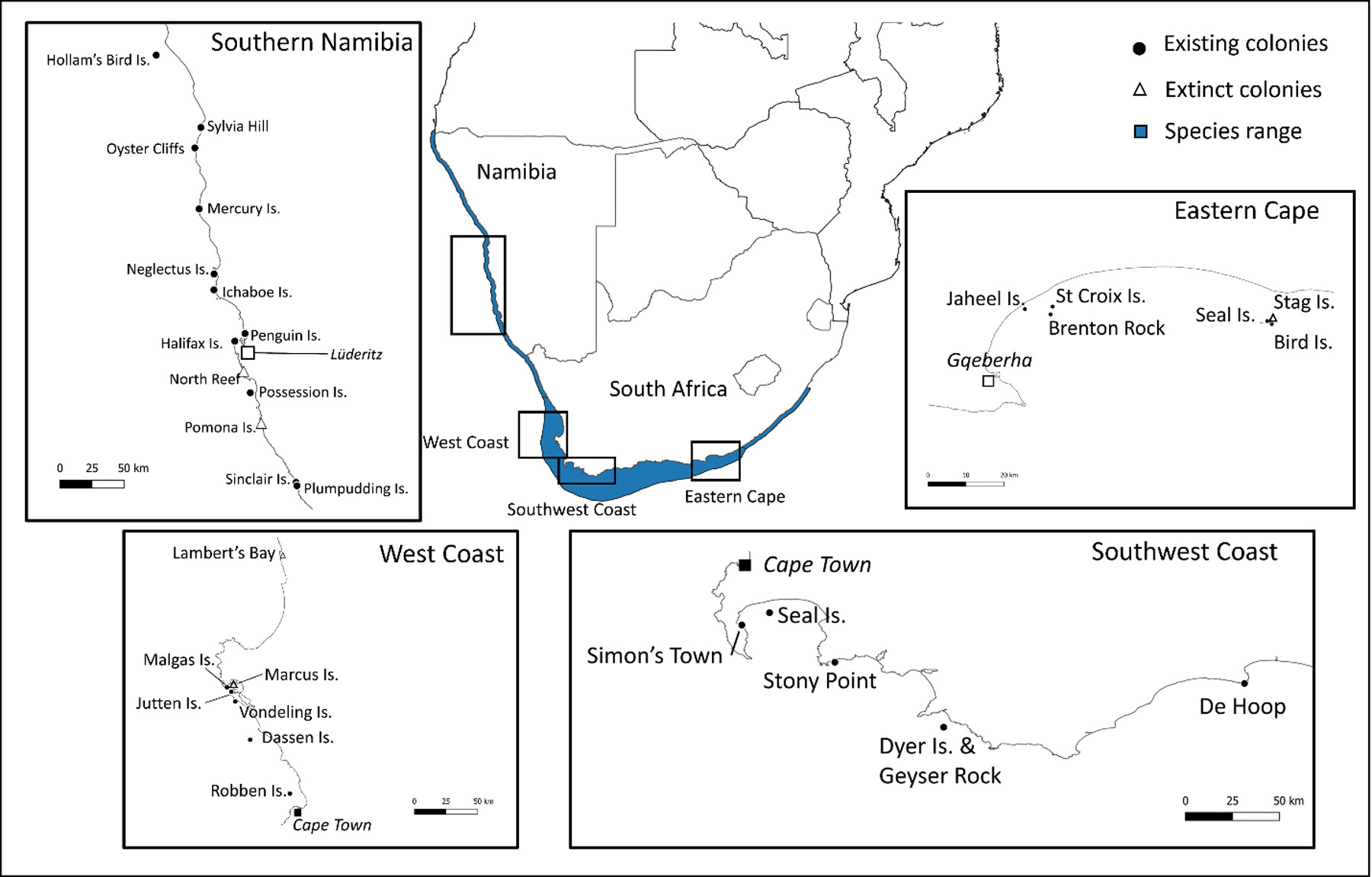
Figure 1: The African Penguin colonies in the region, as well as those in Namibia.
Ecology
African Penguins forage for small pelagic fish (predominantly sardine and anchovy) in inshore waters, usually within 15 km of the coast and can travel up to 50 km from colonies while breeding (Petersen et al. 2006, Pichegru et al. 2010). Outside of the breeding season, they can move further offshore, especially when foraging on the Agulhas Bank off the south coast of South Africa (Crawford et al. 2008, Carpenter-Kling et al. 2022). Juveniles are typically far-ranging and can move up to 1800 km from their natal colony, although they tend to recruit to natal colonies. However, juveniles may recruit away from their natal colonies, a phenomenon believed to be linked to prey availability during prospecting for recruitment sites (Crawford and Whittington 2005). Adults tend to remain within 400 km of their breeding islands (Randall et al. 1987, Carpenter-Kling et al. 2022). The species breeds and moults on coastal islands and protected mainland sites (Crawford et al. 2011). Breeding colonies are usually flat and sandy with varying degrees of vegetation cover although birds can also breed at steep, rocky sites (e.g. St Croix Island). They breed colonially and year-round, although there are clearly defined peaks, usually in winter (Crawford and Whittington 2005). The generation time of 10 years was based on an estimate of mean age at first breeding and a published estimate of mean annual survival (Sherley et al. 2020).
Threats & Conservation
Threats
The species is subject to a broad array of threats across its range. The current population decline has been attributed primarily to a lack of food. Evidence suggests that fish availability during different times of year affects breeding success and adult survival (Crawford et al. 2011, Robinson et al. 2015, Weller et al. 2016a, Crawford et al. 2019). A shift in distribution of Sardine Sardinops sagax and Anchovy Engraulis encrasicolus stocks from the West Coast eastwards to the cause of fish shortages (van der Lingen et al. 2005, Fairweather et al. 2006, Roy et al. 2007). southern Western Cape, away from the major penguin colonies, is the probable Competition for these stocks from the commercial purse-seine fishery has also been implicated (Coetzee et al. 2008). The collapse of the sardine and anchovy stocks in Namibia likely has caused an ecological trap for fledgling African Penguins, which disperse westward and northwards following once-reliable cues for areas of high fish abundance and likely causes increased juvenile mortality rates (Sherley et al. 2017).
Birds are threatened when at sea from oil spills, which can cause significant mortality of both oiled birds and abandoned chicks and eggs (Adams 1994, Crawford et al. 2000, Vanstreels et al. 2023). Potential for catastrophic large-scale oil spills is likely to increase, given further developments planned along the coast. Chronic oiling from leaking wrecks, washing of ship’s tanks and other sources is also a threat (Wolfaardt et al. 2009). Ship-to-ship bunkering (the refuelling of ships at sea) has caused at least four oil spills in Algoa Bay since 2016 (Ryan et al. 2019, SANCCOB 2020). In addition, increased underwater noise as a result of the 10-fold increase in shipping traffic is coincident with the 85% decrease in African Penguin numbers at St Croix Island (Pichegru et al. 2022).
Cape Fur Seal Arctocephalus pusillus predation is a major cause of mortality at some colonies, especially Dyer Island (Kirkman 2009). Seals have also displaced penguins from some breeding sites (Kirkman 2009). Other lesser threats are more specific to certain colonies. Collision with vehicles is a problem at both Robben Island and Boulders Beach (du Toit et al. 2003). Although the Kelp Gull Larus dominicanus population decreased between 2009/10 and 2013/14 (Whittington et al. 2016), predation occurs in most colonies and can halve breeding success (du Toit et al. 2003, Pichegru 2013). Great White Pelican Pelecanus onocrotalus predation may be more of a problem at Dassen and Jutten islands than previously realised. There was certainly some evidence of this early in 2012 at Jutten Island (BM Dyer pers comm). However, predation by pelicans on Kelp Gulls may also help control the gull population (Whittington et al. 2016). Predation by terrestrial mammalian predators such as Leopard Panthera pardus, Caracal Caracal caracal, domestic dogs (City of Cape Town, SANParks and CapeNature, unpubl data) and Water Mongoose Atilax paludinosus (Whittington et al. 1996) can also severely impact mainland colonies.
Although the removal of guano from breeding islands has stopped, the lack of guano in which to create burrows continues to have an effect: at some colonies penguins nest on the surface, exposing their eggs and chicks to temperature extremes, predation, and storms (du Toit et al. 2003, Pichegru 2013). Storm surges and intense storms have flooded nests, causing mortality of chicks and eggs and the removal of those at risk (CapeNature, SANCCOB unpubl data). Avian influenza outbreaks in 2017 and 2021 killed several hundred African Penguins (Roberts et al. 2023).
Conservation Measures Underway
A Biodiversity Management Plan (BMP) for the African Penguin was published in 2013 by CapeNature and the then Department of Environmental Affairs. It outlined the major threats and specified actions to mitigate these. The BMP did not achieve its ambitious aims during the five-year period, so a second iteration was drafted but has been delayed during the public participation review phase and as of March 2025 has yet to come into effect. Monitoring of population size and breeding success is conducted at most breeding colonies by the Department of Environmental Affairs, CapeNature, SANParks and Robben Island Museums with support from Non-Governmental Organisations and academic institutions.
An experiment to investigate the effects of sardine and anchovy fishing around breeding colonies was initiated in 2008, with two sets of paired islands (Robben and Dassen islands in the west and St Croix and Bird islands in the east) being alternately opened and closed to fishing on a three-year cycle. Analysis of the results of the experiment have differed (Pichegru et al. 2010, Butterworth et al. 2015, Sherley et al. 2015, Weller et al. 2016b, Sydeman et al. 2021, 2022, Butterworth and Ross-Gillespie 2022), which along with concerns about the economic impact of closures on the fishing industry has extended the duration of experiment beyond the initial scope. An international review panel was convened in 2023 to make recommendations to the Minister of the DFFE regarding future fisheries closures. Oiled penguins are rehabilitated and released successfully by various rehabilitation centres (Whittington 1999, Vanstreels et al. 2023). There is little difference in the survival rates of oiled birds that have been rehabilitated and unoiled birds (Underhill et al. 1999). There was concern that the long-term breeding success may be diminished for oiled birds (Wolfaardt et al. 2009) but recent analyses have shown this is not the case (SANCCOB, unpubl data). Chicks and eggs abandoned by their parents or rescued from flooding or other unsafe nesting areas are hand reared and released as fledglings by rehabilitation centres (Klusener et al. 2018). Analyses show that these chicks survive as well as wild-reared chicks (Sherley et al. 2014).
Artificial nest boxes of various designs (fibreglass, wood, cement) have been provided at colonies affected by the lack of guano, and can improve breeding success (Kemper et al. 2007, Pichegru 2013). However, some of these boxes, especially the fibreglass design, can overheat and reduce hatching success by at least one third compared to natural burrows (Pichegru 2013, Lei et al. 2014). Double-layered ceramic next boxes have been found to out-perform all other nest types, as they buffer environmental extremes and maintain stable breeding conditions although further investigation is needed into the parasite loads in these nests (Welman and Pichegru 2022).
Feral cats, which can have significant impacts on chicks in particular, have been almost entirely eliminated from Robben Island. Kelp Gull numbers are controlled by SANParks at Bird Island, Algoa Bay. Measures have been put in place by CapeNature to deal with Kelp Gull numbers and Cape Fur Seal predation at Dyer Island. Cape Fur Seals, implicated in penguin predation, are controlled at Dyer Island, Stony Point and islands in Saldanha Bay but not at other islands where seal predation is a problem, such as Dassen and Robben islands. Work started to re-establish the colony at the De Hoop Nature Reserve in 2018 and has shown initial signs of success, with one pair successfully raising two chicks in 2022 (BirdLife South Africa, unpubl data). A temporary moratorium has been put in place on the granting of additional ship-to-ship bunkering licences in Algoa Bay. All colonies are formally protected as provincial nature reserves, national parks or cultural heritage sites and the collection of penguin eggs and guano is prohibited. The African Penguin is listed nationally on the Threatened or Protected Species (TOPS) Regulations and the Western Cape Provincial Ordinance. Internationally, this species is listed on CITES Appendix II and Convention on the Conservation of Migratory Species of Wild Animals (Appendix II).
Conservation Measures Proposed
As outlined above, a number of conservation and monitoring initiatives are already in place to conserve this iconic near-endemic species. Continuous monitoring of the regional and global population is imperative, taking into account recommendations that will emanate from the BMP. Efforts to identify and implement fisheries management measures that may benefit penguins should be continued and the needs of penguins (and other seabirds) should be more explicitly accounted for in the Operational Management Procedures governing the small pelagic fishery. Measures to decrease noise from shipping traffic should be investigated and implemented in Algoa Bay and other busy ports. Prevention of oil pollution by tighter control over the cleaning of ships’ tanks and at oil offloading terminals in Cape Town, Saldanha and possibly Coega harbours should be exercised. Predation by gulls and seals should be monitored at all penguin colonies, and mitigation measures should be implemented where required. In the case of seals, removal of a small number of individuals seen to be predating on seabirds is a solution. It is recommended that tighter control of research permits be maintained to limit disturbance at penguin colonies, particularly those at offshore islands. A different suite of challenges come into play where penguins come into regular contact with humans, such as at the Boulders and Stony Point colonies. In such locations novel measures have been put into place to safeguard penguins, e.g. provision of shelter and restricting human access to boardwalks. Efforts should be made to maintain and upgrade such measures. Mainland colonies provide valuable opportunities for raising awareness, promoting sustainable ecotourism and raising funds for penguin conservation.
Research Priorities and Questions
Existing and needed research includes:
- Additional ways to secure sufficient prey availability for African Penguins through fisheries management should be investigated.
- Develop system-wide population models of African penguins to advise on the relative impact of different threats and assess the effectiveness of management solutions implemented.
- Re-examine African Penguin population genetic structure given the rapidly decreasing population.
- Surveys at all colonies are required to monitor the prevalence of diseases.
- A study should be conducted on the effects of disturbance by fishing vessels at sea.
Contributors & References
Assessor/s
Christina Hagen
Reviewer/s
Lorien Pichegru, Phil Whittington
References
Adams NJ. 1994. Patterns and impacts of oiling of African penguins Spheniscus demersus: 1981–1991. Biological Conservation 68: 35–41.
Barnes KN (ed). 2000. The Eskom red data book of birds of South Africa, Lesotho and Swaziland. BirdLife South Africa.
BirdLife International. 2024. Spheniscus demersus. The IUCN Red List of Threatened Species 2024: e.T22697810A256021744. https://dx.doi.org/10.2305/IUCN.UK.2024-2.RLTS.T22697810A256021744.en. [Accessed on 05 May 2025].
Butterworth DS, Plagányi ÉE, Robinson WML, Moosa N, de Moor CL. 2015. Penguin modelling approach queried. Ecological Modelling 316: 78–80.
Butterworth DS, Ross-Gillespie A. 2022. Comment on “South Africa’s experimental fisheries closures and recovery of the endangered African penguin” by Sydeman et al. 2021. ICES Journal of Marine Science 79: 1965–1971.
Carpenter-Kling T, de Blocq A, Hagen C, Harding C, Morris T, Pichegru L, Roberts J, Ryan PG, Wanless RM, McInnes A. 2022. Important marine areas for endangered African penguins before and after the crucial stage of moulting. Scientific Reports 12: 1–13.
Coetzee JC, van der Lingen CD, Hutchings L, Fairweather TP. 2008. Has the fishery contributed to a major shift in the distribution of South African sardine? ICES Journal of Marine Science: Journal du Conseil 65: 1676–1688.
Crawford RJM, Davis SA, Harding RT, Jackson LF, Leshoro TM, Meÿer MA, Randall RM, Underhill LG, Upfold L, Van Dalsen AP. 2000. Initial im- pact of the Treasure oil spill on seabirds off western South Africa. South African Journal of Marine Science 22: 157–176.
Crawford RJM, Whittington PA. 2005. African Penguin. In: Hockey PAR, Dean WRJ, Ryan PG (eds), Roberts – Birds of Southern Africa, 7th Edn. Cape Town, South Africa: The Trustees of the John Voelcker Bird Book Fund. pp 631–634.
Crawford RJM, Tree AJ, Whittington PA, Visagie J, Upfold L, Roxburg KJ, Martin AP, Dyer BM. 2008. Recent distributional changes of seabirds in South Africa: is climate having an impact? African Journal of Marine Science 30: 189–193.
Crawford RJM, Altwegg R, Barham BJ, Barham PJ, Durant JM, Dyer BM, Geldenhuys D, Makhado AB, Pichegru L, Ryan PG, et al. 2011. Collapse of South Africa’s penguins in the early 21st century. African Journal of Marine Science 33: 139–156.
Crawford RJM, Dyer BM, Kotze PGH, McCue S, Meÿer MA, Upfold L, Makhado AB (eds). 2012a. Status of seabirds breeding in South Africa in 2011. Cape Town, South Africa: Oceans and Coasts, Department of Environmental Affairs.
Crawford RJM, Sydeman WJ, Thompson SA, Sherley RB, Makhado AB. 2019. Food habits of an endangered seabird indicate recent poor forage fish availability off western South Africa. ICES Journal of Marine Science (76 vol.). pp 1344–1352.
du Toit M, Boere GC, Cooper J, De Villiers MS, Kemper J, Lenten B, Petersen SL, Simmons RE, Underhill LG, Whittington PA (eds). 2003. Conservation assessment and management plan for Southern African coastal seabirds. Cape Town, South Africa and Apple Valley, United States of America: Avian Demography Unit and Conservation Breeding Specialist Group.
Fairweather TP, van der Lingen CD, Booth AJ, Drapeau L, Westhuizen JJ Van Der, Town C. 2006. Indicators of sustainable fishing for South African sardine Sardinops sagax and anchovy Engraulis encrasicolus. African Journal of Marine Science 28: 661–680.
Hagen C. 2015. African Penguin. In: Taylor MR, Wanless RM, Peacock F (eds), The Eskom Red Data Book of Birds of South Africa, Lesotho and Swaziland. Johannesburg: BirdLife South Africa. pp 146–148.
Kemper J, Underhill L, Crawford R, Kirkman S (eds). 2007. Revision of the conservation status of seabirds and seals breeding in the Benguela Ecosystem. Cape Town, South Africa: University of Cape Town.
Klusener R, Hurtado R, Parsons NJ, Vanstreels RET, Stander N, Van Der Spuy S, Ludynia K. 2018. From incubation to release: Hand-rearing as a tool for the conservation of the Endangered African Penguin. PLoS ONE 13: 1–17.
Kirkman SP. 2009. Evaluating seal–seabird interactions in southern Africa: a critical review. African Journal of Marine Science 31: 1–18.
Lei BR, Green JA, Pichegru L. 2014. Extreme microclimate conditions in artificial nests for Endangered African Penguins. Bird Conservation International 24(2): 201–213.
Van der Lingen CD, Coetzee JC, Demarcq H, Drapeau L, Fairweather TP, Hutchings L. 2005. An eastward shift in the distribution of southern Benguela sardine. GLOBEC International Newsletter 11: 17–22.
Petersen SL, Ryan PG, Gremillet D. 2006. Is food availability limiting African Penguins Spheniscus demersus at Boulders? A comparison of foraging effort at mainland and island colonies. Ibis 148: 14–26.
Pichegru L, Grémillet D, Crawford RJM, Ryan PG. 2010. Marine no-take zone rapidly benefits endangered penguin. Biology Letters 6: 498–501.
Pichegru L. 2013. Increasing breeding success of an Endangered penguin: artificial nests or culling predatory gulls? Bird Conservation International 23(3): 296–308.
Pichegru L, Vibert L, Thiebault A, Stander N, Ludynia K, Charrier I, Lewis M, Carpenter-Kling T, McInnes A. 2022. Maritime traffic trends around the southern tip of Africa – Did marine noise pollution contribute to the local penguins’ collapse? Science of the Total Environment 849.
Roberts LC, Abolnik C, Waller LJ, Shaw K, Ludynia K, Roberts DG, Kock AA, Makhado AB, Snyman A, Abernethy D. 2023. Descriptive Epidemiology of and Response to the High Pathogenicity Avian Influenza (H5N8) Epidemic in South African Coastal Seabirds, 2018. Transboundary and Emerging Diseases 2023: 1–13.
Robinson WML, Butterworth DS, Plagányi ÉE. 2015. Quantifying the projected impact of the South African sardine fishery on the Robben Island penguin colony. ICES Journal of Marine Science 72: 1822–1833.
Roy C, van der Lingen CD, Coetzee JC, Lutjeharms JRE. 2007. Abrupt environmental shift associated with changes in the distribution of Cape anchovy Engraulis encrasicolus spawners in the southern Benguela. African Journal of Marine Science 29: 309–319.
Ryan PG, Ludynia K, Pichegru L. 2019. Ships’ risky fuel transfers are threatening African Penguins. The Conversation. Available: http://theconversation.com/ships- risky-fuel-transfers-are-threatening-african-penguins-121575. [Accessed on 25 June 2023].
SANCCOB, 2020. SANCCOB report 2019-2020. Available: https://sanccob.co.za/wp-content/uploads/2021/10/SANCCOB-Integrated-Report-of-2019-2020_e-version.pdf. [Accessed on 25 June 2023].
Sherley RB, Waller LJ, Strauss V, Geldenhuys D, Underhill LG, Parsons NJ. 2014. Hand-rearing, release and survival of African Penguin chicks abandoned before independence by moulting parents. Plos One 9: e110794.
Sherley RB, Winker H, Altwegg R, van der Lingen CD, Votier SC, Crawford RJM. 2015. Bottom-up effects of a no-take zone on endangered penguin demographics. Biology Letters 11: 20150237.
Sherley RB, Ludynia K, Dyer BM, Lamont T, Makhado AB, Roux J-P, Scales KL, Underhill LG, Votier SC. 2017. Metapopulation tracking juvenile penguins reveals an ecosystem-wide ecological trap. Current Biology 27: 563–568.
Sherley RB, Crawford RJM, de Blocq AD, Dyer BM, Geldenhuys D, Hagen C, Kemper J, Makhado AB, Pichegru L, Upfold L, et al. 2020. The conservation status and population decline of the African penguin deconstructed in space and time. Ecology and Evolution 10: 8506–8516.
Sherley RB, Makhado AB, Crawford RJM, Hagen C, Kemper J, Ludynia K, Masotla MJ, McInnes A, Pichegru L, Tom D, Upfold L, Waller LJ. 2024. The African Penguin Sphesniscus demersus should be considered Critically Endangered. Ostrich 95. Available: https://doi.org/10.2989/00306525.2024.2355618.
Sydeman WJ, Hunt GL, Pikitch EK, Parrish JK, Piatt JF, Dee Boersma P, Kaufman L, Anderson DW, Thompson SA, Sherley RB. 2021. South Africa’s experimental fisheries closures and recovery of the endangered African penguin. ICES Journal of Marine Science 78: 3538–3543.
Sydeman WJ, Hunt GL, Pikitch EK, Parrish JK, Piatt JF, Boersma PD, Kaufman L, Anderson DW, Thompson SA, Sherley RB. 2022. African Penguins and Localized Fisheries Management: Response to Butterworth and Ross-Gillespie. ICES Journal of Marine Science 79: 1972–1978.
Underhill L, Bartllett P, Baumann L, Crawford R, Dyer B, Gildenhuys A, Nel D, Oatley T, Thornton M, Upfold L. 1999. Mortality and survival of Afri- can Penguins Spheniscus demersus involved in the Apollo Seaoil spill: an evaluation of rehabilitation efforts. Ibis, 141: 29-37.
Vanstreels RET, Parsons NJ, Sherley RB, Stander N, Strauss V, Kemper J, Waller L, Barham BJ, Ludynia K. 2023. Factors determining the number of seabirds impacted by oil spills and the success of their rehabilitation: Lessons learned from Namibia and South Africa. Marine Pollution Bulletin 188.
Weller F, Sherley RB, Waller LJ, Ludynia K, Geldenhuys D, Shannon LJ, Jarre A. 2016b. System dynamics modelling of the Endangered African penguin populations on Dyer and Robben islands, South Africa. Ecological Modelling 327: 44–56.
Weller F, Sherley RB, Shannon LJ, Jarre AC, Stewart T, Scott L, Cecchini L, Crawford RJM, Geldenhuys D, Ludynia K, et al. 2016a. Penguins’ perilous conservation status calls for complementary approach based on sound ecological principles: reply to Butterworth et al. (2015) We. Ecological Modelling 337: 1–3.
Welman S, Pichegru L. 2022. Nest microclimate and heat stress in African Penguins Spheniscus demersus breeding on Bird Island, South Africa. Bird Conservation International 33: e34 (1–9).
Whittington PA, Hofmeyr JH, Cooper J. 1996. Establishment, growth and conservation of a mainland colony of Jackass Penguins Spheniscus demersus at Stony Point, Betty’s Bay, South Africa. Ostrich 67: 144–150.
Whittington PA. 1999. The contribution played by cleaning oiled African Penguins Spheniscus demersus to population dynamics and conservation of the species. Marine Ornithology 27: 177–180.
Whittington PA, Crawford RJM, Martin PA, Randall RM, Brown M, Ryan PG, Dyer BM, Harrison KHB, Huisamen J, Makhado AB, Upfold L, Waller LJ, Witteveen M. 2016. Recent trends of the Kelp Gull (Larus dominicanus) in South Africa. Waterbirds 39 (special publication 1: 99–113.
Wolfaardt AC, Williams AJ, Underhill LG, Crawford RJM, Whittington PA. 2009. Review of the rescue, rehabilitation and restoration of oiled sea- birds in South Africa, especially African penguins Spheniscus demersus and Cape gannets Morus capensis, 1983–2005. African Journal of Marine Science 31: 31–54.
Citation
Hagen C 2025. African Penguin. In: Lee ATK, Rose S, Banda S, Bezeng SB, Maphalala MI, Maphisa DH, Smit-Robinson H (eds), The 2025 Red Data Book of Birds of South Africa, Lesotho and Eswatini. Johannesburg, South Africa: BirdLife South Africa. Available at: https://www.birdlife.org.za/red-list/african-penguin/
Our generous sponsors


