


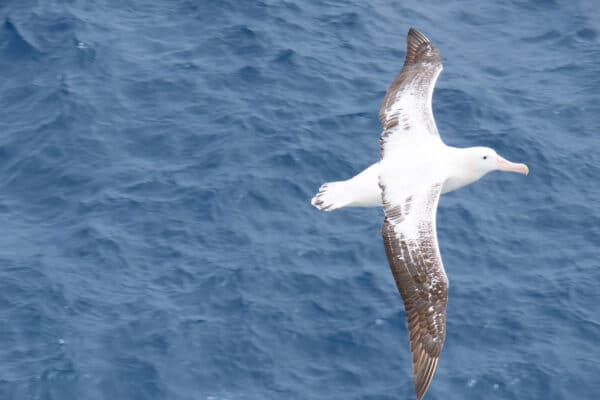
Tristan Albatross
Diomedea dabbenena

Number Of Mature
Individuals (Regional)
Unknown

Regional
Population Trend
Decreasing
2025
Regional Category
Critically Endangered
Search by species
CONTENTSOverview
Names
|
IOC English Name: |
Tristan Albatross |
|
SA & IOC Scientific Name: |
Diomedea dabbenena |
|
BirdLife International Taxonomy (scientific name): |
Diomedea dabbenena |
|
Order: |
PROCELLARIIFORMES |
|
Family: |
Diomedeidae |
|
Species name author: |
Mathews 1929 |
|
Afrikaans: |
Tristangrootalbatros |
|
Sesotho (South Africa): |
Masikaledikepe wa Tristan |
|
Sesotho (Lesotho): |
|
|
Siswati: |
|
|
Zulu: |
unozulane waseTristan da Cunha |
Current Assessment Status
|
2025 Regional Category [Criteria] |
CR [Follows Global Status] |
|
2024 Global Category [Criteria] |
CR [A4ade] (BirdLife International 2018) |
|
Population size (Regional) |
Unknown |
|
Population size (Global) |
7276 – 8240 individuals (global; Oppel et al. 2022) |
|
Distribution size (EOO) (Regional) km2 |
Unknown |
|
Distribution size (EOO) (Global) km2 |
54 900 000 (breeding/resident) |
|
Distribution size (AOO) (Regional) km2 |
Unknown |
|
Generation time |
28.7 years (BirdLife International 2018) |
|
Status change reason |
No Change |
|
Migrant (in the region) |
Non-breeding visitor |
|
Regional endemic |
No |
Historic Listing Information
|
2000 Regional Status |
EN [A2d] |
|
2015 Regional Status |
CR [A4ade; B2ab(v); C1+2a(ii)] |
|
Status change reason (if applicable) |
Genuine (recent) |
|
2015 Population size (Regional) |
4700 mature individuals (global) |
|
2015 Global Status |
CR [A4ade; B2ab(v); C1+2a(ii); D] |
Reason for Inclusion
Reason for Inclusion in the Assessment
This is a globally Critically Endangered species which is a non-breeding visitor to the region, and has been recorded occasionally as bycatch by fisheries operating off South Africa. It was listed as regionally Endangered in 2000, then regionally Critically Endangered in 2015 matching its global uplisting (Taylor and Wanless 2015).
Category Justification
Category Justification
The Tristan Albatross Diomedea dabbenena qualifies as globally Critically Endangered due to a rapid projected population decline of over 80% over three generations. This modelled population size reduction is based on a combination of direct observation, actual or potential levels of exploitation through fisheries-related mortality, and predation by introduced taxa. South African waters form part of this species’ non-breeding distribution and, by virtue of its global status, the species is listed as regionally Critically Endangered.
Population Justification
The 2018 global assessment provided an estimate of c. 1250 – 1750 pairs annual breeding pairs on Gough Island, equivalent to 3400 – 4800 mature individuals, or 5200 – 7300 individuals (BirdLife International 2018). More recently, Oppel et al. (2022) provided an estimate of 7276 – 8240 individuals. Two large chicks were present on Inaccessible Island in November 2018, suggesting at least two breeding pairs there (Ryan et al. 2019). The confidence in the global population estimate is high. The number of birds present in South African waters is unknown.
Trend Justification
New information has been released since the annual decreasing rate of 2.85% was reported in the 2018 global assessment. Oppel et al. (2022) found that the breeding population on Gough Island fluctuated between 1106 and 1921 pairs between 2004-2021, with no evidence of a decrease over that 16-year period (Oppel et al. 2022). The trend for the total population, including immature and non-breeding birds, is a decrease of 1% per year (Oppel et al. 2022). This signifies that the Tristan Albatross is still experiencing an on-going decline which can lead to a loss of 80–100% of the global population over three generations (86 years). The confidence in this population trend estimate is high.
Biology & Ecology
Taxonomy
The Tristan Albatross Diomedea dabbenena was originally described as Diomedea dabbenena by Mathews in 1929, with the holotype collected in Buenos Aires by Dabbene. Historically, the species was considered part of the Wandering Albatross complex Diomedea exulans, but genetic, morphological, and ecological studies have supported its separation as a distinct species. The separation from D. exulans was formalized by Robertson and Nunn (1998) and Cuthbert et al. (2003) based on genetic markers and morphological differences. The species is monotypic and is accepted as a full species by the Agreement on the Conservation of Albatrosses and Petrels (ACAP) and BirdLife International.
Identification
The Tristan Albatross is a large seabird with a wingspan reaching approximately 3.5 meters, making it one of the largest flying birds. Adults measure 100–110 cm in length and weigh between 6–7 kg. Plumage gradually whitens with age over a period of 20 years, more slowly than in the Wandering Albatross. Males are slightly larger and whiter than females. Juveniles have darker plumage with brownish-black wings and a dusky head. The species closely resembles the Wandering Albatross and is practically indistinguishable at sea without genetic analysis or close observation of subtle morphological features (del Hoyo 2023).
Distribution
The Tristan Albatross breeds almost exclusively on Gough Island and occasionally on Inaccessible Island, both part of the Tristan da Cunha group, a United Kingdom Overseas Territory in the South Atlantic Ocean. Historically, the species also bred on Tristan da Cunha Island but has since been extirpated there. At sea, Tristan Albatrosses primarily range across the South Atlantic Ocean, between 50°W and 15°E, mostly between latitudes 30°S and 45°S. Non-breeding adults and immature individuals range more widely, with movements recorded into the Indian Ocean and as far east as Australia. The species is a non-breeding visitor to South African waters, where it overlaps with areas of pelagic longline fishing.
Ecology
The Tristan Albatross is a highly pelagic species, rarely approaching land outside the breeding season. Breeding occurs on gently sloping areas with short, wet heath vegetation, dominated by Calamagrostis deschampsiiformis and Agrostis holdgateana, often extending into the upper Blechnum palmiforme heath zone at elevations between 400 and 700 meters above sea level. Breeding pairs display high mate fidelity and a biennial breeding cycle, with a single egg laid if the previous breeding attempt was successful. Failed breeders may attempt to breed the following year.
Feeding occurs almost entirely at sea, with the species acting as a surface-seizer, preying predominantly on cephalopods and fish. Foraging areas often overlap with major longline fishing zones, increasing the risk of fisheries-related mortality.
The generation length is estimated at 28.7 years, with a slow reproductive rate typical of large albatrosses. Chicks fledge after several months of parental care, and juveniles may remain at sea for several years before returning to breed.
Threats & Conservation
Threats
Fisheries-related mortality is the primary regional threat to this species, although this is minimal compared to other regions (ACAP 2009). Non-breeding adults are known to spend time in South African waters, where their distribution overlaps with that of longline fishing activities (Reid et al. 2013). A few individuals have been subject to bycatch mortality through interactions with pelagic longlines off South Africa (Petersen et al. 2009). It is unknown whether plastic ingestion is a regional threat; Tristan Albatrosses occasionally regurgitate plastic at their nest sites (Ryan 1987, PG Ryan pers obs).
Conservation Measures Underway
Internationally, the Agreement on the Conservation of Albatrosses and Petrels – Annex 1 and the Convention on Migratory Species – Appendix II (as Diomedea exulans) provide protection for this species. Regionally, the Seabirds and Seals Protection Act (Act No. 46 of 1973; SBSPA), the Marine Living Resources Act (Act No. 18 of 1998), the Publication of Policy on the Management of Seals, Seabirds and Shorebirds: 2007, and the National Plan of Action (NPOA) for Reducing the Incidental Catch on Seabirds in Longline Fisheries (2008) provide protection. South Africa, along with the United Kingdom, is listed as a Principal Range State for the species by the Agreement on the Conservation of Albatrosses and Petrels (ACAP 2009). Strong action to reduce bycatch mortality is ongoing.
Conservation Measures Proposed
Beneficial to this, and other seabird species, is the improvement of identification by bycatch monitors, implementation of mandatory bycatch mitigation measures, and increased coverage of observer programmes. Assisting with eradicating introduced House Mice from Gough Island is the most urgent conservation requirement.
Research Priorities and Questions
- Determining the size and distribution of the visiting population and its habitat use.
- Investigating whether plastic ingestion in South African waters is occurring in the visiting population.
Contributors & References
Assessor/s
Shamiso Banda
Reviewer/s
Peter Ryan
References
Agreement on the Conservation of Albatrosses and Petrels. 2009. ACAP species assessment: Tristan Albatross Diomedea dabbenena. Available: https://acap.aq/resources/acap-species/303-tristan-albatross/file. [Accessed 17 July 2023].
BirdLife International. 2018. Diomedea dabbenena. The IUCN Red List of Threatened Species 2018: e.T22728364A132657527. Available: https://dx.doi.org/10.2305/IUCN.UK.2018-2.RLTS.T22728364A132657527.en. [Accessed 17 July 2023].
del Hoyo J, Carboneras C, Jutglar F, Collar N, Kirwan GM, Garcia E. 2023. Tristan Albatross (Diomedea dabbenena), version 1.0. In: Medrano F, Keeney BK (eds), Birds of the World. Ithaca, NY: Cornell Lab of Ornithology. Available: https://doi.org/10.2173/bow.wanalb3.01.
Cuthbert RJ, Phillips RA, Ryan PG. 2003. Separating the Tristan Albatross and the Wandering Albatross using morphometric measurements. Waterbirds 26: 338–344.
Oppel S, Clark BL, Risi MM, Horswill C, Converse SJ, Jones CW, Osborne AM, Stevens K, Perold V, Bond AL, Wanless RM, Cuthbert R, Cooper J, Ryan PG. 2022. Cryptic population decrease due to invasive species predation in a long-lived seabird supports need for eradication. Journal of Applied Ecology 59: 2059–2070.
Petersen SL, Honig MB, Ryan PG, Underhill LG. 2009. Seabird bycatch in the pelagic longline fishery off southern Africa. African Journal of Marine Science 31: 191–204.
Reid TA, Wanless RM, Hilton GM, Phillips RA, Ryan PG. 2013. Foraging range and habitat associations of non-breeding Tristan Albatrosses: overlap with fisheries and implications for conservation. Endangered Species Research 22: 39–49.
Robertson CJR, Nunn GB. 1998. Towards a new taxonomy for albatrosses. In: Robertson CJR, Gales R (eds). Albatross Biology and Conservation. Chipping Norton, Australia: Surrey Beatty and Sons. pp 13–19.
Ryan PG. 1987. The incidence and characteristics of plastic particles ingested by seabirds. Marine Environmental Research 23(3): 175–206.
Ryan PG, Dilley BJ, Ronconi RA. 2019. Population trends of spectacled petrels Procellaria conspicillata and other seabirds at Inaccessible Island. Marine Ornithology 47: 257–265.
Taylor M, Wanless RM. 2015. Tristan Albatross Diomedea dabbenena. In: Taylor MR, Peacock F, Wanless RM (eds), The Eskom Red Data Book of Birds of South Africa, Lesotho and Swaziland. Johannesburg: BirdLife South Africa. pp 32–33.
Citation
Banda S 2025. Tristan Albatross. In: Lee ATK, Rose S, Banda S, Bezeng SB, Maphalala MI, Maphisa DH, Smit-Robinson H (eds), The 2025 Red Data Book of Birds of South Africa, Lesotho and Eswatini. Johannesburg, South Africa: BirdLife South Africa. Available at: https://www.birdlife.org.za/red-list/tristan-albatross/
Our generous sponsors


